

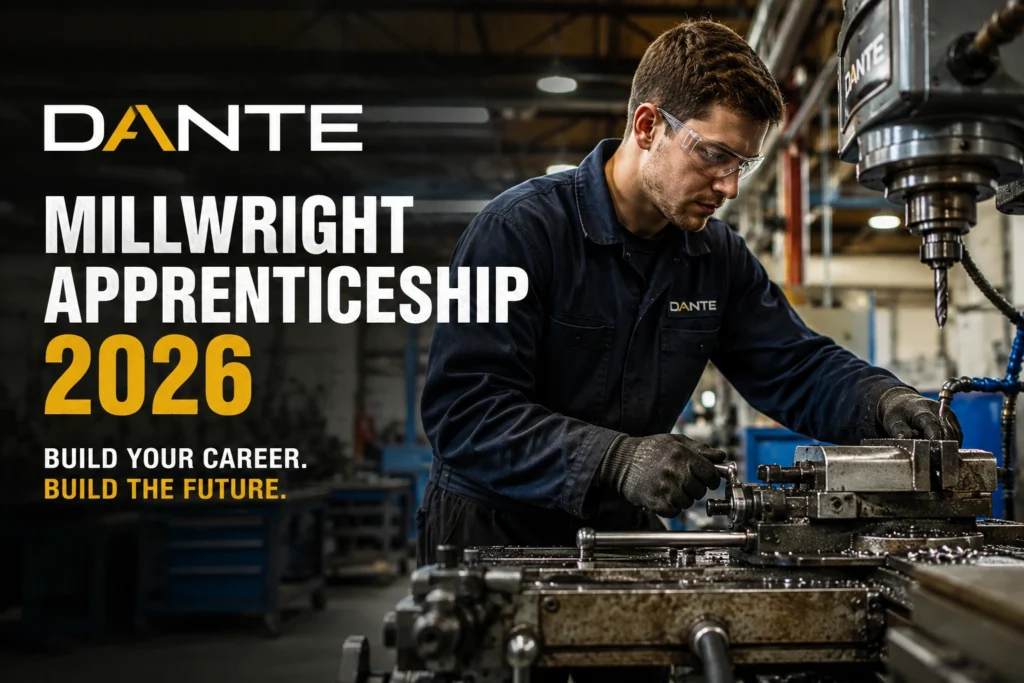
The Dante Millwright apprenticeship 2026 is attracting significant interest among South African job seekers, particularly young people looking for a practical route into the engineering and manufacturing sectors.
At a time when many graduates and school leavers are struggling to secure meaningful work experience, apprenticeship opportunities have become increasingly valuable. The latest opening, advertised through Dante Personnel Recruitment on behalf of a major packaging solutions manufacturer in Germiston, Gauteng, offers candidates a chance to gain hands-on industrial training while earning a monthly stipend.
What makes this opportunity especially noteworthy is the growing national conversation around technical skills shortages. Across manufacturing, mining, logistics and industrial production, employers continue to report difficulties finding qualified artisans and maintenance specialists.
Against that backdrop, the Dante Millwright apprenticeship arrives at a moment when many South Africans are actively searching for alternative career pathways outside traditional university routes.
The Growing Importance of Apprenticeships in South Africa
Over the past decade, apprenticeships have regained prominence as employers place greater emphasis on practical workplace experience.
For years, university qualifications were often viewed as the primary route to career success. However, rising graduate unemployment and persistent shortages in technical occupations have shifted attention toward artisan development programmes.
Millwrights occupy a particularly important position within this ecosystem.
A millwright combines mechanical and electrical expertise to install, maintain, repair and troubleshoot industrial machinery. Modern manufacturing facilities depend heavily on these professionals because production lines can quickly become costly when equipment fails.
The role demands technical precision, problem-solving abilities and a strong understanding of automated systems.
As factories become more technologically advanced, the need for versatile maintenance specialists continues to grow.
Understanding the Dante Millwright Apprenticeship 2026
The apprenticeship opportunity is based in Germiston, Gauteng, one of South Africa’s key industrial hubs.
According to the advertised requirements, the employer is seeking ambitious candidates interested in developing both mechanical and electrical competencies within a manufacturing environment.
Applicants are expected to possess:
- Matric qualification
- N2 or N3 qualification
- Willingness to work shifts
- Mechanical and electrical knowledge (advantageous)
- Troubleshooting and fault-finding abilities
- Ability to read technical drawings and schematics
The programme offers a monthly remuneration ranging from approximately R4,500 to R5,000, with overtime opportunities potentially increasing earnings.
While the stipend may appear modest compared to permanent artisan salaries, apprenticeships are designed primarily as learning opportunities that combine formal technical development with real-world workplace exposure.
For many participants, the long-term value lies in acquiring a scarce skill that can lead to significantly higher earnings later in their careers.
Why Packaging Manufacturing Is an Interesting Training Environment
One aspect that has generated interest around this apprenticeship is the fact that it takes place within the packaging manufacturing sector.
Packaging facilities are often highly automated operations that rely on sophisticated machinery, conveyor systems, motors, sensors and electrical control systems.
This creates an ideal learning environment for aspiring millwrights.
Unlike some industries where apprentices may spend long periods observing experienced artisans, modern manufacturing plants frequently expose trainees to a broad range of technical systems.
They may encounter:
- Pneumatic equipment
- Hydraulic systems
- Electrical motors
- Automated production lines
- Programmable control systems
- Mechanical drive systems
- Preventative maintenance procedures
Such exposure can help apprentices develop versatile skills applicable across multiple industries.
The result is a broader professional foundation that may open doors in manufacturing, food processing, mining, logistics and other industrial sectors.
Recent Developments Driving Interest in Technical Careers
Several developments have contributed to renewed enthusiasm for artisan careers.
First, South Africa continues to invest in infrastructure, manufacturing and industrial development initiatives. These sectors require skilled technicians capable of maintaining and repairing increasingly complex equipment.
Second, employers are placing greater emphasis on practical competence.
In many technical fields, demonstrated workplace ability can be just as valuable as formal academic credentials.
Third, there has been growing awareness among young people that artisan careers often provide stable earning potential and opportunities for advancement.
Qualified millwrights, electricians, fitters and instrumentation technicians frequently enjoy strong employment prospects compared to many oversupplied occupations.
This shift in perception has made apprenticeship opportunities more competitive than they were several years ago.
Public Reaction Among Job Seekers
Online discussions around apprenticeship opportunities often reveal a mixture of optimism and urgency.
Many young South Africans view artisan training programmes as realistic pathways into sustainable employment.
The Dante Millwright apprenticeship has generated interest largely because it offers entry into a recognized trade while requiring qualifications that many technical college students already possess.
For candidates holding N2 or N3 qualifications, opportunities aligned with their studies are particularly valuable.
At the same time, competition is expected to be intense.
South Africa’s high youth unemployment rate means that well-structured apprenticeship programmes often attract large numbers of applicants.
As a result, prospective candidates are being encouraged to ensure that their application documents are complete and professionally prepared.
The Selection Process Could Be More Competitive Than Many Expect
One detail worth noting is the emphasis placed on pre-employment screening.
Successful candidates may need to undergo:
- Safety medical assessments
- Criminal background checks
- Qualification verification
- Reference checks
These requirements reflect broader trends within industrial recruitment.
Manufacturing environments prioritize safety and reliability because employees often work around heavy machinery and potentially hazardous equipment.
Employers therefore seek individuals who demonstrate professionalism, responsibility and a commitment to workplace standards.
For applicants, this means preparation extends beyond submitting a CV.
It also involves ensuring that all supporting documentation is accurate, current and properly certified.
Why Technical Drawing and Troubleshooting Skills Matter
Among the listed requirements, two skills stand out: troubleshooting abilities and reading technical drawings.
These competencies are increasingly valuable in modern industry.
Troubleshooting is essentially the ability to identify the root cause of equipment failures and determine appropriate corrective actions.
In manufacturing environments, downtime can result in substantial production losses.
Workers who can quickly diagnose faults become highly valuable assets.
Similarly, technical drawings and schematics serve as the language of engineering.
Whether assembling equipment, performing maintenance or diagnosing electrical faults, technicians frequently rely on diagrams to understand system design and operation.
Candidates who already possess foundational knowledge in these areas may find themselves better positioned during the recruitment process.
Why This Matters Right Now
The timing of the Dante Millwright apprenticeship 2026 is particularly significant.
South Africa’s labour market continues to face a difficult balancing act.
On one side, unemployment remains stubbornly high. On the other, industries frequently report shortages of skilled technical workers.
This mismatch highlights a broader challenge: creating pathways that connect unemployed youth with sectors actively seeking talent.
Apprenticeships represent one of the most effective mechanisms for addressing that gap.
They allow employers to develop talent according to industry needs while providing participants with practical skills and workplace experience.
For many young people, such programmes offer something increasingly rare in today’s economy—a clear progression route from education into employment.
The relevance extends beyond individual applicants.
Every successful artisan developed through these programmes contributes to strengthening South Africa’s industrial capacity and economic competitiveness.
APPLY HERE: Dante Millwright Apprenticeship 2026
ALSO APPLY FOR: Tongaat Hulett Apprenticeship 2026
The Long-Term Career Potential of Becoming a Millwright
Many applicants understandably focus on the immediate opportunity.
However, the larger story involves where the trade can lead.
Qualified millwrights are employed across numerous sectors, including:
- Manufacturing
- Mining
- Automotive production
- Food processing
- Packaging
- Energy generation
- Logistics facilities
- Chemical processing plants
As experience grows, career progression may include supervisory roles, maintenance planning positions or specialist technical appointments.
Some artisans eventually move into training, consulting or entrepreneurial ventures.
Others pursue additional qualifications that allow them to transition into engineering-related management roles.
This long-term flexibility helps explain why artisan careers continue attracting interest despite the challenges involved in training and qualification.
Challenges Applicants Should Consider
While apprenticeships offer valuable opportunities, they are not easy pathways.
Prospective candidates should understand the realities involved.
Industrial environments can be demanding.
Shift work often requires employees to adapt to changing schedules. Apprentices may spend long hours learning practical skills while balancing theoretical study requirements.
The work itself can be physically and mentally challenging.
Equipment failures often require rapid responses, and safety procedures must be followed rigorously.
Success therefore depends not only on technical ability but also on discipline, reliability and a willingness to learn continuously.
Candidates entering the programme with realistic expectations are more likely to thrive and complete their training successfully.
What Could Happen Next
Several possible outcomes could emerge from the growing attention surrounding opportunities such as the Dante Millwright apprenticeship.
First, increased applicant interest may encourage more manufacturing companies to expand apprentice recruitment initiatives.
Employers facing artisan shortages may recognize the value of investing directly in talent development rather than competing for a limited pool of experienced workers.
Second, technical and vocational education could continue gaining recognition among students and parents.
As successful apprentices move into stable careers, perceptions around artisan trades may improve further.
Third, programmes like this could contribute to strengthening local manufacturing capabilities by helping build a pipeline of skilled maintenance professionals.
For applicants specifically, the immediate next step is clear: ensure all required documents are prepared before the closing date and present a professional application that highlights both technical knowledge and enthusiasm for the trade.
Competition is likely to be strong, making attention to detail especially important.
Final Thoughts
The Dante Millwright apprenticeship 2026 represents more than a single recruitment opportunity. It reflects broader shifts taking place within South Africa’s labour market and industrial economy.
As demand for skilled artisans continues to grow, apprenticeships are becoming increasingly important gateways into sustainable careers.
For candidates with Matric and relevant N2 or N3 qualifications, the Germiston-based programme offers exposure to a sophisticated manufacturing environment while developing highly transferable technical skills.
Although the journey toward becoming a qualified millwright requires commitment, patience and hard work, the long-term prospects remain compelling.
In a job market where practical expertise is becoming ever more valuable, opportunities like this highlight why artisan development continues to play a crucial role in shaping the future workforce.