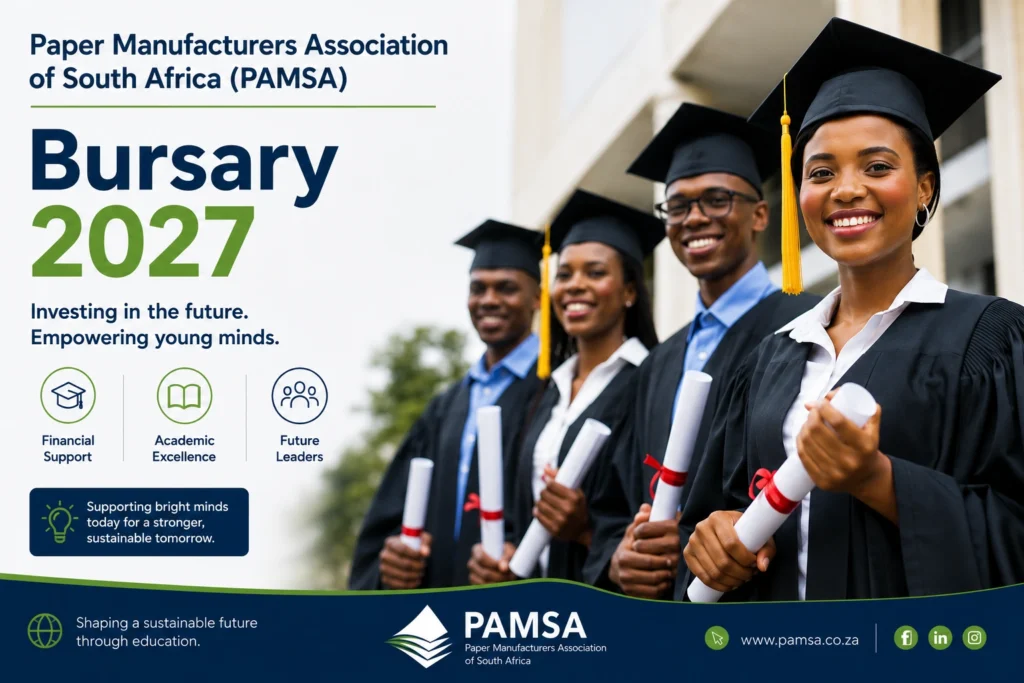

For many South African engineering students, the biggest challenge after completing an undergraduate degree is finding funding for postgraduate studies. A Master’s degree can open doors to advanced research opportunities, specialized careers, and higher earning potential, but the costs can be significant.
The Paper Manufacturers Association of South Africa (PAMSA) Bursary 2027 offers a valuable solution for aspiring chemical engineers who want to continue their studies while contributing to research that supports sustainability and innovation. The programme provides financial support, industry exposure, and the opportunity to work on projects that can make a real difference in South Africa’s growing circular bioeconomy.
If you are currently completing a Chemical Engineering degree or recently graduated, understanding how this bursary works could help you take the next step in your academic and professional journey.
What You Should Know First
The Paper Manufacturers Association of South Africa (PAMSA) Bursary 2027 is a two-year Master’s bursary programme designed specifically for Chemical Engineering students.
Key highlights include:
- Funding worth R320,000 over two years
- Full-time Master’s studies at selected South African universities
- Research opportunities linked to the pulp and paper sector
- Focus on sustainability, renewable materials, and resource efficiency
- Available to South African citizens studying Chemical Engineering
The programme combines financial assistance with research experience, helping students gain skills that are relevant to both academia and industry.
Understanding PAMSA and Its Role in South Africa
Before applying, it is helpful to understand what PAMSA does and why this bursary exists.
The Paper Manufacturers Association of South Africa (PAMSA) represents South Africa’s pulp and paper industry. The organization promotes the responsible use of paper products and supports research aimed at improving sustainability and resource efficiency.
Over the years, PAMSA has invested in research initiatives that explore:
- Renewable materials
- Recycling technologies
- Sustainable manufacturing
- Waste reduction strategies
- Circular economy solutions
Through its bursary and research programme, PAMSA helps develop future engineering talent capable of solving industry challenges.
This means students are not only receiving financial support but also becoming part of research projects that may influence the future of sustainable manufacturing in South Africa.
Why the PAMSA Master’s Programme Matters
Many bursaries focus solely on covering educational expenses. The Paper Manufacturers Association of South Africa (PAMSA) Bursary 2027 goes a step further by integrating research and industry relevance.
The Growing Importance of Sustainability
Around the world, industries are seeking ways to reduce waste and improve environmental performance. Engineers are increasingly needed to develop technologies that use resources more efficiently.
The pulp and paper sector plays an important role because paper products can often be:
- Recycled
- Reused
- Produced from renewable resources
- Integrated into circular economy systems
Students supported through the programme contribute to research that addresses these challenges.
Building Specialized Skills
A Master’s degree allows students to move beyond undergraduate-level learning and develop expertise in:
- Process optimization
- Resource management
- Industrial sustainability
- Advanced chemical engineering research
- Innovation and technology development
These skills are highly valued in industry, research institutions, and consulting environments.
What Field of Study Is Covered?
The bursary is specifically aimed at students pursuing postgraduate studies in Chemical Engineering.
Unlike some bursaries that support multiple disciplines, this programme focuses on developing expertise within a specialized engineering field that is closely linked to the pulp and paper industry.
Applicants must have completed, or be completing, one of the following:
- Bachelor of Science (BSc) in Chemical Engineering
- Bachelor of Engineering (BEng) in Chemical Engineering
This focused approach ensures that students have the technical foundation needed to contribute effectively to the programme’s research objectives.
What Does the Bursary Cover?
One of the most attractive aspects of the programme is the level of financial support provided.
The bursary is valued at R320,000 over two years.
The funding covers several major expenses associated with postgraduate study.
Tuition Fees
Students can use the bursary to cover university tuition costs, reducing the financial burden associated with a Master’s degree.
Accommodation
Housing expenses are often one of the largest costs for postgraduate students. The bursary helps address this challenge by providing accommodation support.
Study Materials
Academic resources, textbooks, software, and research-related materials can be expensive. Funding helps students access the tools they need for successful research.
Living Expenses
The programme also contributes toward day-to-day living costs, allowing students to focus on their studies and research activities.
Participating Universities
Successful applicants will conduct their Master’s studies at one of four participating universities.
These institutions have established engineering faculties and research capabilities that align with the programme’s objectives.
Stellenbosch University
Known for its strong engineering programmes and research culture, Stellenbosch offers excellent opportunities for postgraduate students.
University of the Witwatersrand
Wits University has a long-standing reputation for engineering excellence and industry-linked research.
North-West University
North-West University provides quality engineering education and supports innovation-driven research projects.
University of Pretoria
The University of Pretoria is one of South Africa’s leading institutions for engineering and applied sciences.
Choosing one of these universities allows students to access experienced supervisors, research facilities, and collaborative opportunities.
Eligibility Requirements Explained
Meeting the eligibility criteria is one of the most important steps in the application process.
Let’s break down each requirement.
South African Citizenship
Applicants must be South African citizens.
This requirement ensures that the programme contributes to developing local engineering talent.
Chemical Engineering Qualification
Candidates must be:
- Final-year Chemical Engineering students, or
- Recent graduates with a Chemical Engineering degree
Applicants from other engineering disciplines generally do not qualify.
Minimum Academic Performance
Students must achieve at least a 60% average in their final year of undergraduate studies.
This requirement demonstrates academic readiness for Master’s-level research.
Degree Completion Timeline
Applicants must have completed, or be on track to complete, their undergraduate qualification within five years or less.
This requirement reflects the programme’s preference for students who have progressed through their studies within a reasonable timeframe.
Required Documents: A Step-by-Step Breakdown
Many applications are unsuccessful simply because supporting documents are missing.
Prepare the following documents before beginning your application.
1. South African ID Copy
Provide a clear copy of your identification document.
2. Comprehensive CV
Your curriculum vitae should include:
- Educational background
- Academic achievements
- Leadership experience
- Research projects
- Work experience (if applicable)
3. Academic Transcripts
Submit transcripts covering every year of your undergraduate studies.
These records help evaluators assess academic performance.
4. Lecturer Reference Letter
A strong recommendation from a university lecturer can strengthen your application significantly.
The reference should ideally highlight:
- Academic ability
- Research potential
- Work ethic
- Problem-solving skills
5. Motivation Letter
This document explains why you deserve consideration for the programme.
A strong motivation letter should discuss:
- Career goals
- Research interests
- Academic achievements
- Interest in sustainability and innovation
- Reasons for pursuing a Master’s degree

How to Apply for the Paper Manufacturers Association of South Africa (PAMSA) Bursary 2027
The application process is straightforward when approached systematically.
Step 1: Confirm Eligibility
Review all eligibility requirements carefully.
Make sure you:
- Are a South African citizen
- Study Chemical Engineering
- Meet the academic requirements
- Will complete your degree within the required timeframe
Step 2: Gather Supporting Documents
Create a folder containing all required documents.
Ensure files are:
- Clear and readable
- Correctly named
- Up to date
Step 3: Complete the Online Application
Fill in the online application form accurately.
Double-check:
- Contact details
- Academic information
- Uploaded documents
APPLY HERE: (PAMSA) Bursary 2027
Even small mistakes can delay processing.
Step 4: Submit Before the Deadline
The application closing date is:
16 June 2026
Late applications are generally not accepted, so submit early whenever possible.
ALSO APPLY FOR: Schauenburg Education Trust Bursaries 2027
Common Misunderstandings About Paper Manufacturers Association of South Africa (PAMSA) Bursary 2027
Many students misunderstand certain aspects of the programme.
Misunderstanding 1: Any Engineering Student Can Apply
Not true.
The programme is specifically designed for Chemical Engineering students.
Misunderstanding 2: The Bursary Only Covers Tuition
Incorrect.
The funding package includes tuition, accommodation, study materials, and living expenses.
Misunderstanding 3: Undergraduate Students at Any Stage Can Apply
Only final-year students and recent graduates are eligible.
Earlier-year students typically do not qualify.
Misunderstanding 4: Research Experience Is Mandatory
Previous research experience can help, but the programme primarily evaluates academic performance, potential, and motivation.
Misunderstanding 5: All Applicants Receive Interviews
Only shortlisted candidates are contacted for interviews.
Applicants should not assume that submission guarantees further communication.
Tips for Creating a Strong Application
Competition for postgraduate funding can be intense.
Consider these practical strategies:
Focus on Your Motivation Letter
Explain clearly:
- Why you want to pursue a Master’s degree
- How the programme aligns with your goals
- Your interest in sustainable engineering solutions
Highlight Academic Achievements
Include:
- Awards
- Scholarships
- Leadership roles
- Research projects
- Academic distinctions
Obtain a Quality Reference
Choose a lecturer who knows your abilities well and can provide meaningful insights into your academic potential.
Submit Early
Avoid last-minute technical issues by completing your application before the deadline.
Key Takeaways
- The Paper Manufacturers Association of South Africa (PAMSA) Bursary 2027 supports Chemical Engineering Master’s students.
- The bursary is valued at R320,000 over two years.
- Funding covers tuition, accommodation, study materials, and living expenses.
- The programme focuses on sustainability, resource efficiency, and circular bioeconomy research.
- Participating universities include Stellenbosch University, the University of the Witwatersrand, North-West University, and the University of Pretoria.
- Applicants must be South African citizens with a Chemical Engineering background and a minimum 60% final-year average.
- Required documents include an ID copy, CV, academic transcripts, lecturer reference letter, and motivation letter.
- The application closing date is 16 June 2026.
Frequently Asked Questions (FAQs)
1. Can final-year Chemical Engineering students apply?
Yes. Final-year students who are on track to complete their qualification and meet the academic requirements may apply.
2. How much funding does the bursary provide?
The bursary is worth R320,000 over two years, covering major study-related expenses.
3. Can students from Mechanical or Electrical Engineering apply?
No. The programme is specifically intended for students with a BSc or BEng in Chemical Engineering.
4. What happens after submitting an application?
Applications are reviewed, and shortlisted candidates may be invited for interviews. Only shortlisted applicants are contacted.
Final Summary
The Paper Manufacturers Association of South Africa (PAMSA) Bursary 2027 is an excellent opportunity for ambitious Chemical Engineering students who want to pursue a Master’s degree while contributing to meaningful sustainability-focused research. With substantial financial support, access to leading South African universities, and involvement in industry-relevant projects, the programme offers much more than traditional funding. Students who meet the eligibility requirements and prepare a strong application have the chance to advance their academic careers while helping shape innovative solutions for South Africa’s circular bioeconomy and manufacturing future.