
The email arrives just after lunchtime. A third-year Bachelor of Health Sciences student opens it between lectures, expecting another university notice. Instead, it is an opportunity that could change the direction of an entire career.
Tuition costs for fourth year have been weighing heavily on the student’s family. Finding practical training after graduation is another concern. Suddenly, one programme appears to solve both challenges: a laboratory internship that includes structured workplace training, a bursary towards fourth-year study fees, a stipend during the placement, and the possibility—though not the promise—of permanent employment.
That is what makes the Western Cape Blood Service BHSc Internship 2026 stand out. Rather than offering temporary work experience alone, it creates a pathway that helps students complete professional training while easing some of the financial pressure associated with becoming a Medical Laboratory Scientist.
For South African students preparing to enter an increasingly competitive healthcare sector, opportunities that combine education, income support and clinical experience have become increasingly valuable.
Why this internship matters in today’s healthcare landscape
Behind every successful blood transfusion is a team of laboratory professionals whose work most patients never see.
Whether treating trauma victims after road accidents, supporting mothers during childbirth, assisting cancer patients undergoing chemotherapy or preparing blood products for complex surgeries, Medical Laboratory Scientists play an essential role in modern healthcare.
South Africa’s healthcare system depends on highly accurate laboratory testing. Every blood sample must be handled correctly, every compatibility test performed precisely, and every quality standard followed without exception.
The Western Cape Blood Service BHSc Internship 2026 focuses on exactly these responsibilities.
Instead of entering the workplace without sufficient practical exposure, successful candidates spend approximately nine to twelve months learning how blood transfusion services operate in real clinical environments under experienced professionals.
That experience often becomes the difference between graduating with academic knowledge and developing genuine workplace confidence.
The opportunity goes beyond a typical student internship
Many internships provide practical experience but leave graduates worrying about tuition costs or their next career move.
Western Cape Blood Service has taken a more integrated approach.
Successful applicants receive financial assistance towards their fourth-year Bachelor of Health Sciences studies through a bursary while simultaneously completing workplace training. During the internship, participants also receive a stipend, although the organisation has not publicly disclosed the monthly amount, describing remuneration only as market-related.
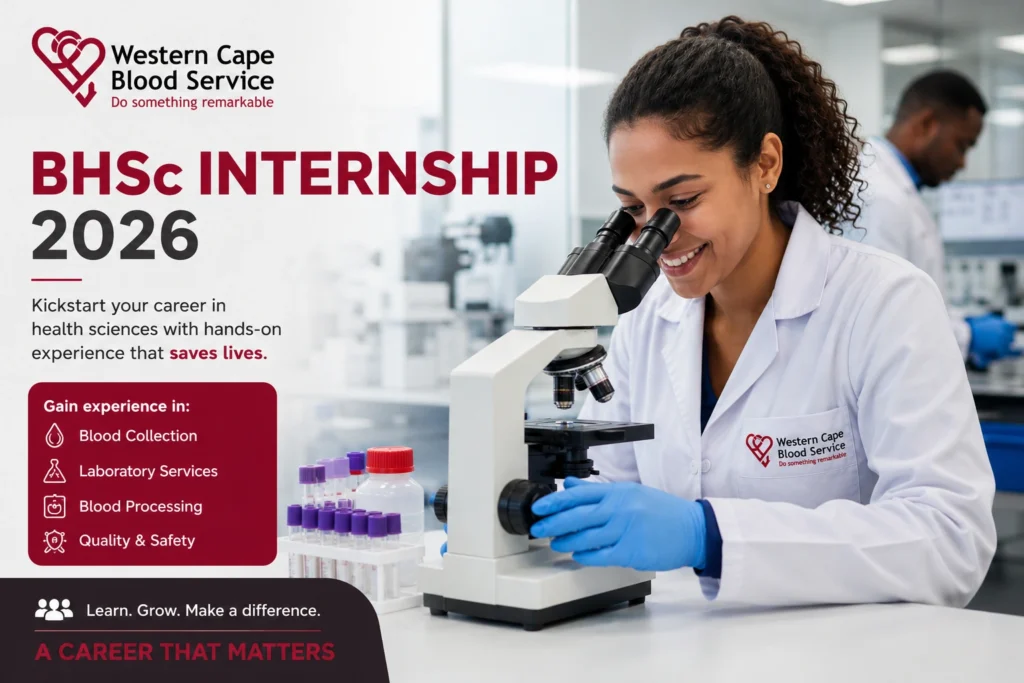
The programme offers exposure to areas including:
- Blood collection procedures
- Immunohaematology laboratory testing
- Blood product processing
- Sample handling and tracking
- Blood compatibility testing
- Laboratory quality assurance
- Infection prevention and laboratory safety
- Blood transfusion protocols
This combination of academic support and workplace learning is relatively uncommon, especially within specialised laboratory medicine.
Instead of treating study and employment as separate phases, the programme connects them into one structured professional development pathway.
Who should consider the Western Cape Blood Service BHSc Internship 2026?
Not every Health Sciences student will qualify.
The internship specifically targets students already progressing through the professional pathway towards becoming Medical Laboratory Scientists.
Applicants must meet several important requirements.
Candidates should:
- Hold a Matric certificate
- Be enrolled as a third-year Bachelor of Health Sciences student
- Achieve at least 50% in Immunohaematology
- Hold current student registration with the Health Professions Council of South Africa (HPCSA)
- Be computer literate
- Be available for approximately nine to twelve months
- Be willing to work shifts where operationally required
The Immunohaematology requirement deserves particular attention.
Unlike many graduate opportunities that simply request a completed qualification, this internship identifies one specific academic subject as a screening criterion.
Students should therefore ensure that their academic transcripts clearly display the required result before submitting an application.
More than laboratory work: learning how patient safety begins
Blood transfusion science is often misunderstood as purely technical work performed behind closed laboratory doors.
In reality, every result produced inside the laboratory can influence life-changing clinical decisions.
When hospitals request compatible blood for emergency surgery, trauma patients or neonatal care, laboratory accuracy becomes directly linked to patient outcomes.
Interns therefore learn far more than laboratory procedures.
They also develop habits that healthcare employers consistently value:
- Working methodically under pressure
- Maintaining strict confidentiality
- Following documented quality systems
- Communicating accurately with healthcare colleagues
- Understanding regulatory compliance
- Taking responsibility for scientific accuracy
These professional behaviours become just as important as technical laboratory skills throughout a Medical Laboratory Scientist’s career.
Expert insight: Why specialised internships are becoming increasingly valuable
South Africa continues investing in healthcare capacity while employers increasingly seek graduates who can contribute immediately rather than requiring lengthy workplace adjustment.
This trend explains why structured internships such as the Western Cape Blood Service BHSc Internship 2026 carry significant value.
Students who combine academic performance with supervised clinical experience often become stronger candidates because they already understand laboratory workflows, quality assurance systems and professional accountability.
Equally important, specialised blood transfusion experience is transferable. Even where permanent employment is not offered, graduates can present practical laboratory exposure that may strengthen future applications in pathology laboratories, diagnostic facilities, blood services and research environments.
Rather than simply adding another qualification, programmes like this help bridge one of the biggest challenges facing many graduates: demonstrating practical competence alongside academic achievement.
Could this internship lead to permanent employment?
Many applicants naturally ask this question.
The answer is encouraging—but realistic.
Western Cape Blood Service indicates that successful interns may be considered for permanent employment after completing the internship and passing the required Final Summative Assessment.
However, this should not be interpreted as a guaranteed job offer.
Employment decisions remain dependent on factors including:
- Assessment performance
- Workplace conduct
- Operational vacancies
- Organisational staffing requirements
- Recruitment policies
Even where permanent positions are unavailable immediately, graduates leave with recognised practical experience in one of healthcare’s most specialised laboratory disciplines.
That experience can strengthen future applications across both public and private healthcare sectors.
Preparing a strong application
Competition for healthcare internships has increased as more graduates seek structured workplace experience before entering professional practice.
Preparation therefore matters.
Applicants should organise documents well before the closing date.
These commonly include:
- Updated curriculum vitae
- South African ID
- Matric certificate
- Latest academic transcript
- Proof of third-year BHSc enrolment
- Evidence of achieving at least 50% in Immunohaematology
- Current HPCSA student registration
- Any additional documents requested on the recruitment portal
One practical mistake applicants often make is uploading incomplete academic records.
If reviewers cannot quickly verify the Immunohaematology mark, applications may experience delays or fail initial screening.
Checking document quality before submission is a simple step that can make a meaningful difference.
APPLY HERE: BHSc Internship 2026
ALSO APPLY FOR: 1Life Intern 2026-2027
Understanding the selection process
Although each recruitment cycle differs slightly, healthcare employers generally evaluate candidates beyond academic performance alone.
Western Cape Blood Service may conduct:
- Qualification verification
- HPCSA registration checks
- Interviews
- Psychometric assessments
- Reference verification
Applicants should also remember that communication after submission is important.
Monitoring email accounts and answering unfamiliar telephone calls during the recruitment period can prevent missing interview invitations or requests for additional information.
Candidates who receive no response within four weeks after the closing process should generally regard their application as unsuccessful.
Local relevance: A profession that supports hospitals across South Africa
Blood services often receive public attention during donor campaigns, yet their scientific work remains less visible.
Laboratory professionals help ensure donated blood reaches patients safely, whether those patients are treated in Cape Town, George, Paarl or other healthcare facilities across the Western Cape.
The work also reflects broader national healthcare priorities.
South Africa continues facing pressure to strengthen laboratory capacity, improve diagnostic services and maintain safe blood supplies for public and private hospitals alike.
As healthcare technology advances, laboratory careers increasingly require professionals who combine scientific knowledge with strict quality standards and ethical responsibility.
That makes internships like this particularly relevant for students planning long-term careers in laboratory medicine.
Frequently Asked Questions
Does the internship guarantee permanent employment?
No. Western Cape Blood Service states that successful interns may be considered for permanent employment after completing the programme and passing the Final Summative Assessment, but employment is not guaranteed.
Is the stipend amount published?
No. The organisation describes remuneration as market-related but has not publicly disclosed the monthly stipend amount.
When is the application deadline?
Applications for the Western Cape Blood Service BHSc Internship 2026 must be submitted through the official recruitment portal before 16 October 2026.
Final thoughts
The Western Cape Blood Service BHSc Internship 2026 reflects a growing recognition that students need more than classroom knowledge to launch successful healthcare careers.
By combining practical laboratory experience with a fourth-year bursary and financial support through a stipend, the programme addresses two significant challenges simultaneously: gaining professional competence and managing the cost of completing higher education.
Its emphasis on immunohaematology, laboratory accuracy and patient safety also highlights the evolving expectations placed on Medical Laboratory Scientists in South Africa’s healthcare system.
For eligible third-year Bachelor of Health Sciences students, this opportunity is about much more than spending a year inside a laboratory. It represents a structured transition from university into a profession where careful scientific work has a direct impact on saving lives. Students who meet the academic requirements, maintain their HPCSA registration and prepare a complete application before 16 October 2026 will place themselves in a strong position to compete for one of the country’s more meaningful healthcare internship opportunities.