

Breaking into the data science industry is one of the biggest challenges many South African graduates face. Most employers expect practical experience, yet graduates often struggle to find opportunities that provide both workplace exposure and formal training. Even students with degrees in mathematics, computer science, statistics, or engineering can find themselves competing against hundreds of applicants for entry-level positions.
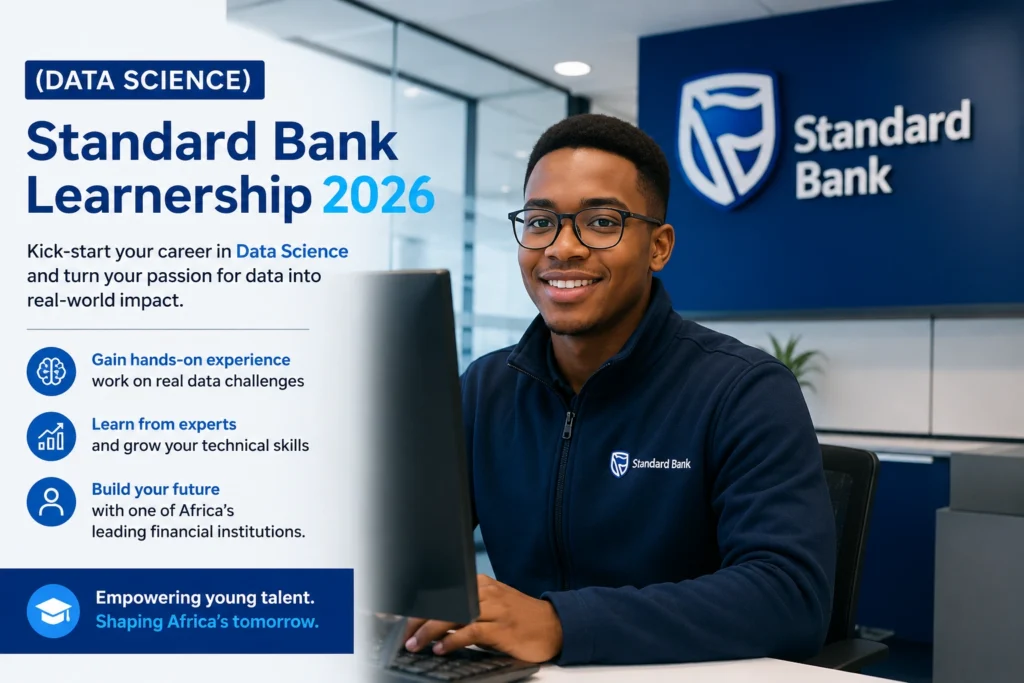
The (Data Science) Standard Bank Learnership 2026 aims to bridge this gap by giving graduates two years of structured workplace experience while they earn an accredited qualification and receive a monthly stipend of R15,000. Instead of learning only through lectures or online courses, participants work alongside experienced professionals in one of South Africa’s largest financial institutions.
This guide explains who qualifies, what learners can expect, how to prepare a competitive application, and why this opportunity could become a valuable stepping stone into the growing field of data science.
Understanding the (Data Science) Standard Bank Learnership 2026
The (Data Science) Standard Bank Learnership 2026 is a 24-month workplace learning programme designed for unemployed South African graduates under the age of 30.
Successful candidates begin the programme on 1 October 2026 and receive:
- Monthly stipend of R15,000
- Student medical aid
- Workplace experience within Standard Bank
- Formal learning toward the Occupational Certificate: Data Science Practitioner
- Mentorship from experienced professionals
- Exposure to internal audit, analytics, governance, and banking operations
Unlike a traditional internship that focuses mainly on work experience, this learnership combines classroom-based learning with structured workplace training.
Graduates gain practical experience while earning a nationally recognized qualification.
Why This Issue Matters
Data science has become one of South Africa’s fastest-growing career fields.
Banks, insurers, retailers, healthcare providers, telecommunications companies, and government departments increasingly rely on data to make business decisions, identify fraud, improve customer experiences, and manage operational risks.
However, employers consistently report that graduates often lack practical workplace experience.
This is where learnerships become valuable.
Rather than expecting graduates to learn everything independently, programmes like the (Data Science) Standard Bank Learnership 2026 allow participants to:
- Work with real business data
- Understand how large organizations use analytics
- Learn professional standards
- Develop workplace confidence
- Build technical portfolios
- Gain experience employers value
For graduates trying to enter data-related careers, two years of banking experience can significantly strengthen future job applications.
Why Standard Bank Combines Data Science with Internal Audit
Many graduates associate data science with artificial intelligence or software development.
In reality, modern banks use data science across almost every department.
Within internal audit, data science helps professionals:
- Identify unusual financial transactions
- Detect operational risks
- Test business controls
- Analyze large datasets efficiently
- Improve business processes
- Support evidence-based decision-making
Instead of checking thousands of transactions manually, analysts use data techniques to identify patterns worth investigating.
Learners therefore develop both technical and business knowledge, making them more versatile professionals.
Who Can Apply?
The programme targets graduates with strong analytical backgrounds.
Relevant qualifications include:
- Information Technology
- Computer Science
- Data Science
- Statistics
- Mathematics
- Econometrics
- Quantitative Analysis
- Engineering
- Other closely related disciplines
Applicants must also:
- Be South African citizens
- Be younger than 30 years old
- Hold a relevant undergraduate qualification
- Speak, read, and write English confidently
- Not be enrolled in another learnership or internship
- Not be studying at another institution
- Be available for the full 24-month programme
- Be able to start on 1 October 2026
Standard Bank has not stated a minimum academic average, but strong academic performance and relevant technical skills can improve competitiveness.
What Learners Will Actually Do
Many graduates imagine data scientists building complex artificial intelligence systems from day one.
That is not how this programme works.
Learners begin by supporting experienced professionals with manageable analytical tasks.
Typical responsibilities include:
- Cleaning business datasets
- Running predefined data analyses
- Identifying unusual patterns
- Supporting audit investigations
- Preparing reports
- Building simple visualizations
- Maintaining organized analytical records
- Following data governance policies
- Presenting findings clearly
- Meeting project deadlines
As confidence grows, learners gradually receive more responsibility.
This structured approach helps participants develop practical skills without being overwhelmed.
Step-by-Step Guide to Applying for the Standard Bank Learnership 2026
Step 1: Confirm Your Eligibility
Before applying, carefully check that you meet every requirement.
APPLY HERE: Standard Bank Learnership 2026
Do not assume that a related qualification automatically qualifies.
Read the job description carefully.
Step 2: Update Your CV
Tailor your CV specifically for data science.
Include:
- Programming languages
- Research projects
- Statistical coursework
- University assignments
- Technical skills
- Problem-solving examples
Avoid submitting a generic graduate CV.
Step 3: Prepare Supporting Documents
Typical documents include:
- Updated CV
- South African ID
- Qualification certificate
- Academic transcript
- Relevant technical certificates
- Reference details (if requested)
Having these ready speeds up your application.
Step 4: Highlight Practical Experience
Even if you have never worked professionally, include university projects involving:
- Python
- SQL
- R
- Excel
- Machine learning
- Statistical analysis
- Dashboards
- Data visualization
Recruiters appreciate evidence of practical learning.
Step 5: Submit Early
Standard Bank has not published a closing date.
Waiting could mean missing the opportunity if applications close unexpectedly.
Submitting early also allows time to correct any application issues.
ALSO APPLY FOR: (AGSA) Learnership 2026
Skills That Make Strong Candidates Stand Out
Technical knowledge matters, but recruiters also assess workplace readiness.
Strong applicants usually demonstrate:
- Analytical thinking
- Logical reasoning
- Attention to detail
- Curiosity
- Accountability
- Communication skills
- Teamwork
- Adaptability
- Professionalism
- Time management
- Business awareness
Employers understand graduates are still learning.
Showing enthusiasm and a willingness to learn can be just as valuable as advanced technical knowledge.
Best Practices Experts Recommend
Career advisors and graduate recruiters consistently recommend several strategies for improving applications.
Tailor Every Application
Customize your CV instead of sending identical versions to every employer.
Demonstrate Real Projects
Include examples such as:
- Customer data analysis
- Sales forecasting
- Statistical modeling
- Dashboard creation
- Predictive analysis
- Data cleaning
Specific examples make stronger impressions than general claims.
Learn Popular Data Tools
Familiarity with tools like:
- Python
- SQL
- Excel
- Power BI
- Tableau
- Git
can strengthen your application considerably.
Practice Explaining Your Work
Interviewers often ask candidates to explain university projects.
Focus on:
- The problem
- The data used
- Your approach
- The results
- What you learned
Clear communication is an important professional skill.
Why Data Governance Matters in Banking
Banks manage highly sensitive financial information.
Every employee handling customer or business data must follow strict standards.
Learners will therefore gain experience in:
- Data privacy
- Confidentiality
- Secure record keeping
- Reproducible analysis
- Accurate reporting
- Responsible data handling
Understanding governance makes graduates more valuable across many industries—not just banking.
Career Opportunities After Completion
The Occupational Certificate and workplace experience can support careers such as:
- Junior Data Analyst
- Data Science Practitioner
- Business Intelligence Analyst
- Audit Data Analyst
- Reporting Analyst
- Financial Data Analyst
- Governance Analyst
- Risk Data Analyst
- Analytics Consultant
- Internal Audit Analyst
Although Standard Bank does not guarantee permanent employment, graduates leave with valuable experience recognized across multiple industries.
Mistakes People Often Make
Many graduates unintentionally weaken otherwise good applications.
Common mistakes include:
Sending Generic CVs
Recruiters can quickly identify applications that were not customized.
Ignoring University Projects
Students often overlook valuable academic work.
Projects demonstrate technical ability even without formal employment.
Listing Skills Without Evidence
Writing “Python” on a CV means little unless supported by projects or coursework.
Waiting Too Long
Because no official closing date has been announced, delaying an application creates unnecessary risk.
Exaggerating Technical Knowledge
Recruiters may ask detailed questions.
Only list programming languages or software you genuinely understand.
How to Build a Stronger Data Science CV
A competitive graduate CV should clearly communicate technical ability.
Include sections covering:
- Programming languages
- Mathematics coursework
- Statistics modules
- SQL experience
- Machine learning projects
- Research assignments
- Dashboards
- Presentations
- Group projects
- Problem-solving achievements
Rather than simply stating:
“Completed data analysis project.”
Instead write:
“Cleaned and analyzed customer purchasing data using Python, identified purchasing trends, and presented findings through an interactive dashboard.”
This gives recruiters much clearer evidence of your abilities.
Frequently Asked Questions
1. Does Standard Bank guarantee permanent employment after the learnership?
No. The programme provides valuable workplace experience and an accredited qualification, but permanent employment is not guaranteed.
2. Can I study while completing the learnership?
No. Applicants must not be studying at another institution during the programme.
3. Is previous work experience required?
No. The programme targets graduates who may have limited or no professional experience.
4. Is there an application closing date?
At the time of publication, Standard Bank has not announced a closing date. Eligible candidates should apply while the vacancy remains active.
Final Thoughts
The (Data Science) Standard Bank Learnership 2026 represents an excellent opportunity for graduates who want to build practical skills in one of South Africa’s fastest-growing fields. Beyond the attractive R15,000 monthly stipend, participants gain two years of structured workplace learning, an accredited Occupational Certificate, exposure to banking operations, and experience applying data science in real business environments.
If you meet the eligibility requirements, don’t wait for a closing date to be announced. Update your CV, showcase your strongest analytical or programming projects, gather your supporting documents, and submit your application as soon as possible. A tailored application that demonstrates both technical ability and a willingness to learn can significantly improve your chances of being selected and help launch a long-term career in data science.