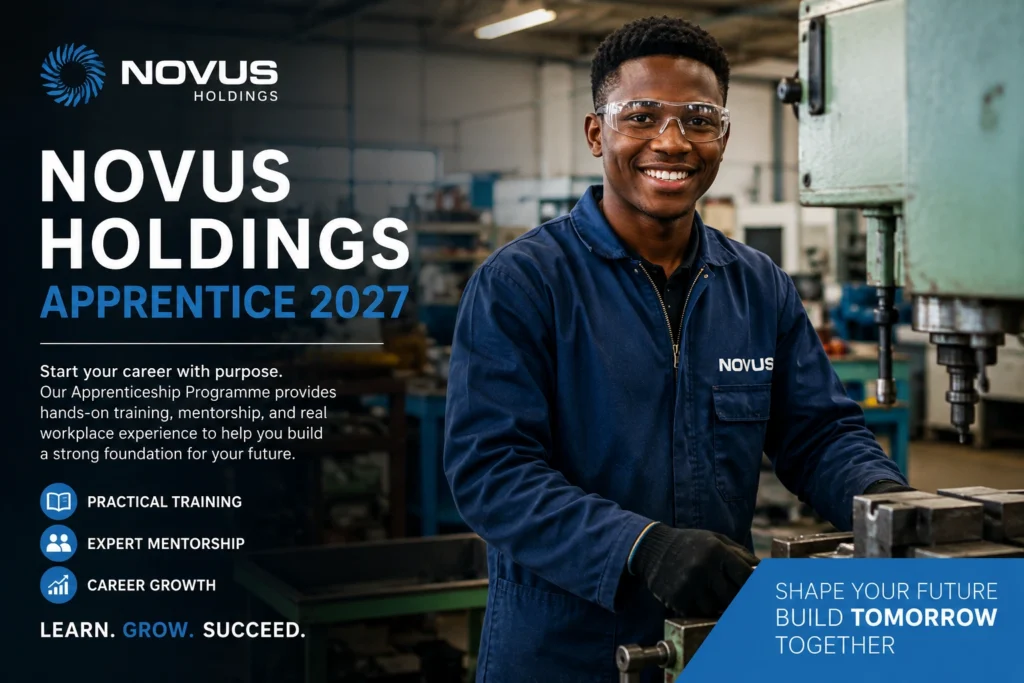

Technical careers often receive far less attention than university pathways, yet they continue to create stable opportunities in industries that quietly power the economy. That is one reason the Novus Holdings Apprentice 2027 programme has attracted attention among South African matriculants looking for practical, industry-recognised training rather than traditional academic routes.
With applications now open for a 36-month apprenticeship beginning in January 2027, Novus Holdings is offering successful applicants the opportunity to train in five specialised printing trades at its Novus Print facility in Montague Gardens, Cape Town. The programme closes on 18 September 2026, giving interested candidates several weeks to prepare their applications.
Unlike many entry-level opportunities that focus on administration or general workplace exposure, this apprenticeship is designed to develop skilled artisans within the commercial printing industry. That distinction is important because South Africa continues to face shortages of technically trained workers in manufacturing and production environments.
While the official advertisement does not mention a stipend or guarantee permanent employment after completion, it offers something many employers increasingly value: structured technical experience backed by recognised industry training.
Why the Novus Holdings Apprentice 2027 Is Getting Attention
Apprenticeships have become increasingly competitive over the past few years.
As youth unemployment remains a major national concern, programmes that combine classroom learning with practical workplace experience are attracting thousands of applications every year.
Novus Holdings’ latest intake stands out because it focuses on an industry that often sits outside the spotlight. Printing may not generate the same headlines as mining, automotive manufacturing or renewable energy, but it remains an essential part of publishing, packaging, education, retail and commercial communication.
Everything from textbooks and food packaging to pharmaceutical labels and newspapers depends on highly skilled printing professionals.
That makes this apprenticeship relevant beyond the printing factory itself.
A Closer Look at Novus Holdings
Novus Holdings is one of South Africa’s established commercial printing and manufacturing companies, providing printing, packaging and related services across multiple sectors.
Although the industry has evolved significantly because of digital technology, commercial printing has not disappeared. Instead, it has become increasingly specialised.
Modern printing facilities rely on sophisticated machinery, automation systems, digital workflows and quality-control processes that require trained technicians rather than simply machine operators.
This apprenticeship reflects that shift.
Five Specialist Trades Offer Different Career Paths
Rather than training everyone in one general discipline, the programme allows apprentices to specialise in one of five printing trades.
The available trades include:
- Lithography Press
- Electronic Pre-Press
- Mechanised Bookbinding
- Gravure Press
- Sheetfed Press
Each trade plays a different role in the production cycle.
Electronic Pre-Press focuses on preparing digital artwork, layouts and files before production begins.
Mechanised Bookbinding concentrates on assembling and finishing printed products such as books, manuals and catalogues.
Meanwhile, Lithography, Gravure and Sheetfed Press apprentices develop expertise in operating sophisticated printing equipment used in large-scale commercial production.
For applicants who enjoy machinery, precision work and problem-solving, these trades offer hands-on technical careers that are very different from office-based employment.
How the Three-Year Training Programme Is Structured
One of the strengths of the apprenticeship is its balanced approach to learning.
Instead of placing apprentices immediately onto the factory floor, Novus Holdings combines formal instruction with practical experience over three years.
The first phase includes approximately three to four months of theoretical learning at the training academy.
This foundation introduces apprentices to industry standards, safety procedures, technical principles and the knowledge required before working independently with specialised machinery.
The remaining phases involve approximately 26 to 30 months of workplace training.
During this period, apprentices work within real production environments while continuing structured learning through both the academy and Printing South Africa.
This combination prepares candidates for their relevant trade tests at the end of the programme.
Why Printing Is Becoming More Technical
One misconception about printing is that it is simply about pressing buttons on large machines.
Today’s commercial printing industry is far more advanced.
Modern production facilities increasingly rely on:
- Digital workflow software
- Automated quality control
- Precision calibration systems
- Colour management technology
- Computer-controlled machinery
- Industrial maintenance practices
As technology evolves, employers need technicians who understand both mechanical systems and digital production methods.
This explains why apprenticeships like this continue to receive industry investment despite broader changes in media consumption.
Who Can Apply?
The minimum academic requirements remain relatively accessible compared with many engineering apprenticeships.
Applicants should have:
- Grade 12
- Mathematics or Mathematical Literacy
- Minimum 60% in Mathematical Literacy (where applicable)
- Matric certificate or latest academic results
- Interest in technical manufacturing
A technical school background may strengthen an application, although it is listed as advantageous rather than compulsory.
Beyond academic results, employers often look for characteristics that cannot easily be measured by marks alone.
These include:
- Attention to detail
- Reliability
- Mechanical interest
- Willingness to learn
- Ability to follow safety procedures
- Good teamwork
Printing environments operate under strict production deadlines and quality standards, making these personal qualities particularly valuable.
An Interesting Detail: No Stipend Has Been Published
One aspect that prospective applicants should note carefully is the absence of any published stipend information.
Unlike some apprenticeship advertisements that clearly specify monthly allowances, the official Novus Holdings listing does not indicate payment details.
This does not necessarily mean apprentices will receive no financial support.
Instead, remuneration and contractual conditions may be discussed during later stages of recruitment.
Applicants should therefore avoid making assumptions based on information from unrelated apprenticeship programmes.
Permanent Employment Is Not Guaranteed
This is another area where the employer has been transparent.
Successful completion of the apprenticeship does not automatically lead to permanent employment.
Some candidates may initially find this disappointing.
However, this reflects how many apprenticeship programmes operate across South Africa.
The primary objective is skills development rather than guaranteed employment.
For many graduates, the recognised trade qualification and practical experience gained during three years of training become valuable assets when applying elsewhere within manufacturing or printing.
Public Reaction Reflects Growing Interest in Skilled Trades
Whenever apprenticeship programmes open, online discussions tend to follow a familiar pattern.
Many young South Africans welcome opportunities that provide practical experience rather than requiring previous employment.
Others appreciate that apprenticeships often lead to nationally recognised qualifications, giving participants greater mobility across industries.
At the same time, some applicants continue to express concerns about limited intake numbers and strong competition.
Another recurring topic is transparency around stipends.
Because living costs remain high, many prospective apprentices hope employers will communicate financial arrangements as early as possible during recruitment.
Overall, however, structured apprenticeships continue to enjoy a positive reputation because they bridge the gap between education and employment.
Why Manufacturing Apprenticeships Still Matter
South Africa continues to encourage artisan development across multiple sectors.
While discussions often focus on electricians, fitters, boilermakers or millwrights, specialised manufacturing trades deserve similar attention.
Commercial printing supports industries including:
- Packaging
- Retail
- Publishing
- Food production
- Pharmaceuticals
- Education
- Marketing
- Logistics
Without skilled printing technicians, many supply chains would struggle to function efficiently.
That broader economic importance makes apprenticeships like this more significant than they may initially appear.
Why This Matters Right Now
Several trends are making programmes like the Novus Holdings Apprentice 2027 especially relevant.
First, employers increasingly prefer candidates with practical workplace experience rather than academic qualifications alone.
Second, South Africa continues to invest in artisan development through partnerships involving industry and sector education authorities.
Third, automation is changing—not eliminating—technical careers.
Rather than replacing skilled workers, newer technologies often increase demand for technicians capable of operating, maintaining and troubleshooting sophisticated equipment.
For matriculants uncertain about university, apprenticeships offer an alternative route into specialised careers without sacrificing long-term professional development.
That growing recognition explains why apprenticeship opportunities consistently attract strong interest online.

Tips for Building a Stronger Application
Competition is likely to be significant.
Candidates can improve their applications by presenting evidence that demonstrates genuine technical interest.
Helpful additions may include:
- School practical projects
- Engineering Graphics and Design experience
- Mechanical Technology subjects
- Robotics participation
- Workshop activities
- Technical competitions
- Community volunteer projects involving repairs or maintenance
A well-organised CV also makes a positive impression.
Applicants should ensure all documentation is clear, accurate and easy to read.
Missing certificates remain one of the simplest reasons applications are delayed or rejected.
Submitting early also allows time to correct any documentation issues before the closing date.
APPLY HERE: Novus Holdings Apprentice 2027
ALSO APPLY FOR: Liebherr Engineering Apprentice 2027
Common Mistakes Applicants Should Avoid
Every recruitment cycle sees avoidable errors that reduce otherwise strong applications.
Some of the most common include:
- Waiting until the closing day
- Uploading unreadable documents
- Omitting academic results
- Using outdated contact information
- Ignoring application instructions
- Submitting incomplete online forms
Because online recruitment systems often close automatically at the stated deadline, late applications are rarely considered.
Preparation matters.
The Bigger Picture for South Africa’s Printing Industry
Although digital media continues to expand, commercial printing remains surprisingly resilient.
Packaging demand continues to grow alongside online shopping.
Educational institutions require printed learning materials.
Businesses still rely on professionally produced marketing materials.
Meanwhile, security printing, pharmaceutical packaging and specialised industrial printing remain highly technical sectors.
As these markets evolve, employers increasingly require technicians capable of operating complex production systems rather than simply performing repetitive manual tasks.
That shift supports continued investment in apprenticeship programmes.
What Could Happen Next
Several possible outcomes could emerge following this recruitment cycle.
If application numbers remain high—as seen across many technical apprenticeship programmes—competition may become even stronger in future intakes.
Employers may also continue expanding digital printing technologies, creating demand for apprentices who combine mechanical aptitude with computer literacy.
For successful candidates, the apprenticeship could serve as a stepping stone toward artisan certification and broader manufacturing careers.
For unsuccessful applicants, the programme highlights an important trend: technical industries continue to invest in structured training, and similar opportunities are likely to appear across manufacturing sectors throughout 2027.
Regardless of the outcome, the growing visibility of apprenticeships signals a broader shift toward skills-based career development.
Final Thoughts
The Novus Holdings Apprentice 2027 is more than another apprenticeship announcement. It reflects the continued importance of technical skills within South Africa’s manufacturing economy.
While the programme does not promise permanent employment and has not published stipend details, it offers something that remains highly valuable: structured training, recognised industry experience and the opportunity to qualify in a specialised trade.
For Grade 12 learners with Mathematics or Mathematical Literacy who enjoy practical work, machinery and production environments, this apprenticeship represents a realistic pathway into an industry that continues to evolve alongside modern technology.
As applications remain open until 18 September 2026, prospective candidates should prepare their documentation carefully, apply early and focus on presenting evidence of both academic readiness and genuine interest in technical careers.