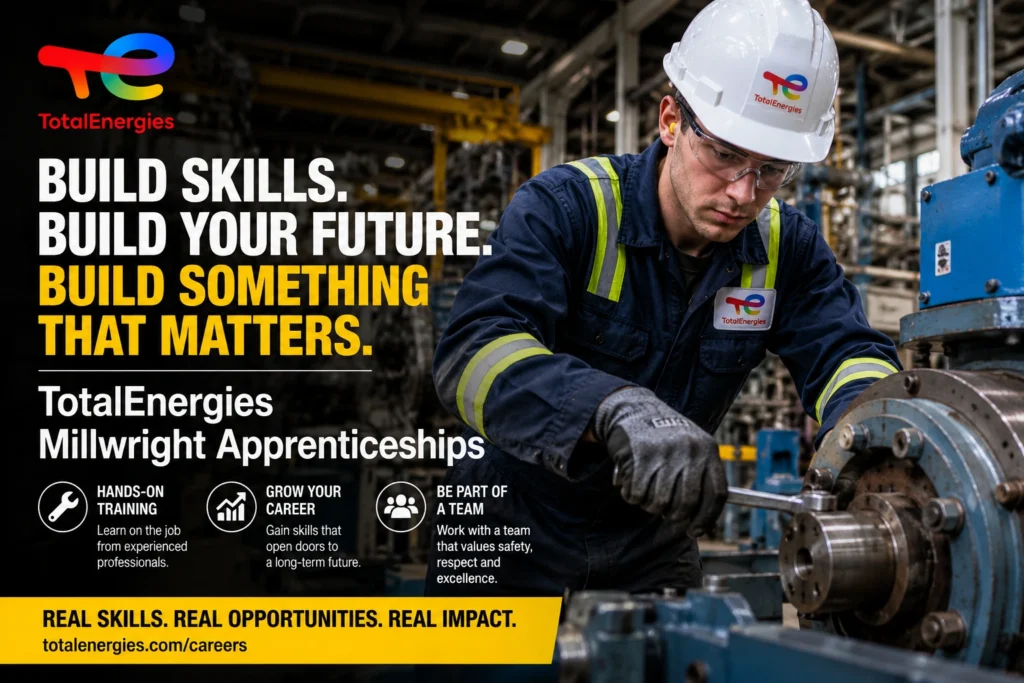

The latest intake for TotalEnergies Millwright Apprenticeships is arriving at a moment when technical skills are becoming some of the most sought-after qualifications in South Africa’s industrial economy. While university graduate unemployment continues to dominate headlines, apprenticeship programmes linked to energy, manufacturing, and engineering firms are quietly becoming one of the country’s most practical entry points into long-term employment.
That is part of the reason the recent apprenticeship opportunity from TotalEnergies is gaining traction online. The Durban-based opportunity is not simply another entry-level training programme. For many applicants, it represents access to a structured industrial environment where practical engineering exposure, technical training, and workplace discipline intersect.
The apprenticeship will be hosted at the company’s Lubricants Manufacturing Plant in Durban, placing successful candidates directly inside a live operational setting rather than a classroom-only learning environment. In an economy where employers increasingly demand experience before offering permanent roles, that detail matters.
Why the TotalEnergies Millwright Apprenticeships Are Trending
Over the past year, South Africa has seen a noticeable increase in attention around artisan careers. Electricians, fitters, millwrights, boilermakers, and instrumentation technicians are once again being discussed as future-proof professions.
Part of this shift comes from economic reality.
Young people entering the labour market are facing a difficult landscape. Traditional white-collar pathways are becoming saturated, while industries connected to infrastructure, manufacturing, logistics, and energy continue to report shortages of technically skilled workers.
Millwright training sits directly inside that conversation.
A millwright is typically responsible for installing, maintaining, troubleshooting, and repairing industrial machinery and automated systems. The role combines mechanical and electrical knowledge, making it one of the more versatile technical trades.
That versatility is exactly why programmes like the TotalEnergies Millwright Apprenticeships are attracting significant attention across job boards and social media platforms.
Unlike short-term learnerships that may only provide limited exposure, apprenticeships are generally viewed as deeper technical pathways. They demand commitment, physical endurance, and strong mathematical understanding, but they also create clearer routes toward trade qualification.
The Durban Opportunity Reflects a Larger Industry Shift
The Durban placement at TotalEnergies’ Lubricants Manufacturing Plant highlights another important development in the energy and manufacturing sectors: companies are increasingly investing in internal technical pipelines instead of relying solely on external recruitment.
This is not happening in isolation.
Across South Africa, industrial employers are under pressure to maintain aging infrastructure, modernise equipment, improve safety performance, and manage increasingly automated systems. That requires technically competent workers who understand both machinery and operational risk.
The apprenticeship announcement reflects this reality through its detailed operational requirements.
Applicants are expected to:
- Work alongside plant maintenance teams
- Participate in structured practical training
- Follow HSSEQ procedures
- Complete technical documentation and logbooks
- Understand work permits and risk assessments
- Support production efficiency standards
- Participate in overtime and standby operations when necessary
These responsibilities may appear demanding, but they reveal how modern apprenticeship programmes have evolved. Employers are no longer treating apprentices as passive observers. Instead, apprentices are expected to become integrated contributors inside industrial environments.
That exposure can become extremely valuable later in a technical career.
Safety Culture Is Clearly a Major Focus
One striking aspect of the apprenticeship description is the strong emphasis on safety and operational compliance.
The programme repeatedly references PPE requirements, hazard escalation procedures, Management of Work systems, permits, and risk assessments. That reflects broader global changes inside the energy sector, where safety culture has become central to operational credibility.
In industries involving manufacturing plants, lubricants, heavy machinery, confined spaces, and elevated work platforms, safety failures can carry severe consequences.
The apprenticeship therefore appears designed not only to build technical skill but also to shape workplace behaviour and professional discipline from the beginning.
This matters because many employers increasingly prioritise workers who understand compliance environments. Technical skill alone is no longer enough in high-risk industrial sectors.
The Physical Requirements Tell Their Own Story
The programme also openly states that applicants must be physically fit and willing to work at heights or inside confined spaces.
That level of transparency is important.
Many young applicants pursue technical programmes without fully understanding the physical realities involved in industrial maintenance careers. Working on top of tanks, climbing platforms, entering vessels, or handling demanding operational schedules is part of the environment.
By outlining these expectations upfront, the company signals that the apprenticeship is designed for real operational readiness rather than symbolic training participation.
In many ways, this honesty may help applicants make better-informed career decisions.
Why Durban Remains Strategically Important
The Durban location itself also plays a role in the significance of the opportunity.
Durban remains one of South Africa’s most important logistics and industrial hubs. Its port infrastructure, manufacturing facilities, petrochemical operations, and distribution networks make it a critical centre for technical employment.
Apprentices gaining workplace exposure in Durban-based industrial facilities often benefit from broader industry visibility and networking opportunities compared to smaller operational sites.
For technical trainees, exposure to large-scale industrial systems can dramatically strengthen future employability.
Why This Matters Right Now
South Africa’s youth unemployment crisis continues to shape almost every conversation about education and work.
But there is also a growing recognition that the country faces a parallel problem: a shortage of practical technical skills in sectors essential to economic growth.
That contradiction has pushed apprenticeships back into the spotlight.
The TotalEnergies Millwright Apprenticeships matter right now because they reflect a wider rebalancing happening across the labour market. Increasingly, employers are rewarding technical competence, operational reliability, and specialised trade skills.
At the same time, younger South Africans are becoming more open to artisan careers that offer tangible workplace pathways rather than uncertain academic outcomes.
There is also another factor driving interest: stability.
Trades linked to energy, manufacturing, maintenance, and infrastructure often provide more resilient long-term opportunities than many entry-level office roles vulnerable to outsourcing or automation.
Millwrights, especially those trained in complex industrial settings, frequently develop adaptable skills that can transfer across sectors including manufacturing, energy, logistics, mining, and processing plants.
That adaptability is becoming economically valuable.
APPLY HERE: TotalEnergies Millwright Apprenticeships
ALSO APPLY FOR: Wilmar SA-Electrician Apprenticeship 2027
Public Reaction Has Been Largely Positive
Online response to apprenticeship announcements like this has generally been enthusiastic, particularly among TVET graduates and N3–N6 engineering students.
Many applicants see these opportunities as realistic alternatives to prolonged unemployment after completing technical studies.
There is also increasing frustration among young graduates who possess theoretical qualifications but lack workplace exposure. Apprenticeships address that gap directly by combining structured learning with operational experience.
Social conversations around artisan careers have also shifted noticeably over the past few years.
Where trade careers were once unfairly viewed as secondary options, many people now see them as practical, respected, and financially sustainable pathways.
The growing visibility of energy-sector apprenticeship programmes is contributing to that perception change.
The Entry Requirements Reveal the Competitive Nature of Modern Apprenticeships
Although the programme is aimed at unemployed youth, the minimum requirements already suggest that competition may be intense.
Applicants need:
- Grade 12 with Mathematics and Physical Science
- N3–N6 engineering qualifications in mechanical or electrical/electronic engineering
- Physical fitness
- Willingness to work in demanding industrial conditions
These expectations show how apprenticeship programmes have become increasingly selective.
Companies are looking for candidates who can handle technical theory while also adapting to workplace discipline and operational pressure.
The combination of academic requirements and physical expectations reflects the reality of millwright work itself: it is intellectually demanding and physically practical at the same time.
The Administrative Side Should Not Be Ignored
One overlooked aspect of many apprenticeships is the administrative discipline involved.
The TotalEnergies programme specifically mentions timesheets, projects, logbooks, assessments, and documentation requirements.
That may sound minor, but in technical industries, documentation accuracy is critical.
Maintenance records, inspection reports, permit systems, and operational tracking form part of modern industrial accountability. Apprentices who learn these systems early often transition more smoothly into permanent technical environments later.
Energy Companies Are Increasingly Investing in Skills Development
The broader energy sector is undergoing transformation globally, and companies are under pressure to strengthen local technical capability.
Programmes like the TotalEnergies Millwright Apprenticeships therefore serve multiple purposes:
- Building future technical talent
- Supporting operational sustainability
- Strengthening compliance culture
- Developing local workforce pipelines
- Addressing long-term maintenance demands
This is particularly important in South Africa, where infrastructure reliability and industrial productivity remain major economic concerns.
Companies capable of developing technically skilled workers internally may gain stronger long-term operational resilience.
What Could Happen Next
The growing attention around apprenticeship programmes could lead to several broader developments.
First, competition for technical training placements is likely to intensify further. As more young people recognise the employment potential linked to artisan careers, demand for apprenticeships may continue rising sharply.
Second, employers may begin expanding partnerships with TVET colleges and technical training providers to strengthen recruitment pipelines.
Third, industries connected to manufacturing, logistics, renewable energy, and infrastructure could increase investment in specialised artisan development as automation and maintenance complexity continue evolving.
There is also the possibility that apprenticeship pathways will gain stronger public status over the next few years.
For a long time, university education dominated South Africa’s career narrative. But economic realities are reshaping perceptions. Technical careers are increasingly being recognised not as backup options, but as strategic professions essential to industrial growth.
If this trend continues, programmes like the TotalEnergies apprenticeship could become even more competitive and influential.
A Practical Opportunity in a Difficult Economy
The attention surrounding the TotalEnergies Millwright Apprenticeships ultimately reflects something larger than a single recruitment notice.
It reflects changing attitudes toward work, skills, and employability in South Africa.
At a time when many young people are searching for realistic entry points into sustainable careers, structured technical training opportunities are carrying renewed significance. The Durban apprenticeship may not promise instant success, but it offers something increasingly rare in the modern labour market: direct exposure to a functioning industrial environment where learning and operational experience happen simultaneously.
That combination is precisely why apprenticeship programmes continue attracting interest despite their demanding nature.
For applicants willing to navigate the physical challenges, technical expectations, and workplace discipline involved, opportunities like this may represent far more than temporary training. They may become the foundation for long-term participation in sectors that continue to rely heavily on skilled technical expertise.
And in South Africa’s current economic climate, that possibility matters more than ever.