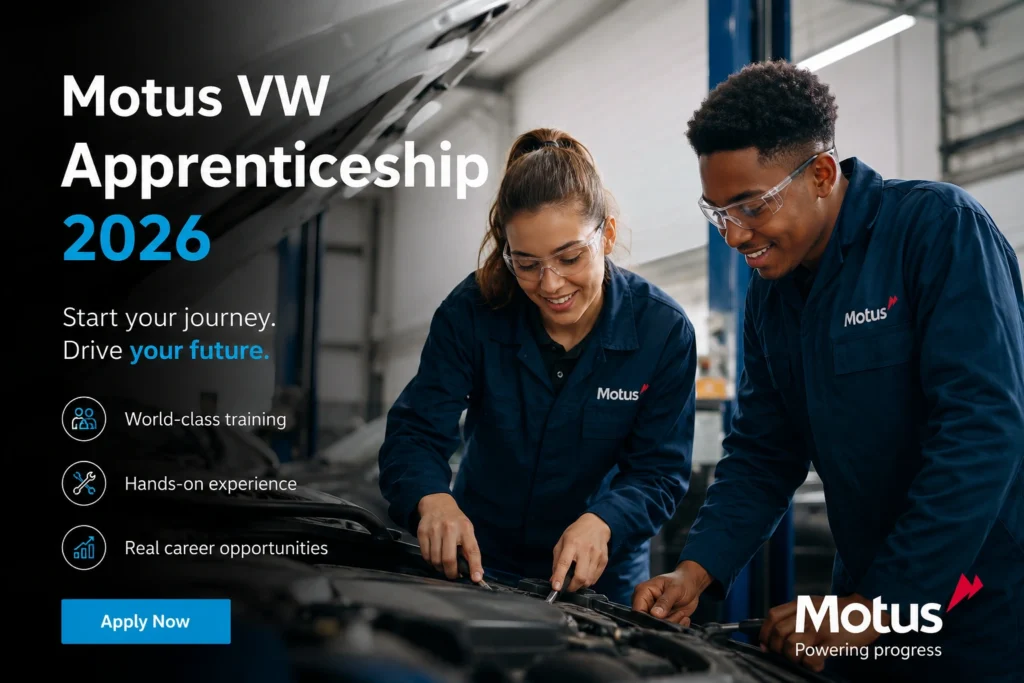

The Motus VW Apprenticeship 2026 is gaining attention at a time when many South African matriculants are searching for practical pathways into employment rather than traditional academic routes alone.
As youth unemployment remains one of the country’s biggest challenges, opportunities that combine structured training with workplace exposure tend to stand out. The latest apprenticeship opening at Volkswagen Bloemfontein, offered through Motus, has become a talking point because it provides something many entry-level candidates struggle to find: a clear starting point.
Unlike short-term internships or temporary work placements, this programme is designed as a three-year apprenticeship, allowing participants to develop technical expertise gradually while working in a real automotive environment.
For young people interested in vehicles, engineering principles, diagnostics, and workshop operations, this opportunity represents more than just training. It represents a possible career foundation.
The Bigger Story Behind the Opportunity
The automotive sector has undergone significant changes over the last decade.
Modern vehicles have become increasingly sophisticated, combining traditional mechanical systems with advanced electronics, software integration, sensors, and diagnostic technologies.
As a result, employers are no longer looking only for workers who can use tools. They need technicians who can adapt, learn continuously, and understand evolving automotive systems.
This shift has created a growing need for structured technical training programmes.
Companies across the motor industry have responded by investing in apprenticeships that prepare future artisans and technicians through practical learning rather than classroom theory alone.
The Motus VW Apprenticeship 2026 fits directly into this trend.
By recruiting candidates early and providing long-term development, the programme helps build the next generation of automotive professionals while addressing skills shortages that affect the industry.
What the Apprenticeship Involves
According to the opportunity details, the apprenticeship is being offered at VW Bloemfontein and falls within Motus’ retail division.
The successful applicant will enter the programme as a Level Year 1 Apprentice and participate in a structured three-year development journey.
During this period, apprentices will assist with day-to-day workshop activities while learning under experienced professionals.
The role includes:
- Supporting daily operational tasks
- Learning automotive industry practices
- Participating in training sessions and workshops
- Following workplace procedures
- Adhering to safety standards
- Taking on increasing responsibilities as skills develop
What makes apprenticeships different from many entry-level jobs is that learning forms part of the role itself.
The expectation is not that applicants already know everything. Instead, they are expected to demonstrate potential, commitment, and a willingness to learn.
Why Automotive Apprenticeships Still Matter
Some people assume traditional trades are becoming less important in a technology-driven economy.
The reality is often the opposite.
As vehicles become more advanced, the need for skilled automotive professionals continues to evolve rather than disappear.
Technicians today work with:
- Electronic control systems
- Computerized diagnostics
- Hybrid technologies
- Advanced safety systems
- Digital maintenance tools
- Complex mechanical assemblies
This means apprenticeships increasingly serve as bridges between practical craftsmanship and modern technology.
For many employers, formal apprenticeship experience remains one of the most respected forms of industry preparation because it demonstrates real-world competence rather than theoretical knowledge alone.
Who Motus Is Looking For
The requirements may appear straightforward, but they reveal a great deal about the type of candidate the company hopes to attract.
Applicants must have:
- Matric
- Physical Science
- Pure Mathematics
- Good communication skills
- Basic computer literacy
- Teamwork ability
- A positive attitude
- Willingness to learn
The inclusion of Physical Science and Pure Mathematics is particularly notable.
These subjects suggest that Motus wants candidates capable of understanding technical concepts and problem-solving processes that often arise in workshop environments.
Automotive work today involves far more than mechanical repairs.
Technicians regularly interpret diagnostic data, analyze faults, follow technical specifications, and understand systems that rely on scientific and mathematical principles.
In that context, the academic requirements make strategic sense.
Recent Developments in South Africa’s Skills Landscape
The timing of this apprenticeship is significant.
Over the past several years, there has been increasing national discussion around technical and vocational education.
Many employers have raised concerns about skills shortages, particularly in engineering, manufacturing, logistics, automotive services, and artisan occupations.
At the same time, young people entering the labour market often face a difficult reality: employers want experience, but obtaining experience without a first opportunity can be challenging.
Programmes like the Motus VW Apprenticeship 2026 attempt to address this gap.
Rather than expecting candidates to arrive fully trained, the apprenticeship creates a pathway where learning and working happen simultaneously.
This model continues to receive support from industry stakeholders because it aligns training more closely with actual workplace needs.
Public Reaction: Why Many Young South Africans Are Paying Attention
Opportunities requiring only Matric but offering structured long-term development frequently attract strong interest.
For many school leavers, the biggest concern is uncertainty.
University pathways can be expensive.
Entry-level jobs can be difficult to secure.
Short-term contracts may not provide meaningful career progression.
A three-year apprenticeship offers something different: a roadmap.
Many aspiring technicians view programmes like this as a chance to gain experience, develop practical skills, and build professional credibility.
Career advisors also tend to highlight apprenticeships because they expose participants to workplace expectations early in their careers.
That exposure often helps young professionals develop discipline, communication skills, teamwork habits, and technical confidence.
These qualities can become valuable assets regardless of where a career eventually leads.
Why This Matters Right Now
The significance of the Motus VW Apprenticeship 2026 extends beyond a single vacancy.
It reflects several broader trends affecting South Africa’s workforce.
First, there is growing demand for practical skills.
Employers increasingly value candidates who can demonstrate real-world capability alongside formal qualifications.
Second, industries are looking for talent pipelines that prepare workers for future technological changes.
The automotive sector is evolving rapidly, and businesses need employees who can learn continuously.
Third, young people are becoming more open to alternative career pathways.
While university education remains important, apprenticeships, learnerships, and vocational training programmes are gaining recognition as viable routes to long-term career success.
For many matriculants, opportunities like this represent a practical way to enter an industry, gain experience, and build employability.
That relevance is one reason the programme has attracted attention.
The Advantages of a Three-Year Training Structure
One aspect that stands out is the programme’s duration.
Three years may seem like a substantial commitment, but it offers important advantages.
Technical competence develops over time.
Skills such as diagnostics, fault identification, workshop procedures, and equipment handling cannot be mastered overnight.
Longer apprenticeships allow participants to:
- Learn progressively
- Practice repeatedly
- Build confidence
- Understand workplace culture
- Develop professional habits
- Gain exposure to different tasks
This gradual development often produces stronger outcomes than short-term training initiatives.
Employers value consistency, and long-duration programmes provide opportunities to demonstrate reliability and growth over an extended period.
What Applicants Should Do Before Applying
Competition for opportunities like this can be intense.
Applicants therefore need to present themselves professionally.
A strong application should include:
- An updated CV
- Accurate contact information
- Clear academic results
- Relevant technical interests
- Computer skills
- Extracurricular achievements
- Volunteer or teamwork experience
APPLY HERE: Motus VW Apprenticeship
One particularly useful strategy is to highlight Mathematics and Physical Science results prominently.
Recruiters reviewing applications often make initial decisions quickly.
Ensuring these subjects are easy to identify can help applicants demonstrate that they meet key eligibility requirements.
Candidates should also proofread carefully.
Simple mistakes can create negative impressions even when a candidate otherwise meets the criteria.
ALSO APPLY FOR: (AA) Apprenticeships 2026
The Broader Career Potential
Many applicants focus only on the immediate opportunity.
However, the larger value often lies in where an apprenticeship can lead.
Automotive careers can branch into numerous directions, including:
- Vehicle diagnostics
- Service technology
- Workshop supervision
- Technical advisory roles
- Parts and service management
- Manufacturer support positions
- Specialized automotive fields
The skills gained during an apprenticeship frequently remain valuable throughout a career.
Even as technologies change, foundational technical knowledge, problem-solving ability, and workplace experience continue to matter.
This is why many industry professionals describe apprenticeships as investments rather than simply training programmes.
What Could Happen Next
Several outcomes are possible once applications close on 8 June 2026.
The immediate next step will likely involve application screening and candidate evaluation.
Applicants who demonstrate strong academic foundations, enthusiasm for technical work, and readiness to learn may advance through the selection process.
For the broader industry, programmes like this could signal continued investment in talent development.
If apprenticeship initiatives prove successful, more automotive employers may expand similar pathways in future years.
The sector’s ongoing technological transformation also means training programmes will likely evolve.
Future apprentices may encounter increasing exposure to:
- Advanced diagnostics
- Digital vehicle systems
- Hybrid technologies
- Connected vehicle platforms
- Emerging automotive innovations
For successful candidates, participation in today’s apprenticeship could become a stepping stone toward opportunities that do not yet fully exist.
That possibility makes programmes like this especially relevant in a rapidly changing industry.
Final Thoughts
The Motus VW Apprenticeship 2026 arrives at a time when many young South Africans are actively seeking practical routes into meaningful careers.
Its appeal lies not only in the opportunity itself but also in what it represents: structured development, workplace experience, technical learning, and the possibility of long-term growth.
For matriculants who have completed Physical Science and Pure Mathematics and have a genuine interest in the automotive sector, this apprenticeship offers more than entry-level exposure.
It offers a chance to build skills in a professional environment over three years while learning from experienced industry professionals.
In an employment landscape where experience often determines opportunity, programmes like this continue to stand out because they provide a bridge between education and industry. For the right candidate, that bridge could become the beginning of a lasting automotive career.