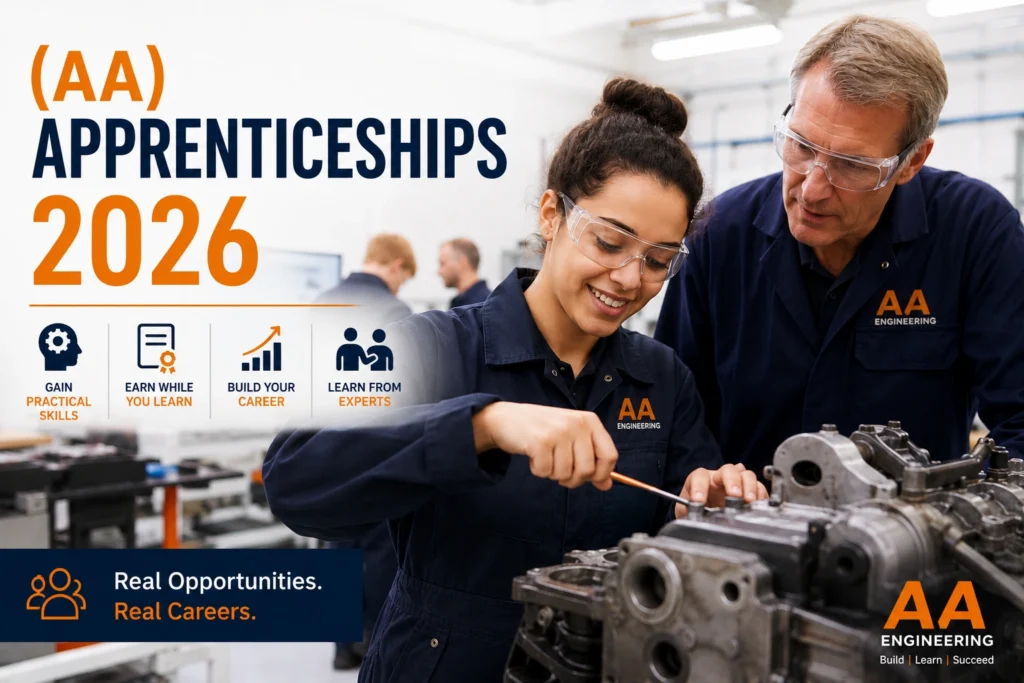

The conversation around Automotive Association (AA) Apprenticeships 2026 is growing rapidly, and it is not difficult to see why.
At a time when many young South Africans are questioning whether traditional university routes still guarantee employment, technical and vocational careers are gaining renewed respect. Industries across the country continue to report shortages of qualified artisans, particularly in automotive maintenance, diagnostics, diesel technology, and electrical vehicle systems.
Against this backdrop, the Automotive Association’s training programmes are attracting attention from school leavers, job seekers, employers, and experienced workers who want formal recognition of their skills.
What makes the current moment especially interesting is that the automotive training landscape itself is changing. Older apprenticeship structures are being phased out, newer occupational qualifications are becoming the norm, and employers are increasingly looking for workers who can adapt to modern vehicle technologies.
For anyone considering a future in the motor industry, 2026 could prove to be an important turning point.
A Trusted Name Entering a New Era
For more than nine decades, the Automobile Association of South Africa (AA) has been associated with road safety, mobility services, driver support, and automotive expertise.
Its training centre has long played a significant role in developing artisans for the South African motor industry. Over the years, thousands of learners have passed through its programmes, gaining the technical knowledge and practical experience needed to qualify as skilled tradespeople.
However, the environment in which these programmes operate has changed dramatically.
Modern vehicles are increasingly dependent on electronic systems, onboard computers, advanced diagnostics, and sophisticated electrical components. The rise of hybrid and electric vehicles is also reshaping the skills required by workshops and dealerships.
As a result, training providers such as the AA are adapting their programmes to align with national occupational standards and future industry requirements.
This evolution is one of the key reasons the Automotive Association (AA) Apprenticeships 2026 programme is generating interest.
The Shift Away From Legacy Trades
One of the most notable developments is the gradual phase-out of traditional apprenticeship pathways known as legacy trades.
These programmes have served the industry for decades and remain recognised qualifications on South Africa’s National Qualifications Framework.
Current legacy trade options include:
- Automotive Electrician
- Diesel Fitter
- Diesel Mechanic
- Motor Mechanic
While these qualifications still carry value, the transition toward newer occupational qualifications means they will not remain available indefinitely.
For prospective learners, this creates a sense of urgency.
Individuals who specifically want one of these traditional trade routes may have a limited window to enrol before the programmes are fully replaced by newer systems.
This transition mirrors broader changes taking place across South Africa’s vocational education sector, where occupational qualifications are increasingly viewed as the future of artisan development.
Why Occupational Qualifications Are Becoming the New Standard
The Quality Council for Trades and Occupations (QCTO) has been driving reforms aimed at creating more integrated and workplace-focused training pathways.
Rather than separating theoretical learning and workplace experience into distinct phases, occupational qualifications aim to blend these elements more effectively.
Supporters of the approach argue that it better reflects the realities of modern industry.
Automotive employers increasingly need workers who can move comfortably between diagnostic software, electronic systems, customer interactions, and hands-on mechanical work.
The newer qualification model seeks to prepare learners for exactly that environment.
For many training providers, including the AA, adopting occupational qualifications is not simply about compliance. It is about ensuring that graduates remain relevant in an industry undergoing rapid technological change.
Why Young South Africans Are Looking at Apprenticeships Again
For years, apprenticeships were often viewed as a secondary option compared with university education.
That perception is beginning to change.
Rising youth unemployment has encouraged many young people to reconsider vocational careers that offer practical experience and a direct route into employment.
The automotive sector remains one of the country’s most important industrial employers. Vehicles require servicing, repairs, diagnostics, and maintenance regardless of broader economic cycles.
Qualified artisans therefore continue to play a critical role.
Many career advisers now point out that skilled trades can provide:
- Stable employment opportunities
- Portable skills recognised across industries
- Entrepreneurial opportunities
- Access to specialised technical careers
- Long-term earning potential
As awareness grows, apprenticeship programmes are increasingly being viewed as strategic career investments rather than fallback options.
What the Training Experience Looks Like
One reason the AA’s programmes continue to attract interest is their structured approach.
Apprenticeships generally follow a multi-level format, with learners progressing through various stages over a period that may range from 18 to 36 months.
The model combines three important elements:
Classroom Learning
Learners study technical theory, workplace safety, regulations, and industry standards.
This theoretical foundation helps apprentices understand the principles behind vehicle systems rather than simply memorising repair procedures.
Practical Skills Development
Hands-on training remains the heart of automotive education.
Apprentices work with tools, engines, diagnostic equipment, electrical systems, and vehicle components under professional supervision.
Workplace Exposure
Real-world workshop experience allows learners to apply what they have learned while developing confidence and professional discipline.
Many employers value this practical exposure as highly as formal qualifications.
Together, these components create a learning environment designed to produce work-ready artisans.
The Entry Requirements May Surprise Some Applicants
One aspect generating discussion is the accessibility of these programmes.
Unlike many higher-education opportunities, the minimum educational requirement is generally Grade 10.
That does not mean the selection process is easy.
Applicants with Grade 11 or Matric, particularly those who studied Mathematics and Physical Science, often have a competitive advantage.
However, the relatively accessible entry threshold opens opportunities for individuals who may not have followed a traditional academic path.
In a country where educational inequality remains a challenge, this accessibility is significant.
It creates pathways for capable learners whose strengths may lie in technical and practical fields rather than purely academic ones.
APPLY HERE: (AA) Apprenticeships 2026
ALSO APPLY FOR: MQA Apprenticeships 2026
The Psychometric Assessment: More Than Just a Test
Among applicants, one of the most frequently discussed aspects of the selection process is the psychometric assessment.
These evaluations are designed to assess aptitude rather than existing technical expertise.
Typical areas include:
- Verbal comprehension
- Numerical reasoning
- Mechanical understanding
- Technical aptitude
- Learning preferences
- Workplace behaviour
Some candidates initially find the idea intimidating.
However, industry professionals generally view these assessments as valuable tools for matching learners with careers suited to their strengths.
A person who demonstrates strong mechanical reasoning and problem-solving ability may thrive in an automotive environment even if they have limited prior experience.
For employers sponsoring apprentices, the assessments can also help identify candidates with long-term potential.
Public Reaction: Growing Interest in Skills-Based Careers
Public attitudes toward vocational training have evolved considerably in recent years.
Conversations on social media, career forums, and youth employment platforms increasingly highlight the value of artisan careers.
Several factors are contributing to this shift:
- Rising university costs
- Concerns about graduate unemployment
- Demand for technical skills
- Entrepreneurial opportunities in skilled trades
- Greater awareness of apprenticeship pathways
Many young people now see artisan development as a practical route to economic mobility.
Industry stakeholders have largely welcomed this trend, arguing that South Africa needs a stronger pipeline of technically skilled workers to support economic growth.
Recognition of Prior Learning Is Expanding Opportunities
Another aspect receiving positive attention is Recognition of Prior Learning (RPL) and Artisan Recognition of Prior Learning (ARPL).
For years, many workers gained substantial automotive experience without obtaining formal qualifications.
These individuals often possess valuable practical knowledge but lack official certification.
RPL programmes provide a pathway to formal recognition.
Instead of repeating years of training, experienced workers can demonstrate existing competence and pursue trade certification based on their knowledge and workplace experience.
For many people, this represents an opportunity to advance their careers, improve employability, and gain professional recognition.
Why This Matters Right Now
The significance of Automotive Association (AA) Apprenticeships 2026 extends beyond individual career opportunities.
South Africa faces an ongoing challenge in developing sufficient numbers of skilled artisans.
Infrastructure projects, manufacturing operations, logistics companies, dealerships, fleet operators, and repair workshops all depend on technical expertise.
At the same time, automotive technology is becoming increasingly sophisticated.
Vehicles now integrate:
- Advanced electronics
- Digital diagnostics
- Driver-assistance systems
- Connectivity features
- Alternative powertrain technologies
Without a strong pipeline of trained artisans, skills shortages could become more severe.
Programmes such as those offered through the AA contribute to addressing this gap while providing meaningful career pathways for young people and experienced workers alike.
The timing is especially important because the transition from legacy trades to occupational qualifications is actively underway.
Prospective learners face decisions that may shape their careers for years to come.
What Could Happen Next
Looking ahead, several developments seem likely.
Greater Demand for Automotive Electrical Skills
As vehicle systems become increasingly electronic, demand for technicians with electrical and diagnostic expertise is expected to rise.
Automotive electricians may find themselves particularly well positioned in the evolving market.
Expansion of QCTO Qualifications
The transition toward occupational qualifications is likely to accelerate.
Future apprenticeship models may become even more integrated with workplace learning and digital assessment systems.
Increased Employer Participation
Businesses facing skills shortages may invest more heavily in apprenticeship sponsorships and learnership partnerships.
This could create additional opportunities for aspiring artisans.
Growth in RPL and ARPL Programmes
As industries seek to formalise existing skills, recognition-of-prior-learning pathways may become increasingly important.
Thousands of experienced workers could potentially benefit from certification opportunities.
New Training Areas
As electric and hybrid vehicles become more common in South Africa, training providers may introduce additional specialised programmes focused on emerging technologies.
A Career Route Worth Watching
The growing interest in Automotive Association (AA) Apprenticeships 2026 reflects broader changes occurring within South Africa’s skills development landscape.
Technical careers are attracting renewed attention, apprenticeship systems are evolving, and employers continue searching for qualified artisans capable of meeting modern industry demands.
For school leavers, the programmes offer a structured entry into a respected profession.
For employers, they represent a way to build future talent.
For experienced workers, RPL and ARPL pathways provide opportunities to gain formal recognition.
Most importantly, these programmes demonstrate that vocational education remains a powerful route toward long-term career development.
As legacy trades approach their final phase and occupational qualifications become the new standard, the decisions made by prospective learners today could shape the future workforce of South Africa’s automotive industry for years to come.