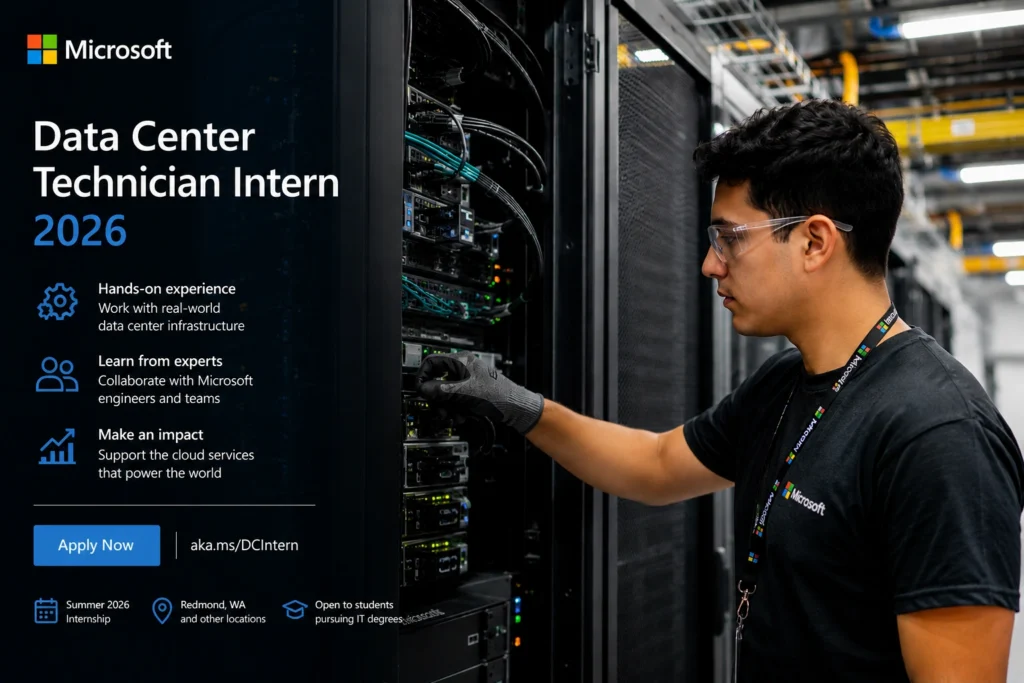

Just after sunrise in Johannesburg, a young IT student badges into a secure building packed with humming servers, blinking network lights, and rows of carefully cooled equipment. On the surface, it looks like a warehouse of machines. But inside that building sits part of the digital backbone powering millions of emails, online meetings, cloud applications, gaming services, and business systems around the world.
For many South African students and graduates, that kind of environment once felt distant — something associated with Silicon Valley or overseas tech hubs. But opportunities like the Microsoft Data Center Technician Intern 2026 are changing that perception. They are bringing global cloud infrastructure careers closer to home, while also exposing local youth to one of the fastest-growing technical sectors in the modern economy.
Microsoft’s latest internship intake for Johannesburg and Cape Town arrives at a time when cloud computing is no longer a niche part of the IT industry. It has become the infrastructure behind banking apps, government systems, streaming services, retail platforms, artificial intelligence tools, and remote work technologies. Behind every cloud service is a physical data center staffed by technicians who keep those systems operational around the clock.
For unemployed graduates and students trying to break into technology careers, this internship represents more than workplace exposure. It reflects how the nature of entry-level IT work is evolving in South Africa.
Why the Microsoft Data Center Technician Intern 2026 matters now
South Africa’s youth unemployment crisis has pushed many students toward technology qualifications in hopes of securing stable careers. Yet one of the biggest frustrations among graduates remains the same: employers want practical experience, even for junior roles.
That gap between theory and hands-on exposure is exactly where internships like this become important.
Microsoft’s Cloud Operations & Innovation division, often called CO+I, manages the infrastructure that powers services such as Microsoft Azure, Office 365, Xbox, Bing, and OneDrive. While users interact with these services digitally, the systems rely on massive physical environments that require constant maintenance, monitoring, troubleshooting, and upgrades.
The Microsoft Data Center Technician Intern 2026 gives participants direct exposure to those operations. Interns are expected to assist with server installation, network equipment maintenance, troubleshooting tasks, ticket resolution, and operational support activities inside live data center environments.
This is significant because data center work blends several technical disciplines at once. It includes hardware support, networking, infrastructure management, security awareness, operational procedures, and systems reliability. Even a junior technician can gain exposure to enterprise-level environments rarely accessible in classroom settings.
In practical terms, that means a student who previously only worked on home computers or campus labs may suddenly be learning how global cloud infrastructure is maintained at scale.
A career path many students overlook
When South African students think about IT careers, software development usually dominates the conversation. Coding bootcamps, app development, and cybersecurity attract attention because they appear more visible online.
But infrastructure careers are quietly becoming equally important.
Data centers require technicians who can physically install servers, replace failing components, monitor connectivity, manage cables, and support operational continuity. As cloud services expand globally, the demand for these skills continues to grow.
What makes this internship particularly interesting is that Microsoft is not only targeting graduates with advanced experience. The programme also welcomes students pursuing technical qualifications who demonstrate curiosity, willingness to learn, and foundational hardware knowledge.
The minimum requirements are relatively accessible compared to some high-level tech internships:
- Grade 12 or equivalent qualification
- Minimum age of 18
- Basic understanding of computer hardware
- Interest in IT equipment and technology
- South African citizenship or valid legal residency
Preferred certifications such as CompTIA A+, Server+, Network+, or structured cabling training may strengthen applications, but they are not strict barriers for entry.
That matters in a country where many talented young people learn technical skills informally through community colleges, online platforms, repair shops, or self-study environments.
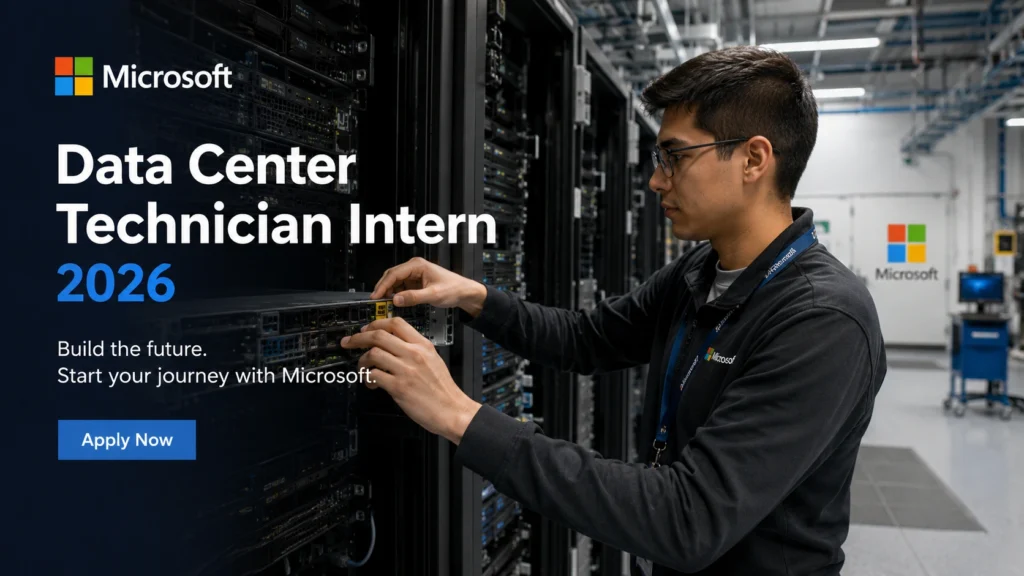
Johannesburg and Cape Town are becoming strategic tech infrastructure hubs
The internship locations themselves tell an important story.
Both Johannesburg and Cape Town have increasingly become focal points for digital infrastructure investment. Cloud providers, telecommunications companies, fintech businesses, and enterprise platforms are all expanding their presence in South Africa as internet usage and cloud adoption accelerate across the continent.
Johannesburg remains the country’s commercial and financial center, making it a natural location for enterprise cloud infrastructure. Cape Town, meanwhile, continues to grow as a technology and startup ecosystem with strong connectivity links and expanding digital services demand.
The growth of local data infrastructure has broader economic implications too. As more organizations move services into cloud environments, there is rising demand for technicians who understand physical infrastructure operations — not only software systems.
APPLY HERE: Microsoft Data Center Technician Intern 2026- Cape Town
APPLY HERE: Microsoft Data Center Technician Intern 2026-Johannesburg
This creates opportunities for students who may not necessarily want to become programmers but still want long-term careers in technology.
ALSO APPLY FOR: Deloitte InfinityX Graduate Intern 2026
The reality of working inside a data center
Popular culture often portrays tech work as glamorous office environments filled with brainstorming sessions and trendy workspaces. Data center operations are different.
The work can be physically demanding. Technicians spend time standing, lifting equipment, tracing cables, replacing hardware, and following strict safety procedures. Environments are highly structured because operational downtime can affect thousands or even millions of users.
Microsoft’s internship listing specifically highlights the need for flexibility around shifts, weekends, and public holidays. That reflects the reality that cloud infrastructure never truly “closes.” Servers run continuously, and operational teams must support that continuity.
For the right candidates, however, this environment can become an excellent learning platform.
Interns may gain exposure to:
- Hardware lifecycle management
- Server deployment procedures
- Network equipment troubleshooting
- Safety and compliance systems
- Operational ticketing platforms
- Incident escalation processes
- Team-based infrastructure management
These are transferable skills that extend beyond one company. Experience inside enterprise infrastructure environments can support future careers in cloud operations, systems administration, networking, cybersecurity, technical support, and infrastructure engineering.
An expert-style insight: why infrastructure skills are becoming future-proof
One overlooked trend in the global technology sector is that artificial intelligence, cloud computing, and digital services all depend on physical infrastructure growth.
As companies race to expand AI tools and cloud platforms, demand for reliable data center operations increases alongside it. That means infrastructure technicians are becoming part of a larger ecosystem supporting the digital economy.
In South Africa, this could become especially important over the next decade. Local businesses are modernizing operations, banks are expanding digital platforms, streaming consumption continues rising, and government services are gradually moving online.
All of these systems require backend infrastructure support.
While entry-level software jobs often attract intense competition, infrastructure pathways sometimes offer more accessible entry points for technically minded candidates willing to work in operational environments.
The Microsoft Data Center Technician Intern 2026 reflects this shift. It signals that cloud infrastructure careers are no longer distant global opportunities — they are becoming part of the local employment landscape.
What makes Microsoft internships particularly competitive
Brand recognition matters.
For many applicants, the chance to work within Microsoft infrastructure immediately strengthens a CV. Even short-term exposure to enterprise systems can improve future employability because recruiters often value candidates who understand corporate operational standards.
But that also means competition for these positions is likely to be intense.
Applicants who stand out are usually those who demonstrate initiative beyond academic qualifications alone. Practical projects, home labs, networking basics, hardware repair experience, or entry-level certifications can all strengthen an application.
Communication skills also matter more than many candidates realize. Data center environments rely heavily on teamwork, documentation, escalation procedures, and operational discipline. Technical ability alone is rarely enough.
The internship’s emphasis on safety briefings, incident reporting, and policy compliance highlights that Microsoft wants candidates who can operate responsibly inside mission-critical environments.
A shift in how young South Africans view tech careers
There is also a cultural shift happening around technology employment.
A decade ago, many young South Africans associated IT careers primarily with office support roles or software coding. Today, the sector includes cloud infrastructure, AI systems, cybersecurity operations, digital logistics, platform engineering, and network operations.
Internships like this expose students to parts of the tech industry that are often invisible to ordinary users.
Most people never think about the physical systems behind cloud storage or streaming platforms. Yet entire career ecosystems exist around maintaining those environments.
For students from under-resourced backgrounds, access to such environments can be transformative. It introduces international operational standards, structured technical processes, and exposure to enterprise-scale technology systems that may otherwise feel inaccessible.
Frequently Asked Questions
Who can apply for the Microsoft Data Center Technician Intern 2026?
South African students or graduates who are at least 18 years old, hold a Grade 12 qualification, and have an interest in computer hardware or infrastructure technology can apply. Candidates studying toward relevant technical qualifications may have an advantage.
Are certifications required for the internship?
No. Certifications such as CompTIA A+, Server+, Network+, or structured cabling are preferred but not mandatory. Applicants with practical knowledge and strong learning potential may still be considered.
Where will the internship take place?
The internship opportunities are available in Johannesburg and Cape Town.
The bigger picture behind the opportunity
The Microsoft Data Center Technician Intern 2026 is not simply another internship advertisement in a crowded graduate market. It reflects how South Africa’s role in the global digital economy is changing.
Cloud infrastructure is expanding. Enterprise technology systems are becoming more localized. International companies are investing in operational capacity across Africa. And alongside those investments comes demand for technically skilled young professionals who can support complex digital environments.
For students and graduates willing to enter infrastructure-focused careers, opportunities like this may offer something increasingly valuable: practical exposure to the systems quietly powering the modern economy.
Not every successful tech career begins with software development or flashy startup culture. Some begin inside carefully controlled server halls, where technicians learn how to keep the digital world running minute by minute.
And for a growing number of South Africans, that path is becoming far more realistic than it once seemed.