

The job market is changing faster than many people expected. Advances in artificial intelligence, automation, robotics, self-service technology, and digital platforms are transforming industries around the world. For workers, this creates a difficult challenge: some careers that once offered stability are shrinking, while entirely new opportunities are emerging.
Many people are asking the same question: Will my job still exist in five or ten years? The concern is understandable. Businesses are constantly looking for ways to improve efficiency, reduce costs, and automate repetitive tasks. As a result, certain roles are becoming less common every year.
Understanding Jobs That Are Disappearing Fast is no longer just interesting career information—it is essential knowledge for anyone who wants long-term employment security. The good news is that disappearing jobs do not automatically mean fewer opportunities. Workers who adapt, learn new skills, and stay informed can position themselves for growing industries and future careers.
This guide explains which jobs are declining, why it is happening, and what practical steps you can take to protect your career.
Understanding Jobs That Are Disappearing Fast
When people hear about disappearing jobs, they often imagine entire professions vanishing overnight. In reality, the process is usually gradual.
A job disappears when technology, changing consumer behavior, or new business models reduce the need for human workers in that role. Some positions become fully automated, while others evolve into more specialized versions requiring different skills.
Several factors are driving this trend:
- Artificial intelligence and machine learning
- Automation of routine tasks
- Digital transformation across industries
- Online shopping and e-commerce growth
- Self-service technology
- Remote work tools
- Advanced robotics and manufacturing systems
The key issue is not that technology replaces all workers. Instead, technology often replaces repetitive, predictable, and rule-based tasks.
ALSO APPLY FOR: Senwes Apprenticeships 2026
ALSO APPLY FOR: Komatsu Apprenticeship 2026
Jobs That Are Disappearing Fast in Today’s Economy
While no prediction is perfect, experts consistently identify several occupations facing significant decline.
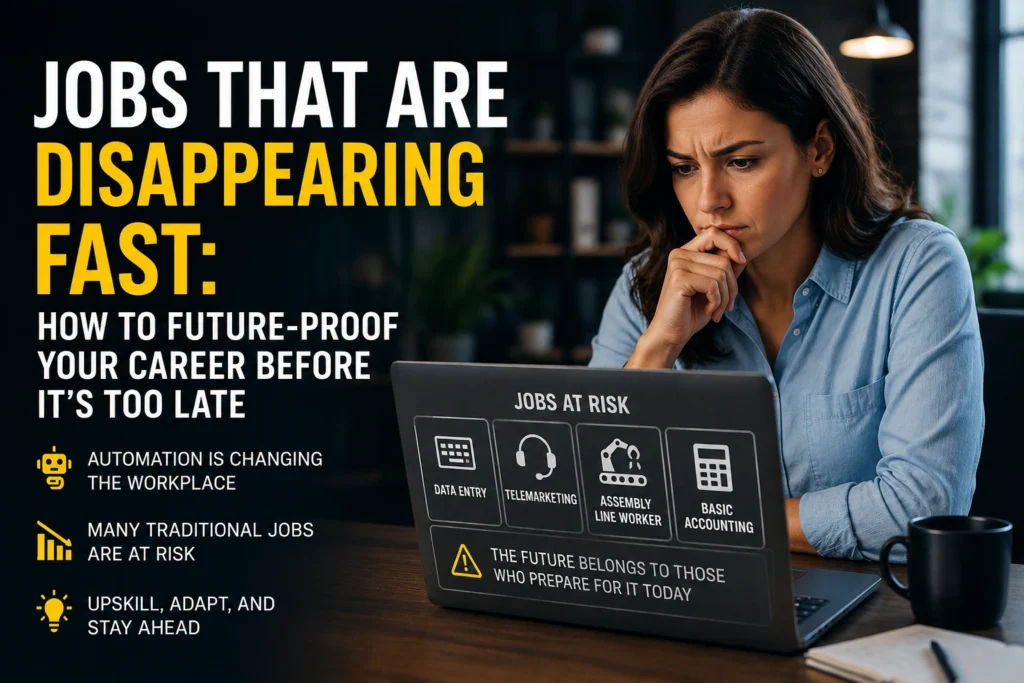
1. Data Entry Clerks
Data entry was once a common entry-level office job. Today, software can automatically collect, organize, and process information with minimal human involvement.
AI-powered systems can:
- Extract information from documents
- Process invoices
- Update databases
- Handle routine recordkeeping
This reduces the need for large teams of data entry workers.
2. Cashiers
Self-checkout systems and digital payment technology continue to expand.
Many retailers now allow customers to:
- Scan their own purchases
- Use mobile payment apps
- Order online
- Use automated kiosks
Although cashiers will not disappear entirely, demand is declining in many sectors.
3. Bank Tellers
Online banking, mobile apps, and digital financial services have dramatically reduced visits to physical branches.
Customers can now:
- Transfer funds
- Deposit checks
- Apply for loans
- Pay bills
As digital banking grows, fewer teller positions are required.
4. Travel Agents
Consumers increasingly book flights, hotels, and tours directly through websites and apps.
While specialized travel consultants still exist, traditional travel agency roles have declined significantly due to online booking platforms.
5. Postal Sorting Workers
Automated sorting machines handle large volumes of mail far faster than manual processes.
At the same time, digital communication continues to reduce traditional mail volumes.
6. Assembly Line Workers
Manufacturing companies increasingly rely on robotics for repetitive production tasks.
Modern robots can:
- Assemble products
- Weld components
- Package goods
- Perform quality inspections
This trend reduces demand for some traditional factory roles.
7. Telemarketers
AI chatbots, automated calling systems, and digital marketing tools have replaced many telemarketing functions.
Companies now use:
- Email marketing
- Social media advertising
- AI-driven customer outreach
- Automated sales funnels
As a result, telemarketing opportunities continue to shrink.
8. Basic Customer Service Representatives
Many routine customer service interactions are now handled through:
- AI chatbots
- Virtual assistants
- Self-service portals
- Automated help centers
Human agents remain important for complex cases, but basic support roles face increasing automation.
Why This Issue Matters
The discussion around Jobs That Are Disappearing Fast affects more than individual workers.
Impact on Individuals
Workers in declining occupations may face:
- Reduced job opportunities
- Lower wage growth
- Increased competition
- Career uncertainty
- Skills becoming outdated
Without preparation, transitioning into a new field can become difficult.
Impact on Businesses
Companies benefit from automation through:
- Lower operating costs
- Improved efficiency
- Faster service delivery
- Reduced errors
However, businesses also need workers with advanced technical, analytical, and interpersonal skills.
Impact on Society
Large-scale job shifts influence:
- Economic growth
- Education systems
- Workforce development
- Income distribution
- Employment policies
Countries that invest in reskilling workers are often better positioned for long-term economic success.
Industries Creating New Opportunities
While some jobs disappear, many others are expanding.
The future job market increasingly rewards skills that machines struggle to replicate.
Growing fields include:
Healthcare
Demand continues rising for:
- Nurses
- Healthcare technicians
- Therapists
- Caregivers
- Medical specialists
An aging population and growing healthcare needs support long-term growth.
Technology
Technology careers remain among the fastest-growing opportunities.
Examples include:
- Software development
- Cybersecurity
- Cloud computing
- Data science
- AI development
Renewable Energy
As countries invest in sustainability, demand increases for workers involved in:
- Solar energy
- Wind power
- Energy efficiency
- Environmental management
Skilled Trades
Many skilled trades remain difficult to automate.
Examples include:
- Electricians
- Plumbers
- Welders
- HVAC technicians
- Construction specialists
These careers often offer strong earnings and steady demand.
Education and Training
As technology changes workplaces, organizations need trainers and educators to help employees develop new skills.
ALSO READ ABOUT: Is Studying IT Still Worth It in South Africa?
How to Protect Yourself From Job Disruption
The best response to disappearing jobs is preparation.
Step 1: Assess Your Current Role
Ask yourself:
- Which parts of my job are repetitive?
- Could software perform these tasks?
- Is automation already being introduced in my workplace?
Understanding your risk level helps you plan effectively.
Step 2: Learn New Skills Continuously
Lifelong learning has become essential.
Focus on skills such as:
- Digital literacy
- Data analysis
- Communication
- Project management
- Problem-solving
- AI tools
- Leadership
Even small improvements can increase career resilience.
Step 3: Develop Human-Centered Skills
Machines excel at repetitive work but struggle with:
- Creativity
- Emotional intelligence
- Complex decision-making
- Negotiation
- Relationship building
These abilities are becoming increasingly valuable.
Step 4: Build Technology Awareness
You do not need to become a programmer to benefit from technology.
Understanding how AI, automation, and digital tools affect your industry can help you identify future opportunities before others do.
Step 5: Expand Your Professional Network
Strong professional networks often lead to:
- Job referrals
- Mentorship opportunities
- Industry insights
- Career transitions
Attend industry events, connect online, and maintain relationships with colleagues.
Step 6: Consider Career Pivot Opportunities
If your industry faces significant disruption, explore adjacent careers where your existing skills remain valuable.
For example:
- A bank teller could move into customer relationship management.
- A data entry clerk could transition into administrative coordination.
- A customer service representative could develop expertise in customer success management.
Best Practices Experts Recommend
Career experts consistently suggest several strategies for staying employable in a changing economy.
Focus on Skills Rather Than Job Titles
Specific job titles may disappear, but transferable skills remain valuable.
Instead of identifying solely as a cashier or teller, think about your skills in:
- Customer service
- Sales
- Problem resolution
- Communication
These abilities can transfer across industries.
Follow Industry Trends
Monitor developments in your sector regularly.
Look for signs such as:
- Increased automation
- New software adoption
- Changing customer expectations
- Emerging regulations
Early awareness provides more time to adapt.
Invest in Certifications
Short professional certifications can often improve employability faster than lengthy degree programs.
Many employers value practical, job-ready skills.
Become Comfortable With AI
Workers who use AI effectively may gain advantages over those who avoid it.
Learn how AI can:
- Improve productivity
- Automate routine work
- Support decision-making
- Enhance professional performance
Maintain a Growth Mindset
The most successful professionals view change as an opportunity rather than a threat.
Adaptability is becoming one of the most important career skills.
Mistakes People Often Make
Many workers underestimate how quickly industries can change.
Here are common mistakes to avoid.
Ignoring Warning Signs
People often assume their industry will remain stable indefinitely.
Waiting until layoffs occur can limit available options.
Refusing to Learn New Technology
Avoiding technology rarely protects jobs.
Workers who understand new tools are often better positioned for promotions and transitions.
Depending on One Skill
Relying on a single specialized skill increases career risk.
Diversifying your abilities creates greater flexibility.
Waiting for Employers to Provide Training
Many organizations offer training, but personal responsibility for learning is increasingly important.
Successful workers often invest in their own development.
Assuming Education Ends After Graduation
Modern careers require continuous learning.
Skills that were valuable five years ago may not be enough today.
The Future of Work: Adaptation Over Fear
The future workplace will likely involve humans and technology working together rather than competing directly.
Automation removes certain tasks, but it also creates new needs.
For example:
- AI requires developers and trainers.
- Automated systems require maintenance specialists.
- Digital businesses require cybersecurity experts.
- Technology companies need human-centered designers and managers.
History shows that technological change often eliminates some jobs while creating others. The challenge is preparing for those changes before they happen.
Frequently Asked Questions
Which jobs are most at risk from automation?
Jobs involving repetitive, predictable tasks are generally most vulnerable. Examples include data entry, telemarketing, basic bookkeeping, cashier positions, and routine administrative work.
Will AI replace all human jobs?
No. AI is likely to automate specific tasks rather than eliminate all work. Careers requiring creativity, empathy, leadership, and complex judgment remain difficult to automate fully.
How can I tell if my job is at risk?
Look for increasing use of automation, AI software, robotics, self-service technology, or digital platforms performing tasks that humans previously handled.
What skills are safest for the future?
Skills that combine technical knowledge with human abilities tend to be strongest. These include communication, leadership, problem-solving, adaptability, critical thinking, and digital literacy.
Summary and Practical Advice
Understanding Jobs That Are Disappearing Fast is essential for anyone planning a long-term career. Technology, automation, and artificial intelligence are reshaping workplaces across nearly every industry. Roles involving repetitive and predictable tasks face the greatest risk, while careers requiring creativity, human interaction, technical expertise, and problem-solving continue to grow.
The most practical approach is not to fear change but to prepare for it. Assess your current role, identify potential risks, learn new skills regularly, embrace technology, and build transferable abilities that remain valuable across industries.
Workers who stay curious, adaptable, and proactive will be far better positioned to succeed in the future job market than those who wait for change to happen around them.
ALSO APPLY FOR: Senwes Apprenticeships 2026
ALSO APPLY FOR: Komatsu Apprenticeship 2026
ALSO READ ABOUT: Is Studying IT Still Worth It in South Africa?