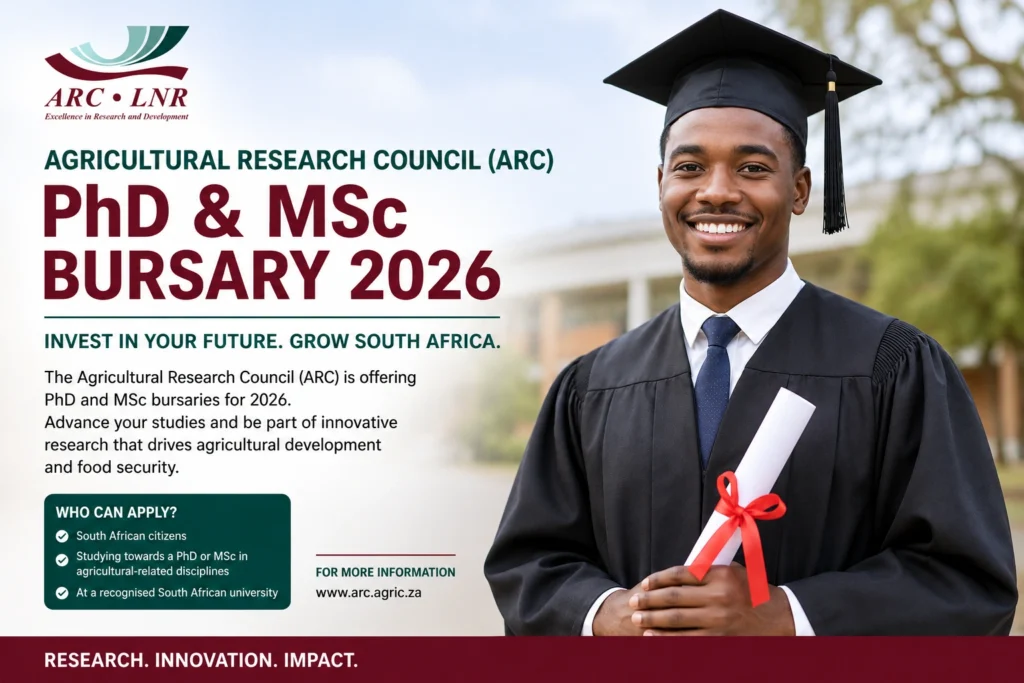

The Agricultural Research Council (ARC) PhD and MSc Bursary 2026 offers an exciting opportunity for postgraduate students who want to build careers in agricultural research, sustainable farming, water management, and agroecology. As agriculture faces growing challenges such as climate change, water scarcity, food security concerns, and environmental degradation, the need for skilled researchers has never been greater.
For students interested in solving real-world agricultural problems through science and innovation, these bursaries provide more than financial support. They offer practical research experience, professional development, access to leading experts, and the opportunity to contribute to projects that could influence the future of South African agriculture.
The ARC has announced two MSc bursary positions in Irrigation Water Management and two PhD bursary positions in Agroecology, creating valuable pathways for graduates who wish to advance their academic qualifications while contributing to meaningful research.
What You Should Know First
Before exploring the details, here are the most important facts about the Agricultural Research Council (ARC) PhD and MSc Bursary 2026:
- Two MSc bursaries are available in Irrigation Water Management.
- Two PhD bursaries are available in Agroecology.
- The MSc programme runs for approximately 2–3 years.
- The PhD programme is offered as a 3-year fixed-term contract.
- Research activities involve fieldwork, data analysis, stakeholder engagement, and scientific publication.
- MSc positions are based in Silverton.
- PhD positions are based in Pretoria.
- The MSc application deadline is 3 June 2026.
- The PhD application deadline is 12 June 2026.
- Applicants must demonstrate strong academic performance and research potential.
These opportunities are designed for students who are serious about pursuing careers in agricultural science, environmental research, and sustainable development.
Understanding the Agricultural Research Council’s Role
The Agricultural Research Council is one of South Africa’s leading agricultural research institutions. Its work supports farmers, policymakers, agricultural businesses, and rural communities through scientific research and innovation.
The ARC conducts studies in areas such as:
- Crop production
- Water management
- Agricultural engineering
- Climate adaptation
- Sustainable farming
- Livestock systems
- Soil health
- Food security
By funding postgraduate research, the ARC helps develop the next generation of agricultural scientists who can address complex challenges affecting food production and natural resource management.
MSc Bursary in Irrigation Water Management Explained
What Is Irrigation Water Management?
Irrigation Water Management focuses on the efficient use of water in agriculture. Since water is one of the most important resources in farming, researchers work to improve irrigation systems, reduce waste, and increase crop productivity.
In South Africa, where many regions experience drought conditions and water shortages, effective irrigation management is critical for sustainable agriculture.
The ARC’s MSc bursary programme supports research that helps farmers use water more efficiently while maintaining agricultural output.
What Research Will MSc Students Conduct?
Successful MSc candidates will participate in projects related to:
- Agricultural water use efficiency
- Irrigation system performance
- Water conservation strategies
- Agricultural infrastructure development
- Data collection and analysis
- Scientific reporting
For example, a student may investigate how different irrigation technologies affect crop yields under varying climate conditions. Another project might analyse water losses in irrigation networks and recommend improvements.
Skills Developed During the MSc Programme
Students can expect to strengthen skills in:
- Research methodology
- Statistical analysis
- Technical report writing
- Agricultural engineering concepts
- Problem-solving
- Field data collection
- Stakeholder engagement
These skills are highly valuable across research institutions, government agencies, consulting firms, and agricultural businesses.
PhD Bursary in Agroecology Explained
What Is Agroecology?
Agroecology is an approach to agriculture that combines ecological principles with farming practices. It focuses on creating productive agricultural systems while protecting the environment and supporting communities.
Rather than relying solely on external inputs, agroecology emphasizes:
- Biodiversity
- Soil health
- Natural resource conservation
- Sustainable farming systems
- Resilient food production
As climate change increasingly affects agricultural production worldwide, agroecology has become an important research field.
What Will PhD Students Research?
The ARC PhD programme focuses on:
- Sustainable farming systems
- Alternative agricultural systems
- Agroecological practices
- Regenerative agriculture
- Agri-food systems
- Environmental sustainability
Researchers may evaluate how regenerative farming techniques improve soil quality, study biodiversity in agricultural landscapes, or assess sustainable food production strategies.
Why Agroecology Matters
Modern agriculture faces several challenges:
- Declining soil fertility
- Water shortages
- Rising production costs
- Climate variability
- Environmental degradation
Agroecological research helps identify solutions that balance productivity with sustainability, making it a growing field with increasing global relevance.
Eligibility Requirements for the Agricultural Research Council (ARC) PhD and MSc Bursary 2026
Understanding the requirements is essential before applying.
MSc Eligibility Requirements
Applicants must possess:
- A BSc degree in Agricultural Engineering, or
- A related undergraduate qualification emphasizing agricultural or irrigation water management
- Strong academic performance
- Good communication skills
- Willingness to travel to farming communities and remote areas
Research projects often require field visits, making flexibility and adaptability important qualities.
PhD Eligibility Requirements
Applicants must have:
- An MSc degree in Agriculture, Agroecology, Environmental Sciences, or a related quantitative field
- Strong academic records
- Statistical and data analysis skills
- Good communication abilities
- Ability to work in multidisciplinary teams
- A valid Code 08 or EB driver’s licence
- Willingness to travel when necessary
Additional advantages include:
- Experience in interdisciplinary research
- Knowledge of regenerative agriculture
- Familiarity with sustainable farming systems
Why These Research Opportunities Are Important
Agriculture is rapidly evolving due to technological advances and environmental pressures. Researchers are increasingly needed to help governments, farmers, and industries make informed decisions.
The ARC bursaries support research in areas directly linked to national development priorities, including:
Food Security
Growing populations require reliable food production systems. Research helps improve yields while conserving resources.
Water Sustainability
Water scarcity remains a major challenge in South Africa. Irrigation research supports more efficient agricultural water use.
Climate Change Adaptation
Scientists are developing farming practices that help producers adapt to changing weather patterns and environmental conditions.
Rural Development
Research findings often contribute to improved livelihoods and economic opportunities in rural communities.
Step-by-Step Guide to Applying Successfully
Applying for a competitive research bursary requires preparation.
Step 1: Review the Requirements Carefully
Ensure your qualifications match the specific programme.
APPLY HERE: (ARC) PhD Bursary 2026
APPLY HERE: (ARC) MSc Bursary 2026
Do not assume related qualifications automatically qualify. Compare your academic background with the advertised requirements.
Step 2: Prepare a Strong Curriculum Vitae
Your CV should include:
- Educational qualifications
- Research experience
- Technical skills
- Publications (if applicable)
- Awards and achievements
- Relevant projects
A well-organized CV helps reviewers quickly assess your suitability.
Step 3: Write a Targeted Cover Letter
Many applicants make the mistake of submitting generic cover letters.
Instead:
For MSc Applicants
Highlight:
- Irrigation knowledge
- Agricultural engineering experience
- Data analysis skills
- Fieldwork experience
For PhD Applicants
Focus on:
- Agroecology knowledge
- Sustainable agriculture research
- Statistical analysis abilities
- Academic publications
- Research achievements
Demonstrating alignment with the research area significantly strengthens your application.
Step 4: Gather Supporting Documents
Prepare:
- Certified academic certificates
- Certified transcripts
- Updated CV
- Cover letter
- Driver’s licence copy (where required)
- Referee contact details
- SAQA evaluation report for foreign qualifications
Ensure all documents are clear and legible.
Step 5: Submit Before the Deadline
Avoid waiting until the final day.
Technical issues, internet problems, or missing documents can delay submission.
Submitting early also demonstrates professionalism and planning skills.
ALSO APPLY FOR: Exxaro Bursaries 2026
Common Misunderstandings About Agricultural Research Council (ARC) PhD and MSc Bursary 2026
Many applicants misunderstand how research bursaries work. Here are some common misconceptions.
Misunderstanding 1: Only Agricultural Engineering Students Can Apply
This is not entirely true.
While specific qualifications are required, related disciplines with relevant agricultural, environmental, or quantitative backgrounds may also be considered depending on programme requirements.
Misunderstanding 2: Research Means Working Only in a Laboratory
Agricultural research often involves:
- Field visits
- Farmer engagement
- Data collection
- Community interaction
- Environmental monitoring
Many projects require extensive work outside traditional laboratory settings.
Misunderstanding 3: A PhD Is Only for Academic Careers
Although many PhD graduates enter academia, others work in:
- Government departments
- Research councils
- Agricultural consulting
- Environmental management
- International development organizations
- Private agricultural companies
Research skills are increasingly valued across multiple sectors.
Misunderstanding 4: Good Grades Alone Guarantee Success
Academic performance matters, but selection committees also evaluate:
- Research potential
- Communication skills
- Motivation
- Relevant experience
- Alignment with project goals
A strong overall application is more important than grades alone.
Best Strategies for Standing Out as an Applicant
Competition for postgraduate research opportunities can be strong.
To improve your chances:
- Demonstrate genuine interest in the research area.
- Show familiarity with current agricultural challenges.
- Highlight relevant technical and analytical skills.
- Explain how the bursary aligns with your career goals.
- Provide professional referees who know your academic work.
- Proofread all documents carefully.
Applicants who clearly connect their experience to the project objectives often stand out during evaluation.
Career Opportunities After Completing These Programmes
Graduates who complete these research programmes may pursue careers in:
- Agricultural research institutions
- Universities
- Government agricultural departments
- Water resource management agencies
- Environmental consulting firms
- Agricultural technology companies
- Development organizations
- Policy and advisory roles
The combination of advanced qualifications and practical research experience can significantly improve long-term career prospects.
Key Takeaways
- The Agricultural Research Council (ARC) PhD and MSc Bursary 2026 offers two MSc and two PhD research opportunities.
- MSc students will focus on Irrigation Water Management.
- PhD students will focus on Agroecology and sustainable farming systems.
- Research includes fieldwork, data analysis, scientific writing, and stakeholder engagement.
- MSc applicants need a relevant undergraduate qualification.
- PhD applicants need an MSc qualification in a related field.
- Strong academic performance and research potential are essential.
- Application deadlines are 3 June 2026 for MSc positions and 12 June 2026 for PhD positions.
- These bursaries provide valuable experience in addressing real agricultural challenges.
Frequently Asked Questions
1. Is the Agricultural Research Council (ARC) PhD and MSc Bursary 2026 only for South African citizens?
Applicants should consult the official ARC recruitment information for specific citizenship requirements. Eligibility conditions may vary depending on funding arrangements and project requirements.
2. Do applicants need previous research experience?
Previous research experience is beneficial but not always mandatory. Strong academic performance and demonstrated interest in the research field are often important factors.
3. Will students be required to conduct fieldwork?
Yes. Both MSc and PhD candidates may travel to farming communities and research sites for data collection and stakeholder engagement activities.
4. What research skills can students gain through these bursaries?
Students can develop skills in data analysis, scientific writing, project management, research design, stakeholder engagement, fieldwork planning, and publication preparation.
Final Thoughts
The Agricultural Research Council (ARC) PhD and MSc Bursary 2026 provides an excellent opportunity for postgraduate students who want to contribute to the future of agriculture through research and innovation. Whether your interest lies in irrigation water management or agroecology, these programmes offer hands-on experience, advanced academic development, and exposure to some of the most important challenges facing modern farming.
For motivated graduates seeking a pathway into agricultural research, environmental sustainability, and scientific leadership, these ARC bursaries represent a valuable step toward bu