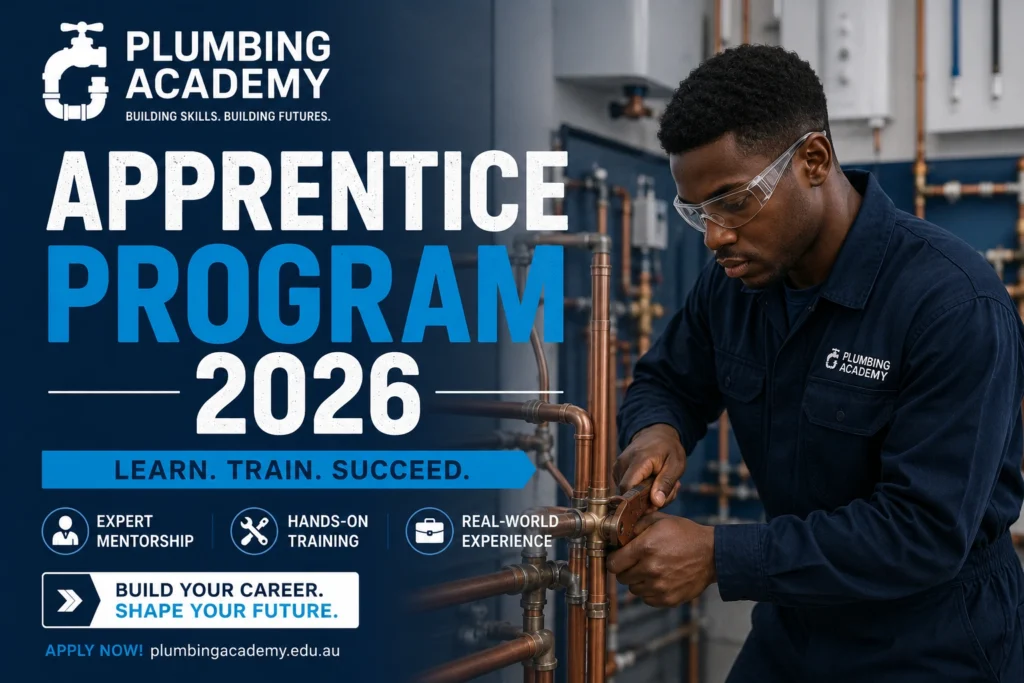

The Plumbing Academy Apprentice Program 2026 is attracting growing interest among young South Africans at a time when many traditional career paths are facing increasing uncertainty.
While university graduates continue to compete in a challenging job market, skilled trades are quietly experiencing a resurgence. Employers across construction, infrastructure, maintenance, and property development are reporting shortages of qualified artisans. Among those scarce skills, plumbing stands out as one of the most resilient and internationally transferable professions available today.
That shift helps explain why apprenticeship opportunities are generating renewed attention in 2026. The Plumbing Academy’s structured training pathway offers something many young people are actively searching for: a direct route into a recognised profession, practical work experience, and the possibility of earning while learning.
In a country where youth unemployment remains one of the most pressing economic challenges, programmes that connect training directly to workplace experience are increasingly viewed as part of the solution.
The Bigger Story Behind the Rise of Skilled Trades
For years, South African career guidance has largely focused on university qualifications as the primary route to success.
However, labour market realities have gradually challenged that assumption.
Employers consistently report shortages of electricians, plumbers, welders, fitters, millwrights, and other technical professionals. Large infrastructure projects, housing developments, industrial facilities, and municipal services all depend on these skills.
At the same time, many young people have begun reconsidering what career success looks like.
Rather than spending years studying without a clear employment pathway, some are choosing careers that offer immediate workplace exposure and practical experience. Plumbing fits neatly into that trend.
The profession combines technical knowledge with hands-on problem-solving. Every building requires water supply systems, drainage networks, maintenance, repairs, and compliance with safety standards. These needs do not disappear during economic downturns.
That reality is one reason why the Plumbing Academy Apprentice Program 2026 is attracting attention from school leavers, job seekers, and even individuals looking to change careers.
How the Plumbing Academy Developed Its Training Model
The academy was established in Port Shepstone, KwaZulu-Natal, by plumbing industry veterans Karmen and Mehan Sewpersadh.
Their objective was not simply to train plumbers but to address a wider skills shortage affecting the industry.
Many businesses struggle to find qualified artisans with both technical knowledge and practical experience. Traditional classroom-only training often leaves graduates underprepared for workplace demands.
The academy’s approach attempts to bridge that gap.
Instead of separating theory and practice, the programme integrates both elements throughout the apprenticeship journey.
Students receive formal instruction at the academy while simultaneously gaining experience on active job sites under qualified professionals.
This model reflects international apprenticeship systems that have long been used successfully in countries with strong artisan sectors.
What Makes the Plumbing Academy Apprentice Program 2026 Different?
One of the programme’s most appealing features is its structured progression.
The apprenticeship runs over three years, creating a clear development pathway from beginner to qualified artisan.
Each year includes approximately 12 weeks of academy-based learning combined with extensive workplace experience.
This approach means apprentices are not simply sitting in classrooms. They are exposed to real plumbing environments where they learn how systems function outside textbooks.
The programme covers:
- Plumbing fundamentals
- Workplace safety procedures
- Water supply systems
- Drainage installations
- Pipework techniques
- Technical drawing interpretation
- Plumbing regulations
- Installation and maintenance practices
- Customer interaction skills
- Problem-solving techniques
These competencies help apprentices build both technical confidence and professional credibility.
In many respects, employers increasingly value this combination of practical and interpersonal skills.
Why Young South Africans Are Paying Attention
Several factors are driving interest in plumbing careers.
The first is employability.
Unlike some occupations where job opportunities fluctuate dramatically, plumbing remains linked to essential services. Homes, businesses, hospitals, schools, factories, and municipalities all require plumbing expertise.
The second factor is income potential.
Qualified artisans often earn competitive salaries, particularly once they gain experience or specialise in high-demand fields. Experienced plumbers can work as employees, contractors, consultants, or business owners.
The third factor is mobility.
A recognised trade qualification can open opportunities beyond provincial or national boundaries. Many countries continue to experience shortages of skilled tradespeople.
For ambitious young South Africans, that creates additional possibilities.
The Plumbing Academy Apprentice Program 2026 taps directly into these aspirations by providing a recognised route toward artisan status.
Understanding the Eligibility Requirements
One reason the programme appeals to many applicants is that previous plumbing experience is not required.
The apprenticeship is designed to accommodate beginners who demonstrate enthusiasm, discipline, and a willingness to learn.
Applicants are generally expected to:
- Be South African citizens
- Fall within the target youth age range
- Show interest in practical work
- Demonstrate commitment and reliability
- Be able to travel to Port Shepstone for academy training
- Be prepared to participate in workplace learning
This accessibility is particularly significant because many young people struggle to gain experience when employers demand prior experience before hiring.
Apprenticeships help break that cycle.
The Value of Learning Through Real Work
One of the strongest arguments in favour of apprenticeship programmes is the workplace experience component.
Many educational programmes focus heavily on theoretical knowledge. While theory remains important, employers often place equal value on practical competence.
Working alongside experienced plumbers exposes apprentices to challenges that cannot easily be simulated in a classroom.
They learn how to diagnose faults.
They observe customer interactions.
They develop troubleshooting skills.
They understand workplace expectations.
These experiences often accelerate professional development.
The Plumbing Academy model recognises that becoming an artisan involves much more than passing examinations.
Recent Developments Fueling Interest in Apprenticeships
Across South Africa, there has been growing emphasis on artisan development and vocational education.
Government agencies, industry bodies, employers, and training providers have increasingly highlighted the importance of technical occupations.
Infrastructure investment, housing projects, water system upgrades, and maintenance backlogs all require skilled workers.
At the same time, conversations about youth unemployment have encouraged greater focus on programmes that lead directly to employment opportunities.
As a result, apprenticeship pathways are receiving renewed attention from policymakers, businesses, and job seekers alike.
The Plumbing Academy Apprentice Program 2026 enters the market during a period when artisan development is being discussed more seriously than it has been for years.
Public Reaction: A Shift in How Careers Are Viewed
Public attitudes toward trades appear to be evolving.
For many years, vocational careers were sometimes perceived as secondary options compared with university education.
That perception is changing.
Parents, educators, and students are increasingly recognising that success can be achieved through multiple pathways.
Social media discussions around apprenticeships frequently highlight the advantages of earning practical experience, avoiding excessive student debt, and entering industries with tangible demand.
Many young people now see artisan careers as entrepreneurial opportunities rather than merely employment options.
Plumbing is particularly attractive because it combines technical expertise with business potential.
A qualified plumber can eventually build an independent client base and establish a successful enterprise.
That entrepreneurial dimension resonates strongly with a generation seeking financial independence.

Why This Matters Right Now
The timing of the Plumbing Academy Apprentice Program 2026 is particularly relevant.
South Africa continues to face significant youth unemployment challenges.
Many school leavers are actively seeking alternatives that offer realistic pathways into the labour market.
At the same time, infrastructure maintenance and development remain national priorities.
Water systems, sanitation networks, residential construction, commercial developments, and industrial facilities all depend on qualified plumbers.
The demand for these services is unlikely to disappear.
For young people evaluating career options in 2026, plumbing represents a profession connected to essential services and long-term demand.
That combination makes the programme especially relevant in today’s economic environment.
APPLY HERE: Plumbing Academy Apprentice Program 2026
ALSO APPLY FOR: Harsco Rail Apprentice 2026
Career Opportunities After Qualification
Completing the apprenticeship can lead to several professional pathways.
Some graduates may choose traditional employment with plumbing companies.
Others may pursue specialist areas such as:
- Solar water heating systems
- Gas installations
- Fire protection systems
- Commercial plumbing
- Industrial maintenance
- Water efficiency solutions
There is also the possibility of entrepreneurship.
Many successful plumbing businesses begin with qualified artisans who gradually expand their operations.
With additional certifications and industry registrations, career prospects can broaden even further.
The ability to diversify is one of the profession’s strongest advantages.
The International Opportunity Factor
One aspect frequently discussed within the plumbing sector is international mobility.
Countries such as Australia, Canada, New Zealand, and the United Kingdom have periodically reported shortages of qualified tradespeople.
While immigration requirements vary significantly and opportunities are never guaranteed, internationally recognised artisan qualifications can strengthen employment prospects abroad.
For some apprentices, this possibility serves as additional motivation.
The trade offers skills that are transferable across many markets and industries.
What Could Happen Next?
Looking ahead, several developments could shape the future of programmes like the Plumbing Academy Apprentice Program 2026.
First, demand for artisan training is likely to continue growing if labour shortages persist.
Second, industry partnerships may expand as employers seek reliable talent pipelines.
Third, specialised plumbing fields—including green building technologies, water conservation systems, and renewable energy-related installations—could create new career opportunities.
There is also potential for greater recognition of vocational pathways within broader education and workforce strategies.
If current trends continue, apprenticeships may become an increasingly mainstream career option rather than an alternative pathway.
For young South Africans, that could mean more opportunities to enter skilled professions through practical training routes.
Final Thoughts
The Plumbing Academy Apprentice Program 2026 arrives at a moment when career conversations are changing.
Young people are looking beyond traditional assumptions about education and employment. Employers are searching for practical skills. Industries need qualified artisans. Communities depend on reliable infrastructure and essential services.
Against that backdrop, plumbing is emerging as a profession with strong fundamentals.
The programme offers more than technical training. It provides structured workplace experience, exposure to industry networks, and a pathway toward recognised artisan status.
For individuals who enjoy practical problem-solving, hands-on work, and building tangible skills, the opportunity deserves serious consideration.
Not every career path begins in a lecture hall. Some begin with tools, training, and a willingness to learn a trade that keeps homes, businesses, and entire communities functioning every day.
The growing attention surrounding the Plumbing Academy Apprentice Program 2026 suggests that more South Africans are starting to recognise exactly that.