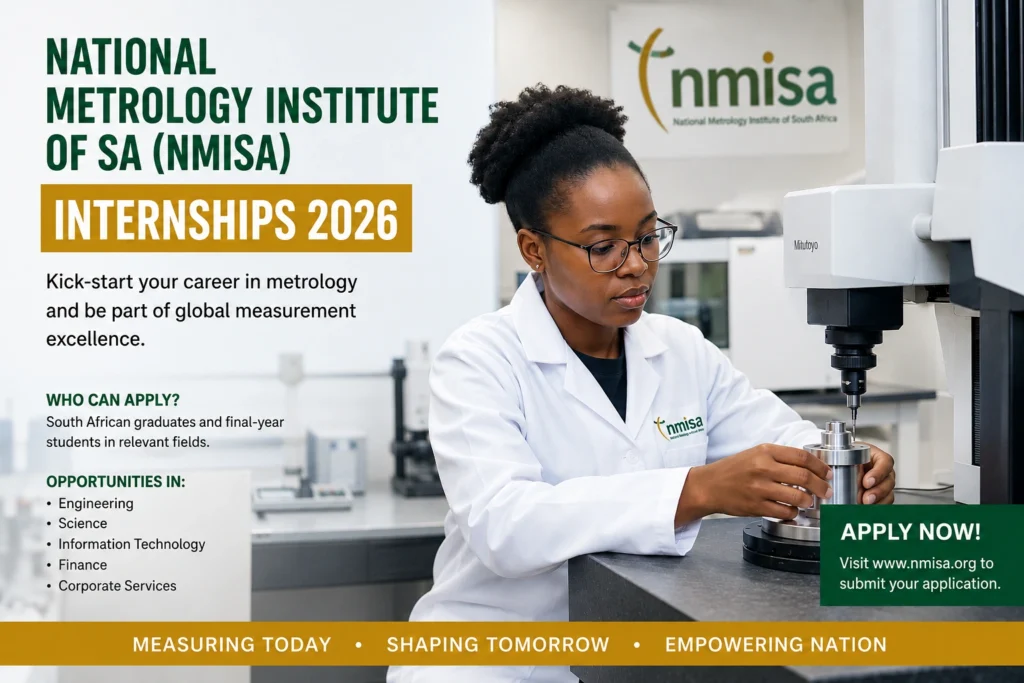

The National Metrology Institute of SA (NMISA) Internships 2026 arrive at a time when graduate employability remains one of South Africa’s most pressing economic challenges. While universities and colleges continue producing qualified graduates across a wide range of disciplines, many young professionals struggle to secure their first meaningful workplace opportunity. The gap between academic achievement and practical experience has become one of the biggest barriers to entering the labour market.
Against this backdrop, NMISA’s newly announced 24-month internship programme offers more than temporary employment. It provides structured workplace exposure inside one of South Africa’s most important scientific and technical institutions. With opportunities spanning logistics, legal compliance, analytical chemistry, and information technology, the programme reflects broader workforce trends that increasingly reward practical skills alongside formal qualifications.
The internship intake, based in Pretoria and offering monthly stipends ranging from R6,758 to R8,878, represents a significant investment in graduate development. More importantly, it highlights how specialised public institutions are becoming critical contributors to skills development and professional training.
Understanding NMISA’s Role in South Africa’s Economy
To understand the value of the National Metrology Institute of SA (NMISA) Internships 2026, it is important to first understand NMISA itself.
NMISA serves as South Africa’s national measurement authority. While the work of metrology may not receive widespread public attention, accurate measurement underpins virtually every sector of the economy. Manufacturing, healthcare, engineering, telecommunications, mining, environmental monitoring, and scientific research all depend on reliable measurement standards.
Without institutions like NMISA, quality assurance systems would be weakened, international trade standards could be compromised, and scientific innovation would face significant obstacles.
This means interns entering the organisation are not simply joining another workplace. They are entering an environment where scientific precision, regulatory compliance, technological innovation, and operational excellence intersect.
For graduates seeking exposure to highly specialised professional environments, this distinction matters.
Many internships focus primarily on administrative work. NMISA’s programme, by contrast, places participants within an institution whose work influences national competitiveness and industrial development.
Why 24-Month Internships Are Becoming More Valuable
One notable feature of the National Metrology Institute of SA (NMISA) Internships 2026 is the duration.
Many internship programmes in South Africa last between six and twelve months. While these shorter placements provide exposure, they often end before graduates gain substantial project experience.
A two-year internship creates a very different learning environment.
Over 24 months, interns typically move beyond introductory tasks and begin contributing to longer-term projects. They gain exposure to annual planning cycles, compliance processes, operational reviews, budgeting periods, and organisational performance assessments.
Employers increasingly favour candidates who can demonstrate sustained workplace experience rather than brief exposure.
Research across labour markets consistently shows that graduates with longer internship histories tend to experience smoother transitions into permanent employment. They develop stronger professional networks, greater confidence, and more evidence of practical competence.
The extended duration offered by NMISA therefore increases the programme’s potential value beyond the immediate stipend.
Participants are likely to leave with a significantly stronger professional portfolio than graduates who have only completed short-term workplace training.
The Four Internship Streams Reflect Key Labour Market Demands
One of the most interesting aspects of the programme is how closely its internship categories align with current labour market priorities.
Rather than concentrating opportunities within a single discipline, NMISA has targeted areas experiencing sustained demand across both public and private sectors.
Logistics and Business Administration
The Outbound Logistics and Administration Assistant Internship reflects the growing importance of supply chain efficiency.
Global disruptions over recent years have highlighted the strategic importance of logistics management. Organisations increasingly require professionals capable of coordinating procurement, inventory management, shipping processes, supplier relationships, and administrative systems.
Graduates entering this internship will gain exposure to operational processes that exist across numerous industries.
The combination of logistics coordination, procurement support, records management, and customer service provides practical experience that remains highly transferable.
This versatility is important because logistics professionals are needed in manufacturing, retail, healthcare, government, mining, and transport sectors.
Legal and Compliance
The Legal and Compliance Internship addresses another rapidly expanding professional field.
Modern organisations operate within increasingly complex regulatory environments. Compliance obligations continue to grow as governments strengthen governance frameworks, data protection requirements, procurement regulations, and accountability standards.
Knowledge areas listed within the programme—including PFMA, POPIA, PAIA, Companies Act requirements, and King IV governance principles—reflect some of South Africa’s most important regulatory frameworks.
For law graduates, exposure to these areas can significantly improve employability.
Many employers today seek legal professionals who understand both traditional legal practice and organisational governance. Compliance expertise has become a valuable specialisation in its own right.
The internship’s emphasis on contract vetting, legal research, policy development, audit preparation, and regulatory reporting aligns closely with skills currently sought by both public institutions and private corporations.
Analytical Chemistry
The Analytical Chemistry Internship may be the most directly linked to NMISA’s scientific mandate.
Scientific graduates often face unique employment challenges despite possessing highly technical qualifications. Employers frequently require laboratory experience that many graduates have not yet had the opportunity to acquire.
This internship addresses that gap directly.
Participants will gain exposure to laboratory testing, equipment calibration, sample preparation, quality management systems, and scientific research support.
These competencies are highly relevant across pharmaceuticals, environmental testing, food production, mining, petrochemicals, manufacturing, and research institutions.
The practical experience gained within a nationally recognised scientific environment may provide a strong foundation for future careers in laboratory science or industrial research.
Information Technology
The IT internships arguably reflect some of the strongest employment trends currently shaping the South African labour market.
Digital transformation remains a priority across virtually every sector.
The programme’s focus on Power BI, data analytics, Active Directory administration, SharePoint support, Microsoft Dynamics 365, network support, and cybersecurity-related functions aligns closely with employer demand.
Importantly, the internship combines technical infrastructure support with data-driven decision-making capabilities.
Employers increasingly seek IT professionals who can bridge the gap between technology operations and business intelligence.
Graduates entering this stream will likely develop skills that remain relevant across both public and private sector organisations.
ALSO VISIT: https://www.nmisa.org
The Stipend Structure Reflects Growing Recognition of Graduate Development
Another noteworthy feature of the National Metrology Institute of SA (NMISA) Internships 2026 is the stipend range.
While internship stipends vary considerably across South Africa, monthly payments between R6,758 and R8,878 position the programme competitively within the graduate development landscape.
Financial support remains a crucial factor in internship accessibility.
Many graduates face significant economic pressure after completing their studies. Transportation costs, accommodation expenses, and family responsibilities often limit participation in lower-paying opportunities.
By providing a structured stipend, NMISA helps reduce some of these barriers.
The financial support also signals that the organisation views interns as contributors rather than simply trainees.
This distinction matters because internship quality often correlates with the level of investment employers make in participant development.
Programmes that allocate meaningful resources to graduate support tend to provide stronger mentoring, clearer learning objectives, and more substantive workplace exposure.
How to Apply
Applicants must submit the following documents:
- Updated CV (PDF format)
- Certified copy of South African ID
- Certified copies of qualifications
- Any additional supporting documents required
Email Applications To: careers@nmisa.org
ALSO APPLY FOR: (SHRA) Internships 2026
Employment Equity and Skills Inclusion Remain Central Themes
The programme also reflects broader national priorities around transformation and inclusion.
NMISA’s emphasis on Employment Equity and encouragement of applications from persons living with disabilities aligns with ongoing efforts to broaden participation within specialised professional and scientific fields.
Historically, access to science, technology, engineering, legal, and technical professions has not always reflected South Africa’s demographic realities.
Graduate development programmes play an important role in addressing this imbalance.
Internships provide entry points into sectors that may otherwise remain difficult to access, particularly for first-generation graduates or individuals without extensive professional networks.
As organisations across the country continue implementing transformation objectives, structured internship programmes increasingly serve as pipelines for future talent development.
This means successful participation can create opportunities extending far beyond the initial training period.
Why Scientific Institutions Are Becoming Important Graduate Employers
An emerging trend in South Africa’s graduate labour market is the growing role of specialised public institutions in workforce development.
Many graduates traditionally focused their job searches on large corporations or government departments.
Today, organisations such as research councils, regulatory bodies, technical institutes, and scientific agencies are becoming increasingly important employers and training providers.
The National Metrology Institute of SA (NMISA) Internships 2026 illustrate this shift.
These institutions often offer unique advantages:
- Exposure to specialised expertise
- Access to highly qualified mentors
- Participation in technically sophisticated projects
- Opportunities to develop niche professional skills
- Experience working within nationally significant programmes
For graduates, these environments can provide distinctive career advantages that are difficult to replicate elsewhere.
A chemistry graduate working within a metrology-focused institution, for example, may gain technical competencies that differentiate them from candidates with more general laboratory experience.
Similarly, IT graduates supporting specialised scientific systems may acquire knowledge applicable to advanced technological environments.
What This Means Going Forward
The broader significance of the National Metrology Institute of SA (NMISA) Internships 2026 extends beyond the immediate vacancies being advertised.
South Africa continues to face a dual challenge: reducing graduate unemployment while simultaneously addressing critical skills shortages.
Programmes like this contribute to solving both problems.
For graduates, the internships provide practical experience, professional mentorship, and exposure to real workplace environments.
For employers, they help develop a pipeline of work-ready professionals equipped with industry-relevant skills.
For the economy, they strengthen the connection between education and employment outcomes.
Looking ahead, demand for professionals in compliance, logistics, analytical science, and information technology is expected to remain strong. Organisations increasingly require workers who can combine technical expertise with practical workplace competence.
This makes experiential learning programmes particularly valuable.
Graduates who successfully complete structured internships often enter the labour market with stronger professional networks, more developed workplace skills, and clearer career direction than peers who struggle to secure practical experience.
The NMISA programme therefore represents more than a temporary training opportunity. It reflects a broader shift toward skills-based employability and workforce readiness.
For graduates seeking to bridge the gap between qualification and career, these internships offer a pathway into sectors that continue to play important roles in South Africa’s economic development.
As competition for graduate opportunities remains intense, programmes that combine long-term training, meaningful workplace exposure, professional mentoring, and nationally recognised institutional experience are likely to remain highly attractive.
The National Metrology Institute of SA has positioned its 2026 internship intake within exactly that category, making it one of the more noteworthy graduate development opportunities currently available in the country.