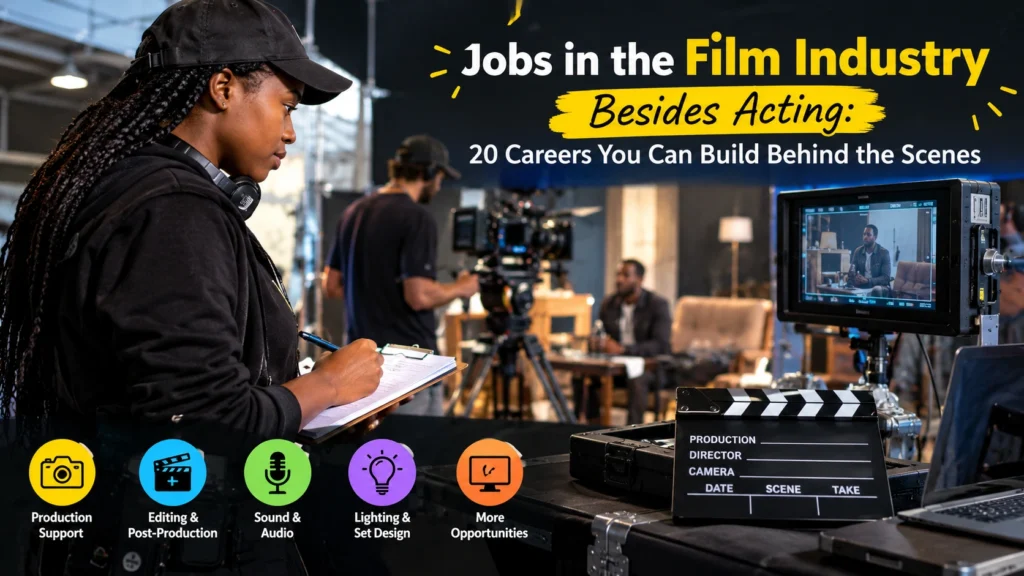

When people hear the words film industry, they often picture actors walking a red carpet, auditioning for roles or appearing in television shows. That narrow image can make aspiring filmmakers believe there are only a few ways to enter the entertainment industry.
But there is a much bigger world happening behind the camera.
Every film, television series, documentary, commercial and streaming production depends on people who write scripts, operate cameras, record sound, manage budgets, design sets, edit footage, organise schedules, create visual effects and market the finished production.
That means Jobs in the Film Industry Besides Acting can offer opportunities for writers, designers, photographers, technology enthusiasts, business graduates, marketers, technicians and highly organised people.
You do not need to be comfortable performing in front of a camera to have a place in film.
In fact, your strongest career opportunity may be in a role that audiences never see.
What Are Jobs in the Film Industry Besides Acting?
Jobs in the film industry cover the entire process of turning an idea into something an audience can watch.
A simplified production journey looks like this:
Idea → Script → Planning → Casting → Filming → Editing → Sound & Visual Effects → Marketing → Distribution
Different professionals become involved at every stage.
For example, a screenwriter develops the story, a producer coordinates the production, a cinematographer creates the visual style, sound professionals capture dialogue, editors assemble the footage and VFX artists add digital elements.
There are also careers outside the actual shoot. Film companies need accountants, lawyers, marketers, administrators, researchers, production coordinators and distribution specialists.
This is important because it means you can enter the industry through skills you already possess.
Quick comparison of film careers
| Career | Main responsibility | Skills that help | Possible entry route |
|---|---|---|---|
| Screenwriter | Develops scripts and stories | Writing, research, storytelling | Short scripts, competitions, independent projects |
| Producer | Coordinates production | Leadership, budgeting, organisation | Production assistant/coordinator |
| Production Assistant | Supports day-to-day production | Reliability, teamwork | Entry-level production work |
| Director | Leads creative vision | Leadership, storytelling | Short films, student productions |
| Cinematographer | Shapes the visual look | Photography, camera skills | Camera assistant/operator |
| Camera Operator | Operates cameras | Technical ability, composition | Camera assistant roles |
| Film Editor | Creates the final sequence | Editing, storytelling | Portfolio projects |
| Sound Recordist | Captures production audio | Audio technology, concentration | Sound assistant roles |
| Boom Operator | Positions microphones | Audio knowledge, teamwork | Sound department experience |
| Production Designer | Creates visual environments | Design, creativity | Theatre/design projects |
| Costume Designer | Develops character clothing | Fashion, design | Portfolio and productions |
| Makeup Artist | Creates character appearance | Makeup, creativity | Portfolio and freelance work |
| Gaffer | Manages lighting | Lighting, electrical knowledge | Lighting assistant roles |
| VFX Artist | Creates digital effects | 3D/VFX software | Demo reel and digital projects |
| Colourist | Adjusts the look of footage | Colour, editing software | Post-production training |
| Animator | Creates animated content | Animation, design | Portfolio and freelance work |
| Location Manager | Organises filming locations | Logistics, negotiation | Production coordination |
| Production Accountant | Manages production finances | Accounting, budgeting | Accounting background |
| Film Marketer | Promotes films and shows | Marketing, communication | Digital marketing experience |
| Distributor | Helps films reach audiences | Business, sales, strategy | Media/business experience |
The important point is that film is not one job. It is an ecosystem of careers.
ALSO APPLY FOR: Cubix Intern 2026
ALSO APPLY FOR: Microsoft Internship 2027
1. Screenwriter: Build the Story Before the Cameras Roll
Every production begins with a story, concept or script.
Screenwriters create the written foundation that directors, actors and production departments work from.
A screenwriter may write:
- Feature films
- Television episodes
- Short films
- Documentaries
- Commercial scripts
- Web series
- Video content
What makes this career attractive?
You can start developing your writing skills without expensive equipment.
A beginner can:
- Learn screenplay formatting.
- Study how professional scripts are structured.
- Write a short five- to ten-page screenplay.
- Get feedback.
- Rewrite it.
- Build a portfolio of finished scripts.
Practical tip: Do not collect dozens of unfinished story ideas. A completed, polished short script can demonstrate more discipline than a folder containing 50 unfinished concepts.
2. Film Producer: The Person Who Helps Make the Production Happen
A producer works on the practical side of bringing a production together.
Depending on the project, responsibilities may include:
- Developing projects
- Managing budgets
- Hiring crew
- Coordinating schedules
- Finding locations
- Communicating with stakeholders
- Overseeing production
- Supporting distribution
This career is particularly suited to people who are natural organisers.
If you enjoy planning events, managing projects or solving problems under pressure, producing may be worth investigating.
3. Production Assistant: One of the Most Practical Starting Points
A production assistant, or PA, supports the production team with various operational tasks.
It can be an excellent way to understand how a professional set works.
You may learn about:
- Set etiquette
- Production schedules
- Communication
- Equipment
- Department responsibilities
- Health and safety procedures
- How filming days are organised
The role can be physically demanding and sometimes involves long or irregular working hours, so applicants should understand the realities of production work.
Nevertheless, the experience can be valuable because you are learning directly inside the production environment.
ALSO READ ABOUT: Drone Careers
4. Cinematographer: Create the Visual Language of a Film
The cinematographer, also known as the director of photography, is responsible for major visual decisions.
This includes working with the director on:
- Camera placement
- Lens choices
- Lighting
- Framing
- Camera movement
- Exposure
- Visual atmosphere
Someone who loves photography may already have a foundation for this career.
Start by learning why a particular shot works—not simply how to operate a camera.
Study composition, lighting, colour, perspective and visual storytelling.
5. Camera Operator: Turn Ideas Into Images
Camera operators operate cameras during filming.
This job requires technical knowledge, concentration and an understanding of visual composition.
A good starting point is to practise shooting short sequences.
For example, film someone making coffee without using dialogue. Tell the story entirely through:
- Wide shots
- Close-ups
- Reaction shots
- Camera movement
- Cutaways
This exercise teaches an important filmmaking principle: every shot should have a purpose.
6. Film Editor: Where the Story Is Often Rebuilt
Editing is much more than cutting clips together.
Editors decide what audiences see, when they see it and how long they stay with a particular moment.
They can influence:
- Pace
- Emotion
- Suspense
- Comedy
- Character development
- Story clarity
A strong editor therefore needs both technical and storytelling ability.
How to start editing
You can:
- Learn DaVinci Resolve or another editing platform.
- Edit short videos.
- Practise cutting dialogue scenes.
- Learn basic sound mixing.
- Study continuity.
- Experiment with pacing.
- Build a short showreel.
You do not need to own a professional cinema camera to begin learning editing.
ALSO READ ABOUT: Most Searched Careers This Year
7. Sound Recordist: The Career Behind the Audio
Audiences may forgive average visuals more easily than terrible sound.
Sound recordists capture dialogue and other production audio.
Their work requires:
- Technical knowledge
- Microphone knowledge
- Attention to detail
- Communication
- Concentration
- Understanding of environmental noise
There are also opportunities in post-production sound, sound editing and mixing.
If you enjoy technology but do not want to work with cameras, sound could be a particularly good direction.
8. Production Designer: Build the World of the Story
A production designer helps determine how the physical world of a film looks.
Imagine a historical drama set in the 1980s. Someone must think carefully about the furniture, colours, locations, props and overall environment.
That is where production design becomes important.
Relevant backgrounds can include:
- Interior design
- Architecture
- Theatre
- Fine art
- Fashion
- Visual design
9. Costume Designer: Tell Stories Through Clothing
Costumes are not simply clothes.
They can reveal a character’s:
- Personality
- Profession
- Wealth
- Culture
- Historical period
- Emotional transformation
Costume designers research characters and periods before creating or sourcing appropriate clothing.
People with fashion, styling or design experience may find this area particularly interesting.
ALSO READ ABOUT: Careers Growing in the Western Cape
10. Makeup and Special Effects Makeup
Film makeup ranges from natural character makeup to complex prosthetics and special effects.
Professionals may work on:
- Character styling
- Period makeup
- Ageing
- Injuries
- Fantasy characters
- Creature effects
A portfolio is particularly important because employers and production teams need to see what you can create.
11. Gaffer and Lighting Careers
Lighting can completely change the mood of a scene.
A lighting team works with the cinematographer to create the required visual environment.
This area may suit someone interested in:
- Photography
- Electrical systems
- Technology
- Stage lighting
- Visual design
Technical competence and safety awareness are especially important.
12. Visual Effects and CGI
Visual effects have become an important part of modern film and television.
VFX professionals can work on:
- CGI
- Compositing
- Digital environments
- Motion graphics
- 3D modelling
- Simulations
- Green-screen work
Software knowledge can be valuable, but the most important thing is to demonstrate what you can actually create.
A demo reel showing your best work can be more persuasive than a long list of software names on a CV.
13. Animation
Animation is another major part of the wider screen industry.
Animators can work in:
- Film
- Television
- Advertising
- Gaming
- Online media
- Educational content
Depending on the specialisation, you could explore 2D animation, 3D animation, character animation or motion graphics.
14. Location Manager
Someone has to find and organise the places where filming happens.
Location managers may research suitable locations, communicate with property owners, handle permissions and coordinate logistical requirements.
This is a strong option for someone who enjoys:
- Planning
- Research
- Negotiation
- Problem-solving
- Working with people
ALSO READ ABOUT: Careers That Will Still Be Hiring in the Next 5 Years
15. Film Marketing and Publicity
A great film still needs an audience.
Marketing professionals help promote productions through campaigns, social media, publicity, trailers, partnerships and other promotional strategies.
This creates opportunities for people with backgrounds in:
- Marketing
- Journalism
- Communications
- Public relations
- Social media
- Digital content
If you already understand online audiences, this can be a practical way to enter the wider entertainment sector.
16. Film Distribution
Making a film is only part of the journey.
Distribution is concerned with getting content to audiences through appropriate channels.
Depending on the business, professionals may work with cinemas, broadcasters, streaming platforms, television networks or other outlets.
Distribution combines entertainment with business, negotiation and audience strategy.
17. Production Accountant
Film is also a business.
Production accountants help track budgets, expenses, payments and financial records.
This career can suit someone with accounting or finance qualifications who wants to work in the entertainment industry without becoming a creative professional.
It is an excellent example of how an existing career can be transferred into film.
18. Colourist
After editing, footage may need colour correction and colour grading.
Colourists help create consistency and establish the visual mood of a production.
They may correct exposure, balance colours and create a particular cinematic look.
This requires a strong visual eye and technical understanding.
19. Script Supervisor
The script supervisor tracks continuity during production.
They may monitor details such as:
- Props
- Dialogue
- Character actions
- Wardrobe
- Scene progression
- Camera coverage
This information can help editors maintain continuity when footage from different takes is assembled.
It is a detail-oriented role that requires concentration and organisation.
ALSO READ ABOUT: The Most Overcrowded Careers in South Africa In 2026
20. Film Researcher
Research is particularly important for documentaries, historical productions and factual programming.
Researchers may investigate:
- People
- Historical events
- Locations
- Archives
- Statistics
- Background information
Someone with strong research and writing abilities can potentially transfer those skills into screen production.
How to Enter the Film Industry Without Acting Experience
Knowing about these careers is useful, but the bigger question is:
How do you actually get your first opportunity?
Use this five-stage approach.
Stage 1: Choose one skill
Avoid trying to become a writer, director, editor, cinematographer and producer at the same time.
Choose one primary skill.
Stage 2: Learn the fundamentals
Use courses, tutorials, books, workshops and practical exercises.
Focus on understanding the principles behind the work.
Stage 3: Create portfolio evidence
Your portfolio should answer one question:
“What can this person actually do?”
Examples include:
- Three edited short videos
- Two completed screenplays
- A cinematography reel
- A VFX demo reel
- Costume designs
- Production design concepts
- Sound recordings
- Photography projects
Stage 4: Work on small productions
Look for:
- Student films
- Independent productions
- Short films
- Theatre projects
- Music videos
- Advertising productions
- Documentary projects
- Community media initiatives
Small productions can provide valuable experience and contacts.
Stage 5: Move towards paid work
Once you have skills and evidence, start targeting:
- Internships
- Trainee roles
- Junior positions
- Freelance projects
- Production assistant jobs
- Assistant department roles
Your first role is primarily an opportunity to build experience, credits and professional relationships.
ALSO READ ABOUT: Best Careers to Study Before AI Changes Everything
A Simple Career-Matching Test
If you are unsure which path suits you, ask yourself these questions:
Do I enjoy writing?
→ Screenwriting, script editing, research.
Do I enjoy computers and digital creativity?
→ Editing, VFX, animation, motion graphics.
Do I enjoy photography?
→ Cinematography, camera operation, lighting.
Do I enjoy organising people and schedules?
→ Producing, production coordination, location management.
Do I enjoy fashion and visual design?
→ Costume, makeup, production design.
Do I enjoy numbers and finance?
→ Production accounting and business roles.
Do I enjoy communication and promotion?
→ Marketing, publicity and distribution.
This approach is more useful than choosing a career simply because it sounds prestigious.
Best Practices Experts Recommend
Build evidence, not just qualifications
A certificate can demonstrate that you completed training. A portfolio demonstrates what you can actually produce.
Ideally, work towards both.
Specialise before expanding
Become genuinely competent in one area before attempting to master several departments.
Learn how the whole production works
Even if you specialise in editing, understand what cinematographers, sound teams and producers do.
This makes collaboration easier.
ALSO READ ABOUT: Carbon Accounting Careers
Treat every project professionally
Even a small independent project can become a reference point for future work.
Be:
- Punctual
- Respectful
- Prepared
- Communicative
- Dependable
Keep your portfolio short and strong
Do not overwhelm employers with everything you have ever created.
Show your strongest work first.
Develop business skills
Freelancers especially benefit from understanding:
- Pricing
- Contracts
- Invoicing
- Copyright
- Client communication
- Budgeting
- Project management
Creative talent becomes much more valuable when combined with professional discipline.
Mistakes People Often Make
Mistake 1: Thinking they need expensive equipment
You can learn filmmaking fundamentals without owning a cinema camera.
Mistake 2: Waiting for someone to discover them
Create projects instead of waiting for permission to begin.
Mistake 3: Having no portfolio
Saying “I can edit” is less convincing than showing three strong edits.
Mistake 4: Trying to learn everything
Specialisation gives you a clearer professional direction.
Mistake 5: Ignoring the business side
Film is a creative industry, but productions still operate around budgets, contracts and deadlines.
Mistake 6: Chasing fame instead of skills
A sustainable career is built around competence, reliability and relationships—not simply visibility.
What Should You Do This Month?
If you are serious about entering film, turn your interest into a small project.
Week 1
Choose your department and research the skills professionals use.
Week 2
Complete beginner training and practise the fundamentals.
Week 3
Create a small project demonstrating your skill.
Week 4
Improve the project, publish it in an appropriate portfolio format and begin contacting relevant production communities or organisations.
Then repeat the process.
After six months, you could have several completed projects instead of simply having six months of “interest in film.”
That difference matters.
Frequently Asked Questions
Can I work in film without acting?
Absolutely. Film requires professionals in production, writing, camera, editing, sound, design, lighting, VFX, marketing, finance and many other areas
Do I need a film degree?
Not always. Formal education can provide structured training and networking, but practical experience and a strong portfolio can also be valuable.
What is the best film career for beginners?
There is no single best option. The right starting point depends on your existing skills and interests. Production assistant, editing, camera, sound and independent creative projects can all provide useful starting points.
Can I work in film if I live outside a major entertainment centre?
Yes. While large production hubs may have more opportunities, digital production, independent filmmaking, advertising, streaming content and remote post-production have created additional pathways.
Final Takeaway
The film industry is much bigger than the people appearing on screen.
If acting does not interest you, that does not mean filmmaking is not for you.
There are opportunities for writers, editors, camera operators, cinematographers, sound professionals, designers, makeup artists, lighting technicians, VFX artists, animators, producers, marketers, accountants and many other specialists.
The smartest way to approach the industry is not to ask:
“How can I become famous in film?”
Ask instead:
“What useful skill can I become exceptionally good at?”
Then build evidence of that skill.
Start small. Learn continuously. Complete projects. Build a focused portfolio. Meet people working in the industry. Take entry-level opportunities seriously. Learn the business side as well as the creative side.
You do not need to be the person on the poster to build a meaningful career in film.
Sometimes the best place to start is behind the camera, behind the editing timeline, behind the microphone—or behind the production desk.