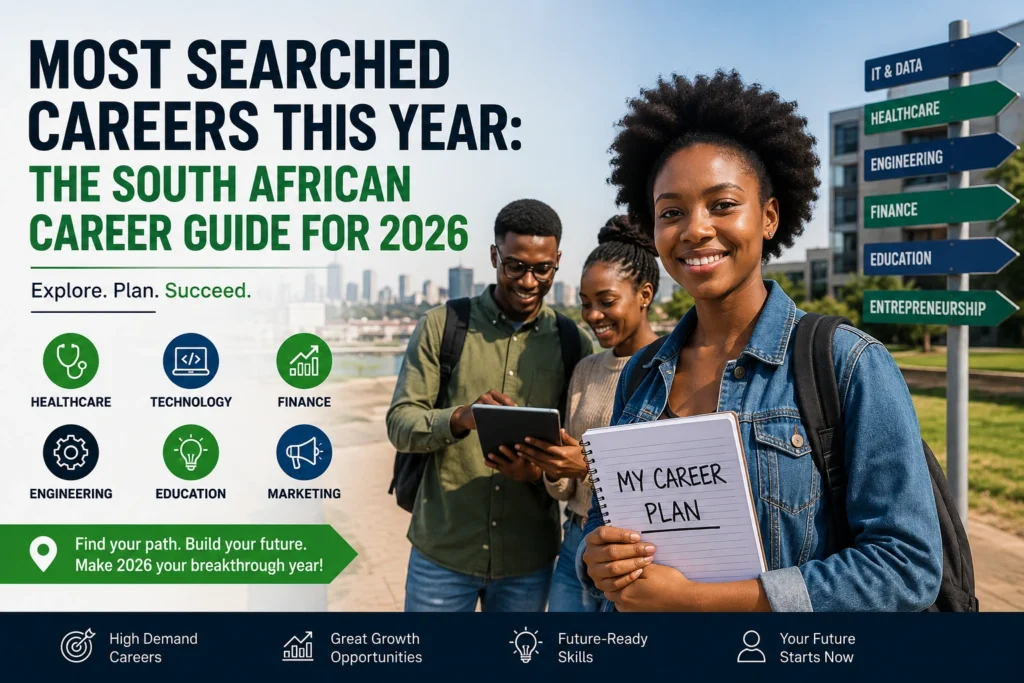

For many South Africans, choosing a career in 2026 is no longer simply about asking what subjects they enjoyed at school. The bigger challenge is working out which qualifications are likely to lead to real opportunities, which skills employers are looking for, and which career paths offer room to grow.
This is particularly important for matriculants deciding what to study, graduates searching for their first job, and workers thinking about changing direction.
Searching for a career online can provide useful ideas, but there is a trap: the most searched career is not necessarily the best career to pursue. A profession can be popular because it sounds attractive while having intense competition or demanding entry requirements.
The smarter approach is to look at a combination of employer demand, competition, qualifications, skills shortages, career progression and your own strengths.
This guide explores the Most Searched Careers This Year, explains why these fields are attracting attention, and gives you a practical strategy for turning career research into an actual employment plan.
At a Glance: Careers Worth Investigating in 2026
The following career areas deserve attention from South African jobseekers because they connect with major employment sectors, digital transformation, infrastructure needs, healthcare requirements and specialist skills.
| Career Area | Example Careers | Typical Entry Route | Skills That Add Value |
|---|---|---|---|
| Information Technology | Software Developer, IT Support, Data Analyst | Diploma/Degree/Certification | Coding, SQL, Cloud, Cybersecurity |
| Cybersecurity | Security Analyst, SOC Analyst | Degree/Certification | Networking, Security, Problem Solving |
| Healthcare | Nurse, Pharmacist, Care Worker | Professional Qualification | Patient Care, Communication |
| Engineering | Civil, Electrical, Mechanical Engineer | Degree/Diploma | Mathematics, CAD, Technical Analysis |
| Finance | Accountant, Financial Analyst | Diploma/Degree | Excel, Accounting Software, Analysis |
| Accounting | Bookkeeper, Management Accountant | Diploma/Degree | Financial Reporting, Tax, Excel |
| Logistics | Supply Chain Officer, Logistics Coordinator | Diploma/Degree | Planning, Excel, ERP Systems |
| Construction | Site Supervisor, Project Coordinator | Diploma/Degree/Trade Route | Safety, Planning, Technical Skills |
| Skilled Trades | Electrician, Fitter, Technician | TVET/Apprenticeship | Practical Problem-Solving |
| Data | Data Analyst, BI Analyst | Degree/Certification | Excel, SQL, Power BI |
| Human Resources | HR Officer, Recruiter | Diploma/Degree | Labour Relations, People Skills |
| Sales | Sales Consultant, Account Executive | School/College/Degree | Communication, Negotiation |
| Marketing | Digital Marketer, SEO Specialist | Diploma/Degree/Portfolio | Analytics, Content, SEO |
| Business Analysis | Business Analyst | Degree/Experience/Certification | Analysis, Documentation, Technology |
| Project Management | Project Coordinator, Project Manager | Diploma/Degree/Certification | Planning, Budgeting, Communication |
The table is not a ranking of which career is “best”. It is a starting point for deciding which areas deserve deeper research.
ALSO APPLY FOR: MTN Internships 2026
ALSO APPLY FOR: Valterra Platinum Intern 2026
What Are the Most Searched Careers This Year?
The phrase Most Searched Careers This Year covers a broad group of professions attracting attention from students, graduates and people already working.
However, online popularity and employment demand are two different things.
A career can be heavily searched because:
- It receives attention on social media.
- People believe it pays well.
- Students are unsure what to study.
- New technology is creating excitement.
- There are visible vacancies.
- The profession has strong long-term potential.
The better question is:
Does the career offer a realistic pathway from education to employable skills and eventually to sustainable work?
That is where career research becomes much more useful.
1. Information Technology and Software Development
Technology remains one of the most important areas for anyone investigating future careers.
Businesses increasingly depend on websites, software, cloud platforms, databases, cybersecurity systems and digital customer services.
Potential careers include:
- Software developer
- Web developer
- IT support technician
- Systems administrator
- Database administrator
- Cloud specialist
- Business analyst
- Technology project coordinator
Why consider IT?
One major advantage is the ability to demonstrate skills through projects.
A graduate who has built a functioning application, website, database or dashboard has something tangible to discuss during an interview.
Skills worth developing
- Python or another programming language
- SQL
- Git
- Cloud fundamentals
- Cybersecurity fundamentals
- Data analysis
- Problem-solving
- Communication
Important: You do not necessarily need to learn everything. Pick one direction and become useful in it.
2. Cybersecurity
As organisations become more dependent on technology, protecting information and systems becomes increasingly important.
Cybersecurity careers can include:
- Security analyst
- SOC analyst
- Cybersecurity technician
- Network security specialist
- Information security analyst
- Governance, risk and compliance specialist
This field is particularly suitable for people who enjoy investigating problems, understanding systems and thinking about how things can go wrong.
A useful starting pathway
Someone without experience should not immediately aim for a senior cybersecurity position.
A more realistic progression could be:
IT fundamentals → Networking → Security fundamentals → Entry-level IT role → Security experience → Cybersecurity specialist
That pathway makes the career more achievable.
3. Healthcare and Nursing
Healthcare is another career area that continues to attract attention because people will always require medical and care services.
Possible pathways include:
- Nursing
- Pharmacy
- Medical laboratory work
- Professional caregiving
- Healthcare administration
- Health information management
Healthcare should not be selected simply because someone describes it as a “secure career”.
You need to consider:
- Professional registration
- Entry requirements
- Training duration
- Practical placements
- Emotional demands
- Working hours
- Location of employment
If you genuinely enjoy helping people and can cope with the responsibilities involved, healthcare can provide a meaningful long-term career.
4. Engineering
Engineering is particularly relevant to South Africa because infrastructure, energy, construction, manufacturing, mining and industrial operations require technical expertise.
Career options include:
- Civil engineering
- Electrical engineering
- Mechanical engineering
- Industrial engineering
- Structural engineering
- Chemical engineering
- Mining engineering
Who should consider engineering?
Engineering may suit you if you enjoy:
- Mathematics
- Physics
- Problem-solving
- Designing systems
- Understanding how things work
- Technical projects
The qualification is demanding, so students should not choose engineering purely because they have heard that engineers earn good salaries.
You need to be prepared for the academic workload.
5. Finance, Accounting and Auditing
Every organisation needs financial controls.
This creates opportunities in:
- Accounting
- Auditing
- Financial analysis
- Management accounting
- Tax
- Payroll
- Risk
- Compliance
- Financial planning
The industry is also becoming increasingly digital.
That means a finance graduate can benefit from skills such as:
- Advanced Excel
- Power BI
- Accounting software
- Data analysis
- Financial modelling
- Automation
The opportunity most students overlook
Do not think of accounting as simply “working with numbers”.
Modern finance teams also need people who can interpret data and explain what it means for the business.
That combination can make you more valuable.
6. Data Analytics and Business Intelligence
Companies collect enormous amounts of information, but raw data has little value if nobody can interpret it.
This creates opportunities for people who can transform information into useful decisions.
Possible careers include:
- Data analyst
- Business intelligence analyst
- Reporting analyst
- Data visualisation specialist
- Junior data scientist
A practical beginner toolkit
You could start with:
Excel → SQL → Power BI → Python
You do not have to master all four immediately.
Start with Excel and data cleaning, then progress to SQL and visualisation.
Most importantly, create projects.
For example:
Take publicly available data about South African unemployment, retail sales or transport and build an interactive dashboard.
That project becomes evidence of your ability.
7. Logistics and Supply Chain
South Africa’s economy depends on the movement of products from suppliers to manufacturers, warehouses, retailers and customers.
Career options include:
- Logistics coordinator
- Supply chain officer
- Procurement officer
- Inventory controller
- Warehouse supervisor
- Transport planner
- Supply chain analyst
Useful skills include:
- Excel
- Inventory management
- Procurement
- Data analysis
- Enterprise systems
- Communication
- Planning
This can be an especially interesting career for someone who enjoys organising processes and solving operational problems.
8. Construction and Infrastructure
Infrastructure creates employment across several levels.
Not everyone working in construction needs to become an engineer.
There are opportunities for:
- Construction managers
- Site supervisors
- Project coordinators
- Quantity surveyors
- Health and safety professionals
- Surveying technicians
- Skilled tradespeople
Technical and practical careers should not be overlooked simply because they are not traditional office jobs.
A strong trade can become the foundation for entrepreneurship as well as employment.
9. Skilled Trades and Technical Careers
Electricians, fitters, mechanics, welders, technicians and other skilled workers remain important to industrial operations.
A typical route can involve:
TVET education → Apprenticeship → Workplace training → Trade test → Qualified artisan
The major advantage is that training combines theory with practical experience.
However, prospective apprentices should investigate the exact requirements of the trade and employer before enrolling.
Do not pay an organisation simply because it promises a guaranteed job.
10. Digital Marketing and E-Commerce
Marketing has changed dramatically.
Companies now need people who understand:
- Search engines
- Social media
- Email marketing
- Analytics
- Online advertising
- Content
- E-commerce
Possible roles include:
- Digital marketing assistant
- SEO specialist
- Content marketer
- Social media coordinator
- Performance marketing specialist
- E-commerce assistant
One of the biggest advantages of digital marketing is the ability to build a portfolio before obtaining your first full-time position.
You could create:
- A small website
- An SEO project
- A content campaign
- A mock advertising campaign
- A social media analytics report
Your portfolio can demonstrate what you can actually do.
ALSO READ ABOUT: Careers Behind Major Sporting Events
Why This Issue Matters
Career decisions have consequences beyond choosing a university course.
A poor decision can result in:
- Spending several years studying a field you do not enjoy.
- Accumulating unnecessary education costs.
- Graduating without practical experience.
- Entering an overcrowded career without a specialisation.
- Discovering too late that additional professional registration is required.
On the other hand, good career research can help you identify opportunities before committing significant time and money.
The objective should therefore not be to find the “number one career”.
Your objective should be to find a career where your abilities, interests and market demand overlap.
How to Find the Right Career: A Step-by-Step Strategy
Step 1: Identify Your Career Zone
Write down three categories:
I am good at:
For example, mathematics, writing, fixing things or working with people.
I enjoy:
For example, technology, healthcare, business or practical work.
Employers need:
Research actual vacancies to find repeated skills.
The overlap is where your strongest options may exist.
Step 2: Study 20 Real Job Advertisements
This is one of the most valuable exercises you can do.
Choose a career and find 20 vacancies.
Create a simple spreadsheet with:
- Job title
- Qualification
- Experience
- Technical skills
- Soft skills
- Location
- Salary, if disclosed
- Closing date
After 20 adverts, patterns will start appearing.
Those patterns tell you what employers actually want.
Step 3: Identify the Skills Gap
Suppose you want to become a data analyst.
You discover that many adverts request:
- Excel
- SQL
- Power BI
- Data visualisation
- Communication
You might already have Excel but lack SQL and Power BI.
Your career plan is now obvious:
Learn SQL + learn Power BI + build two projects + apply for entry-level opportunities.
This is much better than vaguely deciding to “study data”.
Step 4: Build Proof, Not Just Knowledge
This is where many jobseekers lose opportunities.
They say:
“I know Excel.”
But can they demonstrate it?
Instead, create something.
For example:
Finance: Build a monthly budget and financial dashboard.
IT: Build a simple website or application.
Marketing: Conduct an SEO audit.
Data: Build a Power BI dashboard.
Logistics: Create an inventory tracking model.
HR: Develop a recruitment tracking spreadsheet.
Projects turn claims into evidence.
Step 5: Gain Experience Through Multiple Routes
Do not restrict your search to permanent jobs.
Look at:
- Internships
- Graduate programmes
- Learnerships
- Apprenticeships
- Work-integrated learning
- Temporary positions
- Volunteer opportunities
- Freelance projects
- Student programmes
For someone with no work experience, an internship can be more valuable than waiting months for a perfect permanent vacancy.
Step 6: Build a CV That Answers One Question
When a recruiter opens your CV, they should quickly understand:
“Why should I interview this person for this particular role?”
Avoid filling your CV with irrelevant information.
Instead, emphasise:
- Relevant qualifications
- Technical skills
- Projects
- Work experience
- Achievements
- Certifications
- Practical exposure
A targeted two-page CV is often more useful than a long document containing everything you have ever done.
Best Practices Experts Recommend
Follow the job market, not social media hype
A viral career video is not labour-market research.
Check actual vacancies and employer requirements.
Develop a T-shaped skill set
Have:
Broad knowledge + one strong specialisation
For example:
Business graduate + strong data analytics
or
Finance graduate + strong Power BI and Excel
This combination can differentiate you from candidates with only general knowledge.
Learn to communicate
Technical skills can get attention, but communication can determine whether you succeed in an interview and workplace.
Practise:
- Writing professional emails
- Presenting information
- Explaining technical concepts
- Answering interview questions
- Working in teams
Keep your skills current
Do not assume your qualification will remain sufficient forever.
Set aside time every few months to identify:
- New software
- New industry standards
- New certifications
- Emerging technologies
- Skills appearing in job advertisements
Mistakes People Often Make
Mistake 1: Choosing a career because it sounds prestigious
Prestige does not guarantee job satisfaction.
Mistake 2: Looking only at salaries
Salary should be considered alongside entry requirements, career progression and your suitability for the work.
Mistake 3: Ignoring entry-level requirements
A career may be attractive at senior level but difficult to enter without experience.
Mistake 4: Collecting certificates without practical ability
Ten certificates are not necessarily more valuable than one strong project demonstrating real ability.
Mistake 5: Applying for everything
A scattergun application strategy wastes time.
Target roles where you genuinely meet the requirements.
Mistake 6: Ignoring apprenticeships and TVET pathways
University is not the only route to a successful career.
Technical and vocational pathways can lead to valuable skills and employment.
A 90-Day Career Challenge
If you are currently unsure what to do next, try this.
Month 1: Research
- Select three careers.
- Study at least 20 vacancies for each.
- Record common requirements.
- Compare qualifications and training costs.
- Identify competition and location issues.
- Choose your strongest career direction.
Month 2: Build
- Identify your biggest skills gap.
- Complete a relevant course or certification.
- Create at least one practical project.
- Improve your CV.
- Update your professional profile.
- Ask someone working in the field for career advice.
Month 3: Enter the Market
- Apply for internships.
- Apply for graduate programmes.
- Search for learnerships or apprenticeships where appropriate.
- Apply for junior positions.
- Practise interviews.
- Track every application.
- Continue improving your portfolio.
The goal is not to become an expert in 90 days.
The goal is to move from uncertainty to measurable progress.
Frequently Asked Questions
What are the Most Searched Careers This Year?
Technology, healthcare, engineering, finance, data, logistics, construction, skilled trades and digital business careers are among the areas worth investigating in 2026. However, search popularity should not be confused with guaranteed employment
Which career is best for the future?
There is no single best career. The strongest option depends on your abilities, interests, qualifications and the skills employers require.
Is it better to study at university or a TVET college?
Neither route is automatically better. University can be appropriate for professional and academic careers, while TVET colleges and apprenticeships can provide strong pathways into technical and practical occupations.
How can I improve my chances of getting my first job?
Combine your qualification with practical experience, technical skills and evidence of what you can do. Internships, learnerships, apprenticeships, projects and work-integrated learning can help bridge the gap between education and employment.
Final Advice: Don’t Chase a Career — Build One
The biggest lesson from the Most Searched Careers This Year is that career planning should go beyond popularity.
Do not choose a profession simply because it is trending.
Instead, investigate the market, understand the entry requirements and build the skills employers repeatedly request.
A strong career strategy looks like this:
Research → Choose → Learn → Practise → Build evidence → Gain experience → Apply → Improve
If you are still at school, start researching before choosing your tertiary subjects.
If you are studying, start building practical experience before graduation.
If you are unemployed, concentrate on one realistic career direction rather than applying randomly for every vacancy.
And if you are considering a career change, look for transferable skills that can shorten the journey into your new field.
The job market will continue changing. New technologies will create some occupations while transforming others. The people most likely to benefit will not necessarily be those who predict the future perfectly.
They will be the people who keep learning, understand what employers need and can prove the value of their skills.