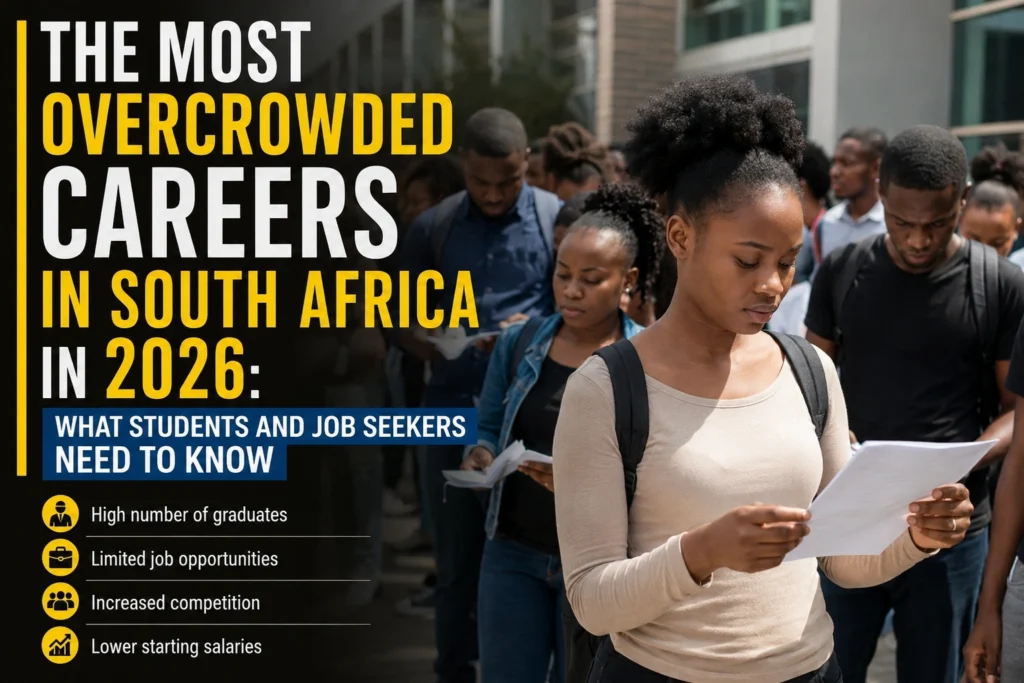

Choosing a career has become more complicated for many South Africans in 2026. Thousands of matriculants, graduates, and unemployed youth are entering the job market every year, but the number of available jobs is not growing at the same pace. The result is fierce competition in certain professions where too many people are chasing too few opportunities.
This is why understanding The Most Overcrowded Careers in South Africa In 2026 matters more than ever. Many people spend years studying for careers that are already saturated, only to struggle with unemployment, low salaries, internships that never lead to permanent work, or endless job applications without success.
At the same time, some industries still face skills shortages and actively recruit qualified candidates. The challenge is knowing which career paths are overcrowded and how to position yourself more strategically.
This guide explains the careers facing the highest competition in South Africa in 2026, why these industries became saturated, and what practical steps students and job seekers can take to improve their future employment prospects.
Understanding Career Overcrowding in South Africa
An overcrowded career is a field where the number of qualified people exceeds the number of available jobs. This creates pressure in the labour market and makes it harder for job seekers to secure stable employment.
Career overcrowding usually happens when:
- A profession becomes popular among students
- Universities and colleges produce more graduates than the economy can absorb
- Employers reduce hiring due to economic pressures
- Technology automates certain roles
- Entry-level opportunities become limited
In South Africa, overcrowding is especially visible among graduates entering white-collar professions. Many students choose careers based on reputation, social pressure, or assumptions about salary potential without researching actual employment demand.
The result is a growing mismatch between qualifications and available jobs.
ALSO APPLY FOR: SACAA Internship 2026
ALSO APPLY FOR: Forvis Mazars Learnership 2026
The Most Overcrowded Careers in South Africa In 2026
General Administration
Administrative jobs remain among the most applied-for positions in South Africa. Thousands of applicants compete for reception, clerk, office assistant, and data-capturing roles.
Why the field is overcrowded:
- Low barriers to entry
- Many short courses and certificates available
- Limited specialised skills required for junior positions
- Companies increasingly automate office functions
Many employers now expect administrative workers to also have digital skills, customer service experience, spreadsheet knowledge, and familiarity with business software.
Human Resources (HR)
Human Resources continues to attract graduates because it appears stable and professional. However, entry-level HR positions are extremely competitive.
Challenges include:
- Too many HR graduates entering the market
- Few junior vacancies
- Employers preferring experienced candidates
- Outsourcing of some HR functions
Many HR graduates spend years working in unrelated positions before securing permanent HR employment.
Law Graduates
Law remains highly respected, but the legal sector has become increasingly crowded.
Common problems include:
- Limited candidate attorney placements
- Intense competition for internships
- Slow career progression
- Oversupply of LLB graduates
While experienced legal professionals can still build successful careers, the entry path has become difficult for new graduates.
Journalism and Media Studies
Traditional journalism jobs continue to decline while digital media evolves rapidly.
Why competition is growing:
- Fewer newsroom jobs
- Media company budget cuts
- Growth of freelance work instead of permanent positions
- Large number of graduates entering creative industries
Many graduates now compete for social media, content creation, and communication roles instead of traditional reporting positions.
Public Management and Public Administration
Government-related qualifications remain popular because many people believe they guarantee state employment. Unfortunately, public-sector hiring has slowed significantly in many departments.
This has created:
- Long waiting periods for vacancies
- Heavy competition for internships
- Reliance on short-term contracts
- High graduate unemployment rates
Policing and Traffic Officer Careers
Many young people pursue careers in policing, metro police, and traffic law enforcement because these roles offer perceived job security.
However:
- Recruitment intakes are limited
- Physical assessments reduce placement numbers
- Competition is extremely high
- Application cycles can take years
Thousands of applicants often compete for a small number of positions.
Teaching in Certain Subjects
Teaching remains valuable, but not all teaching fields experience equal demand.
Overcrowded areas include:
- Foundation phase teaching
- Life Orientation
- General education studies
Meanwhile, schools still struggle to recruit teachers in:
- Mathematics
- Science
- Technology
- Special needs education
This shows how specialisation matters within a profession.
Generic Business Management Qualifications
Business Management is one of the most common qualifications in South Africa.
The problem is that many graduates finish their studies without:
- Technical skills
- Industry experience
- Digital competence
- Specialisation
As a result, employers often struggle to differentiate candidates because thousands hold similar qualifications.
Why These Careers Became Saturated
Several economic and social factors contribute to overcrowding.
Pressure to Choose “Safe” Careers
Families often encourage careers seen as respectable or stable, such as law, HR, administration, or teaching. This creates concentration in a small number of professions.
Limited Career Guidance
Many learners still receive poor career advice at school level. Students may not understand labour market trends before choosing qualifications.
Expansion of Private Colleges
More institutions now offer affordable certificates and diplomas in common fields. While this increases access to education, it also increases competition in already saturated industries.
Slow Economic Growth
South Africa’s economy has struggled to create enough jobs for graduates entering the workforce annually.
Technological Change
Automation and artificial intelligence are reducing demand for certain repetitive administrative and clerical tasks.
Why This Issue Matters
Career overcrowding affects more than just employment statistics. It impacts real people, families, and communities.
When graduates cannot find work:
- Student debt increases
- Families experience financial strain
- Mental health pressures rise
- Young people lose confidence
- Economic inequality worsens
Many graduates end up accepting underpaid work unrelated to their qualifications simply to survive financially.
This issue also affects employers. Companies receive thousands of applications for a single vacancy, making recruitment slower and more difficult.
For students, choosing a career without understanding labour market demand can lead to years of frustration.
That is why researching The Most Overcrowded Careers in South Africa In 2026 is essential before investing time and money into studies.
ALSO READ ABOUT: The Biggest Mistakes Students Make After Matric — And How to Avoid Them
How to Avoid Career Saturation Problems
Avoiding an overcrowded field completely is not always realistic. However, there are ways to improve your chances of success.
1. Research Labour Market Demand
Before enrolling in any qualification:
- Study employment trends
- Look at scarce skills lists
- Research graduate employment rates
- Check internship availability
A career should be evaluated based on long-term opportunity, not just popularity.
2. Develop Technical Skills
Technical and digital skills make candidates more competitive.
Useful skills include:
- Data analysis
- Coding
- Digital marketing
- Project management
- Financial software
- Artificial intelligence tools
- Cybersecurity basics
Even in non-technical careers, digital literacy now matters.
3. Specialise Instead of Staying Generic
Generic qualifications often struggle most in crowded markets.
For example:
Instead of general business management, consider:
- Supply chain management
- Business analytics
- Logistics
- Risk management
Instead of general HR, consider:
- Labour relations
- HR analytics
- Payroll systems
- Talent acquisition technology
Specialisation helps candidates stand out.
4. Gain Work Experience Early
Many graduates wait until after completing studies to seek experience.
Better strategies include:
- Volunteering
- Freelancing
- Job shadowing
- Internships
- Student leadership roles
- Part-time work
Employers increasingly value practical exposure.
5. Consider Skilled Trades and Technical Careers
South Africa still faces shortages in several practical industries.
Examples include:
- Electrical work
- Plumbing
- Renewable energy installation
- Welding
- Mechatronics
- Diesel mechanics
- Software development
These careers may offer stronger employment prospects than some overcrowded office professions.
6. Build a Professional Online Presence
Recruiters increasingly search candidates online.
Useful steps include:
- Creating a professional LinkedIn profile
- Building a portfolio
- Showcasing projects
- Networking online
- Following industry developments
Visibility matters in competitive industries.
Industries With Better Growth Potential in 2026
While some careers are overcrowded, others continue to grow.
Promising sectors include:
Technology
South Africa still needs:
- Software developers
- Data analysts
- Cloud specialists
- Cybersecurity professionals
- AI specialists
Renewable Energy
The energy sector is expanding rapidly due to electricity challenges and green energy investment.
Demand is increasing for:
- Solar technicians
- Electrical engineers
- Energy project managers
Healthcare
Certain healthcare roles remain in demand, especially in underserved areas.
Logistics and Supply Chain
E-commerce growth continues to create opportunities in:
- Warehousing
- Procurement
- Fleet management
- Distribution planning
Artisan Careers
Technical trades remain more stable than many overcrowded graduate careers.
Best Practices Experts Recommend
Career experts and recruiters often recommend several practical strategies for long-term success.
Focus on Skills, Not Just Qualifications
A degree alone no longer guarantees employment. Employers increasingly hire based on capability and adaptability.
Learn Continuously
Industries change rapidly. Short courses, certifications, and digital learning help candidates stay competitive.
Network Consistently
Many jobs are filled through referrals and professional networks before public advertising even begins.
Stay Flexible
Being open to relocation, contract work, or hybrid careers can increase opportunities.
Combine Multiple Skills
Candidates who combine communication, digital literacy, and technical competence usually perform better in crowded markets.
Mistakes People Often Make
Choosing Careers Based Only on Salary
Some professions appear financially attractive but have limited entry-level opportunities.
Ignoring Labour Market Trends
Students often choose qualifications without researching actual employment demand.
Studying Without Building Experience
Graduates who only focus on academics may struggle against candidates with practical exposure.
Following Friends or Social Pressure
Career choices should match personal strengths and market realities, not trends.
Avoiding Technical Skills
Many students underestimate the importance of technology across all industries.
Frequently Asked Questions
Is it still worth studying an overcrowded career?
Yes, but you must differentiate yourself. Specialisation, practical experience, networking, and digital skills can improve your chances significantly.
Which careers are least overcrowded in South Africa in 2026?
Technology, renewable energy, artisan trades, logistics, and certain healthcare fields currently show stronger demand.
Can overcrowded careers still offer success?
Absolutely. Many people succeed in competitive industries by developing niche expertise and strong professional networks.
How do I know if a career is saturated?
Research graduate employment rates, vacancy numbers, industry growth trends, and scarce skills reports before choosing a qualification
Final Thoughts
Understanding The Most Overcrowded Careers in South Africa In 2026 can help students and job seekers make smarter long-term decisions. The reality is that some industries now produce far more graduates than available opportunities, creating intense competition and delayed career growth.
However, overcrowding does not automatically mean failure. Success increasingly depends on adaptability, specialisation, practical experience, and continuous learning.
Instead of blindly following popular career paths, South Africans should focus on developing relevant skills, researching labour market trends, and identifying industries with real growth potential.
The strongest candidates in 2026 are not necessarily those with the most qualifications. They are the people who understand the market, stay flexible, build practical skills, and position themselves strategically for the future economy.
ALSO APPLY FOR: SACAA Internship 2026
ALSO APPLY FOR: Forvis Mazars Learnership 2026
ALSO READ ABOUT: The Biggest Mistakes Students Make After Matric — And How to Avoid Them