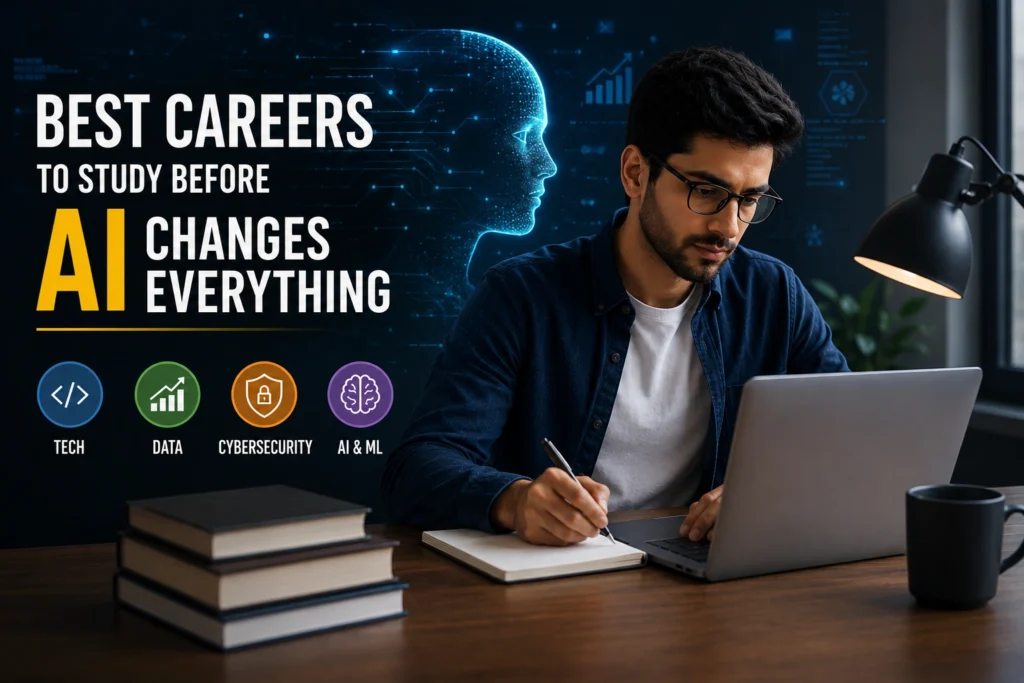

Artificial intelligence is no longer something “coming in the future.” It is already changing how people work, study, hire, communicate, and earn money. Students who choose a degree today are entering a job market that may look completely different within the next five to ten years. That creates a major problem: many people are preparing for careers that could shrink, become automated, or change dramatically before they even graduate.
This uncertainty is making career planning harder than ever. Parents are worried about spending money on qualifications with weak future demand. Students are asking whether traditional office jobs will still exist. Young professionals are wondering whether their current skills will still matter in an AI-driven economy.
The good news is that AI will not eliminate all careers. In fact, it will increase demand for certain skills and professions. The smartest approach is not to avoid AI entirely, but to choose career paths that work alongside technology instead of competing directly against it.
This guide explores the Best Careers to Study Before AI Changes Everything, including which industries are expected to grow, which skills are becoming more valuable, and how students can prepare for long-term success in a rapidly changing world.
Understanding the AI Career Shift
Before choosing a future-proof career, it helps to understand what AI actually changes.
Artificial intelligence is strongest at:
- Repetitive tasks
- Data processing
- Pattern recognition
- Basic content generation
- Predictable workflows
- Administrative automation
AI struggles more with:
- Human relationships
- Emotional intelligence
- Complex judgment
- Ethical decisions
- Physical adaptability
- Creative strategy
- Leadership and persuasion
This means careers built entirely around routine tasks are more vulnerable. Careers involving people, problem-solving, creativity, technical expertise, and real-world adaptability are likely to remain valuable.
The key question is no longer:
“Will AI replace this career?”
The better question is:
“Will AI enhance this career or reduce the need for humans in it?”
That distinction matters enormously when choosing what to study.
ALSO APPLY FOR: Clicks Group TVET Internships 2026
ALSO APPLY FOR: BCE Graduate Internship Programme 2026
Why This Issue Matters
Choosing the wrong career path in an AI-driven economy can have serious consequences.
Many students spend years studying for professions that may offer fewer opportunities by the time they graduate. At the same time, employers are increasingly prioritizing adaptability, digital literacy, and AI-related skills.
The impact is already visible across industries:
- Customer support roles are being automated with chatbots
- Basic accounting tasks are handled by AI software
- Content generation is becoming AI-assisted
- Administrative work is shrinking
- Entry-level office positions are evolving rapidly
But new opportunities are also emerging:
- AI system management
- Cybersecurity
- Healthcare technology
- Renewable energy
- Robotics maintenance
- Data science
- Human-centered professions
Countries worldwide are competing for skilled workers who can operate in technology-driven environments. People who prepare early may enjoy better salaries, stronger job security, and more career flexibility.
This is why understanding the Best Careers to Study Before AI Changes Everything is no longer optional. It is becoming an important survival strategy for the future workforce.
Best Careers to Study Before AI Changes Everything
Not every future-proof career requires advanced coding or computer science. Some of the safest and most valuable careers combine technical skills with human abilities that AI cannot easily copy.
1. Healthcare and Medical Careers
Healthcare remains one of the strongest long-term sectors because humans will always need medical care, empathy, and trust.
Strong options include:
- Nursing
- Physiotherapy
- Occupational therapy
- Radiography
- Mental health counseling
- Medicine
- Speech therapy
AI may assist doctors with diagnostics, but patients still need human interaction, ethical judgment, and emotional support.
Healthcare is also growing because populations are aging globally, increasing demand for medical professionals.
Why it remains resilient
- Human interaction is essential
- Physical presence matters
- Emotional intelligence cannot be fully automated
- Healthcare demand continues growing
2. Software Engineering and AI Development
While AI can generate some code, skilled software engineers remain highly valuable because humans still design systems, solve complex technical problems, and build infrastructure.
Good fields include:
- Software engineering
- Machine learning
- AI engineering
- Cloud computing
- Data engineering
- Mobile app development
The future will likely require more people who understand AI systems, not fewer.
Important reality
Basic coding alone may become less valuable. The highest demand will likely be for professionals who can:
- Build AI systems
- Manage large software platforms
- Solve architecture problems
- Integrate AI into businesses
3. Cybersecurity
As AI grows, cybercrime risks also increase. Companies, governments, banks, and hospitals need experts who can protect systems and data.
Cybersecurity is already experiencing global talent shortages.
Key specializations include:
- Ethical hacking
- Digital forensics
- Network security
- Cloud security
- Information security management
Why this field is strong
Hackers constantly evolve. Human creativity and strategic defense remain necessary, making cybersecurity one of the safest career paths.
4. Skilled Trades and Technical Careers
Many people underestimate skilled trades, but AI and robotics still struggle with unpredictable physical environments.
Strong options include:
- Electrician
- Plumber
- HVAC technician
- Wind turbine technician
- Solar installation specialist
- Industrial maintenance technician
These jobs require hands-on problem-solving and adaptability.
Why trades may become more valuable
Many countries already face shortages in technical trade workers. AI may actually increase demand for technicians who maintain advanced machines and infrastructure.
5. Renewable Energy Careers
The global push toward clean energy is creating enormous opportunities.
Growing fields include:
- Solar engineering
- Environmental science
- Energy management
- Sustainability consulting
- Electrical engineering
- Battery technology
Governments and companies are investing billions into green infrastructure.
Future advantage
This sector combines technology, engineering, and environmental policy — areas expected to expand for decades.
6. Education and Human Development
AI can provide information, but great teachers do much more than deliver facts.
Strong careers include:
- Early childhood education
- Special needs education
- Educational psychology
- Training and development
- Career coaching
Human mentorship, motivation, and emotional understanding remain essential.
Important shift
Educators who understand digital learning tools and AI-assisted education may have even stronger opportunities.
7. Business Strategy and Entrepreneurship
AI automates tasks, but businesses still need leaders who can:
- Make strategic decisions
- Build relationships
- Understand markets
- Lead teams
- Solve complex business problems
Good study areas include:
- Business analytics
- Entrepreneurship
- Marketing strategy
- Supply chain management
- Financial technology
The future may reward adaptable thinkers more than traditional corporate workers.
8. Creative Careers That Combine Human Originality With Technology
Some people believe AI will destroy creative industries entirely. The reality is more complicated.
Routine design work may decline, but highly original human creativity still matters.
Promising creative fields include:
- UX/UI design
- Digital storytelling
- Brand strategy
- Film production
- Animation
- Creative direction
The key is learning how to use AI tools rather than competing against them blindly.
ALSO READ ABOUT: Most Students Don’t Know These Opportunities Even Exist
Step-by-Step Strategy for Choosing a Future-Proof Career
Many students feel overwhelmed by career choices. Breaking the process into steps makes decision-making easier.
Step 1: Focus on Skills, Not Just Degrees
A degree alone is no longer enough.
Employers increasingly care about:
- Problem-solving
- Communication
- Adaptability
- Technical literacy
- Portfolio work
- Real experience
Choose qualifications that build transferable skills.
Step 2: Study Industries With Long-Term Demand
Research sectors expected to grow over the next decade.
Generally strong industries include:
- Healthcare
- Technology
- Renewable energy
- Infrastructure
- Cybersecurity
- Logistics
- Skilled trades
Avoid relying entirely on careers built around repetitive office work.
Step 3: Learn AI Instead of Ignoring It
Trying to avoid AI completely may become a disadvantage.
Students should learn:
- Basic AI tools
- Data literacy
- Automation concepts
- Digital workflows
Even non-technical careers increasingly expect digital competence.
Step 4: Build Human Skills AI Cannot Easily Replace
This is one of the most important strategies.
Valuable human skills include:
- Leadership
- Negotiation
- Emotional intelligence
- Teamwork
- Critical thinking
- Creativity
- Public speaking
These abilities remain difficult for AI systems to replicate authentically.
Step 5: Gain Practical Experience Early
Internships, freelancing, apprenticeships, and volunteer work matter more than ever.
Practical experience helps students:
- Understand industries realistically
- Build networks
- Develop confidence
- Improve employability
Real-world experience often separates strong candidates from average applicants.
Best Practices Experts Recommend
Career experts increasingly recommend a flexible, adaptable approach instead of chasing a “perfect” career.
Here are some best practices professionals suggest:
Combine Technical and Human Skills
The strongest workers may be those who can use technology while also leading, communicating, and solving human problems.
Keep Learning Continuously
The future job market will reward people who constantly upgrade their skills.
Short courses, certifications, online learning, and industry training may become lifelong necessities.
Avoid Choosing Careers Based Only on Current Trends
Some jobs look exciting temporarily but may become oversaturated quickly.
Research long-term demand carefully.
Build a Personal Brand
LinkedIn profiles, portfolios, online projects, and networking increasingly matter in hiring decisions.
Learn Financial Skills
Understanding money, budgeting, investing, and business basics creates flexibility regardless of career path.
Mistakes People Often Make
Many students unintentionally make career decisions that limit future opportunities.
Choosing a Career Only for Salary
High-paying industries can change quickly. Some well-paid jobs today may face automation pressure tomorrow.
Long-term stability matters more than short-term hype.
Ignoring Technology Entirely
Even non-technical careers now involve digital systems and AI-assisted tools.
Avoiding technology can reduce employability.
Following Social Media Career Trends Blindly
Online influencers often promote unrealistic career expectations.
Always research actual job demand, required qualifications, and industry growth before committing.
Underestimating Soft Skills
Communication and teamwork are becoming more important, not less.
Many technically skilled workers struggle because they cannot collaborate effectively.
Waiting Too Long to Gain Experience
Some graduates finish degrees with almost no practical exposure.
Internships, part-time work, and projects create major advantages in competitive job markets.
Frequently Asked Questions
1. Will AI replace most jobs completely?
Probably not completely, but many jobs will change significantly. AI is more likely to automate specific tasks rather than eliminate every profession entirely. Workers who adapt and learn new skills may remain valuable.
2. Is coding still worth studying because of AI?
Yes, but the field is evolving. Basic coding alone may become less valuable, while advanced software engineering, AI development, cybersecurity, and systems design remain highly relevant.
3. Which careers are safest from automation?
Healthcare, skilled trades, cybersecurity, education, leadership roles, and careers requiring emotional intelligence or physical adaptability are generally considered more resilient.
4. Should students avoid office jobs entirely?
Not necessarily. Many office careers will continue, but workers may need stronger digital, analytical, and AI-related skills to stay competitive.
Final Thoughts
The future job market will likely reward adaptability more than rigid specialization. AI is changing industries rapidly, but it is also creating new opportunities for people willing to learn and evolve.
The smartest career strategy is not panic or fear. It is preparation.
Students should focus on careers that combine:
- Human interaction
- Problem-solving
- Technical literacy
- Creativity
- Real-world adaptability
The Best Careers to Study Before AI Changes Everything are not necessarily the most glamorous or trendy. They are the careers that remain valuable when technology changes how work is done.
A strong future-proof plan includes:
- Learning digital skills
- Building communication abilities
- Gaining practical experience
- Staying flexible
- Continuing education throughout life
The people most likely to succeed in the AI era are not those trying to compete against machines in repetitive tasks. They are the people learning how to work alongside technology while strengthening the uniquely human skills AI still cannot replace.
ALSO APPLY FOR: Clicks Group TVET Internships 2026
ALSO APPLY FOR: BCE Graduate Internship Programme 2026
ALSO READ ABOUT: Most Students Don’t Know These Opportunities Even Exist