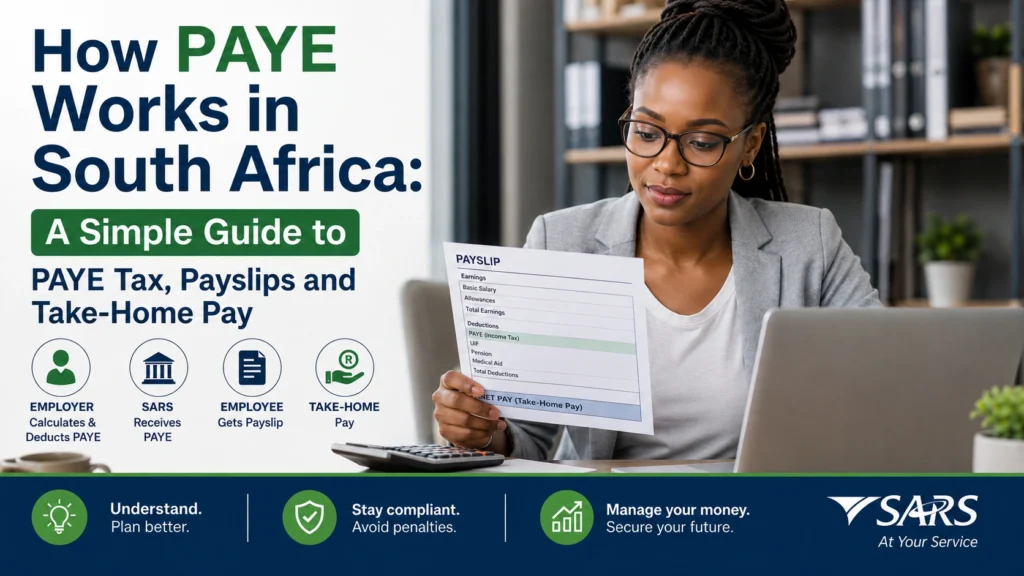

Getting your first payslip can be confusing. You may look at the salary you were promised when you accepted a job and then wonder why the amount deposited into your bank account is much lower.
The answer is usually found in the deductions section.
PAYE, UIF, retirement contributions, medical aid and other deductions can all affect your final take-home pay. The biggest source of confusion, however, is PAYE — particularly when employees see a larger tax deduction after receiving a bonus, overtime payment or salary increase.
Understanding how PAYE works is important because it helps you make better decisions about your salary, monthly budget, employment benefits and tax obligations.
PAYE stands for Pay As You Earn. It is the system through which employers deduct employees’ tax from remuneration and pay the amount to the South African Revenue Service (SARS) on the employee’s behalf. SARS requires employers to deduct or withhold employees’ tax and remit it to SARS monthly.
This guide explains the process in plain language, shows how the South African tax brackets work, explains what you should look for on your payslip and highlights mistakes that can cause unnecessary tax problems.
What Is PAYE?
PAYE means Pay As You Earn.
Instead of waiting until the end of the tax year for an employee to pay all their income tax at once, the PAYE system collects tax throughout the year.
For a typical employee, the process looks like this:
You earn income → your employer calculates PAYE → PAYE is deducted → your employer pays it to SARS → you receive your net salary.
Your employer is responsible for calculating and withholding the employees’ tax according to the applicable SARS rules and deduction tables.
SARS’s 2027 tax-year employer guide states that where an employer pays or becomes liable to pay remuneration to an employee, the employer generally has an obligation to deduct or withhold employees’ tax and pay it to SARS monthly.
PAYE is not a separate “fee”
One important point is that PAYE is not an extra charge imposed by your employer.
It is income tax withheld from your remuneration and paid over to SARS.
This means you should not think about your salary only as:
Gross salary = money received
Instead, think of it as:
Gross remuneration – PAYE – other applicable deductions = net salary
ALSO APPLY FOR: Abbott Intern 2026-2027
ALSO APPLY FOR: AVI Limited Intern 2026-2027
How PAYE Works in Practice
The easiest way to understand PAYE is to follow your salary from the amount stated in your employment contract to the amount that reaches your bank account.
1. You earn remuneration
Your remuneration can include more than your basic salary.
Depending on your employment arrangement, it can include:
- Basic salary
- Overtime
- Bonuses
- Certain allowances
- Taxable fringe benefits
- Commission
- Certain lump-sum benefits
SARS explains that personal income can include employment remuneration such as salaries, wages, bonuses, overtime, taxable fringe benefits and allowances.
This is why your PAYE deduction can change from one month to another.
2. Your employer applies the tax rules
Your payroll department uses SARS’s prescribed tax deduction tables and the information available about your remuneration and applicable deductions.
The calculation is not simply:
Salary × one tax percentage = PAYE
South Africa has a progressive income-tax system, which means different portions of taxable income are taxed at different rates.
3. Rebates and applicable tax credits are considered
Tax rebates can reduce the amount of tax payable.
For the 2026/27 tax year, the primary rebate is R17,820. A secondary rebate of R9,765 applies to qualifying individuals aged 65 and older, while a tertiary rebate of R3,249 applies to qualifying individuals aged 75 and older.
Certain medical scheme fee tax credits may also apply where the relevant requirements are met.
4. PAYE is deducted from your remuneration
Once the payroll calculation has been completed, the applicable PAYE is deducted from your remuneration.
The amount shown on your payslip is therefore the employees’ tax your employer has withheld for that pay period.
5. Your employer pays the tax to SARS
The employer does not simply keep the money.
The PAYE collected is remitted to SARS through the employer’s tax administration process. SARS states that employers remit employees’ tax through the Monthly Employer Declaration (EMP201).
ALSO READ ABOUT: Understanding Taxes
How PAYE Works With South Africa’s Tax Brackets
One of the biggest PAYE myths is that if you enter a higher tax bracket, your entire salary is suddenly taxed at that higher percentage.
That is not how a progressive tax system works.
For the 2026/27 tax year, the tax rates for individuals are as follows:
| Taxable income | Rate of tax |
|---|---|
| R1 – R245,100 | 18% |
| R245,101 – R383,100 | R44,118 + 26% above R245,100 |
| R383,101 – R530,200 | R79,998 + 31% above R383,100 |
| R530,201 – R695,800 | R125,599 + 36% above R530,200 |
| R695,801 – R887,000 | R185,215 + 39% above R695,800 |
| R887,001 – R1,878,600 | R259,783 + 41% above R887,000 |
| Above R1,878,600 | R666,339 + 45% above R1,878,600 |
These rates apply for the 2027 year of assessment, which runs from 1 March 2026 to 28 February 2027.
Here’s the important part
Suppose part of your taxable income falls into a higher bracket.
The higher rate applies to the relevant portion — not automatically to your entire income.
This is why the marginal tax rate and your effective tax rate are not necessarily the same thing.
That distinction becomes particularly important when deciding whether a salary increase is worthwhile.
What Is the Tax Threshold?
The tax threshold is another figure employees should understand.
For the 2026/27 tax year, SARS lists the following thresholds:
| Age | Annual tax threshold |
|---|---|
| Under 65 | R99,000 |
| 65 to below 75 | R153,250 |
| 75 and older | R171,300 |
These are the income levels above which income tax becomes payable under the relevant rules.
The threshold should not be confused with the first tax bracket.
For example, the first tax bracket extends to R245,100, but the applicable rebate means the effective threshold at which an individual becomes liable for normal income tax is lower.
Why This Issue Matters
Understanding PAYE is not just about knowing why money disappears from your salary.
It can affect major financial decisions.
It matters when accepting a job
A company might advertise:
Salary: R25,000 per month
That does not necessarily mean R25,000 will arrive in your bank account.
Your actual take-home pay may be reduced by:
- PAYE
- UIF
- Pension or provident fund contributions
- Medical aid contributions
- Other authorised deductions
When comparing two job offers, therefore, don’t look only at the headline salary.
Look at the total remuneration package and expected net pay.
It matters when receiving a bonus
A bonus can cause your PAYE deduction to look much higher than normal.
This does not automatically mean you have been “taxed 45% on your bonus”.
Payroll calculations consider the relevant remuneration and tax rules.
It matters when changing employers
If you move from one employer to another during the tax year, your total annual income may come from multiple employers.
Your tax position should therefore be considered across your income for the relevant year, rather than looking at one payslip in isolation.
It matters if you have two jobs
Having two sources of employment income can create a PAYE shortfall in certain circumstances.
SARS specifically provides guidance for individuals receiving income from two sources and explains options for addressing potential PAYE shortfalls.
ALSO READ ABOUT: Reading a Payslip
PAYE vs UIF: Don’t Confuse These Deductions
A common mistake is assuming every deduction on a payslip is income tax.
It isn’t.
| Deduction | Basic purpose |
|---|---|
| PAYE | Employees’ income tax |
| UIF | Unemployment Insurance contribution |
| Pension/provident fund | Retirement savings, where applicable |
| Medical aid | Medical scheme contribution |
| Other deductions | Depends on your employment agreement |
PAYE and UIF are therefore different.
Your employer also has separate obligations concerning UIF and other employment-related contributions. SARS’s employer guidance covers employees’ tax, SDL and UIF contributions.
Why Is My PAYE Different Every Month?
Your PAYE deduction does not necessarily have to be identical every month.
It can change when your remuneration changes.
Common reasons include:
- Salary increase
- Overtime
- Bonus
- Commission
- Taxable allowance
- Taxable fringe benefit
- Changes to retirement contributions
- Changes to medical scheme information
- Starting or leaving employment
- Payroll adjustments
- Changes in your tax information
A useful rule
If your gross pay changes significantly but your PAYE remains exactly the same, ask payroll whether the calculation is correct.
Likewise, if your PAYE suddenly increases, don’t immediately assume that payroll made an error.
First check whether something else on your payslip changed.
ALSO READ ABOUT: What Is a TFSA?
What Happens to PAYE When You Get a Salary Increase?
This is where tax misconceptions can cause unnecessary worry.
Imagine you earn R20,000 per month and receive a salary increase.
You may notice that your take-home pay does not increase by the full value of the raise.
That is normal.
Because your taxable income has increased, the additional income may result in additional tax.
However, this does not mean that your entire new salary is taxed at the highest applicable rate.
The practical question is:
How much additional money will I actually take home after tax and other deductions?
That is the figure worth considering when evaluating a salary increase.
What Happens to PAYE on a Bonus?
Bonuses are one of the biggest reasons employees become confused about PAYE.
You might normally receive a payslip showing one PAYE amount, then receive a bonus and see a much larger tax deduction.
This can happen because the additional remuneration affects the payroll calculation.
Before spending your bonus
Don’t assume the gross bonus is the amount you will receive.
Instead:
- Check the gross bonus.
- Check the PAYE deducted.
- Check other deductions.
- Confirm the net bonus.
- Budget using the net amount.
This prevents a common problem: spending money before knowing how much of the bonus will actually reach your bank account.
How to Read PAYE on Your Payslip
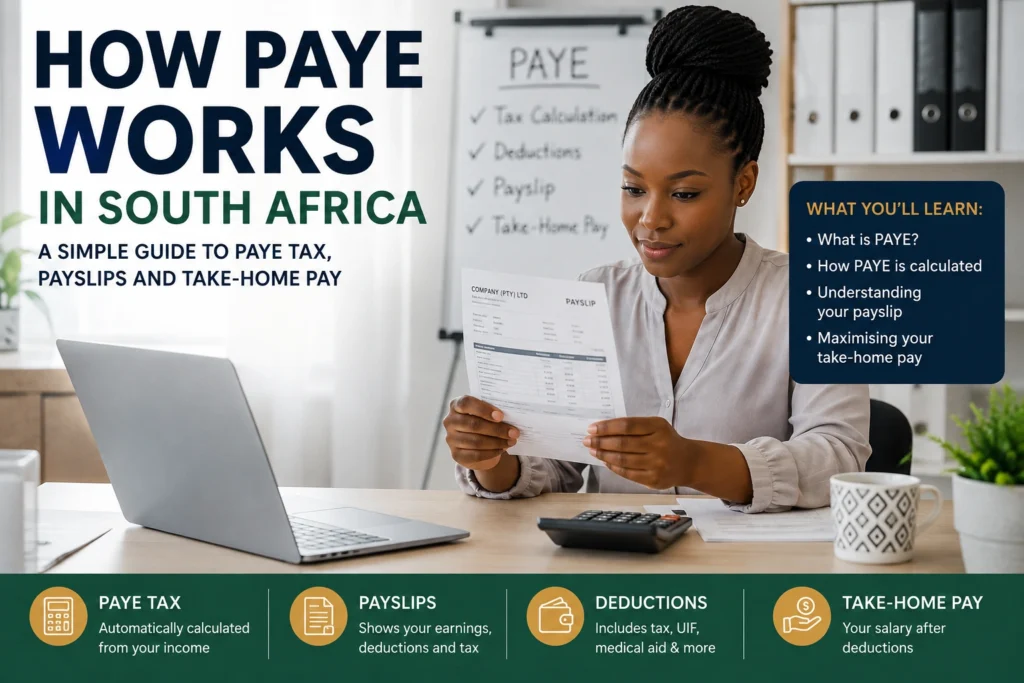
Your payslip is one of the most useful documents for understanding your employment income.
Look for these sections:
Earnings
Check:
- Basic salary
- Overtime
- Commission
- Bonus
- Allowances
- Other remuneration
Deductions
Check:
- PAYE
- UIF
- Retirement contributions
- Medical aid
- Other authorised deductions
Final amount
Look for:
Net pay / take-home pay
This is the amount you should expect to receive, subject to your employer’s payment arrangements.
ALSO READ ABOUT: Understanding Pension and Provident Funds
A Practical Payslip Audit You Can Do in Five Minutes
You don’t need to be a tax expert to check whether your payslip deserves a closer look.
At the end of every month, ask:
1. Did my basic salary change?
If yes, understand why.
2. Did I receive overtime or a bonus?
If yes, expect your taxable remuneration and potentially your PAYE to change.
3. Did a new deduction appear?
Check what it is and why it was introduced.
4. Is the PAYE dramatically different?
If yes, compare the current payslip with the previous month.
5. Is my net pay what I expected?
If not, contact payroll rather than guessing.
Best Practices Experts Recommend
Good PAYE management is mostly about keeping accurate records and understanding your own payslip.
Keep every payslip
Don’t delete your payslips once your salary has been paid.
Keep a digital folder containing:
- Monthly payslips
- Employment contracts
- Bonus statements
- IRP5/IT3(a) certificates
- Relevant tax documents
- Records relating to allowable deductions or tax claims
Check your IRP5
Your IRP5/IT3(a) is an important tax document.
SARS explains that the certificate records information including remuneration and employees’ tax deducted.
When you receive it, don’t simply file it away without checking the information.
Keep payroll informed
Tell your employer’s payroll or HR department when relevant information changes.
For example:
- Personal details
- Employment status
- Retirement contribution information
- Medical scheme information
- Other payroll-related information
Review your tax position if you have multiple income sources
If you earn from more than one employer, pension fund or other taxable source, your total tax position may be more complicated.
SARS recommends considering the combined income and PAYE when addressing potential shortfalls.
Use official SARS information
Tax rules change.
For example, the 2026/27 tax brackets, rebates and thresholds differ from those used in the previous tax year.
Don’t rely on an old social media post or a tax calculator that has not been updated.
ALSO READ ABOUT: TFSA vs ETF vs Savings Account
Mistakes People Often Make
1. Thinking PAYE is a flat percentage
PAYE cannot be accurately explained as “everyone pays 18%” or “everyone pays 45%”.
South Africa has progressive tax rates.
2. Confusing gross salary with take-home pay
If a job advert says R30,000 per month, find out whether that is gross remuneration or another form of package.
3. Thinking a 45% marginal rate means 45% of your entire salary disappears
This is incorrect.
The 45% rate applies to taxable income above the relevant threshold in the highest bracket.
4. Treating PAYE and UIF as the same thing
They are separate deductions.
5. Ignoring a major change in PAYE
A sudden increase may be legitimate, but it should still be investigated if you don’t understand it.
6. Spending your entire bonus
Your gross bonus is not necessarily your net bonus.
7. Forgetting about other income
Rental income, investment income, business income and other taxable sources can affect your overall tax position. SARS lists several forms of income that can contribute to taxable income.
What to Do If You Think Your PAYE Is Wrong
Don’t panic and don’t immediately assume your employer has stolen money from your salary.
Follow a logical process.
Step 1: Compare payslips
Compare the current payslip with the previous month.
Look for changes in:
- Gross remuneration
- Bonus
- Overtime
- Allowances
- PAYE
- UIF
- Other deductions
Step 2: Ask payroll for an explanation
If something doesn’t make sense, ask your employer’s payroll department to explain the deduction.
Step 3: Check your tax documents
Review your IRP5/IT3(a) and other relevant tax information when available.
Step 4: Check SARS information
Use SARS’s current tax information rather than relying on outdated calculators or social media advice.
Step 5: Consider professional advice for complicated situations
A tax practitioner may be useful if you have:
- Multiple employers
- Business income
- Rental income
- Significant investment income
- Complex deductions
- International income
- Complicated employment benefits
A Simple PAYE Checklist for Employees
Save this checklist and use it whenever you receive your payslip.
Every payday:
- Check gross salary
- Check PAYE
- Check UIF
- Check retirement deductions
- Check medical aid deductions
- Check overtime
- Check bonuses
- Check allowances
- Check net pay
- Investigate unexpected changes
At the end of the tax year:
- Check your IRP5/IT3(a)
- Compare your tax certificate with your records
- Review your SARS tax information
- Keep supporting documents
- Check whether you have other taxable income
- Get professional assistance if your tax affairs are complicated
Frequently Asked Questions
Is PAYE the same as income tax?
PAYE is the mechanism through which employers withhold employees’ tax from remuneration and pay it to SARS. Your overall personal income tax liability can depend on your total taxable income and individual circumstances.
Why did my PAYE increase after I received a bonus?
A bonus increases your remuneration and can affect the payroll tax calculation for that period. A larger PAYE deduction in a bonus month does not automatically mean the bonus was taxed at a single flat rate.
Can I earn a salary without paying PAYE?
It depends on your income level and circumstances. For 2026/27, the tax threshold for an individual under 65 is R99,000. Other factors can also affect the calculation.
What happens if I have two jobs?
Your employers may each deduct PAYE, but your combined income can result in a different overall tax liability. SARS provides specific guidance for people receiving income from two sources.
Final Takeaway: Don’t Let PAYE Be a Mystery on Your Payslip
Understanding how PAYE works gives you much more control over your personal finances.
The most important lesson is that your advertised salary, taxable income, PAYE deduction and take-home pay are four different concepts.
Your employer calculates and withholds employees’ tax from your remuneration, then pays the amount to SARS. The calculation takes into account the applicable tax tables and relevant circumstances. For the 2026/27 tax year, individual tax rates range from 18% to a maximum marginal rate of 45%.
You don’t need to become an accountant to manage your PAYE properly.
Start with a few simple habits:
- Read your payslip every month.
- Understand every major deduction.
- Keep your tax records.
- Check your IRP5/IT3(a).
- Don’t confuse PAYE with UIF.
- Don’t assume a higher tax bracket taxes your entire salary at that rate.
- Be especially careful when receiving bonuses or changing jobs.
- Review your tax position if you have multiple income sources.
- Use current SARS information when checking tax rates.
Most importantly, budget from your net salary rather than your gross salary.
Once you understand the difference between what your employer pays you and what actually reaches your bank account, PAYE becomes far less intimidating — and your payslip becomes a useful financial tool rather than a confusing list of deductions.