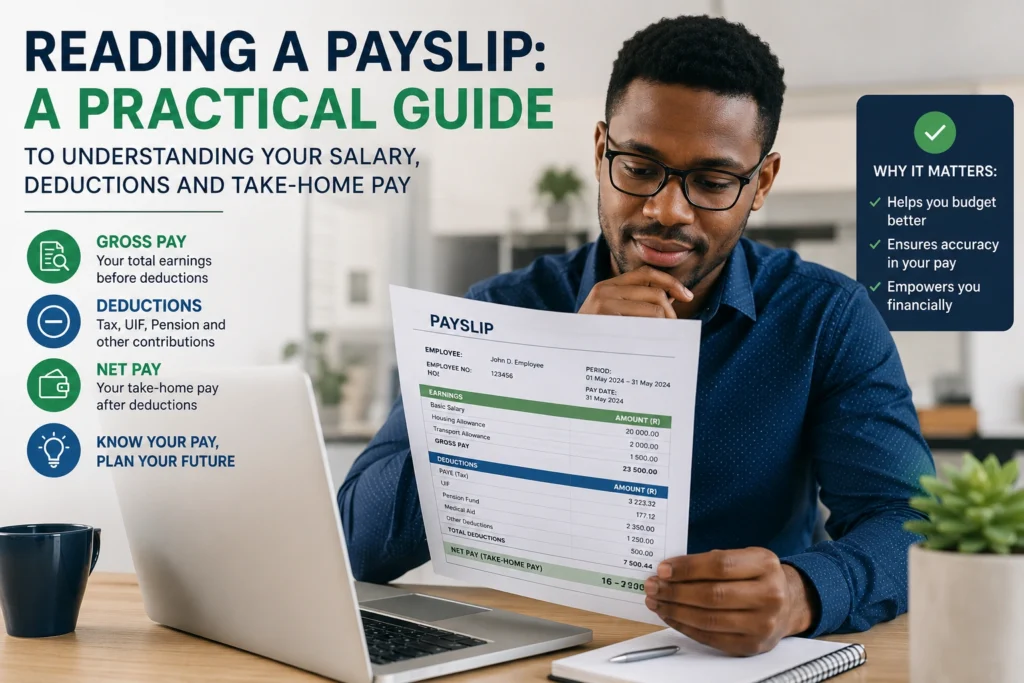

Getting paid is one thing. Understanding exactly how your salary was calculated is another.
For many employees, a payslip arrives as a document filled with abbreviations, figures and unfamiliar payroll terms. You may see a basic salary, taxable income, PAYE, UIF, pension contributions, medical deductions and other amounts without being completely sure what each one means. This can make it difficult to tell whether your pay is correct or whether a deduction has been taken incorrectly.
Reading a payslip is therefore an important financial skill, particularly in South Africa, where employees may have several statutory and employment-related deductions from their gross earnings before reaching their final take-home pay.
The good news is that you do not need to be a payroll specialist to understand your payslip. Once you know what the main sections mean and how the figures connect, you can check your salary with much greater confidence.
This guide explains the key parts of a payslip, how to check your deductions, what warning signs to look for and what to do if something does not appear correct.
What Is a Payslip?
A payslip is a record showing how your employer calculated your pay for a particular salary period.
Depending on the employer, it may be issued monthly, weekly or according to another payroll cycle. A payslip normally contains information about your earnings, deductions and net pay.
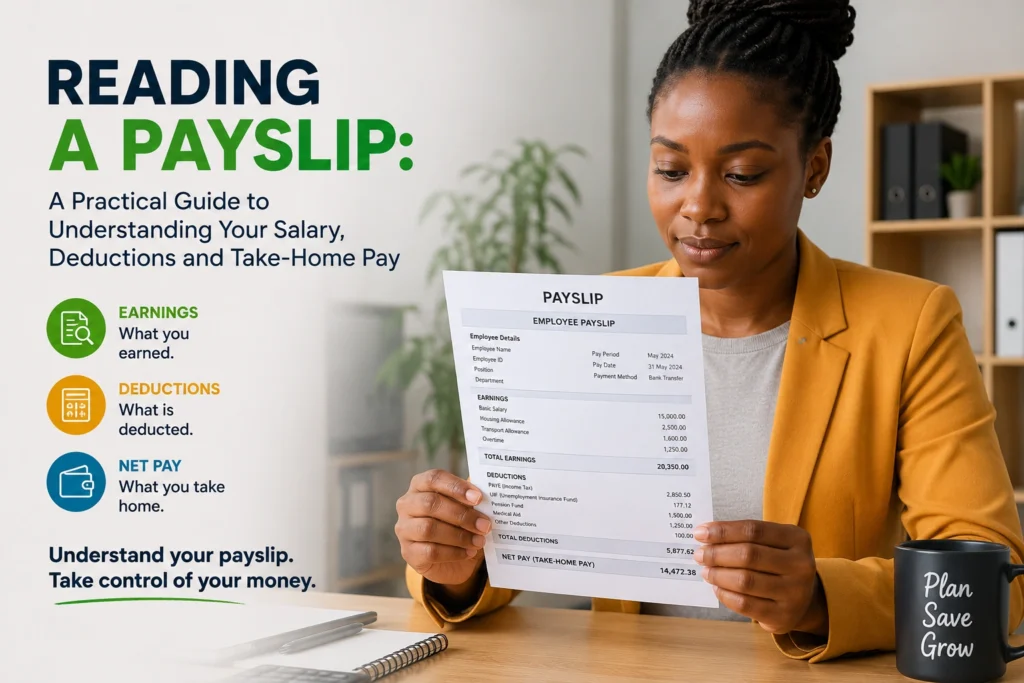
A typical South African payslip can include:
- Employee and employer details
- Pay period
- Basic salary or wages
- Overtime
- Bonuses or commissions
- Allowances
- Gross earnings
- Taxable income
- PAYE
- UIF
- Pension or provident fund contributions
- Medical aid deductions
- Other authorised deductions
- Net salary or take-home pay
Not every payslip will contain all of these items. The information depends on your employment contract, benefits and payroll arrangements.
The most important principle is that gross pay is not the same as the amount that reaches your bank account.
Your gross earnings are calculated first. Applicable deductions are then taken into account, leaving your net salary.
ALSO APPLY FOR: CSOS Intern 2026
ALSO APPLY FOR: Ares Holdings Intern 2026
Reading a Payslip: What the Main Sections Mean
The layout can differ from one employer to another, but the underlying information is generally similar.
1. Employee information
The top section usually identifies you and your employer.
It may include your:
- Full name
- Employee number
- Job title
- Department
- Tax number
- Banking details or partial banking information
- Employment number or payroll reference
Check that your personal information is correct. A wrong tax number or employee record can create administrative problems.
2. Pay period
The payslip should indicate the period for which you are being paid.
For example, a monthly payslip might cover 1 August to 31 August.
This matters because some payments and deductions can relate specifically to a particular payroll period. If you joined an employer during the month, took unpaid leave or left before the end of the month, your salary may not match your normal monthly amount.
3. Basic salary
Your basic salary is the fixed amount you earn before considering additional earnings and deductions.
If your employment contract states that you earn R18,000 per month, for example, your basic salary may appear as R18,000.
However, your actual gross earnings could be higher if you receive overtime, commission, bonuses or certain allowances.
4. Additional earnings
Your payslip may list payments on top of your basic salary.
These can include:
- Overtime
- Commission
- Performance bonuses
- Shift allowances
- Travel allowances
- Housing allowances
- Other employment-related payments
Do not automatically assume that every additional amount will increase your take-home pay by the full amount. Some earnings may have tax or other deductions associated with them.
5. Gross pay
Gross pay is the total amount earned before deductions.
It may include your basic salary plus qualifying additional earnings.
For example:
Basic salary: R18,000
Overtime: R1,500
Allowance: R500
Gross earnings: R20,000
The exact calculation depends on your employer’s payroll system and the nature of the payments.
6. PAYE
PAYE stands for Pay As You Earn.
It is the income tax deducted from employment income and paid over to the South African Revenue Service by the employer on the employee’s behalf.
The amount of PAYE deducted can vary depending on your taxable income and relevant tax circumstances.
This is why simply comparing your basic salary with your take-home pay is not enough to determine whether your tax deduction is correct.
7. UIF
UIF refers to the Unemployment Insurance Fund.
Eligible employees generally contribute a portion of their remuneration to UIF, while employers also make contributions subject to the applicable rules and limits.
The UIF deduction appearing on your payslip is therefore separate from PAYE. It is not another form of income tax.
If you see both PAYE and UIF, they serve different purposes.
8. Retirement fund deductions
If your employer provides a pension or provident fund and you participate in it, your payslip may show a retirement fund contribution.
This deduction reduces your current take-home pay, but it is generally directed towards your longer-term retirement savings.
Your employer may also make a contribution. Check whether your payslip distinguishes between your employee contribution and the employer’s contribution.
9. Medical aid
Employees who belong to an employer-linked medical scheme may see medical aid deductions on their payslips.
The amount depends on the medical scheme, membership arrangement and employer contribution.
Do not assume the figure shown on your payslip represents the full cost of the medical aid. Your employer may contribute part of the cost.
10. Other deductions
This is one of the sections worth examining carefully.
Other deductions might include authorised amounts relating to:
- Salary advances
- Loans
- Union subscriptions
- Employee benefits
- Insurance
- Retirement arrangements
- Other authorised payroll deductions
If you see a deduction that you do not recognise, do not ignore it. Ask payroll or HR for an explanation.
Why This Issue Matters
Understanding your payslip is not simply an administrative exercise.
Your payslip can affect your personal budgeting, tax records, employment benefits and ability to identify payroll errors.
Imagine that you expect R15,000 to reach your account but receive R13,500. Without understanding your payslip, you may assume your employer underpaid you.
After checking the document, you might discover that the difference consists of PAYE, UIF, retirement contributions and a once-off deduction.
The opposite can also happen. A deduction could be incorrect, duplicated or unfamiliar.
Regular payslip checks can help you:
- Build a realistic monthly budget
- Understand your true disposable income
- Track changes in salary
- Check overtime and bonuses
- Identify unexpected deductions
- Keep useful employment records
- Prepare information for financial planning
- Raise payroll issues promptly
For employees who receive irregular earnings, checking the payslip becomes even more important because overtime, commission and bonuses can make monthly income fluctuate.
ALSO READ ABOUT: Understanding Taxes
How to Check Your Payslip Step by Step
You can make payslip checking a simple monthly routine.
Step 1: Check your personal information
Confirm your name, employee number and other important details.
Pay particular attention when you have recently changed departments, moved jobs or updated personal information.
Step 2: Confirm the salary period
Make sure the payslip covers the correct month or pay cycle.
If you started or left employment during the period, check whether the number of days or hours paid appears reasonable.
Step 3: Compare basic salary with your employment contract
Your basic salary should generally correspond with the agreed remuneration structure.
If there has been a formal salary increase, confirm that the new amount appears from the correct effective date.
Step 4: Check additional earnings
If you worked overtime, earned commission or received a bonus, check that the relevant amount appears.
Keep your own records of overtime and approved additional work where applicable. Your personal records give you something to compare with the payroll record.
Step 5: Review gross earnings
Look at the total before deductions.
Ask yourself whether the figure makes sense based on your basic salary and additional earnings.
Step 6: Review each deduction individually
Do not focus only on the final net salary.
Look at PAYE, UIF, retirement contributions, medical aid and other deductions separately.
An unfamiliar deduction deserves an explanation.
Step 7: Check your net pay
Net pay is the amount remaining after applicable deductions.
This is usually the figure that matters most for your monthly household budget because it is closest to the amount actually paid to you.
Step 8: Compare the current payslip with the previous one
This is one of the easiest ways to identify unusual changes.
If your salary has not changed but your take-home pay suddenly falls, compare the deductions line by line.
A change may be legitimate, but you should understand why it occurred.
Step 9: Keep your payslips
Do not immediately delete electronic payslips after checking them.
Keep an organised record of your salary documents. They can be useful when reviewing employment history, financial records or tax-related information.
Best Practices Experts Recommend
A good payslip-checking habit does not have to take more than a few minutes each month.
Check before spending. Know your actual take-home pay before planning your monthly expenses.
Compare month to month. A previous payslip is often the best reference point for spotting unusual changes.
Keep supporting records. Save approved overtime records, bonus notices and salary adjustment letters where relevant.
Understand recurring deductions. Once you know what a deduction represents, it becomes easier to notice when the amount changes unexpectedly.
Ask questions early. If something looks wrong, contact payroll or HR rather than waiting several months.
Protect your payslips. Payslips contain personal and financial information. Store them securely and avoid sending them unnecessarily to unknown people.
Mistakes People Often Make
One common mistake is looking only at the net salary.
Your bank deposit tells you how much you received, but it does not explain how that figure was calculated.
Another mistake is assuming every deduction is tax. PAYE, UIF, retirement contributions, medical aid and other deductions are not interchangeable.
Employees can also overlook changes in recurring deductions. A medical contribution, retirement contribution or benefit-related amount may change, affecting take-home pay.
Another mistake is failing to compare overtime or commission against personal records. If you regularly work additional hours, keeping a simple record can make payroll checking much easier.
Finally, some people ignore unfamiliar deductions because they are afraid of challenging payroll. You are entitled to ask for clarification about deductions appearing on your payslip.
What If Your Payslip Looks Wrong?
Start by identifying the exact issue.
Instead of saying, “My salary is wrong,” point to the specific figure.
For example:
“My payslip shows 12 hours of overtime, but my approved overtime record shows 18 hours.”
This makes it easier for payroll to investigate.
Keep copies of relevant documents and correspondence. If the issue cannot be resolved informally, you may need to seek further assistance through the appropriate workplace or labour channels.
The important thing is to act promptly rather than allowing several incorrect payslips to accumulate.
Frequently Asked Questions
Is gross salary the same as take-home pay?
No. Gross salary is the amount earned before applicable deductions. Take-home pay, or net salary, is what remains after deductions.
Why is my take-home pay lower than my basic salary?
The difference can result from PAYE, UIF, retirement contributions, medical aid and other authorised deductions. Check each deduction on your payslip rather than assuming the entire difference is tax.
Should I check my payslip every month?
Yes. A quick monthly check can help you identify salary changes, missing overtime, unexpected deductions or other payroll issues early.
What should I do if I do not understand a deduction?
Ask your employer’s payroll or HR department to explain the deduction. If necessary, request clarification about what the deduction represents and why it was applied.
Final Summary: Make Payslip Checking a Monthly Habit
Reading a payslip becomes much easier once you understand the relationship between earnings, deductions and net pay.
Start with your personal information and pay period. Confirm your basic salary, then check overtime, bonuses and allowances. Review gross earnings before examining PAYE, UIF, retirement contributions, medical aid and other deductions. Finally, check the net amount against what reaches your bank account.
The most useful habit is to compare every new payslip with the previous one. You do not need to become an expert in payroll to notice that a figure has changed.
If something does not make sense, ask about it.
Your payslip is more than proof that you were paid. It is a monthly record of how your earnings were calculated. Taking a few minutes to understand it can help you budget more accurately, spot potential errors and make better decisions about your income.
ALSO APPLY FOR: CSOS Intern 2026
ALSO READ ABOUT: Understanding Taxes
ALSO APPLY FOR: Ares Holdings Intern 2026