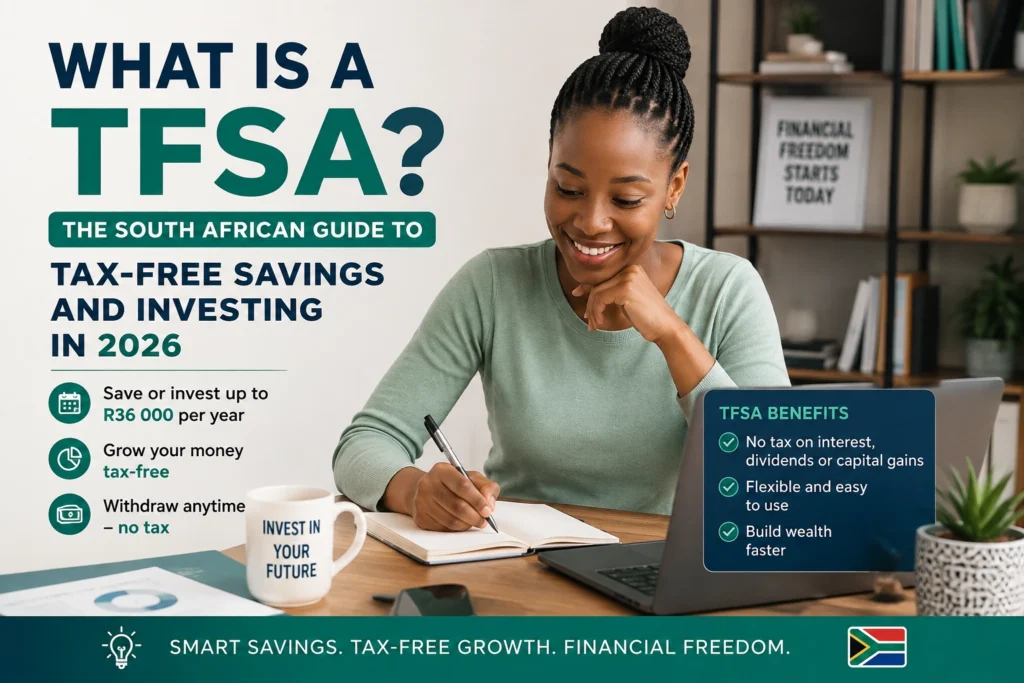

Saving money is difficult when everyday expenses keep rising, but there is another problem many South Africans overlook: what happens to the returns generated by their savings and investments?
You can save diligently for years and still lose part of your investment returns to taxes and fees. At the same time, many people have heard about a Tax-Free Savings Account (TFSA) but are unsure what it actually is, how it works, whether it is better than an ordinary savings account, or how much they are allowed to contribute.
The confusion is understandable. The term “tax-free” sounds simple, but a TFSA comes with specific rules that can have serious financial consequences if you exceed the contribution limits.
So, what is a TFSA?
In South Africa, a Tax-Free Savings Account is a regulated investment structure that allows individuals to invest in qualifying products while enjoying tax-free treatment on eligible returns. This can include interest, dividends and capital growth, depending on the underlying investment.
For the tax year beginning 1 March 2026, the annual contribution limit increased to R46,000, while the lifetime contribution limit remains R500,000.
The real opportunity is not simply opening an account. It is understanding how to use the tax-free environment intelligently over many years.
What Is a TFSA in Simple Terms?
A TFSA is essentially a tax-efficient home for qualifying savings and investments.
You put money into the account, select an eligible investment option, and the returns generated within the TFSA can be exempt from certain taxes.
These tax advantages generally include:
- No tax on interest earned inside the TFSA.
- No dividends tax on qualifying dividends.
- No capital gains tax on qualifying investment growth.
- The ability to invest up to the legislated lifetime contribution limit over time.
However, a TFSA is not unlimited tax-free banking.
There are contribution limits, and these limits apply to your combined TFSA contributions rather than separately to every account you open.
That distinction is extremely important.
ALSO APPLY FOR: Media24 Intern 2026
ALSO APPLY FOR: (CIPC) Graduate Intern 2026
TFSA Rules at a Glance
Here is the most important information to understand before opening or contributing to a TFSA:
| TFSA rule | Current position from 1 March 2026 |
|---|---|
| Annual contribution limit | R46,000 |
| Lifetime contribution limit | R500,000 |
| Annual limit applies across | All your TFSAs combined |
| Tax on qualifying investment returns | Generally tax-free |
| Tax on excess contributions | 40% |
| Can unused annual allowance be carried forward? | No |
| Does withdrawing money restore contribution room? | No |
These limits are based on the rules published by the South African Revenue Service (SARS). (sars.gov.za)
Why the R46,000 figure matters
The annual limit increased from R36,000 to R46,000 from 1 March 2026.
That means an investor who wants to use the full annual allowance could contribute approximately:
R3,833 per month
because R46,000 divided by 12 months is about R3,833.
You do not have to contribute that amount. The important point is that your total contributions during the tax year should remain within the applicable annual limit.
How Does a TFSA Actually Work?
One of the most useful ways to understand a TFSA is to separate the account structure from the investment inside the account.
The TFSA provides the tax-efficient environment.
The investment determines how your money behaves.
Depending on the provider and product, a TFSA may give you access to different qualifying investment options.
For example, you could encounter products based on:
- Cash or interest-bearing investments
- Unit trusts
- Exchange-traded investments
- Other qualifying investment products
This means a TFSA does not automatically mean your money will grow at a particular rate.
If you choose a conservative investment, your returns may be relatively stable but lower.
If you choose growth-oriented investments, your portfolio may have greater short-term fluctuations but potentially stronger long-term growth.
That is why choosing a TFSA should involve two separate questions:
Question 1: Is the TFSA tax structure useful for my financial goal?
Question 2: Is the investment inside the TFSA appropriate for my goal?
Both matter.
Why This Issue Matters
The biggest advantage of a TFSA becomes more visible over time.
Imagine an investment generating returns year after year.
In a taxable environment, certain investment returns can be subject to tax.
In a qualifying TFSA, those returns can remain within the tax-free environment.
This creates an opportunity for compounding.
Compounding happens when your investment earns returns and those returns remain invested, allowing them to potentially generate additional returns.
The longer this process continues, the more important tax efficiency can become.
This is why a TFSA should generally be viewed as a long-term wealth-building tool, rather than simply another place to keep spending money.
The hidden advantage: time
A common mistake is asking:
“How much money will I make from a TFSA this year?”
A better question is:
“How much could tax-free compounding help my long-term financial position?”
The answer depends on your investment performance, contributions, fees, taxes that would otherwise apply, and how long you remain invested.
There are no guaranteed returns.
But the tax advantage can become increasingly valuable as the investment grows.
TFSA vs Ordinary Savings Account
A normal savings account and a TFSA can both involve putting money aside, but they serve different purposes.
| Feature | Ordinary savings account | TFSA |
| Main purpose | Accessible savings | Tax-efficient saving/investing |
| Tax treatment | Interest may be taxable | Qualifying returns are tax-free |
| Contribution limit | Generally no TFSA-style annual limit | Annual and lifetime limits apply |
| Investment choice | Usually limited | Depends on provider/product |
| Long-term wealth building | Depends on product | Can be useful |
| Emergency fund suitability | Often suitable | Depends on product and access |
| Risk level | Often low | Depends on underlying investment |
The important lesson is that a TFSA should not automatically replace your emergency fund.
If your car breaks down tomorrow, your child needs an unexpected expense covered, or you suddenly lose income, you may need money that is easily accessible and stable.
Your emergency savings and long-term investments should therefore have clearly defined jobs.
TFSA vs Retirement Annuity: Which One Is Better?
There is no universal winner.
A TFSA and a retirement annuity (RA) are designed differently.
A retirement annuity is specifically focused on retirement planning and comes with retirement-fund rules.
A TFSA provides a tax-free investment environment that can be used for a broader range of long-term financial objectives.
Depending on your circumstances, you may use both.
For example:
- Emergency fund: accessible savings
- Retirement: retirement annuity and/or pension/provident arrangements
- Long-term flexible investing: TFSA
- Short-term goals: appropriate cash savings or other low-risk investments
The best structure depends on your income, tax position, retirement objectives, investment horizon and access requirements.
ALSO READ ABOUT: Understanding Taxes
How to Use a TFSA: A Practical Step-by-Step Strategy
Opening a TFSA is easy.
Using one intelligently is more important.
Step 1: Decide what the money is for
Before comparing providers, write down your objective.
Are you investing for:
- Retirement?
- A child’s future education?
- A property deposit?
- Financial independence?
- Long-term wealth?
- A future business?
- Another major financial goal?
Your objective determines how much investment risk may be appropriate.
Step 2: Build a financial foundation first
Do not put every spare rand into a long-term investment.
Before aggressively investing, consider whether you have:
- A basic emergency fund
- A manageable level of expensive debt
- Appropriate insurance
- A realistic monthly budget
- A stable contribution amount
There is little value in investing money for 10 years if you have to withdraw it six months later because you have no emergency savings.
Step 3: Check your existing TFSA contributions
This is one of the most important steps.
If you already have a TFSA with another provider, those contributions count towards your overall limit.
Opening another account does not give you another R46,000 annual allowance.
For example:
TFSA A: R30,000 contributed
TFSA B: R16,000 contributed
Total: R46,000
You have reached the annual contribution limit.
Step 4: Compare the provider, not just the advertisement
Do not choose a TFSA simply because you saw the words “tax-free” or “high returns”.
Investigate:
- Platform fees
- Fund management fees
- Transaction charges
- Available investments
- Minimum investment
- Withdrawal process
- Customer service
- Online functionality
- Investment flexibility
A seemingly small fee can have a significant impact over decades.
Step 5: Match the investment to your time horizon
This is where many beginners go wrong.
Someone investing for two years should not necessarily use the same investment strategy as someone investing for 20 years.
Shorter-term goal
You may prioritise:
- Capital stability
- Lower volatility
- Accessibility
Longer-term goal
You may be able to consider:
- Diversified growth investments
- Greater exposure to shares
- Global investments
- Long-term compounding
The correct choice depends on your personal circumstances and risk tolerance.
Step 6: Automate your contributions
Consistency can be more powerful than trying to predict the market.
Instead of asking every month whether you “feel like investing”, automate the contribution.
For example:
R1,000 per month = R12,000 per year
R2,000 per month = R24,000 per year
R3,000 per month = R36,000 per year
Approximately R3,833 per month = R46,000 per year
The goal is not necessarily to reach R46,000 immediately.
The goal is to build a habit that you can sustain.
What Happens If You Contribute More Than the Limit?
This is one area where you should be particularly careful.
If you contribute more than your permitted annual or lifetime limit, the excess contribution can attract a 40% tax charge.
For example, suppose your annual limit is R46,000 but you accidentally contribute R50,000.
The excess is:
R50,000 − R46,000 = R4,000
A 40% charge on R4,000 would be:
R1,600
This example is purely illustrative, but it shows why contribution tracking matters.
SARS specifically warns taxpayers about excess contributions. (sars.gov.za)
A simple prevention system
Keep a spreadsheet or note showing:
- Provider name
- Account number/reference
- Date of contribution
- Amount contributed
- Total contribution for the tax year
- Lifetime contribution total
If you use multiple providers, combine the figures.
Do not rely solely on memory.
What Happens When You Withdraw Money?
Another major misconception is that withdrawing money automatically creates new contribution room.
It does not.
Suppose you have contributed R200,000 over several years and later withdraw R50,000.
You should not assume that you can now contribute R50,000 above the lifetime limit.
Withdrawals do not simply reset your contribution allowance.
This is why you should think carefully before using your TFSA for short-term spending.
A TFSA can be flexible, but every withdrawal can potentially reduce the amount of money you have working for you in the tax-free environment.
Best Practices Experts Recommend
A strong TFSA strategy does not require complicated financial products.
It requires discipline.
1. Start with your objective
Do not invest first and decide what you are saving for later.
2. Think in decades, not weeks
The greatest potential advantage of tax-free investing comes from long-term compounding.
3. Diversify
Avoid putting all your long-term investment money into a single company, sector or highly concentrated asset.
4. Keep costs under control
Compare total investment costs rather than focusing only on advertised returns.
5. Automate
A monthly debit order can remove much of the emotional decision-making from saving.
6. Track your contributions
Especially if you have multiple TFSAs.
7. Do not panic during market declines
If your TFSA contains market-linked investments, temporary declines can happen.
A falling market does not automatically mean your long-term strategy is broken.
8. Review, don’t constantly trade
A yearly review is often more useful than checking your investment every day.
Mistakes People Often Make
Mistake 1: Thinking every TFSA is a bank savings account
A TFSA can contain different qualifying investment products.
Always understand what you are actually investing in.
Mistake 2: Believing you can contribute R46,000 to every TFSA
You cannot.
The annual allowance applies to your combined contributions.
Mistake 3: Ignoring the lifetime R500,000 limit
The annual allowance does not mean you can contribute R46,000 indefinitely without eventually reaching the lifetime limit.
Mistake 4: Contributing beyond the limit
The 40% tax treatment on excess contributions can be costly.
Mistake 5: Using a TFSA as an emergency wallet
A TFSA is generally more valuable when used as a long-term investment structure.
Mistake 6: Choosing based only on returns
Look at:
- Fees
- Risk
- Investment strategy
- Diversification
- Time horizon
Mistake 7: Withdrawing too early
You may lose years of potential compounding and cannot simply reclaim the withdrawn contribution space.
Mistake 8: Believing tax-free means risk-free
This is perhaps the most important distinction.
Tax-free does not mean guaranteed.
If your TFSA contains market-linked investments, its value can rise and fall.
A Beginner’s TFSA Checklist
Before opening or contributing to a TFSA, ask yourself:
- Do I understand what a TFSA is?
- Do I know my current contribution history?
- Do I understand the R46,000 annual limit?
- Do I understand the R500,000 lifetime limit?
- Have I established an emergency fund?
- Do I know what investment I am buying?
- Have I compared fees?
- Does the investment match my time horizon?
- Can I contribute consistently?
- Am I keeping records of all contributions?
- Do I understand the consequences of withdrawing?
- Have I avoided choosing an investment simply because it advertises high returns?
If you cannot answer these questions, take time to understand the product before depositing significant amounts.
Frequently Asked Questions
Is a TFSA really tax-free?
Yes, qualifying investment returns within a South African TFSA receive tax-free treatment under the applicable rules. However, the account is subject to annual and lifetime contribution limits.
Can I have two TFSAs?
Yes, but having multiple accounts does not increase your annual or lifetime allowance. Your contributions across all qualifying TFSAs must be considered together.
Is a TFSA good for retirement?
It can be useful for long-term retirement planning, but it should not automatically be viewed as a replacement for a retirement annuity or other retirement savings arrangements. Your overall financial strategy matters.
Final Takeaway: Use a TFSA as a Long-Term Wealth Tool
So, what is a TFSA?
It is more than a savings account.
A Tax-Free Savings Account is a tax-efficient investment structure that can help South Africans build long-term wealth by allowing qualifying returns to grow without certain taxes that would normally apply outside the tax-free environment.
But the account itself is not the magic.
The real value comes from combining:
Regular contributions + suitable investments + low costs + diversification + time + tax efficiency.
The 2026 increase in the annual contribution limit to R46,000 gives South Africans more room to make use of the tax-free investment framework, while the lifetime limit remains R500,000. (sars.gov.za)
If you are starting from zero, do not feel pressured to immediately invest the maximum.
Start by understanding your budget.
Build an emergency reserve.
Reduce expensive debt where appropriate.
Then determine how much you can invest every month without putting your finances under pressure.
Most importantly, do not choose a TFSA simply because it is called “tax-free.” Investigate what is inside it, how much it costs, what level of risk you are taking and whether the investment matches your goal.
A good TFSA strategy is not about getting rich quickly. It is about giving your money more time to compound while making efficient use of the tax rules available to you.
ALSO APPLY FOR: Media24 Intern 2026
ALSO APPLY FOR: (CIPC) Graduate Intern 2026
ALSO READ ABOUT: Missing Middle in Student Funding