
A newly qualified graduate can spend months applying for jobs without hearing back. Then, occasionally, an opportunity appears that asks for something more useful than a long employment history: the right qualification, practical exposure and the willingness to learn.
That is what makes the Abbott Intern 2026-2027 opportunity in Johannesburg worth a closer look for graduates from Medical Technology, Biomedical Sciences, Medical Sciences and related disciplines.
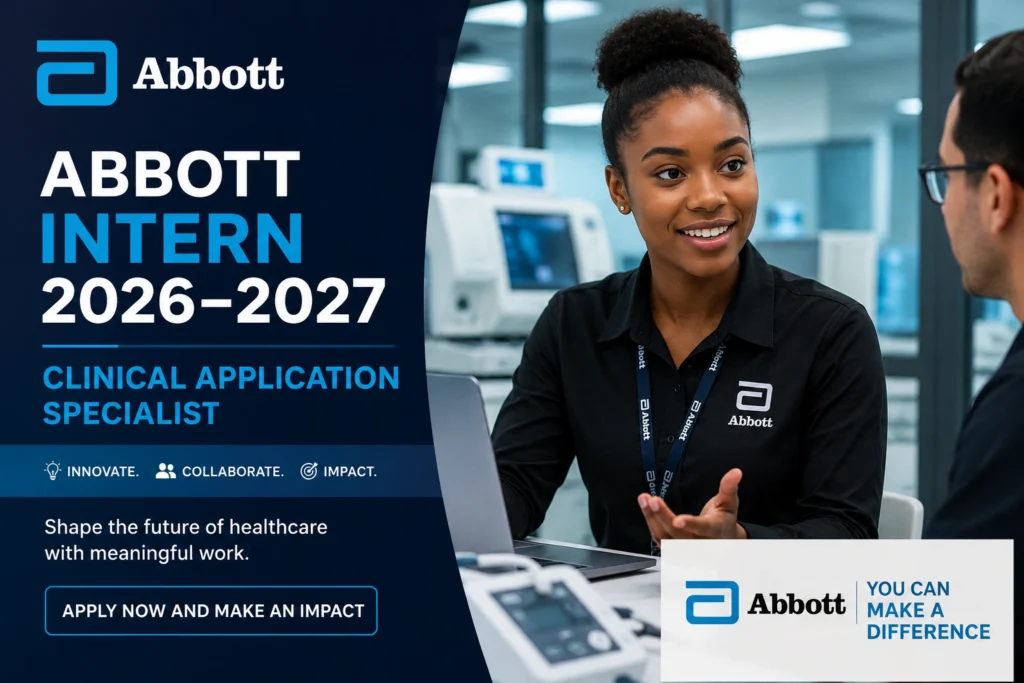
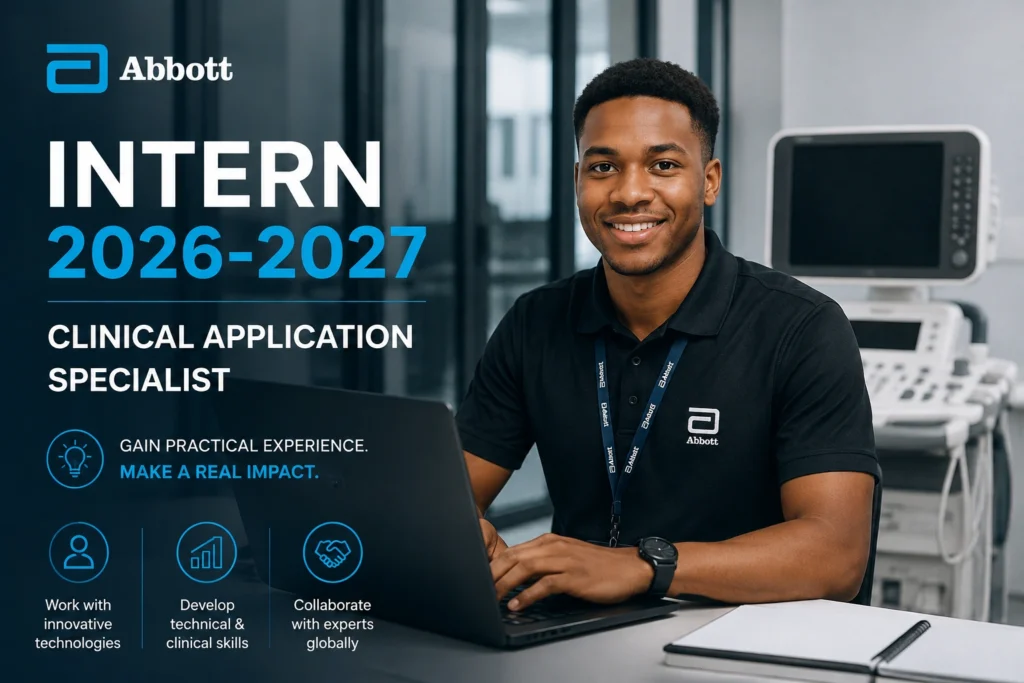
The Clinical Application Specialist Intern position sits at an interesting point between laboratory science, healthcare technology and customer support. Rather than spending the internship entirely behind a desk, successful candidates can expect exposure to clinical diagnostic instruments, laboratory environments, technical troubleshooting, customer training and installation-related activities.
For a graduate who has completed a National Diploma or Honours-level qualification but has not yet built formal work experience, that distinction matters. The first job after graduation is often the hardest one to secure because employers want experience while graduates need an opportunity to obtain it.
This Abbott internship potentially helps bridge that gap.
What the Abbott Intern 2026-2027 opportunity actually involves
The position is for a Clinical Application Specialist Intern within Abbott Core Diagnostics, based in Johannesburg, Gauteng.
The title may sound highly specialised, but its purpose becomes clearer when you look at the practical side of the work. A clinical application specialist operates where healthcare professionals, laboratory equipment and diagnostic technology meet.
Imagine a laboratory receiving a new diagnostic instrument. Installing the machine is only part of the process. Laboratory personnel need to understand how it works, how to use it correctly, how to interpret operational information, and what to do when something does not function as expected.
That is where application-focused support becomes important.
An intern in this environment can therefore gain exposure to activities such as:
- Supporting customer training and demonstrations.
- Assisting with instrument installations.
- Providing technical and application-related support.
- Helping investigate and troubleshoot problems.
- Learning how diagnostic laboratory systems operate.
- Working with experienced professionals and customers.
- Developing a practical understanding of laboratory workflows.
This is considerably different from an internship where the graduate simply observes experienced employees.
The value lies in learning how scientific knowledge is applied in a real healthcare environment.
For someone who studied Medical Technology or Biomedical Sciences, that connection can be particularly useful. University or college provides the scientific foundation, but professional experience teaches you how that knowledge fits into actual laboratory operations, customer requirements, equipment and workplace procedures.
The basic eligibility picture
According to the opportunity information provided, applicants should have a completed qualification in an appropriate discipline and meet the practical requirements attached to the position.
| Requirement | What applicants should understand |
|---|---|
| Position | Clinical Application Specialist Intern |
| Company | Abbott – Core Diagnostics |
| Location | Johannesburg, Gauteng |
| Work arrangement | Full-time, on-site |
| Qualification | National Diploma or Honours/degree in Medical Technology, Biomedical Sciences, Medical Sciences or related field |
| Formal experience | No formal work experience required |
| Current employment | Applicants should not currently be working |
| Advantage | Previous In-Service Training or WIL experience |
| Licence | Valid South African driver’s licence is essential |
| Closing date | No closing date specified in the supplied opportunity information |
The absence of a formal experience requirement is particularly important.
It does not mean that every graduate with the correct qualification will automatically be competitive. Employers still assess communication, technical understanding, professionalism, adaptability and evidence that a candidate can function effectively in a workplace.
In other words, “no experience required” should be interpreted as an invitation to entry-level candidates—not as a reason to submit an unfinished application.
Why this internship is different from a typical graduate opportunity
Healthcare technology is changing quickly, but the importance of reliable diagnostic services has not diminished.
Modern healthcare depends heavily on laboratories and diagnostic systems. Before clinicians can make many decisions, they need dependable information generated through diagnostic testing. Behind that information are trained professionals, sophisticated instruments, quality-control procedures and carefully managed laboratory processes.
That creates an important career space for graduates who understand both science and technology.
A Clinical Application Specialist role can expose an intern to the operational side of this ecosystem. Instead of learning only how a scientific process works in theory, the graduate begins to understand questions such as:
How is the technology used by a laboratory?
What happens when an instrument produces an unexpected result?
How do you explain a technical process to someone else?
How does customer feedback affect technical support?
Why are accuracy, consistency and correct procedures so important in diagnostics?
These are professional skills that can take years to develop if a graduate has limited workplace exposure.
The Johannesburg location is also significant. Gauteng is one of South Africa’s major economic and healthcare centres, and an on-site role can provide exposure to a professional environment where communication, punctuality, travel and customer interaction become part of everyday work.
For a graduate whose only previous experience is academic or WIL-based, that transition can be as valuable as the technical knowledge itself.
An expert-style insight: the hidden value is application knowledge
Career insight: For early-career biomedical graduates, the most valuable outcome of an application-focused internship may not be a single technical skill. It is learning how scientific knowledge is translated into operational decisions.
That distinction can influence future career options.
A graduate who understands laboratory science and how diagnostic technology is implemented, supported and explained may eventually be able to explore paths involving applications, technical support, diagnostics, laboratory equipment, quality, customer training or other healthcare-technology functions.
The internship should therefore be viewed as a chance to develop a professional foundation—not simply as a temporary job.
What applicants should do before pressing “Apply”
The biggest mistake graduates make with entry-level opportunities is assuming that because an employer does not demand years of experience, preparation is unnecessary.
The opposite is usually true.
When formal employment history is limited, your application needs to make other evidence easy to see.
Start with your CV.
Your qualification should be immediately visible. If you completed In-Service Training, Work Integrated Learning, laboratory practicals or relevant projects, do not hide them at the bottom of the document. Explain briefly what you actually did.
For example, instead of simply writing “WIL completed”, describe the relevant exposure you received, provided it is accurate.
You might mention experience involving laboratory procedures, equipment, sample handling, quality processes, documentation, testing environments or technical support.
Do not exaggerate your responsibilities. The objective is to demonstrate relevance, not to turn student exposure into professional experience.
Your driver’s licence should also be clearly indicated because it is identified as an essential requirement for this opportunity.
A simple application strategy
1. Check your qualification.
Make sure your completed qualification falls within the fields requested by the employer or is genuinely related to them.
2. Confirm the driver’s licence requirement.
If you do not have the required valid South African driver’s licence, this could affect your eligibility.
3. Update your CV.
Keep it focused on education, laboratory exposure, WIL/In-Service Training, technical abilities and relevant projects.
4. Prepare supporting information.
Have your qualification details and other commonly requested documents available so that you are not searching for them while completing the application.
5. Read the vacancy carefully.
Do not apply based only on the job title. Understand the responsibilities and assess whether the working environment suits you.
6. Apply through the official Abbott recruitment channel.
Use the employer’s legitimate careers platform rather than relying on an unofficial form or social-media message.
7. Keep a record of your application.
Save the vacancy details and note when you applied. This helps you track correspondence and prepare if you are contacted.
APPLY HERE: Abbott Intern 2026-2027
ALSO APPLY FOR: AVI Limited Intern 2026-2027
Because no closing date is specified in the supplied listing, graduates should avoid assuming that the vacancy will remain open indefinitely. Recruitment systems can close applications once enough candidates have been identified.
The skills that could make a graduate stand out
Having the required qualification gets an applicant into consideration, but professional behaviour can determine what happens next.
For this particular type of role, applicants should think beyond academic marks.
A strong candidate is likely to demonstrate an ability to learn technical information and communicate it clearly. Customer-facing technical work requires patience because not every person receiving training will have the same level of technical knowledge.
Problem-solving is equally important.
If an instrument or process does not behave as expected, the answer is not necessarily to panic or immediately escalate everything. A professional learns to gather information, follow procedures, identify possible causes and communicate the issue accurately.
Communication therefore becomes a technical skill in its own right.
Graduates should also be prepared for the realities of an on-site position. The work may involve interaction with customers, laboratory environments, equipment and experienced colleagues. Professional presentation, reliability and willingness to learn can matter considerably.
The best preparation is to ask yourself before applying:
- Can I explain technical information clearly?
- Am I comfortable learning unfamiliar equipment?
- Can I communicate professionally with customers?
- Can I troubleshoot problems methodically?
- Am I willing to work on-site in Johannesburg?
- Can I demonstrate genuine interest in diagnostics and healthcare technology?
If the answers are mostly yes, the opportunity deserves serious consideration.
Frequently asked questions
1. Who can apply for the Abbott Intern 2026-2027 opportunity?
The supplied requirements indicate that candidates should have completed a National Diploma or an Honours/degree in Medical Technology, Biomedical Sciences, Medical Sciences or a related field. The opportunity is aimed at candidates without formal work experience, with previous WIL or In-Service Training considered advantageous.
2. Where is the Clinical Application Specialist Intern position based?
The position is based in Johannesburg, Gauteng, and is described as a full-time, on-site opportunity.
3. Is there a closing date?
No closing date is specified in the opportunity information provided. Candidates should therefore avoid waiting unnecessarily and should verify the current vacancy status on Abbott’s official recruitment platform before applying.
Final assessment
For a newly qualified South African biomedical or medical technology graduate, the difficult part of entering the workforce is often not a lack of ambition. It is getting the first opportunity that allows academic knowledge to become professional experience.
That is why the Abbott Intern 2026-2027 opportunity deserves attention.
The Clinical Application Specialist position offers exposure to a side of healthcare that many graduates may not encounter during their studies: the practical relationship between diagnostic technology, laboratory professionals, customers and healthcare delivery.
It is also important to approach the opportunity realistically. An internship will not automatically guarantee permanent employment, and meeting the minimum requirements does not guarantee selection. Applicants still need to present themselves professionally and demonstrate why their qualification, practical exposure and personal strengths fit the role.
But for the right graduate, the potential value is clear.
The opportunity can provide more than a line on a CV. It can help develop the technical confidence, communication ability and workplace understanding needed to navigate the healthcare technology sector.
For graduates who have been waiting for a first serious opportunity to turn their studies into practical experience, that is precisely the kind of opening worth pursuing—carefully, professionally and without unnecessary delay.