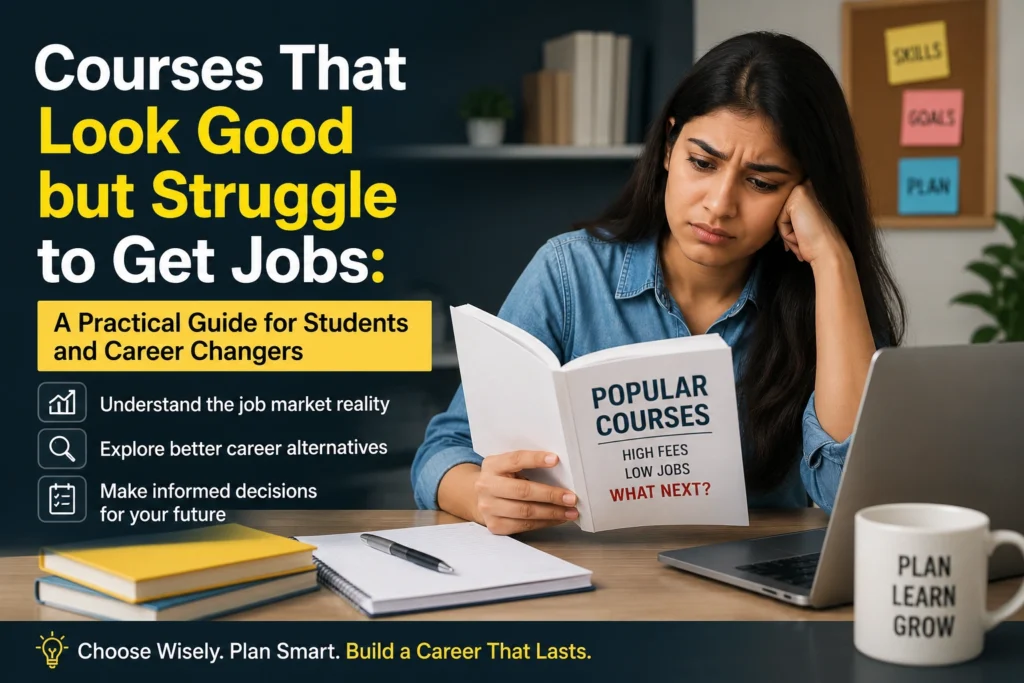

Choosing a course can feel like one of the most important decisions of your life. Colleges, universities, and training providers often promote exciting programmes with attractive titles, promising creativity, flexibility, or future opportunities. However, many students discover after graduation that some qualifications do not translate easily into employment.
This creates a difficult situation. You invest years of study, pay tuition fees, and dedicate significant effort, only to find that employers are hiring fewer people in that field than expected. The challenge is not that these courses are useless. Many provide valuable knowledge and skills. The problem is that the job market may not have enough demand to absorb all graduates.
Understanding Courses That Look Good but Struggle to Get Jobs can help students make more informed decisions before enrolling. This guide explores why some qualifications face employment challenges, how to evaluate career prospects, and what strategies can improve your chances of finding work after graduation.
Understanding Courses That Look Good but Struggle to Get Jobs
When people hear that a course struggles to produce employment opportunities, they often assume the qualification has no value. That is usually not true.
Many courses offer excellent academic content, develop critical thinking, and broaden personal growth. The issue often lies in the relationship between graduate numbers and labour market demand.
Several factors contribute to employment difficulties:
- Too many graduates competing for limited positions
- Rapid technological changes affecting industries
- Lack of practical workplace experience
- Narrow specialization with few employers
- Economic shifts reducing demand for certain roles
- Employers prioritizing technical or vocational skills
The result is that graduates may face longer job searches, lower starting salaries, or the need to pursue additional qualifications.
ALSO APPLY FOR: Solareff YES Learnerships 2026
ALSO APPLY FOR: Harcourts Real Estate Agents Internships 2026
Why This Issue Matters
The choice of qualification affects more than just your education.
A course with weak employment prospects can influence:
Financial Stability
Many students rely on loans, family support, or savings to study. If employment takes longer than expected, recovering those costs becomes more difficult.
Career Growth
Starting in a field with limited opportunities may delay professional development and progression into higher-paying roles.
Mental Wellbeing
Extended job searches can lead to frustration, reduced confidence, and uncertainty about future career plans.
Economic Mobility
For many families, education is viewed as a pathway to improved living standards. Choosing a qualification with stronger employment prospects can significantly impact long-term financial outcomes.
This is why understanding Courses That Look Good but Struggle to Get Jobs is not about discouraging education. It is about making informed decisions that balance passion with practicality.
Common Courses That Often Face Employment Challenges
It is important to note that employment outcomes vary by country, region, economic conditions, and individual performance. However, certain fields frequently experience higher competition or lower demand.
General Arts Degrees
Arts programmes can provide strong communication, research, and analytical skills. However, graduates often compete for broad roles rather than clearly defined career pathways.
Without additional specialization or practical experience, finding employment may take longer.
Performing Arts
Acting, theatre, dance, and related disciplines can be rewarding for talented individuals. However, the entertainment industry is highly competitive, and permanent positions are relatively limited.
Success often depends on networking, portfolios, auditions, and entrepreneurial efforts.
Fashion Design
Fashion attracts many creative students, but available industry positions are often fewer than the number of graduates entering the field each year.
Many professionals ultimately work freelance or start their own businesses.
Photography
Digital technology has transformed photography into a highly accessible skill. While opportunities exist, competition has increased significantly.
Many photographers rely on self-employment rather than traditional employment.
Journalism
The media landscape has changed dramatically. Traditional newsroom jobs have declined in many regions due to digital transformation.
Modern journalists often need skills in video production, social media, digital marketing, and content creation.
Music Studies
Music education develops artistic talent and discipline. However, full-time employment opportunities can be limited, requiring graduates to diversify into teaching, production, performance, or business-related roles.
Certain Specialized Academic Fields
Some highly specialized programmes may offer deep expertise but have limited employer demand outside academic or research environments.
Graduates may require postgraduate study before accessing career opportunities.
Why Some Graduates Succeed Anyway
Despite employment challenges, many people build successful careers from these qualifications.
The difference often comes down to how they position themselves.
Successful graduates frequently:
- Build professional networks early
- Complete internships
- Develop complementary technical skills
- Create strong portfolios
- Gain freelance experience
- Learn business and marketing skills
- Adapt to changing industry needs
The qualification alone rarely guarantees employment. The combination of skills, experience, and adaptability often matters more.
How to Evaluate a Course Before Enrolling
One of the best ways to avoid disappointment is to investigate employment outcomes before committing to a programme.
Step 1: Research Labour Market Demand
Look at current job advertisements in your country and region.
Ask questions such as:
- How many vacancies exist?
- What qualifications are employers requesting?
- Are salaries competitive?
- Is demand increasing or decreasing?
If very few jobs appear despite many graduates entering the field, proceed carefully.
Step 2: Check Graduate Employment Statistics
Many institutions publish graduate employment outcomes.
Pay attention to:
- Employment rates
- Time taken to find work
- Average salaries
- Industries hiring graduates
These figures often reveal more than promotional brochures.
Step 3: Talk to Industry Professionals
Reach out to people already working in the field.
Ask about:
- Daily responsibilities
- Career progression
- Hiring trends
- Industry challenges
- Skills employers value most
Real-world insights can be more valuable than marketing materials.
Step 4: Examine Practical Components
Courses with internships, workplace learning, apprenticeships, or industry projects generally provide stronger employment prospects.
Practical experience helps bridge the gap between education and employment.
Step 5: Consider Transferable Skills
Some qualifications provide skills that can be applied across multiple industries.
Look for courses that develop:
- Communication
- Problem-solving
- Project management
- Data analysis
- Digital literacy
- Leadership
These competencies increase career flexibility.

ALSO READ ABOUT: The Best Careers for Introverts in South Africa
Strategies to Improve Employability Regardless of Your Course
Even if you choose a qualification known for employment challenges, there are practical ways to strengthen your position.
Build Digital Skills
Nearly every industry values digital competence.
Useful skills include:
- Data analysis
- Content management
- Social media management
- Graphic design
- Artificial intelligence tools
- Basic coding
- Digital marketing
These abilities can complement almost any qualification.
Gain Work Experience Early
Employers consistently value experience.
Consider:
- Internships
- Volunteer work
- Freelance projects
- Part-time employment
- Industry placements
Even small projects can demonstrate workplace readiness.
Create a Portfolio
For creative and professional fields, portfolios often carry significant weight.
Include:
- Projects
- Case studies
- Published work
- Presentations
- Creative outputs
- Professional achievements
A strong portfolio can distinguish you from other graduates.
Network Consistently
Many opportunities arise through relationships.
Attend:
- Industry events
- Career fairs
- Professional associations
- Online networking groups
Building connections early can open doors later.
Learn Business Skills
Many graduates overlook entrepreneurship.
Understanding:
- Sales
- Marketing
- Budgeting
- Client management
- Negotiation
can help create opportunities even when traditional employment is limited.
Best Practices Experts Recommend
Career advisers and recruitment specialists frequently suggest the following approaches:
Match Passion with Market Demand
Pursue interests, but understand employment realities.
The ideal choice often sits at the intersection of:
- Personal interest
- Natural ability
- Market demand
Develop Multiple Skill Sets
Modern employers increasingly seek versatile candidates.
Combining disciplines can create stronger career opportunities.
Examples include:
- Journalism plus digital marketing
- Art plus UX design
- Music plus audio production
- Fashion plus e-commerce
Monitor Industry Trends
Industries evolve rapidly.
Stay informed about:
- Emerging technologies
- New regulations
- Employer needs
- Skills shortages
Continuous learning helps maintain competitiveness.
Prioritize Experience Over Credentials Alone
A degree remains valuable, but employers often evaluate practical capabilities.
Projects, internships, and work samples frequently influence hiring decisions.
Build a Personal Brand
Professional visibility matters.
Maintain:
- A polished CV
- Professional online profiles
- Industry-relevant content
- Evidence of achievements
Employers increasingly research candidates online.
Mistakes People Often Make
Many students unintentionally reduce their employability by making avoidable decisions.
Choosing a Course Based Solely on the Name
Some qualifications sound impressive but may not align with labour market demand.
Always investigate career outcomes.
Ignoring Employment Statistics
Students sometimes focus only on academic interests while overlooking job prospects.
Balanced decision-making is essential.
Waiting Until Graduation to Gain Experience
Experience should begin during studies, not after.
Early exposure significantly improves employability.
Neglecting Networking
Many opportunities are never publicly advertised.
Professional connections can provide valuable leads and referrals.
Refusing to Adapt
Industries change constantly.
Graduates who continuously learn new skills often outperform those who rely solely on their original qualification.
How to Balance Passion and Practicality
A common misconception is that students must choose between happiness and employability.
In reality, a balanced approach usually works best.
For example:
- Study a creative subject while learning digital marketing.
- Pair an arts degree with business courses.
- Combine design skills with technology training.
- Develop entrepreneurial abilities alongside academic qualifications.
This approach allows you to pursue interests while maintaining career flexibility.
The goal is not to avoid passion-driven education. The goal is to build a career strategy around it.
FAQ
1. Are courses with weaker job prospects a waste of time?
No. Many provide valuable knowledge and transferable skills. The challenge is that employment may require additional specialization, networking, or practical experience.
2. Should I avoid creative courses entirely?
Not necessarily. Creative industries can offer rewarding careers. However, students should understand the competitive nature of these fields and develop complementary skills that improve employability.
3. How can I determine whether a course has good employment prospects?
Research labour market demand, graduate employment statistics, salary trends, and employer requirements before enrolling.
4. What matters more: the degree or experience?
Both matter, but employers increasingly prioritize practical experience. A strong combination of education and workplace exposure typically delivers the best outcomes.
Final Thoughts: Making Smarter Education Decisions
Understanding Courses That Look Good but Struggle to Get Jobs can help students avoid common pitfalls and make more informed career decisions. A qualification should not be judged solely by its title, reputation, or popularity. What matters most is how well it aligns with real employment opportunities and long-term career goals.
Before enrolling, research industry demand, speak with professionals, review graduate outcomes, and evaluate practical learning opportunities. If you choose a course with limited job prospects, strengthen your position by gaining experience early, building complementary skills, networking actively, and remaining adaptable.
The most successful graduates are rarely those who rely only on their qualifications. They are the individuals who combine education, practical experience, continuous learning, and strategic career planning. By taking this approach, you can turn almost any qualification into a stronger pathway toward meaningful employment.
ALSO APPLY FOR: Solareff YES Learnerships 2026
ALSO APPLY FOR: Harcourts Real Estate Agents Internships 2026
ALSO READ ABOUT: The Best Careers for Introverts in South Africa