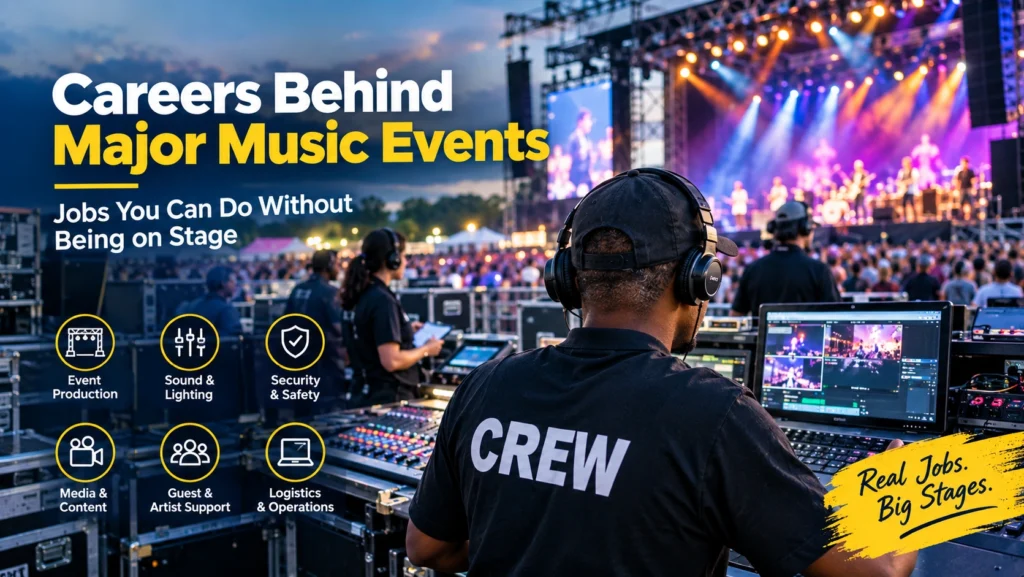

When thousands of people arrive at a music festival, they see the headline performer, the giant screens, the lights and the packed crowd. What they do not see is the enormous team working behind the scenes to make those few hours possible.
A major concert can involve event planners, sound technicians, electricians, stage crews, security personnel, marketers, accountants, drivers, IT specialists, ticketing teams, photographers and hospitality staff. Some may have spent weeks or months preparing before the audience ever enters the venue.
This creates an overlooked career opportunity.
If you love music but cannot sing, play an instrument or perform on stage, you are not automatically excluded from the music industry. There are many Careers Behind Major Music Events where your existing skills in technology, administration, marketing, finance, logistics, customer service or technical work can become useful.
The difficult part is knowing where to start.
Should you study event management? Can you get a concert job without experience? Are temporary festival jobs useful? What qualifications are needed for sound, lighting or production work? And how do you build experience when employers keep asking for experience?
This guide answers those questions and shows how to turn an interest in live entertainment into a practical career plan.
What Really Happens Behind a Major Music Event?
A large music event is much more than an artist and a stage.
Before the first song is performed, teams have already dealt with venue bookings, contracts, ticketing, transportation, equipment, marketing, staffing, security, technical production and health and safety.
During the event, another layer of work begins.
Someone needs to make sure the artist arrives on time. Someone checks that the microphones work. Someone operates the lighting. Someone monitors the stage schedule. Someone handles ticketing problems at the entrance. Someone manages suppliers. Someone creates social-media content. Someone deals with unexpected problems.
After the final performance, the work is still not finished.
Equipment must be removed, venues cleaned, suppliers paid, reports completed and promotional content published.
That is why the live-events industry needs people with very different skills.
A major music event may need people working in:
- Event management
- Production
- Sound and audio
- Lighting
- Electrical and technical services
- Stage management
- Security
- Logistics and transportation
- Marketing
- Public relations
- Ticketing
- Hospitality
- Finance
- IT and technology
- Photography and video
The important lesson is simple: you do not have to be the person on stage to build a career around music.
ALSO APPLY FOR: Carat Media Intern 2026
ALSO APPLY FOR: Double Frame Solutions Intern 2026
Careers Behind Major Music Events: Which Jobs Could Suit You?
Different roles require different combinations of education, experience and practical skills.
| Career | What you could do | Useful background | Possible entry route |
|---|---|---|---|
| Event Coordinator | Help organise schedules, suppliers and staff | Administration, business, events | Internship/assistant |
| Production Assistant | Support the production team | Organisation, technical interest | Small events |
| Sound Technician | Set up and operate audio equipment | Audio/technical training | Assistant role |
| Lighting Technician | Help install and operate stage lighting | Electrical/technical skills | Technical training |
| Stage Manager | Coordinate stage activities and schedules | Communication, production | Assistant/crew |
| Event Marketer | Promote concerts and festivals | Marketing, social media | Portfolio/internship |
| Content Creator | Produce photos, videos and social posts | Photography/video | Portfolio |
| Logistics Coordinator | Organise equipment and transportation | Logistics, administration | Operations assistant |
| Ticketing Staff | Assist with ticketing and venue entry | Customer service | Temporary event work |
| Hospitality Staff | Support guests, VIPs and artists | Hospitality | Event shifts |
| Finance Assistant | Process invoices, budgets and records | Accounting/finance | Internship |
| IT Technician | Support event technology and connectivity | IT/networking | IT support role |
| Security Officer | Help maintain crowd and venue safety | Relevant security training | Licensed security work |
| Driver/Transport Crew | Move people or equipment | Driving/logistics | Transport role |
| Photographer | Capture the event and promotional content | Photography | Portfolio/freelance |
Not every role is suitable for someone without training. Technical, electrical, security, rigging and other safety-sensitive positions can require specific qualifications, licences or supervised experience.
That is important because working around a concert does not mean you can simply teach yourself a high-risk technical task on the day.
1. Event Management: The People Who Connect the Pieces
Event managers are responsible for coordinating multiple parts of an event.
Their work can begin long before tickets go on sale.
Depending on the role, responsibilities may include:
- Coordinating suppliers
- Communicating with venues
- Managing schedules
- Arranging staff
- Tracking deadlines
- Assisting with budgets
- Coordinating event-day operations
- Solving problems when plans change
This career could suit someone who enjoys organising people and information.
A qualification in event management, business, hospitality, communications or project management may be useful.
However, one of the best ways to understand the work is to gain practical experience.
A small community festival can teach you lessons that a classroom cannot.
2. Sound Engineering and Audio Technology
The audience may simply hear music coming from speakers, but live audio is highly technical.
Sound professionals may work with:
- Microphones
- Mixing consoles
- Speakers
- Monitors
- Digital audio systems
- Stage cabling
- Wireless equipment
Potential career paths include sound technician, live audio assistant, monitor technician and sound engineer.
If you are interested in this area, start learning the fundamentals of live audio rather than immediately trying to operate a large concert system.
Useful skills include:
- Understanding signal flow
- Basic audio terminology
- Microphone knowledge
- Troubleshooting
- Digital audio technology
- Team communication
Shadowing or assisting an experienced technician can be particularly valuable.
3. Lighting and Electrical Careers
The dramatic visual experience at a concert is created by a technical team.
Lighting technicians work with lighting fixtures, control systems, cables and production equipment.
This area can be particularly relevant to people who already have electrical or technical training.
But safety should come before curiosity.
Working with electrical systems, suspended equipment or specialist stage infrastructure can involve serious risks. Appropriate training, supervision and workplace procedures are essential.
If you have an electrical qualification, look for legitimate opportunities to apply your skills in entertainment, events, venues or production companies.
ALSO READ ABOUT: Jobs in the Film Industry Besides Acting
4. Production Assistants: One of the Practical Starting Points
If you want to understand how concerts actually work, production can be an interesting route.
A production assistant may support the wider production team with tasks such as:
- Checking schedules
- Coordinating deliveries
- Assisting crew members
- Communicating information
- Preparing production areas
- Helping with setup and breakdown
You may spend more time carrying out practical tasks than sitting behind a desk.
That is exactly why this type of work can be useful.
It exposes you to the relationship between artists, technical crews, suppliers, venues and event organisers.
5. Marketing: The People Who Fill the Venue
An excellent event still needs people to attend.
Marketing teams help turn an upcoming concert into something people know about and want to attend.
Their work can involve:
- Social media
- Digital advertising
- Email marketing
- Influencer partnerships
- Posters and promotional material
- Public relations
- Content creation
- Audience research
You do not necessarily need to wait for a company to give you professional experience.
Create your own portfolio.
For example, choose a fictional music festival and produce:
- Five social-media posts
- One event poster
- A 30-second promotional video
- Three advertising concepts
- A short press release
- A basic content calendar
You have now created evidence of your marketing ability.
That is considerably more useful than simply writing “I am passionate about music” on your CV.
6. Logistics: The Invisible Machine Behind the Show
Imagine a festival requiring hundreds of pieces of equipment.
Where does everything come from?
Who transports it?
Where is it stored?
When does it arrive?
Where does each supplier unload?
Who makes sure the equipment gets to the correct area?
That is where logistics becomes critical.
People working in event logistics may coordinate:
- Vehicles
- Equipment
- Deliveries
- Crew movements
- Storage
- Timetables
- Supplier communication
If you are naturally organised and enjoy solving practical problems, this could be a useful career direction.
A qualification or experience in logistics, supply chain, transport or operations can be valuable beyond the entertainment industry too.
ALSO READ ABOUT: Careers Behind Major Sporting Events
7. IT and Technology Careers at Music Events
Concerts are increasingly dependent on technology.
Technology can support ticketing, communication, payment systems, internet connectivity, digital displays, security systems and other event operations.
This creates opportunities for people with IT skills.
Potential roles include:
- IT support technician
- Network technician
- Systems support
- Event technology assistant
- Technical support specialist
Someone studying IT does not necessarily need to abandon their qualification simply because they want to work around music.
Instead, they can look for ways to combine both interests.
IT + live events can become a niche career direction.
8. Photography, Video and Content Creation
Modern events generate enormous amounts of visual content.
Photographers and videographers may create material for:
- Artists
- Event organisers
- Sponsors
- Social-media platforms
- Media outlets
- Promotional campaigns
The important thing is to build a portfolio.
You can begin by photographing smaller performances, cultural events or community activities where you have permission to work.
Your portfolio should demonstrate:
- Composition
- Technical ability
- Editing
- Storytelling
- Understanding of live environments
Do not simply upload hundreds of photographs.
Choose your strongest work.
ALSO READ ABOUT: How the Creator Economy Is Creating New Jobs
9. Hospitality, Ticketing and Customer Experience
Not every music-event career requires specialist technical knowledge.
Large events also need people dealing directly with attendees.
Jobs may include:
- Ticketing assistant
- Guest-services representative
- Hospitality assistant
- VIP support
- Front-of-house staff
- Customer-service staff
These positions can be useful for people who are building their first event-industry experience.
They can also teach valuable skills in communication, crowd interaction, problem-solving and working under pressure.
Why This Issue Matters
The biggest problem for many aspiring workers is that they define the industry too narrowly.
They see a famous singer and think:
“I need to become a musician to work in music.”
That is not how the industry works.
A major music event is effectively a temporary operation involving multiple professions.
This matters because job seekers may already possess transferable skills that could be useful.
For example:
Accounting graduate → entertainment finance
IT graduate → event technology
Marketing graduate → concert promotion
Logistics graduate → event operations
Electrical graduate → technical production
Hospitality graduate → guest services
The career connection may not be obvious until you deliberately look for it.
It also means that your first event-industry opportunity does not have to be your dream position.
A temporary ticketing role, production assistant position or hospitality shift could give you an opportunity to understand the environment and build contacts.
ALSO READ ABOUT: Careers Inside Airports You Never Hear About
How to Start a Career in the Live-Events Industry
Step 1: Pick a specific career path
Avoid saying:
“I want a job in music.”
Instead say:
“I want to become a live-event production assistant.”
Or:
“I want to work in concert marketing.”
Specific goals make your job search much easier.
Step 2: Research the requirements
Look at several real job advertisements for the career you want.
Create two lists:
Skills I already have
and
Skills I need to develop
This identifies your actual skills gap.
Step 3: Start with smaller events
Do not make your first target the largest festival in the country.
Look at:
- Local concerts
- Community events
- University productions
- Theatre productions
- Conferences
- Cultural festivals
- Corporate events
- Small entertainment venues
Smaller events can provide practical experience without requiring you to compete immediately for highly sought-after positions.
Step 4: Build evidence of your skills
Your CV says what you can do.
Your portfolio shows what you can do.
Depending on your career, build:
- Marketing campaigns
- Photography
- Video
- Event plans
- Production schedules
- Audio projects
- Graphic designs
- IT projects
Step 5: Search using the correct job titles
Instead of searching only for:
“music jobs”
try:
- Event assistant
- Production assistant
- Event coordinator
- Live sound assistant
- Lighting technician
- Event marketing assistant
- Operations assistant
- Event logistics assistant
- Guest-services assistant
- Content creator
- Event IT technician
This can reveal opportunities you would otherwise miss.
Step 6: Treat temporary work seriously
A two-day event job may not sound impressive.
But ask yourself what you can learn.
You could gain experience with:
- Event setup
- Customer interaction
- Venue procedures
- Production schedules
- Team communication
- Crowd management
- Event technology
Record that experience afterwards.
It can strengthen future applications.
Best Practices Experts Recommend
Become known for reliability
Live events operate under strict deadlines.
If a team knows that you arrive when expected, communicate clearly and complete your tasks, you become more valuable.
Learn before asking for opportunities
Before approaching someone, understand what their company does and what role you are interested in.
A thoughtful message is more professional than simply saying, “Do you have a job?”
Keep a career evidence file
After every project, record:
- Date
- Event
- Employer or organisation
- Your role
- Tasks completed
- Equipment or software used
- Skills developed
- Supervisor/contact, where appropriate
This becomes a personal career record.
Develop transferable skills
Even if you eventually leave events, skills such as communication, project management, budgeting, customer service and digital technology remain valuable.
Protect your reputation
The entertainment industry is highly collaborative.
Your behaviour matters.
Be professional with everyone—from security personnel and cleaners to technical directors and artists.
Take safety seriously
Never attempt electrical, rigging, security or other specialist work without appropriate training and authorisation.
A career opportunity is never worth ignoring a safety procedure.
ALSO READ ABOUT: Why Cloud Computing Careers Are Growing
Mistakes People Often Make
1. Waiting for a permanent job
Some people refuse temporary event work because it is not permanent.
That can mean missing an opportunity to gain practical experience.
2. Believing passion is enough
Saying that you love music is not a professional skill.
Employers need to know what you can actually contribute.
3. Applying with a generic CV
A CV for an event-marketing position should look different from one for an IT role.
Highlight the skills relevant to the position.
4. Ignoring smaller events
Small events can be valuable training grounds.
You may get to perform responsibilities that would be divided among several people at a huge festival.
5. Chasing celebrities instead of careers
You do not need access to famous musicians to build a career.
Focus on organisations, companies, venues and professional teams.
6. Paying for fake opportunities
Be extremely cautious if someone promises guaranteed employment, access to famous artists or a guaranteed event position in exchange for money.
Verify the organisation and opportunity independently before providing personal information or making payments.
A Practical 90-Day Plan
If you are serious about entering this industry, turn your interest into a project.
Month 1: Choose and learn
Pick one career path.
Research:
- Qualifications
- Entry-level positions
- Common software
- Industry terminology
- Typical responsibilities
Then identify three skills you need to improve.
Month 2: Create evidence
Complete at least one project.
For example:
Marketing: Create a fictional festival campaign.
Photography: Build a portfolio from permitted local events.
IT: Create a technical project demonstrating relevant skills.
Event management: Develop a detailed plan for a fictional 1,000-person event.
Finance: Create a sample event budget using realistic assumptions.
Month 3: Enter the industry
Start applying for:
- Internships
- Assistant positions
- Temporary event work
- Venue jobs
- Production opportunities
- Marketing positions
- Hospitality roles
At the same time, continue networking and improving your portfolio.
The goal after 90 days is not necessarily to have your dream job.
It is to have a defined career direction, stronger skills, practical evidence and actual industry exposure.
ALSO READ ABOUT: Cybersecurity Careers
Frequently Asked Questions
Can I work in the music industry without being a musician?
Yes. The industry requires many non-performance roles, including event management, marketing, finance, logistics, IT, hospitality, production and technical services.
Do I need a university degree?
Not for every role. Requirements vary considerably. Some technical professions require specialised training, while practical experience and portfolios can be important for other positions.
What is the easiest music-event job to start with?
There is no single entry-level role that is easiest for everyone. Temporary event work, hospitality, ticketing, administration and assistant positions can provide entry points, depending on your existing skills and the requirements of the employer
Can a short-term concert job help my career?
Yes. If the work is legitimate and relevant, it can provide practical experience, references, professional contacts and a better understanding of the industry.
Final Advice
The most useful way to think about Careers Behind Major Music Events is to stop looking only at the stage.
Look behind it.
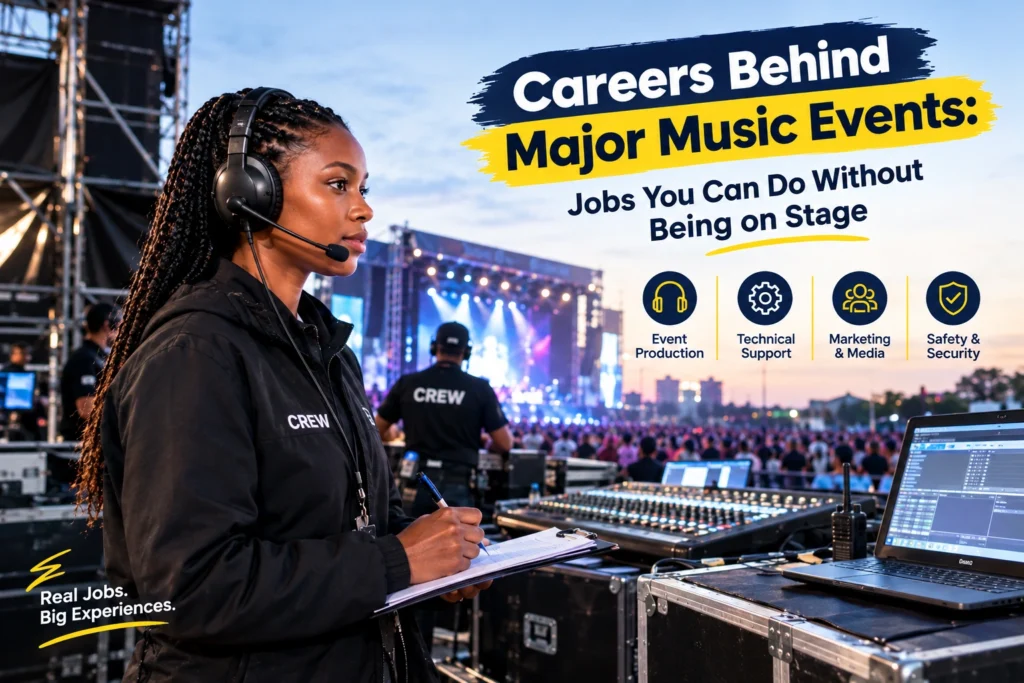
Look at the person checking the production schedule. The technician testing the microphone. The marketer publishing the event campaign. The IT professional troubleshooting the ticketing system. The logistics coordinator organising equipment. The accountant tracking payments. The hospitality team looking after guests.
Every one of these jobs requires skills.
If you want to enter the industry, identify the skill you can offer—or the skill you are prepared to learn—and build from there.
Start small. Gain practical experience. Build a portfolio. Apply for relevant entry-level positions. Keep records of what you learn. Most importantly, do not assume that being passionate about music is the only qualification that matters.
The people behind the biggest music events are professionals doing specialised jobs. Your path into the industry begins when you identify which of those jobs matches your abilities and start preparing for it.