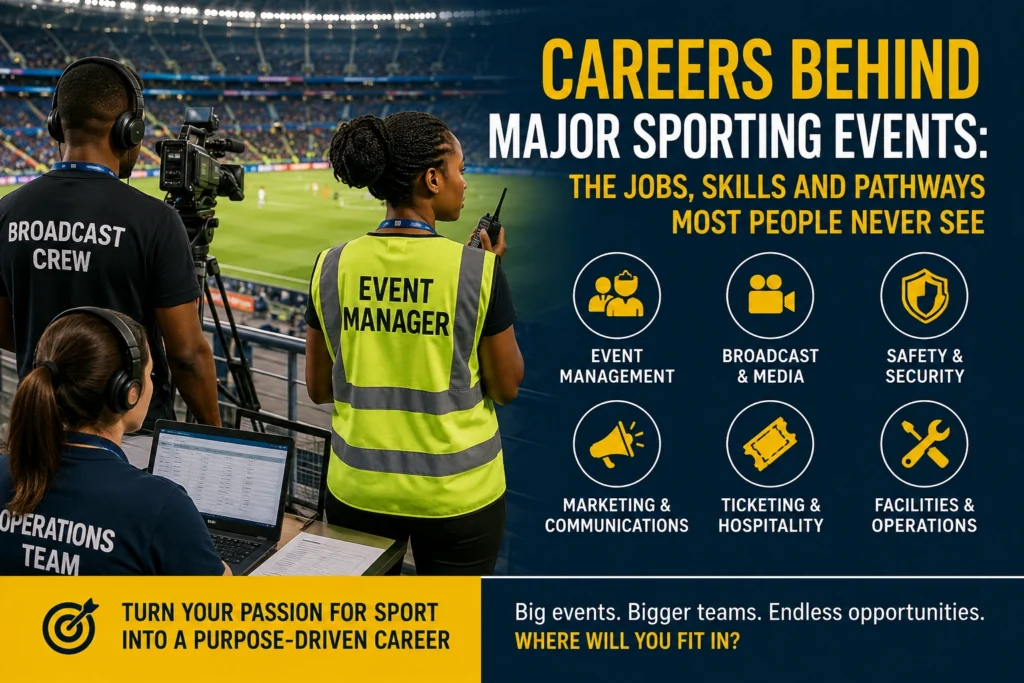

A packed stadium makes a major sporting event look simple: athletes compete, spectators cheer and the winners collect their medals. What audiences rarely see is the enormous workforce operating behind the scenes.
Before the first whistle, thousands of decisions may already have been made. Venues need to be prepared, tickets processed, transport coordinated, security planned, technology tested and media operations established. Sponsors need to be supported, guests welcomed and emergency procedures ready.
That creates an opportunity that many job seekers overlook.
You do not have to be a professional athlete to build a career in sport. You may already have skills that sporting organisations, venues, broadcasters, sponsors and event companies need.
The challenge is knowing where those opportunities are, which qualifications matter, how to gain experience and how to turn a short-term event job into a longer-term career.
This guide explores Careers Behind Major Sporting Events, the skills employers value and practical ways to position yourself for opportunities in this competitive industry.
What Are Careers Behind Major Sporting Events?
Careers behind major sporting events are the professional and support roles that make sporting competitions possible.
These positions can exist before, during and after an event.
For example, an international tournament may require people to:
- Plan the event programme.
- Prepare and manage venues.
- Coordinate transport.
- Manage spectators and guests.
- Operate ticketing systems.
- Produce television and digital content.
- Protect athletes and spectators.
- Manage suppliers and contractors.
- Handle budgets and payments.
- Promote the event.
- Maintain IT systems.
- Coordinate volunteers.
- Provide medical and emergency support.
- Analyse data and event performance.
This is why the sports industry is much larger than what happens on the playing surface.
A person with an accounting qualification can work in sports finance. An IT graduate can work with event technology. A marketing graduate can work with sponsors and digital campaigns. A hospitality graduate can manage VIP experiences.
ALSO APPLY FOR: MTN Internships 2026
ALSO APPLY FOR: Takealot Group Intern 2026
The key is to connect your existing skill set to a sporting environment.
Why This Issue Matters
Sporting events can create demand for a wide range of occupations, but many young people search for jobs using only terms such as “sports jobs” or “football jobs.”
That approach can cause them to miss opportunities.
A job advertisement might never mention “sport” in its title. Instead, it could be called:
- Event Coordinator
- Operations Assistant
- Digital Content Producer
- Venue Assistant
- IT Support Technician
- Logistics Coordinator
- Guest Services Officer
- Marketing Assistant
- Procurement Administrator
- Finance Officer
- Security Coordinator
The connection to sport may only become clear when you examine the employer or event.
For South African job seekers, this broader approach can be especially useful when looking at stadiums, sporting federations, clubs, event organisers, broadcasters, hospitality companies, sponsors and major venues.
The lesson is simple: search for the function you can perform, not only the sport you love.
The Biggest Careers Behind Major Sporting Events
There is no single route into this industry. Your best option depends on your education, skills, interests and previous experience.
| Career area | Typical responsibilities | Useful skills/qualifications | Possible entry point |
|---|---|---|---|
| Event Management | Planning schedules, suppliers and operations | Project management, organisation | Event assistant |
| Marketing | Campaigns, promotions, sponsors and social media | Marketing, communications, digital skills | Marketing assistant |
| Media | Articles, interviews, photography and video | Journalism, writing, editing | Content assistant |
| IT | Networks, systems, ticketing and technical support | IT, networking, cybersecurity | IT support |
| Hospitality | Guest services, VIP areas and catering | Hospitality, customer service | Guest services |
| Logistics | Transport, equipment and deliveries | Logistics, supply chain | Logistics assistant |
| Finance | Budgets, invoices and financial reporting | Accounting, finance | Finance administrator |
| Security | Access control, safety and crowd management | Security training, risk awareness | Security/event support |
| Venue Operations | Facilities, equipment and event readiness | Operations, technical skills | Venue assistant |
| Data | Attendance, performance and audience analysis | Statistics, analytics, Excel | Data assistant |
This table highlights an important point: there are multiple ways into the sports industry.
1. Event Management and Operations
Event managers are responsible for turning plans into reality.
Their work may involve coordinating:
- Staff
- Contractors
- Equipment
- Venues
- Timetables
- Suppliers
- Volunteers
- Accreditation
- Event-day operations
This career suits people who remain organised when there are multiple deadlines.
Skills that can help
- Project management
- Time management
- Communication
- Problem-solving
- Budget awareness
- Attention to detail
- Ability to work under pressure
A useful way to gain experience is to help organise community tournaments, school competitions, charity events or university sporting activities.
2. Sports Marketing and Sponsorship
Major sporting events need audiences and commercial partners.
Marketing professionals may promote competitions through social media, advertising, email campaigns, websites and other channels.
Sponsorship professionals have a different but related responsibility: helping brands receive value from their association with an event.
Their work may include:
- Sponsor activations
- Advertising campaigns
- Brand visibility
- Social media content
- Audience research
- Promotional events
- Campaign reporting
How to stand out
Don’t simply say you are “passionate about sports marketing.”
Create evidence.
For example, build a sample campaign for a fictional football tournament showing:
- Target audience
- Social media strategy
- Example posts
- Advertising ideas
- Sponsorship opportunities
- Expected campaign objectives
That portfolio can demonstrate practical thinking before you have formal experience.
3. Sports Media, Journalism and Content Creation
Fans increasingly consume sporting content through websites, social media, streaming platforms and mobile devices.
This creates opportunities for:
- Sports writers
- Journalists
- Photographers
- Videographers
- Editors
- Social media managers
- Content producers
- Camera operators
- Production assistants
A journalism qualification can help, but a strong portfolio is also valuable.
If you want to enter sports media, start producing work.
You could:
- Write match reports.
- Interview local athletes.
- Photograph community competitions.
- Create short sports videos.
- Produce player profiles.
- Analyse sporting events.
- Build a professional social media portfolio.
Your first portfolio does not need to cover a World Cup or international championship. Local sport is enough to demonstrate your ability.
4. Technology and IT
Technology has become essential to modern sporting events.
IT professionals can be involved in:
- Ticketing platforms
- Digital accreditation
- Network connectivity
- Stadium Wi-Fi
- Cybersecurity
- Websites
- Data systems
- Communication platforms
- Technical support
This is one of the strongest options for someone who loves technology but does not necessarily want a traditional office environment.
Skills worth developing
Depending on your career direction, consider learning:
- Networking
- Cybersecurity
- Cloud technologies
- Database management
- Data analysis
- Technical support
- Website administration
- Troubleshooting
You do not need to become an expert in everything.
Choose one technical area and build genuine competence.
5. Data and Analytics
Modern sport generates enormous amounts of information.
Data can be used to understand:
- Attendance
- Ticket sales
- Fan behaviour
- Social media performance
- Merchandise sales
- Sponsorship results
- Player performance
- Operational efficiency
This creates opportunities for people with backgrounds in mathematics, statistics, economics, computer science, business analytics and related fields.
Even strong Excel skills can provide a useful starting point for entry-level administrative or analytical roles.
6. Hospitality and Guest Services
A major sporting event is also a customer experience.
Spectators, sponsors, athletes, officials, journalists and VIP guests may all require different services.
Hospitality professionals can work in:
- VIP lounges
- Guest relations
- Hotels
- Catering
- Stadium hospitality
- Corporate hospitality
- Front-of-house operations
For someone without extensive experience, hospitality can be a practical entry point because customer-service skills are transferable across many employers.
7. Logistics and Transport
Imagine moving thousands of people and tonnes of equipment to the right locations at the right time.
That is a logistics challenge.
Teams may coordinate:
- Athlete transportation
- Equipment deliveries
- Vehicle schedules
- Warehousing
- Supplier deliveries
- Venue access
- Staff movement
- Event infrastructure
Qualifications in logistics, supply chain management, transport or operations can be useful.
However, organisational ability and practical experience also matter.
8. Finance, Procurement and Administration
Sport is also a business.
Large events require budgets, contracts, purchasing processes, supplier management, payroll and financial reporting.
This creates opportunities for:
- Bookkeepers
- Accountants
- Finance administrators
- Procurement officers
- Payroll staff
- Administrative assistants
- Business analysts
This is an important reminder that you can work in sport without having a sports-related qualification.
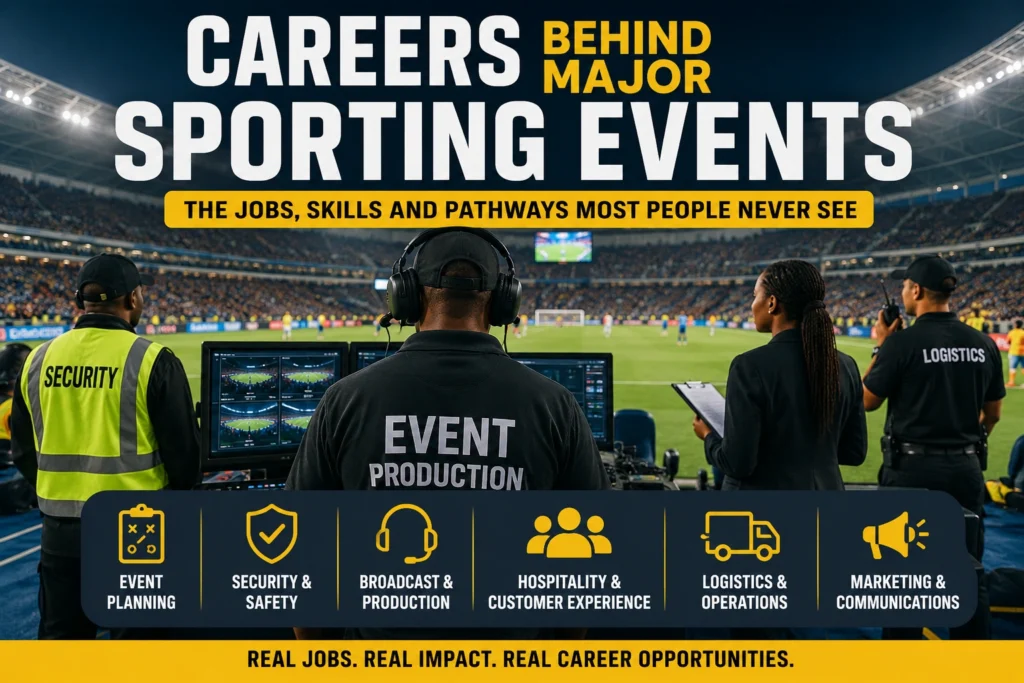
9. Security, Safety and Risk Management
Large crowds require careful planning.
Security and safety teams may be responsible for access control, crowd movement, emergency response procedures, restricted areas and general venue safety.
Requirements vary depending on the position, employer and jurisdiction, and certain roles may require specific training, registration or certification.
People interested in this area should always verify the employer’s requirements rather than assuming that informal experience is sufficient.
ALSO READ ABOUT: 7 Bursary Application Mistakes
How to Get Your First Opportunity
Getting your first role is often the hardest part.
The most effective strategy is to stop waiting for a perfect vacancy and start building relevant evidence.
Step 1: Choose One Career Lane
Do not apply for every sports-related position simply because it involves sport.
Choose one primary area.
For example:
“I want to work in sports marketing.”
That gives you a clear development plan.
You can then focus on marketing qualifications, social media skills, content creation and campaign experience.
Step 2: Audit Your Existing Skills
Write down:
- Your qualifications
- Software you know
- Previous work experience
- Volunteer experience
- Communication skills
- Technical skills
- Customer-service experience
- Event experience
- Leadership experience
Then ask:
Which sporting industry roles could use these skills?
You may discover that you are already closer to the industry than you thought.
Step 3: Start With Smaller Events
One of the biggest mistakes aspiring sports professionals make is waiting for a major tournament.
Instead, start locally.
Look for opportunities at:
- School sports days
- University competitions
- Running events
- Community tournaments
- Local football matches
- Athletics meetings
- Charity sporting events
- Amateur leagues
You may be able to volunteer or assist with registration, media, logistics, administration or customer service.
The experience can become evidence on your CV.
Step 4: Build a Sports Portfolio
A portfolio can be more convincing than a statement of ambition.
Your portfolio might contain:
- Event plans
- Marketing campaigns
- Sports articles
- Photography
- Video projects
- Social media campaigns
- Data dashboards
- Design work
- Event reports
Choose examples that match the career you want.
Step 5: Search Beyond Job Boards
Do not depend on one website.
Monitor:
- Sporting organisations
- Stadium operators
- Event management companies
- Broadcasters
- Sports clubs
- Hospitality companies
- Sponsors
- Advertising agencies
- Technology companies
- Government and municipal sporting programmes
- Professional networking platforms
Also search using combinations such as:
“event coordinator” + sport
“venue operations” + stadium
“sports marketing” + internship
“event assistant” + athletics
“sports media” + graduate
This can uncover opportunities that a generic “sports jobs” search misses.
Best Practices Experts Recommend
If you want to build a serious career, focus on becoming useful.
1. Combine sport knowledge with professional skills
Sport knowledge alone may not distinguish you from hundreds of applicants.
Sport + IT, sport + marketing or sport + finance creates a stronger professional profile.
2. Build relationships ethically
Networking does not mean asking strangers for jobs.
Instead:
- Attend industry events.
- Follow professionals online.
- Ask thoughtful questions.
- Learn about different career paths.
- Share useful work.
- Keep professional relationships active.
3. Treat temporary work seriously
A short contract can provide valuable experience.
During the assignment:
- Arrive on time.
- Learn quickly.
- Communicate professionally.
- Volunteer for appropriate responsibilities.
- Build relationships.
- Ask for feedback.
A temporary position can become a reference or lead to another opportunity.
4. Keep developing your skills
The industry changes with technology.
Continue learning about areas relevant to your career, especially digital communication, data, event technology and customer experience.
Mistakes People Often Make
Mistake 1: Thinking you must be an athlete
You don’t.
The majority of jobs behind major sporting events involve professional skills rather than athletic ability.
Mistake 2: Waiting for a famous event
Your first opportunity is more likely to come from a smaller event.
Use local experience as a stepping stone.
Mistake 3: Sending the same CV everywhere
Tailor your CV to the position.
Highlight the experience most relevant to the employer’s requirements.
Mistake 4: Having no evidence of your skills
If you claim to be good at marketing, writing, design, data or video, show examples.
Mistake 5: Ignoring temporary opportunities
Short-term work can be extremely valuable early in your career.
Mistake 6: Paying for a job
Be extremely cautious of anyone promising guaranteed employment in exchange for money.
Legitimate employers should provide clear information about the position, recruitment process and requirements.
A Practical 30-Day Plan for Aspiring Sports Professionals
If you are unsure where to begin, use the next month to create momentum.
Week 1: Choose your direction
Select one area:
- Marketing
- Events
- IT
- Media
- Hospitality
- Logistics
- Finance
- Security
- Venue operations
Week 2: Improve one skill
Spend time developing a skill directly connected to your chosen field.
Week 3: Build one portfolio project
Create something that demonstrates your ability.
For example, a marketing applicant could develop a mock campaign for a local sporting event.
Week 4: Start applying and networking
Identify suitable organisations and opportunities.
Apply selectively and tailor each application.
At the same time, connect professionally with people working in your target field.
The objective is not to transform your career in 30 days. It is to move from interested spectator to active candidate.
Frequently Asked Questions
Do I need a sports degree to work at major sporting events?
No. Many roles require qualifications in areas such as IT, finance, marketing, logistics, journalism, hospitality or business administration.
Can someone with Matric enter this industry?
Yes. Entry-level opportunities, volunteering, hospitality, administration, event support and certain operational roles may provide starting points, depending on the employer’s requirements.
Is volunteering worth it?
It can be, particularly when you are using it to gain relevant experience, references and practical knowledge. Choose opportunities that give you meaningful responsibilities rather than simply adding a name to your CV.
What is the best career behind a sporting event?
There is no single best option. The strongest career is the one that matches your skills, qualifications and interests. IT, data, marketing, event management, logistics, media, hospitality and finance can all provide viable pathways.
Final Takeaway
The most important thing to understand about Careers Behind Major Sporting Events is that the stadium is only the visible part of a much larger industry.
Behind every successful competition are people managing money, technology, transport, communications, security, hospitality, media, suppliers and thousands of operational details.
That means your entry point may not have “sport” in the job title at all.
If you are interested in this industry, start by identifying the professional skill you can offer. Then gain practical experience, build a portfolio, improve your CV and begin following organisations that operate in the sports and events ecosystem.
You do not need to wait until a global tournament comes to your city.
Start with the event that is happening near you. Build the skill you can use. Create evidence of what you can do. Then use that experience to move towards bigger opportunities.
That is a much more realistic pathway into the sporting industry than simply waiting for a dream job to appear.