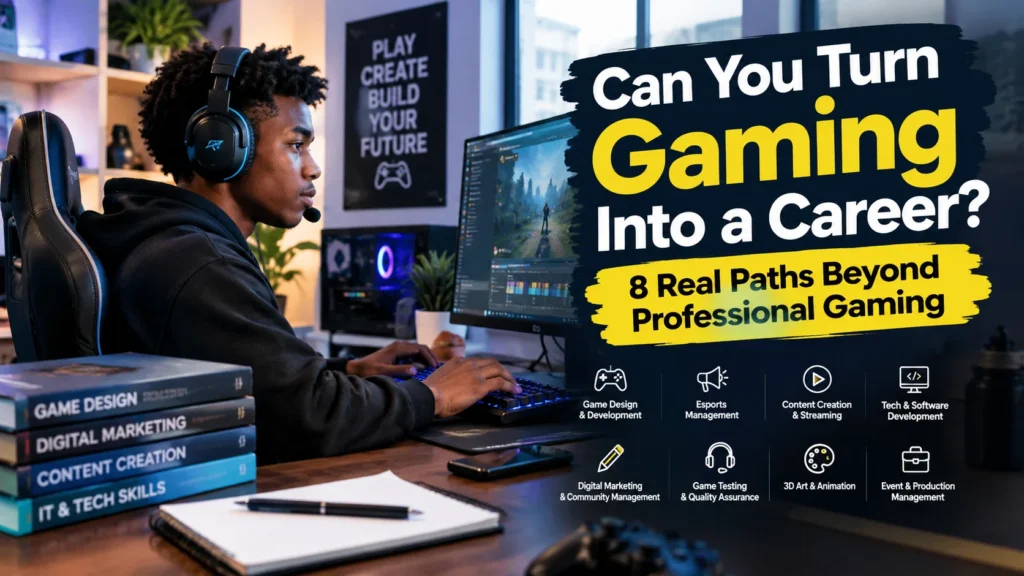

For years, parents have told young people to stop playing games and concentrate on “something useful”. But the gaming industry has changed dramatically. What was once viewed almost entirely as entertainment has developed into a global industry involving technology, media, design, marketing, esports and content creation.
That creates an interesting question for young South Africans who spend their free time gaming: Can you turn gaming into a career?
Yes, but there is an important catch.
You are unlikely to build a sustainable career simply by playing games for long hours. The opportunity comes from turning your interest in gaming into valuable skills, content, experience or services that other people are willing to pay for.
You could become an esports competitor, streamer, gaming content creator, programmer, game designer, 3D artist, video editor, QA tester, community manager or digital marketer.
The trick is knowing which path suits you and what you need to do before expecting an income.
What Does a Gaming Career Really Look Like?
When people hear “gaming career”, they often imagine a professional esports player sitting on a stage competing for prize money.
That is only one part of the industry.
Behind every major game, tournament or gaming channel is an ecosystem of people working on technology, artwork, video, marketing, community management and business operations.
Consider these possibilities:
| Gaming career | Main responsibility | Skills to develop | Portfolio idea |
|---|---|---|---|
| Esports player | Competitive gaming | Strategy, teamwork, discipline | Tournament results |
| Streamer | Live entertainment | Communication, personality, consistency | Streaming channel |
| Content creator | Gaming videos and posts | Editing, research, storytelling | YouTube/TikTok portfolio |
| Game developer | Builds games | Programming, debugging | Small playable games |
| Game designer | Creates gameplay experiences | Creativity, systems thinking | Game design document |
| QA tester | Finds and reports bugs | Testing, observation, documentation | Sample bug reports |
| 3D artist | Creates game assets | Modelling, texturing, animation | 3D portfolio |
| Video editor | Produces gaming content | Editing, sound, storytelling | Edited gaming videos |
| Community manager | Engages players | Communication, moderation | Community projects |
| Gaming marketer | Promotes games/events | Marketing, analytics, social media | Campaign examples |
This is why aspiring gaming professionals should ask a better question than “How do I get paid to play?”
Ask:
“Which problem in the gaming industry can I learn to solve?”
That question can completely change your approach.
ALSO APPPLY FOR: Arjo YES Learnership 2026-2027
ALSO APPLY FOR: (SA) Citi Learnerships 2026-2027
Why This Issue Matters
The gaming industry sits at the intersection of several growing fields: technology, entertainment, social media and digital communication.
For a young person trying to enter the job market, that matters because gaming can provide a practical environment in which to develop transferable skills.
For example, someone creating gaming videos could learn:
- Video editing
- Thumbnail design
- Search engine optimisation
- Social media management
- Copywriting
- Audience research
- Analytics
- Storytelling
A person developing a game could learn:
- Programming
- Problem-solving
- Project management
- User experience
- Testing
- Digital design
These skills are not limited to gaming.
A video editor could eventually work with businesses. A programmer could move into software development. A digital marketer could work for an agency. A 3D artist could explore advertising, animation or visualisation.
Gaming can therefore be viewed as a skills laboratory.
However, there is another side of the story.
Gaming income can be unpredictable. A creator can have a successful video followed by several videos that attract very little attention. An esports player can perform well but still face limited opportunities. A streamer may build an audience without earning enough to make streaming a full-time job.
That is why skill development should come before income expectations.
8 Gaming Career Paths You Can Explore
1. Professional Esports
If competitive gaming is your strongest skill, esports is the most obvious career path.
But being good at a game is only the starting point.
Professional competitors need to develop:
- Advanced game knowledge
- Mechanical skills
- Team communication
- Strategic thinking
- Mental discipline
- Match analysis
- Consistent practice
- Professional behaviour
Start by competing in legitimate local and online tournaments.
Keep records of your results. Save match footage. Study your mistakes.
A useful question after every competition is:
What specifically cost me the match?
Perhaps your positioning was poor. Maybe communication broke down. Perhaps you made predictable decisions.
Professional improvement comes from identifying those patterns rather than simply playing more matches.
Important reality check
Do not build your entire financial future around tournament winnings when you are still developing as a player.
Treat competitive gaming as one part of your career plan until you have evidence that it can generate reliable income.
2. Streaming
Streaming combines gaming with entertainment.
Your gameplay matters, but viewers may stay because they enjoy your personality, commentary, humour, expertise or interaction with the community.
A new streamer therefore needs to answer:
Why should somebody watch me instead of hundreds of other streamers?
Possible niches include:
- Beginner-friendly gaming
- Competitive analysis
- Funny challenges
- South African gaming
- Game tutorials
- Esports commentary
- Horror-game reactions
- Gaming news
- Speedrunning
- Retro gaming
Choose a clear identity rather than attempting to appeal to everyone.
Start before buying expensive equipment
You do not need the most expensive microphone, camera or gaming PC to begin.
Prioritise:
- Clear audio
- Stable internet
- Good lighting if using a camera
- Consistent content
- A clear niche
Upgrade equipment when it solves an actual problem.
ALSO READ ABOUT: How Brands Hire TikTok Content Creators
3. Gaming Content Creation
You do not have to livestream to build a gaming career.
You could create:
- YouTube videos
- TikTok clips
- Gaming guides
- Reviews
- Tutorials
- Esports analysis
- Gaming news
- Walkthroughs
- Podcasts
- Articles
This can be particularly useful because content creation teaches several commercially valuable skills at once.
A simple content workflow
Find a question → research it → create the content → edit it → publish it → study the response → improve the next piece.
For example:
Instead of making another generic gameplay video, create:
“5 Mistakes New Players Make in [Game]”
That gives the viewer a reason to click because the content solves a specific problem.
4. Game Development
If you enjoy asking how games are built, development could be more suitable than streaming.
Game developers can work across areas such as programming, gameplay systems, tools, interfaces and technical implementation.
You can begin with a very small project.
Do not attempt to build a massive multiplayer game as your first project.
Build something simple:
- A basic platformer
- A puzzle game
- A short adventure
- A simple mobile game
- A small multiplayer prototype
The objective is not to become famous.
The objective is to finish something.
A completed small project teaches you about planning, debugging, testing and publishing.
5. Game Design
Game designers think about how a game actually works.
They may consider:
- Rules
- Levels
- Player progression
- Difficulty
- Rewards
- Challenges
- Game mechanics
- User experience
You can practise without being employed by a studio.
Take a game you know well and analyse it.
Ask:
- Why is the opening level easy?
- When does the difficulty increase?
- How does the game reward progress?
- What makes the player continue?
- Which mechanics become repetitive?
- What would you change?
Then create your own game concept.
Write down the mechanics, objectives, progression system and target audience.
That document becomes an early portfolio piece.
6. Game Testing and Quality Assurance
One misconception is that game testing means playing games for fun all day.
Professional QA is much more systematic.
A tester may need to repeat the same action many times to determine exactly when a problem occurs.
For example:
Problem: The character becomes stuck after entering a particular area.
A useful bug report should explain:
- Where the problem occurs
- What the tester did
- The exact steps to reproduce it
- What should have happened
- What actually happened
- Whether the problem happens consistently
- Screenshots or video evidence where appropriate
This makes attention to detail and written communication important skills.
If you enjoy finding problems, QA could be worth investigating.
ALSO READ ABOUT: Careers Behind Major Music Events
7. Gaming Video Editing and Design
There is a huge difference between raw gameplay footage and a polished video.
Creators need people who can:
- Remove boring sections
- Add captions
- Improve pacing
- Synchronise sound
- Create transitions
- Produce thumbnails
- Turn long videos into short clips
This means you can potentially enter the gaming ecosystem without becoming a gamer with a large following yourself.
You could become the person helping creators produce better content.
Start by editing your own videos.
Then offer to edit short clips for smaller creators and build a portfolio.
8. Gaming Community and Marketing Careers
Games need communities.
Companies and organisations may need people to manage social-media conversations, communicate announcements, organise events and understand player feedback.
Marketing is another major area.
A gaming company needs to attract players and communicate why its product is worth their attention.
Skills that can help include:
- Social media
- Copywriting
- Analytics
- Graphic design
- Community management
- Customer communication
- Digital advertising
These skills can also transfer into industries outside gaming.
ALSO READ ABOUT: The Skills That Could Become Essential by 2030
How to Turn Gaming Into a Career: A Step-by-Step Plan
If you are starting with no experience, do not wait for someone to hand you a job.
Build evidence that you can do the work.
Step 1: Choose one primary path
Pick one:
- Esports
- Streaming
- Content creation
- Programming
- Game design
- QA
- Video editing
- 3D art
- Community management
You can explore other areas later.
Step 2: Identify the skills employers or clients need
For example:
Game developer → programming, debugging, game engines
Video editor → editing software, storytelling, sound
Streamer → communication, entertainment, audience building
QA tester → observation, testing, documentation
Do not learn randomly. Learn according to the career you want.
Step 3: Build three small projects
This is one of the most useful steps.
Instead of saying:
“I am interested in gaming.”
You want to eventually say:
“Here are three things I have created.”
Examples:
- Three edited gaming videos
- Three game prototypes
- Three 3D models
- Three detailed game reviews
- Three professional bug-report examples
- Three social-media campaigns
Projects provide evidence of ability.
Step 4: Create a simple portfolio
Your portfolio does not need to be complicated.
Include:
- Your name
- Your chosen field
- A short introduction
- Your best projects
- Skills
- Contact information
- Links to relevant work
Quality matters more than quantity.
Five strong examples can be more useful than 30 unfinished projects.
Step 5: Get real experience
Look for:
- Internships
- Junior opportunities
- Freelance work
- Gaming events
- Esports competitions
- Volunteer projects
- Creator collaborations
- Student projects
Your first opportunity may not be glamorous.
That is okay.
The purpose is to obtain experience that strengthens your next application.
The 90-Day Gaming Career Challenge
If you want something practical, try this three-month plan.
| Period | Main objective | What to do |
|---|---|---|
| Days 1–30 | Learn | Pick one skill and practise consistently |
| Days 31–60 | Create | Complete 2–3 portfolio projects |
| Days 61–90 | Publish & connect | Publish work, network and seek opportunities |
During the first month
Spend your time learning rather than worrying about followers.
During the second month
Start producing actual work.
During the third month
Put your work where people can see it.
Contact creators, studios, communities and organisations professionally.
The goal after 90 days is not necessarily to have a full-time job.
The goal is to have skills + evidence + visibility + direction.
That is a much stronger starting position.
How to Know Which Gaming Career Suits You
Your favourite game does not necessarily determine your best career.
Instead, look at what you naturally enjoy doing.
| If you enjoy… | Consider exploring… |
|---|---|
| Competition and strategy | Esports |
| Talking to people | Streaming/community management |
| Making videos | Content creation/video editing |
| Coding | Game development |
| Drawing | Game art |
| Solving problems | QA/testing |
| Designing experiences | Game design |
| Analysing audiences | Marketing |
| Writing | Gaming journalism/content |
This is important because your career should be based on your strengths and interests, not simply the amount of time you spend playing.
Best Practices Experts Recommend
A professional approach to gaming starts with treating your work seriously.
Build transferable skills
Do not learn a skill that is useful only in one narrow situation.
Programming, editing, communication, design and marketing can open doors in multiple industries.
Finish projects
A finished small project is valuable.
An unfinished ambitious project teaches less about your ability to deliver.
Create consistently
Whether you are making videos, art or games, regular production improves your skills.
Study analytics
If you create content, do not only look at views.
Look at:
- Watch time
- Audience retention
- Click-through rate
- Engagement
- Returning viewers
The numbers can help you understand what your audience actually responds to.
Network without begging
Instead of sending strangers messages saying “Please give me a job”, demonstrate your work.
Ask thoughtful questions.
Share useful contributions.
Build genuine professional relationships.
Keep another income option
Until your gaming income becomes consistent, maintain another source of income where possible.
This reduces financial pressure and gives you time to develop your gaming career properly.
Mistakes People Often Make
Playing instead of practising a professional skill
Gaming for six hours is not necessarily career development.
Expecting instant followers
Most creators do not become successful overnight.
Copying popular creators
Study successful creators, but develop your own angle.
Spending before earning
Do not spend thousands of rand on equipment before proving that you are committed to the path.
Ignoring education and qualifications
A gaming career and formal education are not mutually exclusive.
Programming, media, business, design and technology qualifications can complement gaming interests.
Falling for scams
Be cautious about opportunities promising guaranteed gaming jobs, guaranteed sponsorships or instant income.
Be especially careful if someone asks you to pay money to secure employment.
Neglecting your health
A career built around screens still requires sleep, movement, breaks and a sustainable routine.
How Gaming Can Become a Career Even If You Never Become Famous
This may be the most important lesson.
You do not need millions of followers to build a gaming-related career.
Imagine someone starts making gaming videos at 18.
They learn video editing.
Then they learn graphic design.
They begin editing videos for smaller creators.
Later, they learn digital marketing.
Eventually, their portfolio includes gaming campaigns, edited videos and social-media work.
Their career may eventually have very little to do with personally playing games.
Yet gaming was the starting point.
That is why young people should not think of gaming careers as a choice between “professional gamer” and “nothing.”
There is an entire middle ground.
Frequently Asked Questions
Can you turn gaming into a career without being a professional gamer?
Yes. Gaming supports careers in development, design, QA, video editing, content creation, marketing, community management, art and other fields.
Do I need expensive gaming equipment?
Not necessarily. Start with equipment that allows you to produce acceptable work. Upgrade when better equipment solves a genuine limitation.
What is the best gaming career to start with?
There is no universal answer. Consider your strongest interests and skills. Someone who loves coding may be better suited to development, while someone who enjoys communication may prefer content creation or community management.
Final Summary: Turn Your Gaming Interest Into Something Valuable
Can you turn gaming into a career? Absolutely—but the sustainable route is usually not simply playing more games.
The bigger opportunity is learning how the gaming ecosystem works and finding a valuable skill within it.
You can:
- Compete in esports
- Build a streaming channel
- Create gaming content
- Develop games
- Design gameplay
- Test software
- Create 3D artwork
- Edit videos
- Manage gaming communities
- Work in gaming marketing
The most practical strategy is simple:
Choose one path → learn the required skills → build projects → create a portfolio → gain experience → network → apply for opportunities → keep improving.
If you are currently spending hours gaming every week, challenge yourself to turn some of that time into productive development.
Instead of only finishing another game, finish a project.
Instead of only watching another streamer, study how they build an audience.
Instead of buying another accessory, learn a skill that could eventually pay for it.
Your first objective should not be “make money from gaming.”
It should be:
Become good enough at something valuable that gaming becomes the doorway to an opportunity.
That shift—from consumer to creator, learner and professional—is where a gaming hobby can start becoming a genuine career pathway.