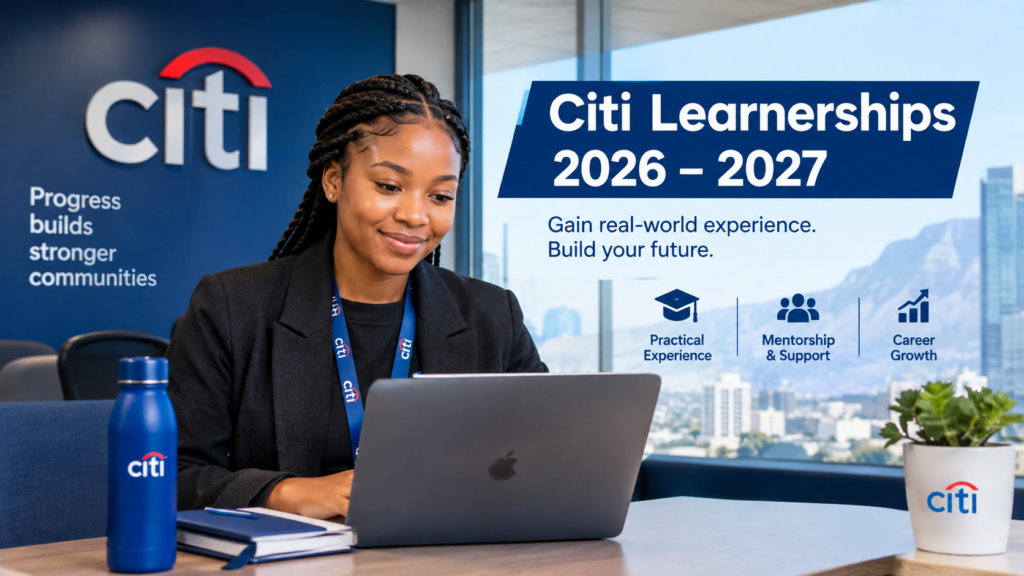

Finding a graduate opportunity in South Africa can be difficult even after you have completed a university degree. Many entry-level financial services positions ask for previous workplace experience, while graduates are expected to somehow gain that experience before they can qualify.
The (SA) Citi Learnerships 2026-2027 programme offers a different route. Citi South Africa is inviting newly qualified graduates to apply for its Graduate Learnership Programme – Markets in Johannesburg. The one-year programme is designed to provide practical exposure to the financial services industry, with successful candidates placed within Equities and Markets.
For graduates interested in investment banking, financial markets, trading, equities or broader financial services careers, the opportunity is worth understanding carefully before applying. It is not simply about having a degree. Candidates need to demonstrate strong academics, professional readiness and a genuine interest in the environment in which they will work.
Important: The information supplied for this article does not specify an application closing date. Applicants should verify the current vacancy and closing information through Citi’s official recruitment channels before submitting personal information.
What Are the (SA) Citi Learnerships 2026-2027?
The Citi South Africa Graduate Learnership Programme is a 12-month workplace-based opportunity aimed at newly qualified university graduates.
Unlike a purely academic programme, the learnership is intended to expose participants to the working environment of a major financial institution. Successful candidates will be placed in Equities and Markets, where they can gain practical knowledge of how financial markets operate.
The opportunity is based in:
| Programme detail | Information |
|---|---|
| Organisation | Citi South Africa |
| Programme | Graduate Learnership Programme – Markets |
| Location | Johannesburg, Gauteng |
| Duration | 1 year |
| Level | Graduate / Entry Level |
| Work experience | Not required; up to 1 year acceptable |
| Qualification | Undergraduate or Master’s degree |
| Academic requirement | 65% GPA or above for undergraduate applicants |
| Field of study | Any academic discipline |
| Advantage | Accounting qualification |
| Closing date | Not specified in the supplied information |
One particularly important detail is that your degree does not necessarily have to be in finance or accounting. The stated requirement allows applicants from any academic discipline, provided they meet the relevant academic requirement.
Accounting, however, is specifically identified as an advantageous qualification.
Why This Issue Matters
A university qualification can demonstrate that you have acquired academic knowledge, but employers also want evidence that you can operate in a professional environment.
This is one reason graduate programmes and learnerships can be valuable. They can bridge the gap between academic achievement and workplace capability.
For a graduate interested in financial services, practical exposure may help develop skills such as:
- Professional communication
- Analytical thinking
- Understanding financial markets
- Working with colleagues and managers
- Research and information analysis
- Time management
- Attention to detail
- Problem-solving
- Workplace professionalism
- Understanding how a large financial organisation operates
The Citi programme is particularly interesting because it is positioned within Markets, rather than being a generic graduate opportunity.
That distinction matters. Someone interested in financial markets may gain more relevant exposure from working around Equities and Markets than from an unrelated administrative graduate programme.
However, applicants should also keep expectations realistic. Completing a learnership does not automatically guarantee permanent employment. The main value is the combination of workplace exposure, learning and professional development.
Who Can Apply for Citi’s Graduate Learnership?
The supplied requirements are relatively straightforward.
Applicants must have completed either an undergraduate or Master’s degree.
For undergraduate applicants, Citi requires a minimum 65% GPA or above.
The degree can be in any academic discipline.
This opens the programme to graduates who may initially assume that financial-sector opportunities are only available to people with finance degrees.
For example, depending on the employer’s recruitment assessment, graduates from fields outside traditional finance may still be eligible because the stated degree requirement is not restricted to one subject.
Work experience is not compulsory
Another important feature is the experience requirement.
Citi states that applicants do not need previous work experience, although candidates with up to one year of experience may still be eligible.
This makes the programme particularly relevant to graduates who have completed university but have not yet secured their first professional position.
Accounting can strengthen your application
An Accounting qualification is listed as advantageous.
This does not mean that non-accounting graduates should automatically exclude themselves. Rather, it indicates that accounting knowledge could be useful within the programme.
If you studied Accounting, Finance, Economics, Mathematics, Computer Science, Engineering or another discipline, focus your application on the skills that connect your academic background to analytical and commercial work.
What Could You Gain From the Programme?
The biggest benefit is the opportunity to move from theoretical learning into a professional environment.
A graduate working around Equities and Markets could potentially encounter concepts and processes that are difficult to understand fully from textbooks alone.
The experience can help you understand:
How financial markets work: You can develop a better appreciation of how market-related businesses operate.
Professional standards: Working in a major financial institution exposes graduates to workplace expectations, communication standards and professional conduct.
Transferable skills: Research, analysis, communication and problem-solving can be useful across many careers.
Industry exposure: Graduates can begin developing an understanding of financial services and the types of roles available within the industry.
Career direction: Workplace exposure can help you determine whether markets and financial services genuinely suit your interests.
Remember that these are potential learning benefits rather than guaranteed employment outcomes.

How to Apply for the Citi Learnership 2026-2027
Because the supplied listing does not provide a closing date, applicants should avoid assuming that the opportunity will remain open indefinitely.
Use this process when preparing your application.
Step 1: Confirm the vacancy
Search for the Citi South Africa Graduate Learnership Programme – Markets through Citi’s official careers/recruitment platform.
Check that:
- The programme is still accepting applications.
- The location is Johannesburg.
- The position relates to the Graduate Learnership Programme – Markets.
- The requirements match your qualifications.
- The application process is hosted through a legitimate Citi recruitment channel.
APPLY HERE: (SA) Citi Learnerships 2026-2027
Step 2: Check your academic eligibility
Before spending time on the application, confirm that you meet the academic requirement.
For undergraduate applicants, the supplied information states a 65% GPA or above.
Have your academic record available because the employer may request evidence of your results.
Step 3: Prepare your CV
Your CV should be easy to read and focused on evidence.
Include:
- Full name and contact details
- University and qualification
- Graduation information
- Academic achievements
- Relevant projects
- Leadership experience
- Work experience, if applicable
- Internships or vacation work
- Technical skills
- Relevant extracurricular activities
Do not fill your CV with unrelated information simply to make it longer.
A graduate CV can be effective without being several pages long.
Step 4: Highlight analytical ability
Because the opportunity is within Markets, think carefully about how your experience demonstrates analytical ability.
You could mention:
- Research projects
- Data analysis
- Financial modelling
- Statistics
- Excel
- Programming
- Economics
- Accounting
- Mathematics
- Business projects
- Problem-solving competitions
Only include skills you genuinely possess.
Step 5: Prepare supporting documents
Keep electronic copies of commonly requested documents ready, such as:
- Updated CV
- Academic transcript
- Degree certificate, if already available
- Identification document
- Proof of qualifications where requested
Do not upload documents that the application does not require unless the official application specifically asks for them.
Step 6: Review before submitting
Check spelling, dates, qualification names and contact details.
A simple mistake in a telephone number or email address can make it harder for a recruiter to contact you.
ALSO APPLY FOR: Arjo YES Learnership 2026-2027
Best Practices Experts Recommend
A strong application should do more than prove that you have a degree.
Connect your background to the opportunity
If you studied Accounting, explain how your knowledge relates to financial analysis.
If you studied Mathematics or Statistics, highlight quantitative problem-solving.
If you studied Computer Science, discuss analytical and technical projects.
If your degree is unrelated to finance, focus on transferable capabilities rather than apologising for your field of study.
Research Citi before an interview
Learn about the organisation, its financial-services activities and the general role of markets within an investment bank.
You do not need to pretend to be an expert.
Instead, be able to explain why you are interested in learning about financial markets.
Prepare for behavioural questions
Think about examples showing:
- A difficult problem you solved
- A time you worked in a team
- A project you completed under pressure
- A mistake you learned from
- A situation where you demonstrated leadership
- A time you had to learn something quickly
Use real examples rather than memorised answers.
Be accurate about your qualifications
Never increase your marks, invent work experience or claim skills you cannot demonstrate.
Graduate recruitment can involve verification, and inaccurate information can damage an otherwise promising application.
Mistakes People Often Make
1. Assuming finance graduates are the only eligible applicants
The supplied requirements state that the degree may be in any academic discipline. Do not eliminate yourself simply because your qualification is outside finance.
2. Ignoring the 65% requirement
Applicants should check their academic results before applying. Meeting the stated minimum does not guarantee selection, but failing to meet a stated requirement can make an application unsuitable.
3. Treating “no experience required” as “no preparation required”
No previous employment experience is required, but candidates still need to present themselves professionally.
Your CV, academic record, communication and interview preparation matter.
4. Sending the same CV everywhere
A generic CV may fail to show why you are interested in a Markets environment.
Adjust your profile and relevant skills to the opportunity without exaggerating your experience.
5. Waiting until the last minute
The supplied listing does not specify a closing date. That should not be interpreted as an unlimited application period.
Check the official vacancy and apply as soon as possible if applications are still open.
6. Paying someone to “secure” the opportunity
Legitimate graduate programmes should not require you to pay a person to guarantee selection.
Be especially cautious if someone asks for money, banking details or personal documents through an unofficial WhatsApp number or social-media account.
Frequently Asked Questions
1. Does Citi require previous work experience?
No. The supplied programme information states that work experience is not required, although applicants with up to one year of experience may be considered.
2. What qualification do I need?
You must have completed an undergraduate or Master’s degree. For undergraduate applicants, the stated minimum is a 65% GPA or above, and the degree can be in any academic discipline.
3. Is Accounting compulsory?
No. Accounting is described as an advantageous qualification, not a compulsory qualification.
4. Where is the programme based?
The Graduate Learnership Programme – Markets is based in Johannesburg, Gauteng, and has a stated duration of one year.
Final Advice for Applicants
The (SA) Citi Learnerships 2026-2027 opportunity is aimed at graduates who want to gain practical exposure to the financial services industry, particularly within Equities and Markets.
The important points to remember are simple: you need a completed undergraduate or Master’s degree, undergraduate applicants are expected to have a 65% GPA or above, the degree can be from any academic discipline, and previous work experience is not compulsory. Accounting may provide an advantage, but it is not presented as a mandatory qualification.
Your next step should be to verify the current vacancy through Citi’s official recruitment channels, prepare a targeted graduate CV and gather your academic documents before applying.
Do not wait for your CV to become perfect. Make it accurate, relevant and easy for a recruiter to understand. Most importantly, never pay anyone who claims they can guarantee you a place.