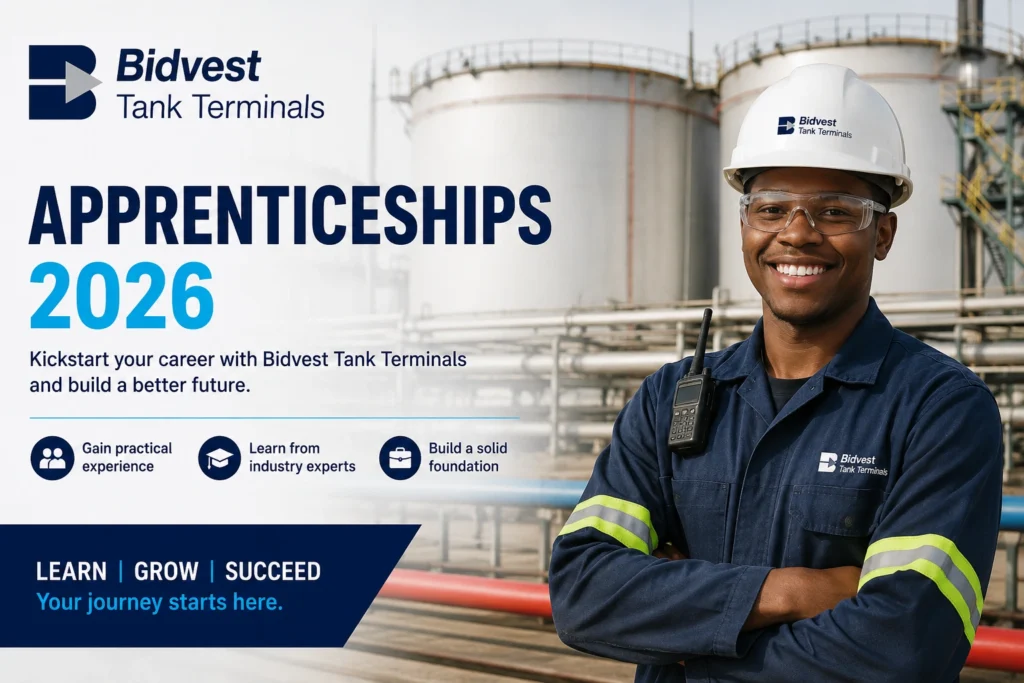

The Bidvest Tank Terminals (BTT) Apprenticeships 2026 conversation is gaining momentum among South African job seekers, and it is easy to understand why.
As competition for technical and operational positions intensifies across the country’s logistics, energy, and industrial sectors, opportunities linked to established employers are attracting significant interest. The latest recruitment drive by Bidvest Tank Terminals (BTT) in Durban has become one of those opportunities that industry watchers, experienced operators, and aspiring technical professionals are paying close attention to.
While the advertised position is officially listed as Operator Level 2, the broader discussion extends beyond a single vacancy. It reflects growing demand for skilled operational talent capable of managing complex bulk storage environments safely and efficiently.
In an economy where practical technical experience often carries as much weight as academic qualifications, the BTT opportunity highlights an important trend: employers are increasingly seeking candidates who can combine operational knowledge, safety awareness, and digital competency in modern industrial workplaces.
Understanding the Background
To understand why the Bidvest Tank Terminals (BTT) Apprenticeships 2026 topic is generating interest, it helps to look at how the industry has evolved.
South Africa’s bulk liquid storage sector forms a critical part of the country’s logistics infrastructure. Facilities such as those operated by BTT play an important role in managing the movement, storage, heating, cooling, and transfer of various products through ports and industrial supply chains.
Over the past decade, operational environments have become significantly more sophisticated.
Companies are now expected to meet strict safety regulations, environmental standards, and efficiency targets while maintaining uninterrupted operations. This has created demand for employees who understand both traditional operational processes and modern digital systems.
The Durban terminal remains strategically important because of the city’s role as one of Africa’s busiest port hubs. Any opportunity connected to operations in this environment naturally attracts attention from candidates seeking long-term careers in logistics, storage operations, and industrial services.
What the Opportunity Involves
The Operator Level 2 position offers a glimpse into the realities of modern terminal operations.
The role requires individuals to support safe and efficient bulk storage activities while working within structured shift systems. Unlike many entry-level industrial jobs, this position combines physical operational work with documentation, reporting, equipment management, and system-based recordkeeping.
Key responsibilities include:
- Coordinating site and shipping activities
- Conducting vessel entry inspections
- Preparing tanks and equipment for operations
- Monitoring pumping rates and stock movements
- Managing weighbridge operations
- Recording operational data through SAP systems
- Ensuring environmental compliance
- Supporting safety and SHEQ requirements
This combination of duties demonstrates how operational roles are evolving.
Today’s operators are expected to understand equipment and processes while also working confidently with digital tracking systems and operational databases.
The Skills Modern Employers Are Looking For
One of the most interesting aspects of this opportunity is what it reveals about employer expectations in 2026.
The minimum requirements include:
- Grade 12 with Mathematics and Science
- English proficiency
- Completion of Operator Level 2 competency modules
- At least two years of BTT operations experience
- Physical fitness
- Strong communication skills
On the surface, these requirements may appear straightforward.
However, they point to a broader industry shift.
Employers increasingly value candidates who can operate across multiple skill areas rather than focusing exclusively on one technical function.
For example, an operator may need to:
- Conduct safety inspections
- Interpret operational data
- Communicate with supervisors
- Coordinate logistics activities
- Complete regulatory documentation
- Respond to changing operational conditions
This blend of technical and administrative capability is becoming a defining characteristic of industrial careers.
Recent Developments Driving Interest
Several broader developments are helping fuel attention around industrial opportunities like this one.
Growing Focus on Infrastructure
Infrastructure investment continues to be a major discussion point across South Africa’s logistics and transport sectors.
As companies seek to improve efficiency and strengthen supply chains, operational roles become increasingly important.
Every improvement in storage, transport, and distribution requires skilled people behind the scenes to ensure systems function correctly.
Safety Standards Are Rising
Industrial employers are placing greater emphasis on safety compliance than ever before.
The extensive SHEQ responsibilities outlined in the BTT position reflect this reality.
Modern operators are no longer simply equipment users.
They are active participants in risk management and workplace safety culture.
Digital Transformation
The requirement to capture operational information through systems such as SAP highlights another major trend.
Industrial operations are becoming increasingly data-driven.
Employers want personnel who understand both physical operations and digital recordkeeping processes.
This trend is expected to accelerate throughout the remainder of the decade.
Public Reaction Among Job Seekers
Among South African job seekers, operational opportunities within established companies often generate strong interest.
Many applicants view positions like this as more than just employment opportunities.
They are seen as pathways into industries that offer long-term career progression.
Online discussions surrounding industrial vacancies frequently reveal several recurring themes:
Stability Matters
Many job seekers continue to prioritize opportunities connected to well-established employers.
In uncertain economic conditions, stability often becomes a major factor when evaluating career options.
Skills Development Remains Important
Candidates increasingly want opportunities that allow them to build transferable technical skills.
Experience in bulk storage operations, logistics coordination, safety management, and industrial systems can open doors to future advancement.
Career Mobility
Operational experience often serves as a foundation for progression into supervisory, planning, technical, or management positions.
This career mobility makes opportunities such as the BTT role particularly attractive.

Why This Matters Right Now
The relevance of the Bidvest Tank Terminals (BTT) Apprenticeships 2026 discussion extends beyond a single recruitment process.
It highlights several important realities shaping South Africa’s labour market.
First, technical operational roles continue to offer viable career pathways despite broader economic challenges.
Second, employers increasingly value practical competency alongside formal education.
Third, industrial sectors are actively adapting to new technologies, environmental requirements, and safety expectations.
For young professionals and experienced workers alike, these developments signal where future opportunities may emerge.
Understanding the skills employers require today can help candidates prepare for tomorrow’s workforce demands.
The BTT vacancy effectively serves as a case study illustrating how industrial employment is evolving.
APPLY HERE: Bidvest Tank Terminals (BTT) Apprenticeships 2026
ALSO APPLY FOR: BMW Apprenticeship 2026
The Growing Importance of Operational Excellence
Operational excellence has become a strategic priority for many companies.
In bulk storage environments, small mistakes can create significant consequences.
A minor operational error can affect:
- Safety outcomes
- Environmental performance
- Product quality
- Logistics schedules
- Customer service levels
As a result, companies increasingly invest in employees who demonstrate attention to detail and strong procedural discipline.
The BTT position reflects this philosophy through its focus on inspections, documentation, reporting, and compliance.
These responsibilities may not always appear glamorous, but they form the backbone of successful industrial operations.
Environmental Responsibility Is No Longer Optional
Another notable aspect of the role is its environmental focus.
Responsibilities relating to effluent management, separator operations, and environmental protection reflect broader industry priorities.
Environmental performance has become a central component of operational strategy.
Regulators, customers, investors, and communities increasingly expect companies to demonstrate responsible environmental practices.
Employees working in operational environments therefore play a direct role in achieving sustainability objectives.
This represents a significant shift from earlier eras when environmental considerations were often treated separately from daily operational activities.
Today, they are integrated into routine responsibilities.
What Could Happen Next
Looking ahead, several possible developments could influence opportunities similar to the Bidvest Tank Terminals (BTT) Apprenticeships 2026 pathway.
Increased Automation
Industrial facilities are expected to continue adopting automation technologies.
Rather than eliminating operational jobs entirely, this trend may reshape them.
Future operators could spend more time monitoring systems, analyzing data, and coordinating activities rather than performing purely manual tasks.
Greater Demand for Technical Competency
As operations become more complex, employers may place even greater emphasis on technical certifications and competency-based training.
Continuous learning could become increasingly important for career progression.
Expansion of Data-Driven Operations
Operational decision-making is becoming more data-focused.
Employees capable of interpreting information from monitoring systems and enterprise software platforms may enjoy stronger career prospects.
Stronger Sustainability Requirements
Environmental standards are likely to become even more rigorous.
Operational personnel will continue playing a key role in helping organizations meet regulatory and sustainability objectives.
Advice for Aspiring Applicants
For individuals interested in opportunities like this, several lessons stand out.
Focus on building both technical and practical experience.
Employers increasingly value candidates who can demonstrate real-world operational competence.
Develop strong safety awareness.
Safety remains one of the most important priorities in industrial environments.
Improve digital literacy.
Experience with operational software systems can provide a significant advantage.
Strengthen communication skills.
Operational success often depends on effective coordination between teams, shifts, supervisors, and external stakeholders.
Finally, embrace continuous learning.
Industrial sectors are changing rapidly, and adaptability is becoming one of the most valuable professional traits.
Final Thoughts
The growing interest surrounding Bidvest Tank Terminals (BTT) Apprenticeships 2026 reflects larger changes occurring across South Africa’s industrial economy.
Although the advertised opportunity focuses on an Operator Level 2 role in Durban, the broader significance lies in what it reveals about modern workforce expectations.
Today’s industrial employers are seeking professionals who combine technical knowledge, operational discipline, safety awareness, environmental responsibility, and digital competency.
For job seekers, that message is clear.
The future of industrial employment is not simply about operating equipment. It is about understanding systems, managing information, maintaining compliance, and contributing to efficient, sustainable operations.
As industries continue evolving, opportunities like this provide a valuable window into the skills and capabilities that will define successful careers in the years ahead. The attention surrounding the BTT recruitment drive therefore reflects more than immediate job interest—it highlights where South Africa’s industrial workforce is heading next.