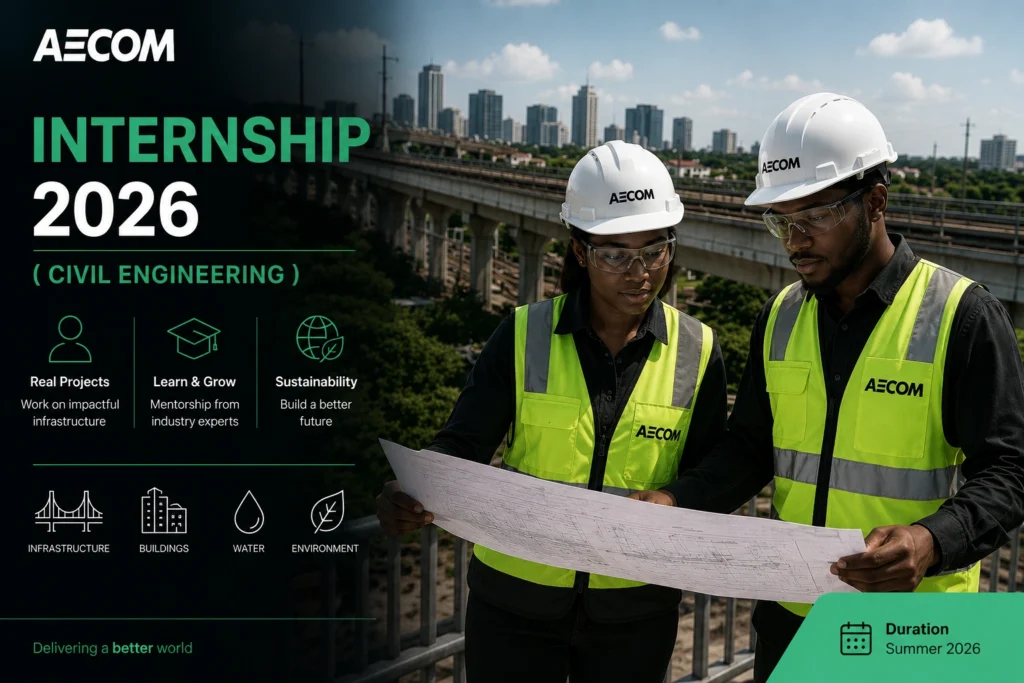

For many Civil Engineering students, there comes a moment when theory is no longer enough.
After semesters spent studying soil mechanics, structural analysis, surveying, hydraulics, and engineering drawing, the next challenge becomes finding a place where those concepts come alive. The transition from lecture halls to active engineering projects is often one of the most important stages in an aspiring engineer’s journey.
Imagine being a National Diploma student who has completed most of the academic requirements of your qualification. Your final hurdle is securing P1 or P2 practical training. You send applications to dozens of companies, hoping for a response. Then an opportunity appears with one of the world’s largest infrastructure consulting firms—an organisation involved in projects that shape cities, transport systems, water networks, and critical infrastructure around the globe.
That is precisely why the AECOM Internship 2026 has attracted attention among South African Civil Engineering students.
With placements available in Centurion, Bellville, and Durban, the programme offers more than just workplace exposure. It provides an opportunity to experience how major infrastructure projects are planned, designed, coordinated, and delivered in a modern engineering environment.
Why the AECOM Internship 2026 Matters Right Now
South Africa faces a growing demand for infrastructure development. Roads require upgrades, water systems need expansion, municipalities need engineering expertise, and climate resilience is becoming a major priority in infrastructure planning.
At the same time, many engineering students struggle to secure the practical workplace training required to complete their qualifications.
This gap between academic learning and industry experience has become one of the biggest challenges facing technical graduates.
The AECOM Internship 2026 addresses that challenge directly by creating structured workplace opportunities for National Diploma students who require P1 and/or P2 practical training as part of their studies.
Rather than entering a workplace as an observer, interns are expected to participate in real project activities under professional supervision. That distinction is important because meaningful workplace learning often determines how quickly a graduate can transition into a successful engineering career.
Inside a Global Infrastructure Leader
AECOM is widely recognised as one of the world’s leading infrastructure consulting firms. The company operates across sectors including transportation, water, environment, energy, buildings, and urban development.
Its projects often involve complex engineering challenges that require multidisciplinary expertise and international collaboration.
What makes this internship particularly interesting is its placement within AECOM’s Enterprise Capabilities (EC) division.
The EC team functions as a global technical delivery network, supporting project teams across multiple countries. With thousands of technical professionals working across different regions, the division helps accelerate project delivery while maintaining technical excellence.
For South African interns, this means exposure to professional standards and engineering practices that extend beyond local projects. Even when working from Centurion, Bellville, or Durban, interns become part of a broader engineering ecosystem that operates on a global scale.
In an increasingly interconnected engineering profession, that experience can be valuable long after the internship ends.
What Daily Life Could Look Like for an Intern
One of the misconceptions students often have about internships is that they mainly involve administrative tasks.
In reality, engineering internships are most effective when they expose students to the entire project lifecycle.
At AECOM, interns are expected to gain familiarity with project documentation, design processes, technical reporting, and engineering workflows.
The programme includes exposure to:
- Engineering drawings and drafting
- Technical documentation and reporting
- Infrastructure design concepts
- Construction site activities where applicable
- Health, safety, and environmental procedures
- Engineering quality management systems
Students may also encounter projects involving dams and associated infrastructure, providing valuable insight into large-scale civil engineering systems.
While interns will work under supervision, the experience offers a practical understanding of how engineering decisions move from concept to implementation.
For many students, this is where classroom concepts finally connect with real-world outcomes.
The Hybrid Workplace Is Changing Engineering Training
An interesting feature of the AECOM Internship 2026 is its hybrid work model.
The role requires at least three days per week in the office while allowing some flexibility for remote work.
This reflects a broader transformation occurring throughout the engineering industry.
Traditionally, engineering training was viewed as something that could only happen in offices and on construction sites. However, advances in digital collaboration, cloud-based design tools, and virtual project management systems have changed that reality.
Today’s engineers often work across multiple locations while collaborating with teams around the world.
For interns entering the profession, learning how to operate effectively in a hybrid environment may be just as important as mastering technical skills.
The ability to communicate digitally, manage documents, participate in virtual meetings, and collaborate remotely is becoming a standard expectation across the engineering sector.
More Than Technical Skills: The Professional Development Advantage
Engineering employers consistently report that technical competence alone does not guarantee career success.
Communication, teamwork, adaptability, and problem-solving are increasingly important attributes.
The internship therefore offers value beyond engineering calculations and design work.
Interns gain exposure to professional workplace culture, project communication processes, and multidisciplinary collaboration.
These experiences can be difficult to teach in a classroom.
Working alongside qualified engineers also provides mentorship opportunities that many students rarely encounter during their studies.
A conversation with an experienced professional about career progression, project challenges, or industry trends can sometimes have a lasting impact on a young engineer’s development.
Expert Insight: Why P1 and P2 Training Remains Critical
One of the less discussed realities of engineering education is that practical workplace exposure often reveals gaps that students never knew existed.
A student may excel academically yet struggle to understand how engineering decisions are influenced by budgets, regulations, environmental considerations, stakeholder expectations, and construction constraints.
P1 and P2 training creates an environment where technical theory meets practical reality.
Employers frequently value candidates who have already experienced project environments because they tend to adapt faster when entering full-time employment.
For National Diploma students, practical training is therefore not simply a graduation requirement—it is often the first real test of professional readiness.

Who Should Consider Applying?
The opportunity is specifically designed for students currently enrolled in a National Diploma in Civil Engineering at a recognised South African University of Technology.
Applicants must require P1 and/or P2 practical training as part of their qualification and must be able to provide supporting documentation from their institution.
Students in good academic standing are encouraged to apply.
Importantly, previous work experience is not required.
This aspect makes the internship accessible to students who may not yet have industry exposure but possess a strong academic foundation.
Basic Microsoft Office skills are expected, while familiarity with AutoCAD or Civil 3D can strengthen an application.
Given the competitive nature of engineering internships, students who can demonstrate technical curiosity, attention to detail, and a willingness to learn may stand out during the selection process.
APPLY HERE: AECOM Internship 2026
ALSO APPLY FOR: Capitec Graduate Internships 2027
South Africa’s Engineering Skills Pipeline Needs Opportunities Like This
The significance of programmes such as the AECOM Internship 2026 extends beyond individual career development.
South Africa continues to face a shortage of highly skilled technical professionals in several infrastructure-related fields.
Engineering training pathways depend on collaboration between educational institutions and industry employers.
Without practical training placements, many students struggle to complete their qualifications, slowing the development of the country’s future engineering workforce.
Internships therefore serve a dual purpose.
They help students progress academically while simultaneously strengthening the national skills pipeline.
As South Africa invests in infrastructure renewal, water security, transportation upgrades, and sustainable development projects, the demand for qualified civil engineers is expected to remain strong.
Creating opportunities for emerging professionals today helps address industry needs tomorrow.
Preparing a Strong Application
Students interested in the internship should focus on presenting a complete and professional application.
Required documentation includes:
- An updated CV
- Academic transcripts or results
- South African ID copy
- A university letter confirming the P1/P2 requirement and duration
Because no closing date has been specified, early submission may provide an advantage.
Applicants should also tailor their CVs to highlight relevant coursework, technical software exposure, and academic achievements.
Even classroom-based projects can demonstrate valuable skills when presented effectively.
For students who have worked with AutoCAD, Civil 3D, surveying software, or engineering design assignments, these experiences should be clearly reflected in their application documents.
Frequently Asked Questions
Is the AECOM Internship 2026 paid?
Yes. Successful candidates will receive a monthly stipend aligned with CIDB standards applicable to infrastructure skills development programmes.
How long does the internship last?
The placement duration will be either six or twelve months, depending on the requirements confirmed by the student’s university.
Do applicants need previous industry experience?
No. The programme is intended for students who require practical training and may have no prior professional work experience.
Looking Beyond the Internship
For many students, an internship represents a short-term opportunity. In reality, its impact can extend much further.
Engineering careers are often built on the experiences, networks, and professional habits developed during those first months in industry.
The AECOM Internship 2026 arrives at a time when South Africa needs skilled engineers capable of contributing to infrastructure development and economic growth. For students seeking practical training, the programme offers a chance to move beyond textbooks and engage with the realities of modern engineering practice.
Whether working on technical reports, reviewing drawings, supporting project teams, or learning from experienced professionals, interns will gain exposure to the type of environment that shapes future engineers.
In a competitive graduate market, that experience can become a defining step in a young professional’s career journey.
For Civil Engineering students still searching for the right P1 or P2 opportunity, this internship is more than a placement requirement. It is a chance to see how engineering works in the real world—and perhaps discover where they fit within the future of South Africa’s infrastructure landscape.