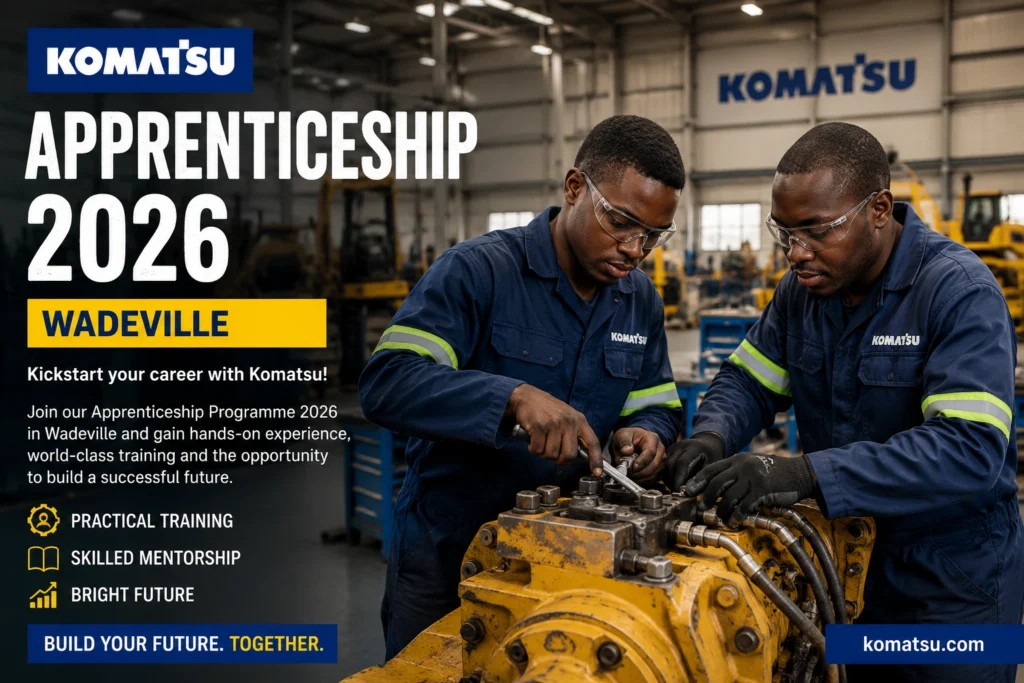

The Komatsu Apprenticeship in Wadeville, Germiston is generating significant interest among aspiring artisans and technical learners across South Africa, and it is easy to understand why.
At a time when many young people are searching for practical career opportunities that lead to stable employment, apprenticeships offered by globally respected industrial companies have become increasingly valuable. With skills shortages continuing to affect sectors such as mining, construction, heavy equipment maintenance, and industrial engineering, opportunities that combine formal training with real workplace experience are attracting more attention than ever.
Komatsu’s latest apprenticeship intake is not simply another training programme. For many applicants, it represents a potential gateway into a high-demand profession that can provide long-term career growth, nationally recognised qualifications, and exposure to advanced machinery used around the world.
As discussions around youth employment, technical education, and artisan development continue to dominate conversations in South Africa, the Wadeville apprenticeship programme has emerged as one of the opportunities many career seekers are watching closely.
Why the Komatsu Apprenticeship Is Trending Now
Several factors have contributed to the growing interest surrounding the programme.
First, there is the reputation of Komatsu itself. As one of the world’s leading manufacturers of mining, construction, forestry, and industrial equipment, the company has built a strong presence across multiple continents. Its machines operate in some of the most demanding environments globally, making technical expertise within the company highly respected.
Second, the apprenticeship does not have a publicly specified closing date. In an environment where many learnerships and internships close within days, the absence of a fixed deadline has encouraged many candidates to explore the opportunity immediately rather than risk missing out.
Third, there is growing awareness among young South Africans that artisan careers can provide strong earning potential and employment stability. While university education remains a popular route, many students are increasingly recognising that technical trades offer practical alternatives with excellent long-term prospects.
The combination of these factors has placed the Komatsu Apprenticeship in Wadeville, Germiston firmly on the radar of job seekers, TVET graduates, and technically minded learners.
How This Opportunity Fits Into South Africa’s Skills Landscape
South Africa continues to face a significant challenge when it comes to youth unemployment.
At the same time, industries such as mining, manufacturing, engineering, and construction frequently report shortages of qualified artisans and technicians.
This creates an interesting contradiction. While thousands of young people struggle to find work, employers continue searching for workers with specialised technical skills.
Programmes like Komatsu’s apprenticeship are designed to help bridge that gap.
Rather than expecting candidates to arrive fully qualified, the programme provides a structured pathway that allows participants to develop skills over several years while working in a real industrial environment.
The result is a model that benefits both the employer and the apprentice. Companies develop future talent aligned with their operational standards, while apprentices gain valuable experience that would otherwise be difficult to obtain.
A Closer Look at the Training Programme
One of the aspects that stands out most is the programme’s duration.
Unlike short-term learnerships that may last 12 months, Komatsu’s apprenticeship spans approximately four and a half years. This extended training period reflects the complexity of the trades involved and the depth of competence required to become a qualified artisan.
Participants receive a combination of theoretical instruction and practical workplace exposure.
Over time, apprentices progressively build their knowledge while working alongside experienced professionals who understand the realities of maintaining and repairing sophisticated industrial equipment.
The approach is designed to ensure that graduates are not only technically qualified but also workplace-ready.
For many aspiring artisans, that combination is one of the programme’s biggest attractions.
The Trades That Could Shape Future Careers
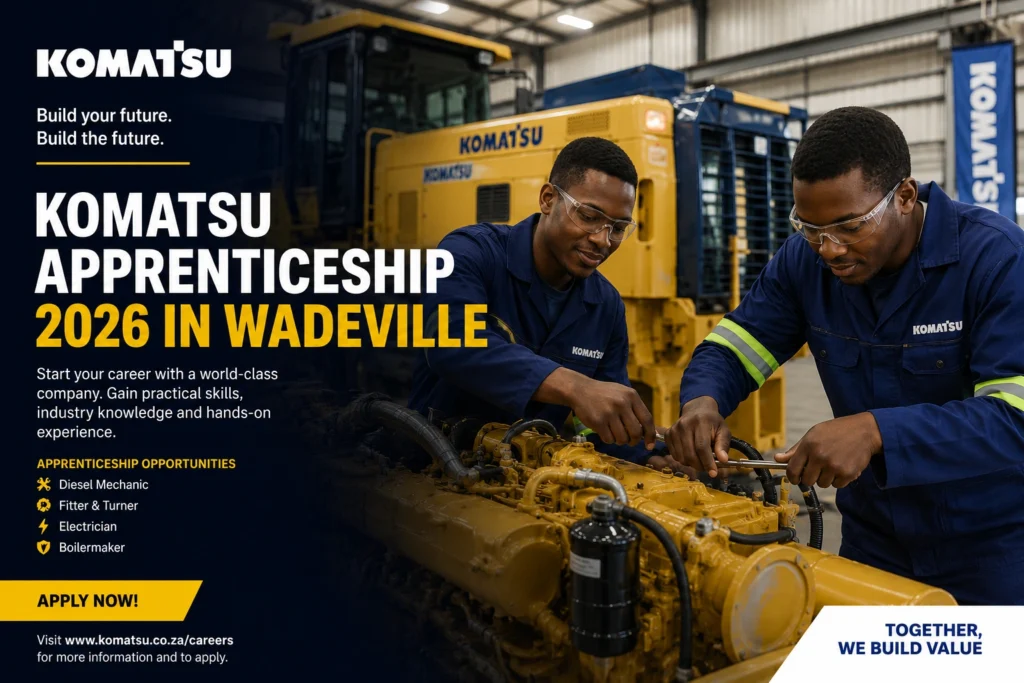
The apprenticeship programme supports several specialised trades that remain highly relevant in today’s industrial economy.
These include:
- Millwright
- Heavy Equipment Mechanic
- Electrical
- Auto Electrical
Each trade plays a critical role within industrial operations.
Heavy Equipment Mechanics are responsible for maintaining and repairing machinery that powers mining and construction projects.
Millwrights combine mechanical and electrical expertise to install, maintain, and troubleshoot complex industrial systems.
Electrical artisans remain essential across virtually every industrial sector.
Auto Electrical specialists increasingly work with advanced electronic systems integrated into modern equipment and vehicles.
As machinery becomes more sophisticated, demand for these skills is expected to remain strong.
What Komatsu Appears to Be Looking For
While technical qualifications remain important, the company is also placing significant emphasis on personal attributes.
The ideal candidate is described as energetic, self-motivated, willing to learn, and capable of working effectively within a team environment.
That emphasis reflects a broader shift in industrial recruitment.
Employers increasingly recognise that technical skills can be developed through training, but attitude, adaptability, and commitment often determine long-term success.
Safety awareness also occupies a central role.
Throughout the apprenticeship, participants are expected to operate within a safety-first culture and demonstrate responsible workplace behaviour.
In industries where employees interact with heavy machinery and complex systems, safety is not merely a compliance requirement—it is a professional expectation.
Why Entry Requirements Matter More Than Ever
One of the key messages emerging from the programme details is the importance of meeting the specified academic requirements.
Applicants need qualifications such as:
- N3 Certificate with relevant trade subjects
- NC(V) Level 4 Certificate
- S1 or higher qualification
Mathematics and Physical Science performance remains particularly important.
This requirement highlights a reality often overlooked by students considering technical careers.
Engineering and artisan occupations rely heavily on mathematical reasoning, measurement, diagnostics, and problem-solving skills.
As industrial technology becomes increasingly advanced, foundational technical knowledge becomes even more valuable.
For applicants who do not yet meet the requirements, the apprenticeship serves as a reminder that upgrading qualifications through TVET colleges can create future opportunities.
Public Reaction: Why Career Seekers Are Paying Attention
Across social media, employment forums, and career-focused communities, artisan opportunities consistently generate strong engagement.
Many young people view apprenticeships differently from traditional entry-level jobs.
Rather than offering temporary work experience, they provide a defined route toward professional qualification.
The Komatsu opportunity appears to resonate particularly strongly with candidates seeking careers that combine practical work with long-term advancement.
There is also growing appreciation for opportunities linked to globally recognised companies.
Having a respected multinational employer on a CV often strengthens future career prospects, whether employees remain with the company or pursue opportunities elsewhere later in their careers.
That perception contributes to the heightened interest surrounding the Wadeville programme.
ALSO VISIT: https://www.komatsu.com
Why This Matters Right Now
The timing of this apprenticeship is particularly significant.
South Africa continues investing heavily in infrastructure development, mining operations, energy projects, and industrial growth initiatives.
All of these sectors depend on skilled artisans.
At the same time, conversations around employability have shifted.
Employers increasingly prioritise practical competence and workplace experience alongside academic qualifications.
This makes apprenticeship programmes more relevant than ever.
For young people uncertain about their career direction, the Komatsu Apprenticeship in Wadeville, Germiston represents more than a training opportunity.
It reflects a broader trend toward skills-based employment pathways that offer tangible outcomes.
In a competitive labour market, obtaining a recognised trade qualification can create opportunities that remain valuable for decades.
APPLY HERE: Komatsu Apprenticeship 2026
ALSO APPLY FOR: Senwes Apprenticeships 2026
Understanding the Selection Process
Another reason the programme is attracting attention is the comprehensive assessment process.
Candidates are not selected solely on academic records.
The process includes:
- Online application screening
- Video interviews
- Face-to-face interviews
- Practical assessments
- Technical evaluations
- Medical examinations
- Reference checks
While some applicants may view this as demanding, it also demonstrates the seriousness of the opportunity.
Komatsu is investing substantial resources into developing future artisans and therefore seeks candidates capable of succeeding in a rigorous technical environment.
For applicants, understanding this process early can improve preparation and increase competitiveness.
The Long-Term Career Value of an Apprenticeship
One of the most important aspects often overlooked in apprenticeship discussions is long-term earning potential.
Qualified artisans remain among the most sought-after professionals across multiple industries.
Experienced electricians, millwrights, and heavy equipment specialists often enjoy strong employment mobility because their skills are transferable across sectors and geographic regions.
Furthermore, technical careers frequently offer progression opportunities into supervisory, specialist, training, or management roles.
An apprenticeship therefore represents more than entry-level employment.
It serves as a foundation for an entire professional journey.
That reality helps explain why many candidates view opportunities like this as career-defining rather than simply job opportunities.
What Could Happen Next
Several outcomes are possible as interest in the programme continues growing.
The first is increased competition.
As awareness spreads, more qualified applicants are likely to submit applications, making early preparation increasingly important.
The second possibility is stronger employer focus on apprenticeship-based recruitment. If programmes such as Komatsu’s continue producing successful artisans, other industrial employers may expand similar initiatives.
A third possibility is increased interest in technical education pathways. Opportunities like this often encourage students to reconsider vocational and artisan careers, particularly when they see clear examples of progression and long-term employment prospects.
For successful candidates, the next few years could involve intensive training, skills development, and professional growth that positions them for highly specialised careers.
For the wider industry, programmes like this help strengthen the pipeline of skilled workers required to support economic development.
Final Thoughts
The Komatsu Apprenticeship in Wadeville, Germiston arrives at a time when skilled technical careers are becoming increasingly important to South Africa’s future.
Its combination of structured training, practical workplace experience, internationally recognised standards, and potential long-term employment makes it one of the more compelling artisan development opportunities currently available.
While the selection process is competitive and the training commitment substantial, the rewards can be equally significant.
For technically minded individuals with the required qualifications and a genuine passion for engineering, machinery, and problem-solving, this apprenticeship offers far more than workplace experience.
It offers the chance to build a profession, develop valuable skills, and establish a career that could remain relevant and rewarding for decades to come.
As interest continues to grow, one message stands out clearly: opportunities that combine learning, qualification, and real-world industry experience remain among the most valuable career pathways available today. The Komatsu apprenticeship is a strong example of that trend in action.