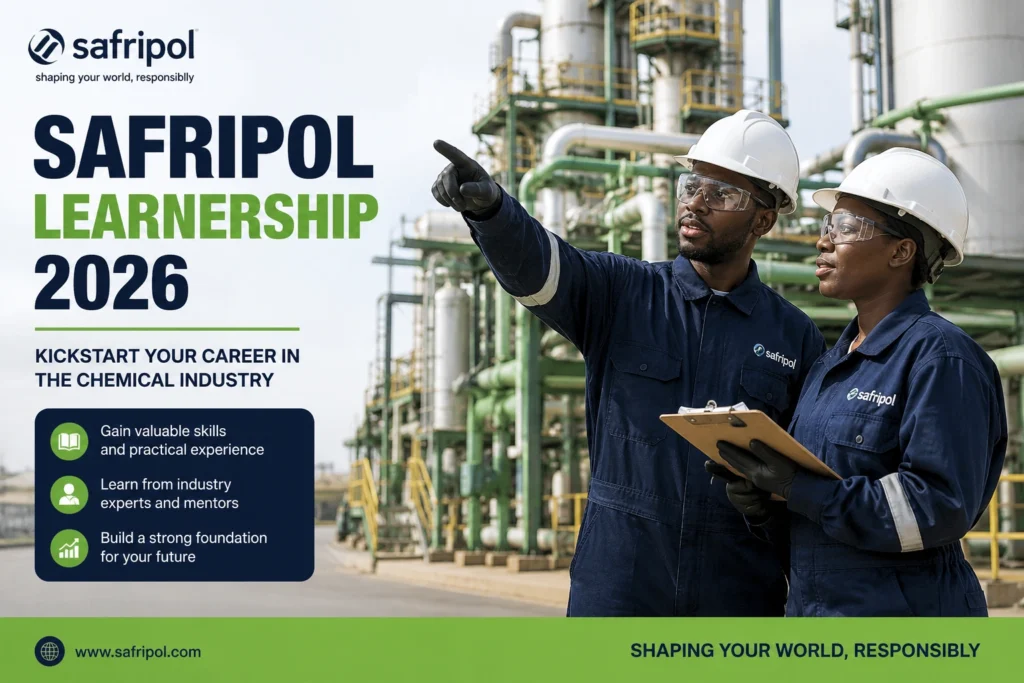

Many Chemical Engineering graduates face the same challenge after completing their studies: they have strong theoretical knowledge but limited exposure to real industrial operations. Employers often look for candidates who understand plant environments, safety procedures, production processes, and practical problem-solving. Without this experience, breaking into the chemical manufacturing sector can be difficult.
This is where the Chemical Engineering Safripol Learnership 2026 becomes highly valuable. The programme offers graduates an opportunity to gain practical workplace exposure within a chemical manufacturing environment while working alongside experienced professionals. For many aspiring engineers, this type of experiential learning serves as a bridge between university studies and a long-term engineering career.
If you are a Chemical Engineering graduate looking to strengthen your technical skills and improve your employability, this guide explains everything you need to know about the opportunity, who should apply, and how to maximize your chances of success.
What Is the Chemical Engineering Safripol Learnership 2026?
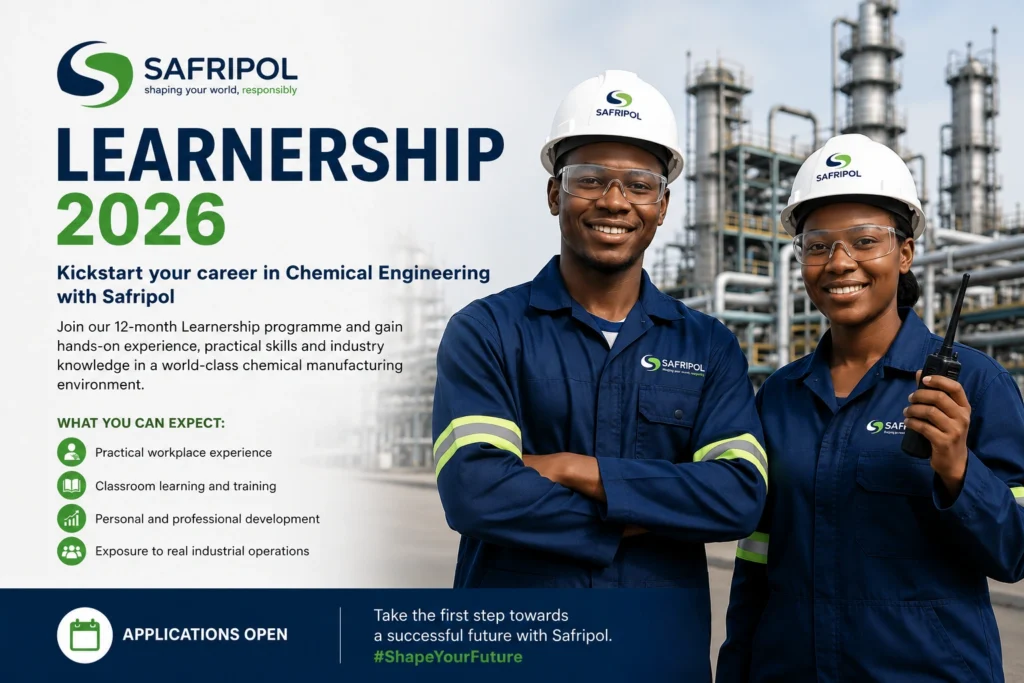
The Chemical Engineering Safripol Learnership 2026 is a fixed-term experiential learning programme designed for graduates who want practical experience in the chemical industry.
Unlike traditional classroom learning, this programme places learners within an operational plant environment where they can observe and participate in real engineering activities. The learnership combines workplace exposure, technical learning, project participation, and collaboration with engineering teams.
The primary goal is to help graduates develop industry-relevant skills while gaining a deeper understanding of chemical manufacturing operations.
Key Learnership Details
- Company: Safripol
- Programme: Experiential Learnership – Chemical Engineering
- Reference Number: SAF260611-1
- Location: Durban, South Africa
- Department: Shared Man Prod-PET
- Type: Temporary Fixed-Term Learnership
- Minimum Qualification: BTech, BEng, or BSc in Chemical Engineering
- Closing Date: 19 June 2026
This opportunity is particularly suitable for graduates who want to transition from academic studies into practical engineering environments.
Who Is Safripol?
Safripol is one of South Africa’s leading producers of polymer materials used across multiple industries. The company focuses on innovation, sustainability, responsible manufacturing practices, and creating value for stakeholders.
Its operations involve sophisticated manufacturing processes that require strong engineering expertise, making it an excellent environment for Chemical Engineering graduates to gain practical experience.
Working within such a setting allows learners to observe how engineering principles are applied to solve real production challenges while maintaining safety, efficiency, and quality standards.
Why This Issue Matters
One of the biggest concerns facing engineering graduates today is the gap between academic qualifications and workplace readiness.
Universities provide essential theoretical foundations, but many graduates struggle when employers request practical industry experience. This challenge is especially significant in sectors such as chemical manufacturing, petrochemicals, process engineering, and production operations.
The Chemical Engineering Safripol Learnership 2026 helps address this problem by providing:
- Real plant exposure
- Workplace learning opportunities
- Experience with operational processes
- Interaction with experienced engineers
- Practical understanding of industrial safety systems
- Exposure to process optimization and problem-solving
Graduates who complete experiential learning programmes often find it easier to compete for graduate engineering positions because they can demonstrate both technical knowledge and workplace experience.
Who Should Apply?
This learnership is ideal for graduates who are eager to learn and interested in chemical manufacturing environments.
You should strongly consider applying if you:
- Have completed a Chemical Engineering qualification
- Want practical plant experience
- Enjoy technical and analytical work
- Are interested in process engineering
- Want exposure to manufacturing operations
- Can work effectively in teams
- Are willing to learn from experienced professionals
- Can adapt to a structured workplace environment
The programme is particularly valuable for graduates who have not yet secured full-time engineering employment and want to strengthen their professional profile.
Minimum Requirements
To qualify for the Chemical Engineering Safripol Learnership 2026, applicants must meet the following requirements:
Educational Requirements
- Matric or Grade 12 certificate
- BTech in Chemical Engineering, or
- BEng in Chemical Engineering, or
- BSc in Chemical Engineering
Professional Skills
Applicants should also demonstrate:
- Excellent communication skills
- Strong interpersonal abilities
- Ability to work with people at different organizational levels
- Ability to perform under pressure
- Professional attitude and willingness to learn
Advantageous Experience
While not mandatory, the following may strengthen an application:
- Exposure to chemical operations
- Manufacturing-related experience
- Process simulation projects
- Industrial training
- Laboratory experience
- Plant visits
- Research projects related to chemical processes
What Will Learners Do During the Programme?
One of the most attractive aspects of the Chemical Engineering Safripol Learnership 2026 is the variety of practical experiences available.
Successful candidates may participate in:
Plant Operations Exposure
Learners gain insight into how production facilities operate on a daily basis.
This may include exposure to:
- Production systems
- Process control activities
- Operational procedures
- Equipment monitoring
- Safety systems
Working with Process Engineers
Learners may collaborate with engineering professionals responsible for maintaining and improving plant performance.
This experience helps graduates understand:
- Engineering decision-making
- Process troubleshooting
- Operational planning
- Production optimization
Technical Projects
Participants may assist with technical investigations and improvement initiatives.
These projects often help learners develop:
- Analytical thinking
- Data interpretation
- Reporting skills
- Engineering problem-solving techniques
Studies and Simulations
Engineering simulations are frequently used to analyze and improve plant performance.
Learners may gain exposure to:
- Process modelling
- Performance analysis
- Production studies
- Operational improvement strategies
Practical Experience You Can Expect
The biggest benefit of experiential learning is exposure to real-world engineering challenges.
Instead of solving textbook problems, learners may encounter situations involving:
- Process inefficiencies
- Equipment performance concerns
- Safety considerations
- Production targets
- Resource optimization
- Operational troubleshooting
These experiences help graduates understand how engineering theory translates into practical solutions.
Over time, this exposure can significantly improve technical confidence and workplace readiness.
ALSO VISIT: https://www.safripol.com
How to Prepare a Strong Application
Competition for engineering learnerships is often high. A well-prepared application can make a significant difference.
Step 1: Update Your CV
Ensure your CV highlights relevant Chemical Engineering experience.
Include:
- Final-year projects
- Process simulation work
- Laboratory practicals
- Research assignments
- Engineering software experience
- Manufacturing exposure
- Leadership activities
APPLY HERE: Safripol Learnership 2026
Avoid submitting a generic CV that does not showcase your engineering background.
Step 2: Gather Supporting Documents
Prepare:
- Updated CV
- Certified South African ID copy
- Matric certificate
- Degree or diploma certificate
- Academic transcript
- Additional certificates
- Proof of any industry exposure
Ensure all documents are clear and readable.
Step 3: Highlight Technical Skills
Employers want evidence of practical capability.
Mention experience with:
- Process design
- Process simulation software
- Data analysis
- Engineering calculations
- Safety awareness
- Technical reporting
Even academic projects can demonstrate valuable skills.
Step 4: Complete Your Online Profile Carefully
Many applicants rush through online application systems.
Before submitting:
- Verify contact details
- Check qualification information
- Upload all documents
- Review spelling and grammar
- Confirm the application is complete
Incomplete profiles often lead to disqualification.
Step 5: Submit Early
Do not wait until the closing date.
Technical issues, internet problems, or missing documents can prevent successful submission.
Aim to apply several days before the deadline.
ALSO APPLY FOR: Busamed Learnerships 2026
Best Practices Experts Recommend
Graduates who succeed in engineering learnership programmes often share several common habits.
Demonstrate a Learning Mindset
Employers understand that graduates are still developing professionally.
Show enthusiasm for learning rather than pretending to know everything.
Focus on Safety Awareness
Chemical manufacturing environments place strong emphasis on safety.
Demonstrating awareness of:
- Risk management
- Process safety
- Workplace procedures
- Safe engineering practices
can strengthen your application.
Understand the Industry
Research:
- Chemical manufacturing
- Polymer production
- Process engineering principles
- Industrial operations
Basic industry knowledge shows initiative.
Develop Communication Skills
Engineers regularly collaborate with operators, technicians, supervisors, and management teams.
Strong communication skills are often just as important as technical knowledge.
Highlight Teamwork Experience
Engineering projects rarely happen in isolation.
Include examples of:
- Group projects
- Leadership roles
- Collaborative assignments
- Volunteer activities
These experiences demonstrate your ability to work effectively with others.
Mistakes People Often Make
Many qualified candidates weaken their applications through avoidable errors.
Submitting Generic CVs
A generic CV fails to showcase engineering-specific skills.
Tailor your CV for the learnership.
Ignoring Academic Projects
Some graduates underestimate the value of university projects.
Engineering design projects, simulations, and laboratory work can provide strong evidence of technical capability.
Waiting Until the Last Minute
Late applications often lead to mistakes, incomplete profiles, or missed deadlines.
Failing to Proofread
Spelling mistakes and incorrect information create a poor first impression.
Always review your application carefully.
Not Researching the Company
Candidates who know little about the organization often struggle during interviews.
Spend time understanding Safripol’s operations, products, and values.
Frequently Asked Questions
1. Can recent graduates apply for the Chemical Engineering Safripol Learnership 2026?
Yes. The programme is specifically designed for graduates seeking practical industry exposure after completing their Chemical Engineering qualifications.
2. Is prior work experience required?
No. Previous exposure to chemical operations or manufacturing environments may be advantageous, but it is not listed as a mandatory requirement.
3. What qualifications are accepted?
Applicants should have a BTech, BEng, or BSc in Chemical Engineering along with a Matric certificate
4. When is the application deadline?
Applications for the Chemical Engineering Safripol Learnership 2026 close on 19 June 2026. Candidates should submit their applications before the deadline to avoid disappointment.
Final Thoughts
The Chemical Engineering Safripol Learnership 2026 presents an excellent opportunity for graduates who want practical exposure in a professional chemical manufacturing environment. For many aspiring engineers, gaining real plant experience is the missing step between academic success and career growth.
The programme offers valuable exposure to process engineering, plant operations, technical projects, simulations, and collaboration with experienced engineering teams. These experiences can strengthen technical competence, improve workplace confidence, and make graduates more competitive in the job market.
If you meet the qualification requirements, start preparing your application immediately. Update your CV, organize supporting documents, highlight relevant engineering projects, and complete your online profile carefully. Most importantly, submit your application before the 19 June 2026 closing date.
Graduates who take advantage of opportunities like this often build stronger professional foundations and position themselves for future roles in chemical manufacturing, process engineering, production management, and broader industrial sectors.