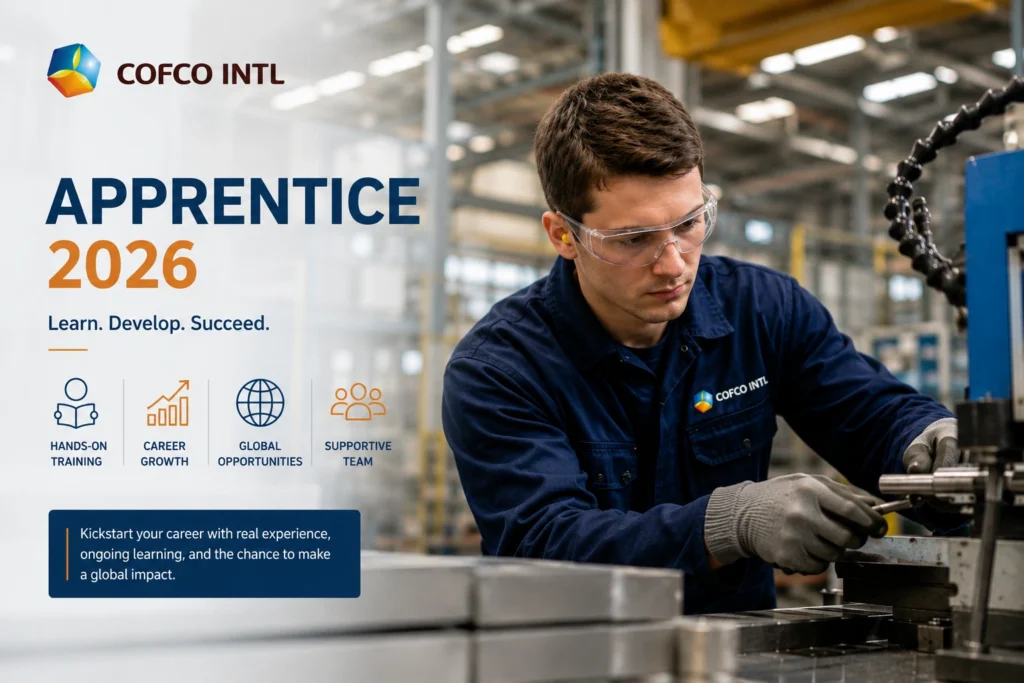

The COFCO INTL Apprentice 2026 programme has emerged as one of the more interesting entry-level opportunities currently attracting attention among South African youth, particularly in Mpumalanga’s Lekwa region. At a time when unemployment remains a major challenge and technical skills are increasingly valued across industries, apprenticeship opportunities like this are receiving significant interest from school leavers and technical college graduates alike.
What makes this announcement noteworthy is not simply the availability of two apprentice positions. Rather, it reflects a broader trend taking place across South Africa’s industrial sector: companies are investing in practical skills development to address future technical workforce needs.
For many young people searching for a pathway into engineering and industrial careers, the COFCO International Instrument Technician apprenticeship represents something increasingly rare — a structured opportunity to combine theoretical knowledge with real-world workplace experience.
Understanding the Opportunity
COFCO International South Africa is seeking two Apprentice Instrument Technicians for its operations in Standerton through Standerton Oil Mills. The positions fall under the Engineering Department and are specifically targeted at local youth from the Lekwa area.
The apprenticeship is designed to introduce participants to the world of industrial instrumentation, a field that plays a critical role in modern manufacturing and processing environments.
Successful candidates will work alongside qualified Instrument Technicians while learning how industrial systems operate, how equipment is calibrated, and how process control technologies help keep production facilities running efficiently.
The programme focuses on practical workplace exposure rather than classroom-only learning, giving participants a chance to develop skills directly within an industrial environment.
How Instrumentation Became a Critical Career Field
To understand why this apprenticeship matters, it helps to understand the growing importance of instrumentation in modern industry.
Today’s factories, processing plants, agricultural facilities, and manufacturing operations rely heavily on automated systems. These systems use sensors, controllers, transmitters, and monitoring equipment to maintain production quality, improve efficiency, and ensure safety.
Instrument Technicians are responsible for ensuring these systems operate correctly.
Years ago, many industrial processes relied heavily on manual oversight. Today, automation has transformed how industries function. As facilities become increasingly technology-driven, demand for workers who understand instrumentation and control systems continues to grow.
This shift has created opportunities for technically minded young people willing to develop specialized skills.
What Apprentices Will Actually Learn
One reason the COFCO INTL Apprentice 2026 programme stands out is the range of practical responsibilities included in the training process.
Participants will assist qualified technicians with:
- Calibration of instrumentation equipment
- Installation of industrial control devices
- Preventative maintenance activities
- Fault-finding and troubleshooting
- Reading technical drawings
- Understanding process control documentation
- Adhering to safety and environmental procedures
While these tasks may sound highly technical, they form the foundation of a profession that supports some of the world’s most advanced industrial operations.
Learning directly from experienced technicians can provide apprentices with insights that are difficult to gain through theoretical study alone.
Why Standerton Is an Important Location
Standerton has long played an important role in South Africa’s agricultural and industrial economy.
The town serves as a significant agricultural hub, with industries linked to grain processing, oil production, and related manufacturing activities. Companies operating in these sectors require reliable engineering and maintenance teams to keep facilities functioning efficiently.
This creates an environment where apprentices can gain exposure to real industrial challenges rather than simulated training scenarios.
For local youth in Lekwa, opportunities close to home can also reduce barriers that often prevent participation in skills-development programmes. Relocation costs, accommodation challenges, and transport expenses frequently limit access to career opportunities.
By focusing recruitment on local candidates, the programme may help retain talent within the region while supporting community development objectives.
The Qualifications Reflect Industry Expectations
The minimum requirements for the apprenticeship are relatively straightforward but reveal what employers increasingly expect from future technical workers.
Applicants must possess:
- Grade 12 / Matric
- Mathematics
- Physical Science
Additional qualifications such as:
- N6 in Instrumentation
- S4 in Instrumentation
- Higher Certificate in Instrumentation
are considered advantageous.
This requirement highlights an important reality in today’s labour market. While many industries still provide entry-level training opportunities, employers increasingly seek candidates who already demonstrate an interest in technical disciplines.
Mathematics and science remain foundational subjects for engineering-related careers because they support problem-solving, analytical thinking, and technical understanding.
More Than Technical Skills
An interesting aspect of the vacancy is the emphasis placed on personal attributes.
The company specifically highlights qualities such as:
- Good communication skills
- Problem-solving ability
- Self-motivation
- Teamwork
- Attention to detail
- Adaptability
- Safety awareness
This reflects a broader shift occurring across industries worldwide.
Technical expertise remains important, but employers increasingly value workplace behaviours that contribute to productivity, safety, and collaboration.
Industrial environments are complex. Equipment failures often require teamwork. Maintenance schedules demand discipline. Safety procedures require consistent attention.
As a result, employers often view attitude and learning potential as equally important as academic qualifications.
Recent Developments in South Africa’s Apprenticeship Landscape
The announcement comes during a period when technical training pathways are receiving renewed attention across South Africa.
Government institutions, TVET colleges, manufacturers, utilities, and private-sector employers have all increased efforts to develop practical workplace training opportunities.
Several factors are driving this trend.
Firstly, many experienced artisans and technicians are approaching retirement age. Industries need a pipeline of younger workers to replace these skills.
Secondly, industrial modernization requires workers capable of operating increasingly sophisticated systems.
Thirdly, youth unemployment remains one of South Africa’s most pressing economic challenges, creating pressure for practical skills-development solutions.
Apprenticeships sit at the intersection of these challenges by helping employers build future talent while creating career pathways for young people.
Public Reaction to Opportunities Like This
Whenever technical apprenticeship programmes are announced, public reaction tends to be overwhelmingly positive.
On employment-focused platforms and social media channels, many young job seekers express enthusiasm for opportunities that provide both training and workplace exposure.
The appeal is understandable.
Many graduates and matriculants face a frustrating cycle where employers request experience, yet obtaining experience requires first securing employment.
Apprenticeships help bridge that gap.
Parents, educators, and career advisors often encourage participation because apprenticeships provide structured learning combined with industry exposure that can strengthen future employability.
At the same time, competition for these opportunities can be intense due to limited positions and high demand.
With only two apprentice positions available in this programme, interest is likely to exceed available spaces significantly.
Why This Matters Right Now
South Africa’s economic future will depend heavily on its ability to develop technical and vocational skills.
While university education remains important, industries across manufacturing, agriculture, logistics, energy, and engineering continue to require skilled technical professionals.
The COFCO INTL Apprentice 2026 programme highlights several important realities.
First, employers are still investing in workforce development despite economic uncertainty.
Second, technical careers remain accessible through multiple pathways, not only through traditional university routes.
Third, local recruitment initiatives can help ensure economic opportunities benefit surrounding communities.
For young people evaluating career options, the growing emphasis on automation, industrial technology, and process control suggests that instrumentation-related careers may remain relevant for years to come.
The apprenticeship therefore represents more than a short-term job opportunity. It reflects wider labour market trends shaping future employment prospects.
APPLY HERE: COFCO INTL Apprentice 2026
ALSO APPLY FOR: Electrical Apprentice 2026-Diageo
The Global Dimension
Another interesting aspect is the international nature of the employer.
COFCO International operates across more than 35 countries and participates in global agricultural supply chains.
For apprentices entering such an environment, exposure extends beyond local operations.
Modern agricultural processing facilities increasingly incorporate international standards, advanced technologies, and globally recognized operational practices.
Even entry-level trainees can benefit from understanding how local production connects to international markets and supply networks.
This broader perspective may become valuable as careers progress.
Challenges Applicants Should Consider
While apprenticeships offer excellent opportunities, they also require commitment.
Industrial environments can be demanding.
Apprentices often need to:
- Learn quickly
- Follow strict safety procedures
- Work with complex equipment
- Adapt to structured work schedules
- Balance practical training with theoretical learning
Success rarely happens overnight.
Those entering technical fields should view apprenticeships as the beginning of a long-term professional development journey rather than an immediate destination.
The most successful technicians often continue learning throughout their careers as technologies evolve and new systems are introduced.
What Could Happen Next
Several possible outcomes could emerge from programmes like the COFCO INTL Apprentice 2026 initiative.
For successful candidates, the apprenticeship could serve as a stepping stone toward artisan qualifications, advanced technical certifications, or long-term engineering careers.
For employers, investing in apprentices may help address future skills shortages while strengthening workforce continuity.
For local communities, programmes targeting regional youth can contribute to skills retention and economic participation.
More broadly, continued industry investment in apprenticeships could encourage additional companies to expand similar initiatives.
If demand for technical skills continues rising, apprenticeship models may become increasingly important in addressing both employment challenges and workforce development needs.
There is also the possibility that companies operating in sectors such as agriculture, manufacturing, food processing, and industrial automation will increase collaboration with TVET colleges and training institutions to create stronger pathways into technical careers.
A Signal of Changing Career Opportunities
The significance of the COFCO apprenticeship extends beyond the vacancy announcement itself.
It reflects changing attitudes toward technical careers and workplace learning.
For years, public conversations about employment often focused primarily on university education. Increasingly, however, employers are recognizing the value of vocational pathways that combine practical experience with technical expertise.
Instrumentation is one of several fields benefiting from this shift.
As automation, data monitoring, process control, and industrial technology become more central to production environments, skilled technicians will remain essential.
That reality makes opportunities like this apprenticeship particularly relevant for young people seeking stable, future-focused careers.
Final Thoughts
The COFCO INTL Apprentice 2026 programme arrives at a time when technical skills development is becoming more important than ever.
Although only two positions are available, the opportunity highlights broader trends shaping South Africa’s labour market: growing demand for technical expertise, increased emphasis on workplace learning, and ongoing efforts to create pathways for young people entering the workforce.
For aspiring Instrument Technicians in the Lekwa area, this apprenticeship offers more than training. It offers a practical introduction to an industry where technology, engineering, and agriculture increasingly intersect.
Whether viewed as a career launchpad, a skills-development initiative, or a reflection of wider economic trends, the programme demonstrates how targeted apprenticeships can help connect ambition with opportunity in a rapidly changing world.