
Finding a job can feel frustrating when you spend hours perfecting your CV, only to receive no response. Many job seekers assume recruiters carefully read every word on every application. In reality, recruiters often spend only a few seconds on an initial CV scan before deciding whether to continue reading or move on to the next candidate.
This is why understanding The First Thing Recruiters Check on Your CV can dramatically improve your chances of landing interviews. The difference between a CV that gets shortlisted and one that gets ignored is often determined in the first glance.
In today’s competitive job market, employers receive dozens or even hundreds of applications for a single vacancy. Recruiters need a fast way to identify suitable candidates, which means your CV must immediately communicate value, relevance, and professionalism.
This guide explains exactly what recruiters look at first, why it matters, and how you can optimize your CV to make a strong first impression.
What Is the First Thing Recruiters Check on Your CV?
When recruiters open a CV, they are usually looking for one key question:
“Is this candidate relevant for the position?”
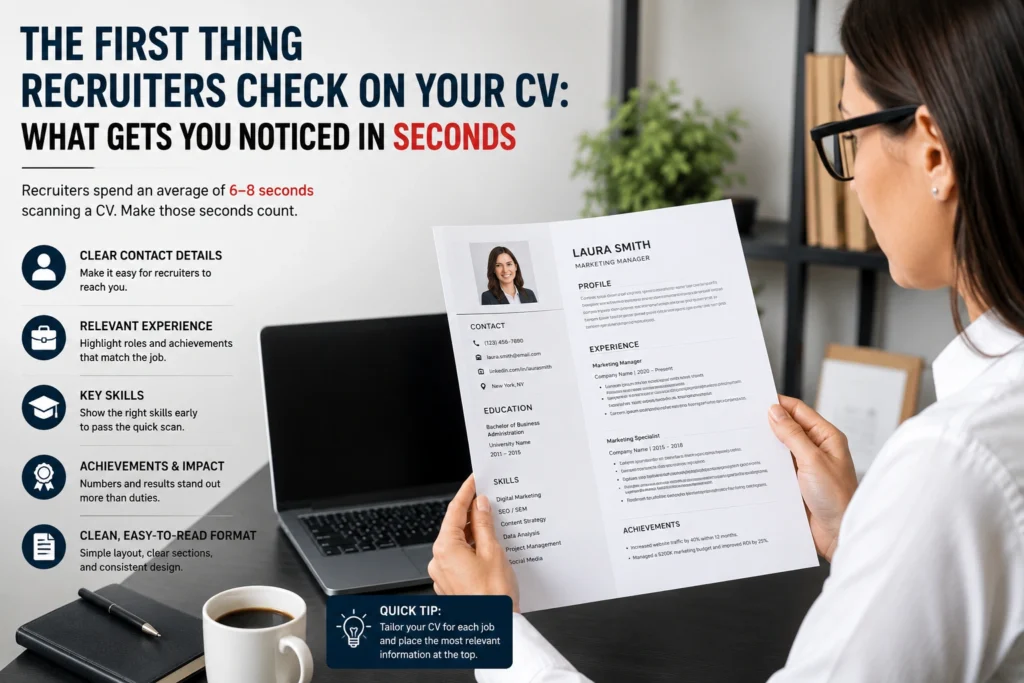
Before reading your full employment history or educational background, recruiters often focus on the top section of your CV. This includes:
- Your professional headline
- Current or recent job title
- Career summary
- Key skills
- Overall formatting and presentation
Within seconds, recruiters try to determine whether your experience aligns with the role they are hiring for.
For example, if a company is hiring a Digital Marketing Specialist and your CV immediately highlights digital campaigns, SEO, content marketing, and analytics experience, you are far more likely to keep their attention.
If the recruiter struggles to understand what you do or how you fit the role, they may move on without reading further.
ALSO APPLY FOR: (SHRA) Internships 2026
ALSO APPLY FOR: UIF ITR Learnership 2026
Why This Issue Matters
Understanding The First Thing Recruiters Check on Your CV is important because first impressions directly affect your chances of getting an interview.
The modern recruitment process is highly competitive. Many organizations use Applicant Tracking Systems (ATS) to filter applications before a human recruiter even reviews them.
When recruiters finally review shortlisted CVs, they often spend less than a minute evaluating each one. If your most relevant qualifications are buried deep within the document, they may never be noticed.
The consequences can include:
- Missing interview opportunities
- Being filtered out despite being qualified
- Longer job searches
- Increased competition against better-presented applicants
- Reduced confidence during the application process
On the other hand, a CV that quickly communicates your value can improve visibility, increase interview invitations, and help employers recognize your suitability immediately.
The Top Elements Recruiters Notice First
1. Your Job Title or Professional Identity
One of the first items recruiters notice is your current or most recent professional title.
For example:
- Financial Analyst
- Mechanical Engineer
- Administrative Assistant
- Customer Service Consultant
- Project Manager
Your title helps recruiters instantly categorize your experience.
If your title is unclear or missing, recruiters may struggle to understand your background.
Instead of writing:
“Experienced professional seeking opportunities”
Write:
“Administrative Coordinator with 4 years of experience in office operations and client support.”
The second option immediately tells recruiters what you do.
2. The Professional Summary
Your professional summary sits near the top of your CV and serves as a quick introduction.
A strong summary should:
- Highlight years of experience
- Mention key skills
- State industry expertise
- Demonstrate value
Example:
“Customer Service Specialist with five years of experience handling client inquiries, complaint resolution, and relationship management in fast-paced retail environments.”
This gives recruiters an instant snapshot of your qualifications.
3. Relevant Skills
Recruiters often scan for skills that match the job description.
Examples include:
- Microsoft Excel
- Data Analysis
- Project Management
- Customer Relations
- Accounting
- Sales
- Digital Marketing
- Coding Languages
Including role-specific skills near the top of your CV makes it easier for recruiters to identify your suitability.
4. Recent Work Experience
Recruiters usually pay attention to your most recent role before reviewing older positions.
They want to know:
- Where you worked
- What you did
- How recently you performed those duties
Recent experience often carries more weight than jobs from many years ago.
5. Overall Presentation
Formatting matters more than many candidates realize.
Recruiters notice:
- Clean layout
- Readable fonts
- Consistent formatting
- Logical structure
- Professional appearance
A cluttered CV can create a negative first impression before recruiters even read the content.
How Recruiters Scan a CV in the First 10 Seconds
Understanding recruiter behavior can help you design your CV more effectively.
Most recruiters follow a pattern:
First 2 Seconds
They check:
- Name
- Job title
- Professional identity
Next 3 Seconds
They review:
- Career summary
- Core competencies
- Skills section
Final 5 Seconds
They scan:
- Most recent work experience
- Relevant achievements
- Industry alignment
If your CV successfully answers their main question—“Can this candidate do the job?”—they continue reading.
Step-by-Step Guide to Improving the First Impression of Your CV
Step 1: Customize Your CV for Every Job
Avoid sending the same CV everywhere.
Study the job description carefully and adjust:
- Skills
- Summary
- Keywords
- Achievements
Employers want candidates whose experience matches their specific needs.
Step 2: Create a Strong Professional Headline
Place a headline directly below your name.
Examples:
- Human Resources Administrator
- Graduate Mechanical Engineer
- Customer Service Specialist
- Marketing Coordinator
This instantly communicates your expertise.
Step 3: Write a Focused Summary
Keep your summary between three and five lines.
Include:
- Years of experience
- Key strengths
- Industry knowledge
- Major accomplishments
Avoid vague statements such as:
“Hardworking individual looking for growth opportunities.”
Instead, focus on measurable value.
Step 4: Highlight Relevant Skills Early
Position important skills near the top of the document.
Recruiters should not need to search for them.
Use bullet points and ensure they align with the job advertisement.
Step 5: Quantify Achievements
Numbers grab attention.
Instead of:
“Managed customer accounts.”
Write:
“Managed 150+ customer accounts while maintaining a 95% client satisfaction rate.”
Measurable achievements stand out quickly.
Step 6: Prioritize Recent Experience
Your latest roles should contain the most detail.
Include:
- Responsibilities
- Achievements
- Results
- Impact
Older positions can be summarized more briefly.
Step 7: Keep Formatting Professional
Use:
- Clear section headings
- Consistent spacing
- Easy-to-read fonts
- Simple layouts
Avoid excessive graphics, colors, and decorative elements that can distract from content.
ALSO READ ABOUT: The Most Overcrowded Careers in South Africa In 2026
The Role of Applicant Tracking Systems (ATS)
Many employers use ATS software before a recruiter even sees your application.
These systems scan for:
- Job-related keywords
- Relevant skills
- Qualifications
- Industry terminology
This means understanding The First Thing Recruiters Check on Your CV also involves ensuring your CV is ATS-friendly.
Tips include:
- Use standard headings
- Include keywords from the job description
- Avoid text boxes and complex graphics
- Save documents in accepted formats
A well-optimized CV improves both machine and human readability.
Best Practices Experts Recommend
Career coaches and recruitment professionals consistently recommend several strategies.
Focus on Relevance
Every section should support your suitability for the target role.
Remove outdated or unrelated information that adds little value.
Use Action Verbs
Strong action words create impact.
Examples include:
- Led
- Developed
- Managed
- Improved
- Implemented
- Coordinated
- Delivered
These words make accomplishments more compelling.
Showcase Results
Recruiters are interested in outcomes.
Highlight:
- Revenue growth
- Cost reductions
- Productivity improvements
- Customer satisfaction improvements
- Project success metrics
Keep Information Current
Ensure your:
- Contact details
- Job titles
- Employment dates
- Certifications
are accurate and up to date.
Make Your Value Obvious
Recruiters should immediately understand:
- What you do
- What you are good at
- Why you are qualified
The faster they understand this, the better your chances.
Mistakes People Often Make
Even qualified candidates sometimes weaken their applications with avoidable mistakes.
Using Generic Summaries
Generic introductions fail to differentiate you from other applicants.
Tailor your summary to each role.
Hiding Important Information
Do not bury your strongest qualifications deep within the CV.
Place them near the top.
Including Irrelevant Experience
Not every past job deserves equal attention.
Focus on experience that supports your current career goals.
Writing Long Paragraphs
Large blocks of text are difficult to scan.
Use bullet points where appropriate.
Ignoring Keywords
Many applicants forget to match the language used in the job advertisement.
This can reduce ATS visibility.
Poor Formatting
Inconsistent fonts, spacing, and layout can make a CV look unprofessional.
Presentation matters.
How to Make Recruiters Want to Read More
Think of your CV as a marketing document.
Its purpose is not to tell your entire life story.
Its purpose is to convince recruiters that you are worth interviewing.
Ask yourself:
- Can someone understand my profession within five seconds?
- Are my strongest skills visible immediately?
- Does my summary highlight relevant expertise?
- Are achievements supported by measurable results?
- Does my CV look professional and organized?
If the answer to these questions is yes, you are already ahead of many applicants.
Frequently Asked Questions
1. How long do recruiters spend looking at a CV?
Initial scans often last between a few seconds and a minute. This is why the top section of your CV is so important.
2. Is work experience more important than education?
For many roles, recent and relevant work experience receives more attention. However, education remains important for graduate positions and professions requiring specific qualifications.
3. Should I use a one-page or two-page CV?
A one-page CV can work for graduates and entry-level applicants. Experienced professionals often require two pages to present their qualifications effectively.
4. What if I have little work experience?
Focus on internships, volunteer work, academic projects, transferable skills, certifications, and achievements that demonstrate your capabilities.
Final Thoughts
Understanding The First Thing Recruiters Check on Your CV can significantly improve your job search results. Recruiters are not looking for perfection—they are looking for relevance. Within seconds, they want to know who you are, what you do, and whether your experience matches their hiring needs.
A strong professional headline, targeted summary, relevant skills, recent experience, and clear formatting help create an immediate positive impression. By customizing your CV for each application, highlighting measurable achievements, and ensuring ATS compatibility, you make it easier for recruiters to recognize your value.
The most practical step you can take today is to review the top third of your CV. If a recruiter can instantly understand your expertise and suitability for the role, your chances of securing interviews become much stronger.
ALSO APPLY FOR: (SHRA) Internships 2026
ALSO APPLY FOR: UIF ITR Learnership 2026
ALSO READ ABOUT: The Most Overcrowded Careers in South Africa In 2026