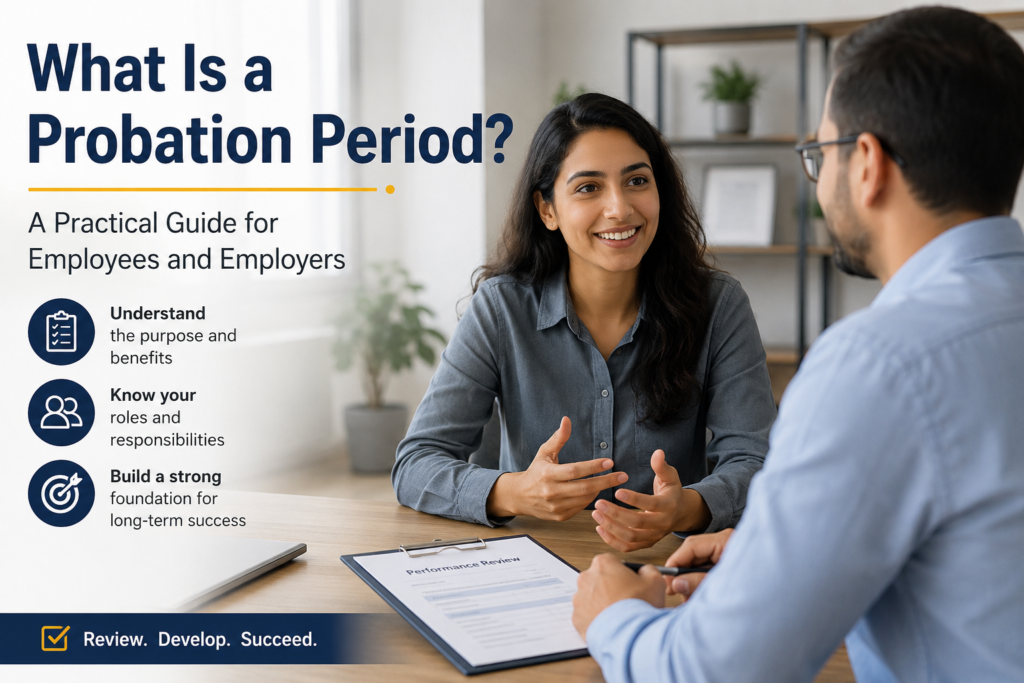

Starting a new job can be exciting, but it can also be stressful. Many employees are unsure about their rights during the first few months of employment, while employers often wonder how to evaluate whether a new hire is the right fit. Questions such as “Can I be dismissed during probation?”, “How long does probation last?”, and “What should I do to pass probation successfully?” are common.
Understanding What Is a Probation Period? is important because it affects job security, performance expectations, workplace relationships, and long-term career success. Whether you are a new employee trying to make a strong impression or an employer looking to build an effective workforce, knowing how probation works can help you avoid costly mistakes and achieve better outcomes.
This guide explains everything you need to know about probation periods, including their purpose, benefits, challenges, best practices, and common misconceptions.
What Is a Probation Period?
A probation period is a specified trial period at the beginning of employment during which an employer assesses whether a new employee is suitable for the role. At the same time, the employee evaluates whether the company, position, and work environment meet their expectations.
During this period, performance, skills, attendance, behavior, adaptability, and overall fit within the organization are closely monitored.
Probation periods vary depending on the company, industry, and employment contract. Common durations include:
- Three months
- Six months
- Nine months
- Twelve months (less common)
The exact length is usually outlined in the employment contract or company policy.
The purpose is not simply to “test” employees but to provide a structured period for evaluation, training, feedback, and development.
ALSO APPLY FOR: Schaeffler Apprenticeship 2026
ALSO APPLY FOR: GTG Apprentice Bus and Coach Engineer 2026
Why This Issue Matters
Many people underestimate the importance of probation periods until problems arise.
For employees, failing probation may mean losing a job opportunity they worked hard to secure. Even when employment continues, a poor probation experience can damage confidence and career growth.
For employers, hiring the wrong person can be expensive. Recruitment costs, training expenses, reduced productivity, and workplace disruption can quickly add up.
A well-managed probation period helps:
- Reduce hiring risks
- Improve employee performance
- Clarify job expectations
- Strengthen workplace culture
- Increase long-term retention
- Build trust between employers and employees
When both parties understand the process, probation becomes a valuable opportunity rather than a source of anxiety.
Why Employers Use Probation Periods
Organizations introduce probation periods for several practical reasons.
Assessing Job Performance
A resume and interview can only reveal so much. Employers use probation to evaluate how employees perform in real workplace situations.
They observe:
- Technical skills
- Problem-solving abilities
- Communication skills
- Productivity levels
- Ability to meet deadlines
Evaluating Cultural Fit
An employee may possess excellent qualifications but struggle to work effectively within a company’s culture.
Probation allows employers to determine whether a person:
- Works well with colleagues
- Shares organizational values
- Demonstrates professionalism
- Adapts to workplace norms
Identifying Training Needs
Not every new employee starts fully prepared. Probation helps managers identify areas where additional support or training may be needed.
Reducing Hiring Risks
Hiring mistakes can be costly. Probation provides a structured period to address concerns before confirming long-term employment.
Benefits of a Probation Period for Employees
Many workers view probation negatively, but it can offer significant advantages.
Opportunity to Learn
The first few months of a job often involve learning new systems, procedures, and expectations.
Probation gives employees time to:
- Understand their responsibilities
- Build confidence
- Learn company processes
- Develop professional relationships
Regular Feedback
Many employers provide more frequent feedback during probation than after confirmation.
This feedback helps employees:
- Improve performance
- Correct mistakes early
- Understand expectations clearly
Career Evaluation
Probation is a two-way process. Employees can assess whether:
- The role matches expectations
- The work environment is healthy
- Career growth opportunities exist
- The company aligns with their goals
Strong Foundation for Success
Successfully completing probation often creates momentum that supports future promotions, performance reviews, and career development.
How a Typical Probation Period Works
Although every organization is different, most probation processes follow a similar structure.
Step 1: Orientation and Onboarding
New employees receive information about:
- Company policies
- Job responsibilities
- Performance expectations
- Workplace procedures
Clear onboarding significantly improves probation outcomes.
Step 2: Goal Setting
Managers usually establish measurable objectives.
Examples include:
- Completing specific training modules
- Achieving productivity targets
- Meeting customer service standards
- Delivering assigned projects
Employees should understand exactly what success looks like.
Step 3: Ongoing Monitoring
Managers observe performance and provide guidance.
This may include:
- Weekly check-ins
- Performance discussions
- Progress reports
- Coaching sessions
Step 4: Mid-Probation Review
Many organizations conduct a formal review halfway through the probation period.
This allows both parties to discuss:
- Strengths
- Areas for improvement
- Progress toward goals
- Additional support requirements
Step 5: Final Evaluation
At the end of probation, the employer typically decides whether to:
- Confirm employment
- Extend probation
- Terminate employment where permitted and justified under applicable laws and procedures
Employees are usually informed of the decision through a formal meeting or written communication.
How Employees Can Successfully Pass Probation
If you’re wondering how to improve your chances of success, these practical steps can help.
1. Understand Expectations Early
Don’t assume you know what your manager wants.
Ask questions such as:
- What are the key priorities?
- How will success be measured?
- What are common challenges in this role?
Clarity prevents misunderstandings.
2. Arrive Prepared and Punctual
Reliability matters.
Consistently arriving on time demonstrates:
- Professionalism
- Commitment
- Respect for workplace standards
Small habits often influence managers’ impressions.
3. Take Initiative
Managers appreciate employees who actively contribute.
Look for opportunities to:
- Solve problems
- Assist colleagues
- Improve processes
- Volunteer for projects
Initiative demonstrates engagement and potential.
4. Accept Feedback Positively
Constructive criticism is a normal part of probation.
Instead of becoming defensive:
- Listen carefully
- Ask clarifying questions
- Implement suggestions
- Demonstrate improvement
Employers often value responsiveness more than perfection.
5. Build Strong Workplace Relationships
Positive relationships support success.
Make an effort to:
- Communicate professionally
- Collaborate effectively
- Respect colleagues
- Participate in team activities
A strong team fit can significantly strengthen your position.
6. Keep Track of Achievements
Document accomplishments throughout probation.
Maintain records of:
- Completed projects
- Positive feedback
- Training achievements
- Performance milestones
This information can be valuable during reviews.
7. Stay Professional at All Times
Avoid behaviors that commonly create problems, including:
- Excessive absenteeism
- Workplace gossip
- Missing deadlines
- Ignoring company policies
Professional conduct is often evaluated just as closely as technical performance.
ALSO READ ABOUT: How to Choose References for a Job Application
Best Practices Experts Recommend
Employment professionals and HR specialists consistently recommend several practices for successful probation management.
Set Clear Expectations
Ambiguity causes problems.
Employees should receive written information regarding:
- Job duties
- Performance standards
- Probation length
- Review procedures
Schedule Regular Feedback Sessions
Waiting until the end of probation is ineffective.
Frequent discussions help identify issues before they become serious.
Focus on Development
Probation should not be viewed solely as an assessment tool.
Employers should provide:
- Coaching
- Mentorship
- Training opportunities
- Performance support
Document Progress
Keeping accurate records protects both employers and employees.
Documentation should include:
- Objectives
- Feedback provided
- Improvement plans
- Review outcomes
Encourage Open Communication
Employees should feel comfortable discussing challenges and seeking assistance.
Open communication often prevents minor issues from becoming major problems.
Mistakes People Often Make
Many probation challenges stem from avoidable mistakes.
Assuming the Job Is Already Secure
Some employees relax their efforts after being hired.
Remember that probation is still an evaluation period.
Continue demonstrating professionalism and commitment.
Failing to Ask Questions
Trying to appear knowledgeable can backfire.
Employees who avoid asking questions may make unnecessary mistakes.
Seeking clarification is usually viewed positively.
Ignoring Feedback
Repeatedly disregarding feedback is one of the fastest ways to create concerns.
Managers expect visible improvement after discussions.
Poor Time Management
Missing deadlines and failing to prioritize tasks can negatively affect performance reviews.
Develop strong organizational habits from day one.
Lack of Communication
Employees sometimes remain silent when facing difficulties.
Inform managers early if you need support, resources, or clarification.
Employers Providing Insufficient Guidance
Managers also make mistakes.
Failing to train, mentor, or communicate expectations clearly can undermine an otherwise capable employee’s success.
Can a Probation Period Be Extended?
Yes, in many workplaces probation may be extended if additional time is needed to evaluate performance or allow improvement.
Extensions are often considered when:
- Performance is improving but not yet satisfactory
- Training requirements are incomplete
- Additional assessment is necessary
Employees should receive clear information regarding:
- The reasons for the extension
- Areas requiring improvement
- New review dates
- Expected outcomes
Transparency is essential during any extension process.
What Happens After Probation?
Successful completion of probation typically results in employment confirmation.
This may include:
- Formal confirmation letters
- Eligibility for additional benefits
- Greater responsibility
- Long-term development opportunities
However, probation completion does not mean performance expectations disappear.
Employees are expected to maintain professional standards throughout their employment.
Frequently Asked Questions
1. What is a probation period in a job?
A probation period is a trial phase at the beginning of employment during which an employer evaluates a new employee’s performance, conduct, and suitability for the role.
2. How long does a probation period usually last?
Most probation periods last between three and six months, although the duration can vary depending on company policies, industry requirements, and employment contracts.
3. Can an employee resign during probation?
Yes. Employees can generally resign during probation, although they should follow the notice requirements specified in their employment contract.
4. Does passing probation guarantee permanent employment?
Passing probation usually confirms continued employment, but employees must still meet performance expectations and comply with workplace policies after confirmation.
Conclusion
Understanding What Is a Probation Period? can help both employees and employers navigate the early stages of employment more successfully. Rather than viewing probation as a hurdle, it should be seen as an opportunity to establish expectations, develop skills, build relationships, and confirm a good match between employer and employee.
Employees can improve their chances of success by understanding expectations, accepting feedback, demonstrating reliability, and maintaining professional conduct. Employers can achieve better outcomes by providing clear communication, regular feedback, proper training, and fair evaluation processes.
When managed effectively, a probation period creates a strong foundation for long-term success, productivity, and career growth.
ALSO APPLY FOR: Schaeffler Apprenticeship 2026
ALSO APPLY FOR: GTG Apprentice Bus and Coach Engineer 2026
ALSO READ ABOUT: How to Choose References for a Job Application