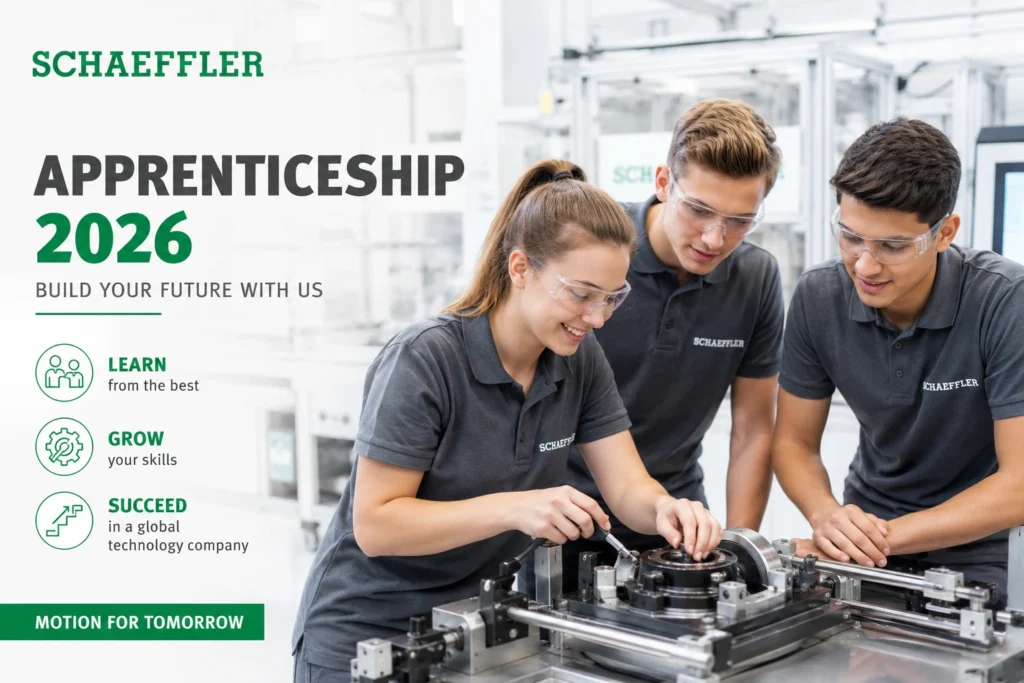

The Schaeffler Apprenticeship 2026 is generating significant interest among South African school leavers and aspiring engineers—and it is easy to understand why.
At a time when youth unemployment remains one of the country’s biggest challenges, opportunities that combine formal training, workplace experience, and industry-recognised qualifications are becoming increasingly valuable. Apprenticeships have re-emerged as one of the most practical pathways into technical careers, particularly within manufacturing, automotive, and industrial engineering.
Against this backdrop, Schaeffler’s latest apprenticeship opportunity in Port Elizabeth arrives at a moment when many young people are actively searching for alternatives to traditional university routes.
For candidates with strong Mathematics and Physical Science results—or an N2 qualification in Electrical or Mechanical Engineering—this programme represents far more than a training opportunity. It offers a potential entry point into one of the world’s most respected engineering and motion technology companies.
The growing attention surrounding the programme reflects broader trends within South Africa’s skills-development landscape, where technical expertise is becoming increasingly important for economic growth and industrial competitiveness.
Why Engineering Apprenticeships Are Back in the Spotlight
Over the past few years, employers across multiple sectors have reported a growing need for technically skilled workers.
While universities remain important, many industries continue to face shortages of artisans, technicians, and engineering specialists. As a result, companies have invested more heavily in vocational training programmes that develop practical skills directly in the workplace.
This shift has transformed apprenticeships from being viewed as alternative career options into highly respected professional pathways.
Modern engineering apprenticeships now combine classroom learning, structured assessments, mentorship, and real-world experience. Participants gain exposure to industrial processes while working toward recognised qualifications that can open doors throughout their careers.
The Schaeffler Apprenticeship 2026 fits squarely into this trend.
Rather than focusing solely on academic theory, the programme aims to help participants develop competencies that employers actively seek in today’s engineering environment.
Understanding Schaeffler’s Global Influence
One reason this apprenticeship stands out is the reputation of the company behind it.
Schaeffler is recognised internationally for its expertise in motion technology, precision engineering, automotive components, bearings, linear systems, and industrial solutions.
Its technologies play critical roles in sectors ranging from automotive manufacturing to renewable energy, robotics, aerospace, and industrial automation.
As global industries increasingly embrace automation and advanced manufacturing, companies like Schaeffler occupy an important position within the engineering ecosystem.
For apprentices, this means exposure to international standards, sophisticated technologies, and modern operational practices.
That exposure can be particularly valuable for young professionals seeking to build long-term careers in technical fields.
What Makes This Apprenticeship Different?
Many training programmes promise experience.
What distinguishes structured apprenticeships is their focus on measurable professional development.
According to the programme overview, successful candidates will participate in a vocational training pathway designed to lead toward an acknowledged certification.
The approach combines several key elements:
- Practical workplace learning
- Collaboration with experienced professionals
- Formal coursework requirements
- Skills assessments
- Exposure to operational environments
- Ongoing professional development
This blend of theory and application is often regarded as one of the most effective ways to develop engineering competence.
Rather than learning concepts in isolation, apprentices see how engineering principles function in real production and industrial settings.
That experience can significantly accelerate career readiness.
The Port Elizabeth Advantage
The programme’s location also contributes to its appeal.
Port Elizabeth—officially known as Gqeberha—has long been one of South Africa’s most important manufacturing and automotive hubs.
The region has built a reputation for engineering excellence, supported by decades of industrial development and investment.
Automotive production, component manufacturing, logistics, and industrial services all play significant roles in the local economy.
For aspiring engineers, working within such an environment provides exposure to industries that continue to shape South Africa’s manufacturing future.
It also places apprentices within a broader network of technical professionals, suppliers, and industrial organisations.
These connections often become valuable long after a programme concludes.
Who Can Apply?
One reason the Schaeffler Apprenticeship 2026 has attracted attention is that it remains accessible to school leavers.
Applicants must meet one of the following educational requirements:
Pathway One
Matric with:
- Minimum 50% in Mathematics
- Minimum 50% in Physical Science
Pathway Two
- N2 Electrical Engineering
- N2 Mechanical Engineering
The programme also seeks individuals who demonstrate:
- Strong willingness to learn
- Adaptability
- Energy and enthusiasm
- Commitment to personal development
- Interest in technical and engineering work
These requirements highlight an important trend within modern apprenticeship recruitment.
Employers increasingly prioritise attitude and learning potential alongside academic performance.
Technical skills can be taught, but curiosity, commitment, and resilience often determine long-term success.

Why This Matters Right Now
The timing of this apprenticeship is particularly significant.
South Africa continues to face a complex employment landscape where many young people struggle to gain meaningful workplace experience.
One of the most common challenges for first-time job seekers is the so-called “experience gap.” Employers want experienced candidates, yet many young people cannot gain experience without first being hired.
Apprenticeships help bridge that gap.
The Schaeffler Apprenticeship 2026 provides participants with structured workplace exposure while they continue learning.
This approach benefits both employers and trainees.
Companies develop future talent according to industry needs, while participants gain practical experience that strengthens future employment prospects.
The programme also aligns with broader national priorities around skills development, youth employment, and industrial growth.
As manufacturing and engineering sectors continue evolving, the demand for technically capable workers is expected to remain strong.
For many applicants, this apprenticeship may represent an opportunity to enter industries that offer sustainable long-term careers rather than short-term employment.
APPLY HERE: Schaeffler Apprenticeship 2026
ALSO APPLY FOR: GTG Apprentice Bus and Coach Engineer 2026
Public Interest and Applicant Reaction
Whenever major engineering employers advertise apprenticeship opportunities, public response tends to be strong.
Career forums, student communities, and employment-focused social media groups frequently highlight programmes like these because they offer something many young people are actively seeking: a clear career pathway.
The reaction often reflects several common themes.
First, candidates value opportunities that provide recognised qualifications.
Second, there is growing appreciation for programmes that combine earning and learning.
Third, many applicants see global companies as attractive employers because of their training standards and potential career mobility.
The Schaeffler Apprenticeship 2026 appears to tick all three boxes.
Its combination of vocational certification, practical experience, and association with a multinational engineering company naturally increases interest among aspiring technicians and engineers.
The Skills That Could Shape Future Careers
Engineering workplaces are changing rapidly.
Automation, digitisation, predictive maintenance, advanced manufacturing technologies, and smart industrial systems are becoming increasingly common.
This means tomorrow’s engineering professionals need more than traditional technical skills.
They also require:
- Problem-solving ability
- Data awareness
- Adaptability
- Teamwork
- Continuous learning habits
- Safety consciousness
- Technical communication skills
Structured apprenticeships provide environments where these competencies can develop organically.
Participants learn not only how equipment works but also how engineering teams collaborate to solve operational challenges.
These transferable skills often remain valuable regardless of where future career opportunities arise.
Beyond the Qualification: Building Professional Confidence
One frequently overlooked benefit of apprenticeships is confidence.
For many school leavers, entering a professional workplace for the first time can feel intimidating.
A structured programme provides guidance, mentorship, and support during that transition.
Apprentices learn workplace expectations, professional communication, time management, and industry standards.
Over time, they begin seeing themselves not merely as students but as emerging professionals.
That shift in mindset can have a lasting impact on career progression.
By the end of an apprenticeship, participants often possess a stronger understanding of both their technical capabilities and their career potential.
What Could Happen Next?
Several possible outcomes could emerge for successful participants.
Permanent Employment Opportunities
Many apprenticeships serve as talent pipelines.
Employers frequently consider trained apprentices when future vacancies arise because they already understand company systems, processes, and culture.
Further Specialisation
After gaining foundational qualifications, individuals may choose to pursue advanced technical certifications or specialised engineering fields.
Career Mobility
Experience with internationally recognised companies often strengthens future employment applications across the manufacturing and engineering sectors.
Leadership Development
Some apprentices eventually progress into supervisory, technical specialist, or management roles as they gain experience and qualifications.
While no apprenticeship guarantees a specific outcome, programmes like this often provide strong foundations for long-term professional growth.
Why Applicants Should Not Delay
One detail that stands out in this opportunity is the absence of a specified closing date.
In recruitment terms, this typically creates urgency.
Positions may remain open only until sufficient suitable candidates are identified.
For applicants, delaying submission can therefore increase the risk of missing an opportunity altogether.
Preparing documentation early—including certified qualifications, identification documents, and an updated CV—can help candidates submit complete applications without unnecessary delays.
In competitive programmes, organisation and preparation often make a meaningful difference.
A Bigger Picture for South Africa’s Engineering Sector
The significance of the Schaeffler Apprenticeship 2026 extends beyond individual career opportunities.
Programmes like this contribute to broader workforce development efforts.
Every successful apprentice represents additional technical capacity within South Africa’s economy.
As industries adopt new technologies and expand operational capabilities, the need for skilled artisans, technicians, and engineering professionals is likely to remain substantial.
Investments in apprenticeship programmes help ensure that future workforce needs can be met while creating pathways for young people to build meaningful careers.
That dual benefit explains why engineering apprenticeships continue attracting attention from employers, educators, policymakers, and job seekers alike.
Final Thoughts
The Schaeffler Apprenticeship 2026 arrives at a time when practical skills, technical expertise, and workplace experience are becoming increasingly valuable assets.
For school leavers with strong Mathematics and Physical Science results—or candidates holding an N2 qualification in Electrical or Mechanical Engineering—the programme offers more than vocational training. It provides access to a structured learning environment within a globally respected engineering company.
In a competitive job market, opportunities that combine professional development, recognised qualifications, and hands-on experience remain highly sought after.
Whether viewed as a stepping stone toward technical specialisation, long-term employment, or broader engineering ambitions, the Schaeffler Apprenticeship 2026 represents a pathway worth serious consideration.
For aspiring engineers eager to transform academic potential into practical expertise, this could be one of the most important career opportunities currently available in South Africa.