

Imagine being a final-year student at a South African university in late 2026. Graduation is approaching, but so is a question that keeps many students awake at night: What comes next?
For thousands of graduates across the country, the transition from university to the workplace can feel uncertain. Academic achievements are important, yet employers increasingly look for practical experience, adaptability, digital skills, and leadership potential. In a competitive job market, finding an opportunity that offers both structured development and real career progression can be challenging.
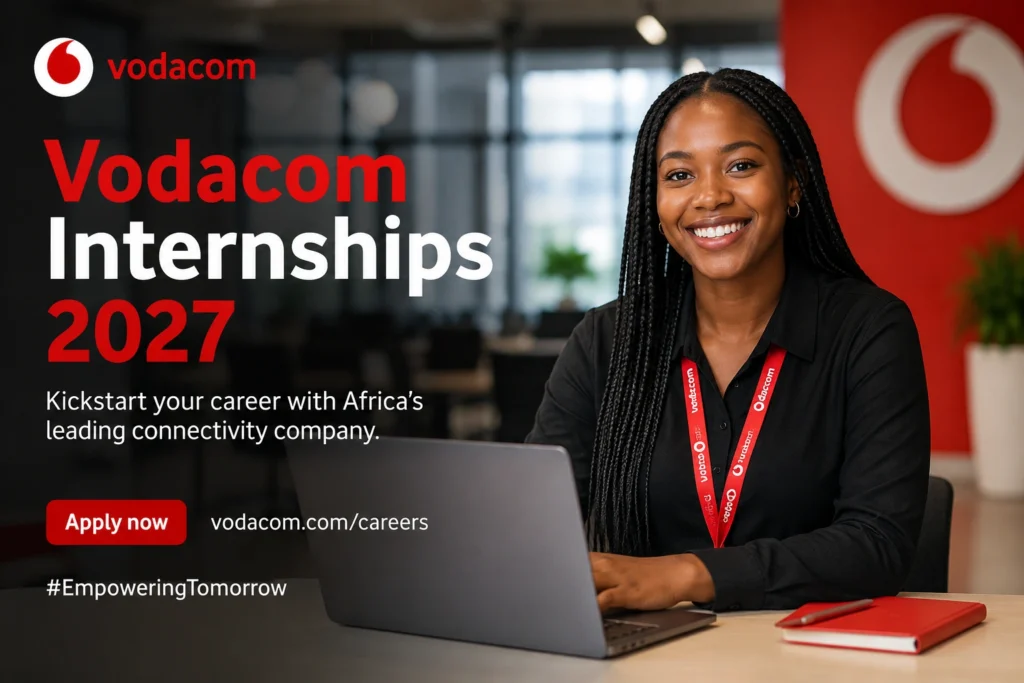
This is why the announcement of Vodacom Internships 2027 and the broader Vodacom Early Careers Programmes has attracted significant attention among students and graduates. More than just an internship opportunity, these programmes represent a pathway into one of South Africa’s most influential technology and telecommunications companies.
As digital transformation continues reshaping industries across Africa, programmes like these are becoming increasingly important for young professionals seeking meaningful careers in technology, business, engineering, and innovation.
Why Vodacom’s Early Careers Programmes Matter Right Now
South Africa’s youth unemployment challenge remains one of the country’s most pressing economic issues. Even highly educated graduates often struggle to gain their first professional opportunity because employers frequently require experience that recent graduates simply do not possess.
Large organisations have responded by investing more heavily in structured graduate and internship programmes that bridge the gap between education and employment.
Vodacom’s 2027 Early Careers Programmes arrive at a time when digital skills are becoming essential across virtually every sector. Telecommunications companies are no longer merely mobile network providers. They are technology-driven businesses operating at the intersection of connectivity, financial services, artificial intelligence, cloud computing, cybersecurity, and digital transformation.
For graduates entering the workforce today, exposure to this environment can provide skills that remain valuable long after the programme itself ends.
The company’s latest intake includes two distinct opportunities:
- Discover Graduate Programme
- Internship Programme
While both are designed for emerging professionals, they serve different career objectives and stages of development.
Understanding the Difference Between the Graduate Programme and Internship
One of the most common mistakes applicants make is assuming that all early-career programmes are identical.
In reality, Vodacom has created two separate pathways.
The Discover Graduate Programme
The Discover Graduate Programme is a two-year immersive leadership development initiative designed to identify and develop future leaders within the organisation.
Unlike many graduate programmes that simply rotate participants through departments, Vodacom’s model focuses on accelerated growth, leadership development, strategic exposure, and long-term career planning.
Successful participants begin the programme on 1 February 2027 and enter permanent employment from the outset.
One of the most attractive features is the possibility of international exposure through global rotation opportunities. For graduates seeking broader industry perspectives and multinational experience, this can be a significant advantage.
The programme aims to prepare participants for career-defining roles within Vodacom after completion, making it particularly appealing to ambitious graduates interested in long-term growth.
The Internship Programme
The Internship Programme follows a different model.
This is a 12-month paid internship designed primarily to provide practical workplace experience and professional development.
Starting in February and March 2027, interns gain hands-on exposure to real projects while building technical and professional skills in a structured environment.
Importantly, the internship is not merely administrative work or observation-based learning. Participants are expected to contribute, collaborate, learn from experienced professionals, and develop capabilities that improve future employability.
For many graduates, the internship can also serve as a stepping stone toward future opportunities, including potential progression into the Discover Graduate Programme.
Vodacom Internships 2027: Who Should Apply?
The strongest candidates are not necessarily those with perfect academic records.
While academic performance remains important, Vodacom’s requirements suggest the company is looking for a combination of educational achievement, digital readiness, adaptability, and leadership potential.
Applicants for both programmes must generally:
- Complete or have completed an undergraduate qualification by the end of 2026
- Hold a minimum B-degree qualification such as BCom, BSc, or BTech at NQF Level 7
- Achieve a minimum academic average of 65%
- Have less than two years of formal work experience after completing studies
For certain technical disciplines, a three-year National Diploma at NQF Level 6 may also be considered.
These fields include:
- Electrical Engineering
- Electronic Engineering
- Computer Software Engineering
- Information Systems
- Information Technology
The eligibility requirements reflect broader industry trends. Companies increasingly seek candidates who possess both technical expertise and the ability to adapt to rapidly changing technological environments.
Beyond Qualifications: What Vodacom Appears to Value
Reading through the programme criteria reveals something interesting.
The emphasis is not solely on technical skills or academic performance. Instead, there is significant focus on personal attributes that align with future workplace demands.
Terms such as learning agility, collaboration, critical thinking, customer focus, and leadership potential appear repeatedly throughout the programme descriptions.
This reflects a growing reality across the global technology sector.
Technical knowledge can become outdated relatively quickly. However, individuals who learn continuously, solve problems creatively, communicate effectively, and adapt to change often remain valuable regardless of technological shifts.
Candidates who can demonstrate these qualities through academic projects, leadership roles, volunteer activities, entrepreneurship, or extracurricular involvement may have a competitive advantage.
An Expert Perspective: Why Telecommunications Is Becoming a Career Launchpad
Many graduates still associate telecommunications primarily with mobile networks and connectivity.
That perception is increasingly outdated.
Today’s telecom companies operate at the centre of digital ecosystems that include financial technology, cybersecurity, cloud services, data analytics, artificial intelligence, digital commerce, and enterprise solutions.
For graduates, this means an internship or graduate programme in telecommunications can provide exposure to multiple industries simultaneously.
Rather than specialising too narrowly at the beginning of a career, participants often gain insight into diverse business functions, making them more versatile professionals over the long term.
This broader exposure is one reason graduate programmes at major telecommunications companies continue attracting strong competition from top university talent.
Preparing a Competitive Application
Applications for the Vodacom Early Careers Programmes close on 31 August 2026, giving prospective candidates time to prepare thoroughly.
A rushed application rarely stands out.
Instead, applicants should approach the process strategically.
First, ensure all required documentation is ready:
- Updated CV
- Most recent academic transcript
- Certified identification documents if requested
- Certified qualifications if studies are already completed
- Additional supporting documents requested during the process
However, documentation alone will not secure success.
Graduates should also evaluate whether their CV clearly demonstrates problem-solving abilities, teamwork, initiative, leadership experiences, and digital literacy.
Recruiters often review hundreds or even thousands of applications. Clear evidence of impact, achievements, and growth can help candidates distinguish themselves from equally qualified peers.
For example, rather than stating:
“Participated in student society activities.”
A stronger approach might be:
“Led a team of 15 students in organising a technology awareness event attended by 300 participants.”
Specific achievements create stronger impressions than general descriptions.
APPLY HERE: Vodacom Internships 2027
ALSO APPLY FOR: Herotel Sonic Internship 2026
The Johannesburg Advantage
The programmes are based in Johannesburg, South Africa’s economic powerhouse and one of the continent’s most significant business hubs.
This location offers benefits beyond the internship itself.
Johannesburg remains a centre for corporate headquarters, technology innovation, financial services, entrepreneurship, and digital transformation initiatives.
Graduates who begin their careers in such an environment often gain exposure to industry leaders, professional networks, and opportunities that can influence future career trajectories.
Even within a hybrid and increasingly remote world, physical proximity to major business ecosystems continues to create valuable networking opportunities.
For young professionals, these informal connections can sometimes prove just as valuable as formal training programmes.
What Makes These Opportunities Different?
South Africa offers numerous graduate programmes each year, yet not all create lasting career impact.
The distinguishing feature of the Vodacom approach appears to be its focus on future readiness.
The company consistently highlights themes such as:
- Digital capability
- Innovation
- Leadership development
- Global exposure
- Continuous learning
- Career progression
These themes align closely with the skills expected to drive economic growth throughout the remainder of the decade.
As businesses adopt more automation, artificial intelligence, data-driven decision-making, and digital service delivery, graduates with exposure to technology-focused environments may find themselves particularly well positioned.
This makes the programmes relevant not only for telecommunications careers but also for broader opportunities across South Africa’s evolving economy.
Frequently Asked Questions
When do Vodacom Internships 2027 applications close?
Applications for the Vodacom Early Careers Programmes close on 31 August 2026. Late applications may not be considered.
Is the Vodacom Internship Programme paid?
Yes. The programme is described as a 12-month paid internship that provides workplace experience, professional development, and practical skills training.
Can final-year students apply?
Yes. Final-year students who will complete their qualifications by the end of 2026 are eligible to apply, provided they meet the programme’s academic and other eligibility requirements.
Looking Beyond the Application
The story behind Vodacom Internships 2027 is ultimately about more than securing a placement.
It reflects a larger shift taking place across South Africa’s economy. Employers are increasingly investing in structured talent pipelines that prepare graduates for a future shaped by technology, innovation, and continuous learning. At the same time, graduates are seeking opportunities that provide more than a salary—they want growth, mentorship, meaningful work, and long-term career prospects.
Vodacom’s Early Careers Programmes sit at the intersection of these needs.
For ambitious students and graduates, the programmes offer a chance to gain practical experience, develop professional confidence, and enter one of Africa’s most dynamic industries. Whether through the year-long internship or the two-year Discover Graduate Programme, successful candidates will be stepping into an environment where digital transformation is not a future concept but a daily reality.
As the August 2026 application deadline approaches, interested candidates would be wise to prepare carefully, present their strongest achievements, and view the application process as the first step in building a career rather than simply finding a job. In a rapidly changing economy, opportunities that combine learning, exposure, and long-term development may prove to be among the most valuable investments a graduate can make in their future.