

First impressions happen fast—often faster than we realize. Whether you’re attending a job interview, meeting a potential client, going on a first date, networking at an event, or simply introducing yourself to someone new, people begin forming opinions within seconds. The challenge is that many individuals focus on saying the perfect thing while overlooking the psychological factors that shape how others perceive them.
A poor first impression can close doors before meaningful conversations even begin. On the other hand, a strong first impression can build trust, create opportunities, and establish positive relationships that last for years.
Understanding The Psychology Behind a Great First Impression is not about manipulating people or pretending to be someone you’re not. It’s about recognizing how human perception works and using that knowledge to communicate confidence, authenticity, and credibility from the start.
This practical guide explores the science behind first impressions and provides actionable strategies you can use in professional and personal situations.
What Is The Psychology Behind a Great First Impression?
The Psychology Behind a Great First Impression refers to the mental processes people use to evaluate others during initial interactions. Humans are wired to make rapid judgments because our brains constantly seek shortcuts to process information efficiently.
When meeting someone for the first time, people unconsciously assess factors such as:
- Appearance and grooming
- Facial expressions
- Body language
- Voice tone
- Eye contact
- Confidence level
- Friendliness
- Trustworthiness
- Competence
Psychologists often describe this as “thin slicing”—the ability to make surprisingly quick judgments based on limited information.
Although these initial assessments are not always accurate, they can strongly influence future interactions. Once an impression forms, people tend to look for evidence that confirms their initial beliefs.
This is why first impressions often carry significant weight in both social and professional settings.
ALSO APPLY FOR: Alfa Laval Internship 2026
ALSO APPLY FOR: DHL Inhouse Graduate Internships 2026
Why This Issue Matters
Many opportunities are influenced by first impressions long before skills, experience, or personality can fully emerge.
Consider these common scenarios:
Career Opportunities
Recruiters and hiring managers often form initial opinions within minutes of meeting candidates. While qualifications matter, confidence, professionalism, and communication style can influence how those qualifications are perceived.
Business Relationships
Potential customers and clients decide whether they trust a business professional almost immediately. A positive first impression can strengthen credibility and improve relationship-building.
Networking Success
Networking events are often filled with brief interactions. People remember individuals who appear approachable, engaged, and confident.
Personal Relationships
Friendships and romantic relationships frequently begin with an initial assessment of warmth, authenticity, and compatibility.
Leadership and Influence
Leaders who create strong first impressions often gain trust more quickly and find it easier to motivate teams and build support.
Understanding The Psychology Behind a Great First Impression can therefore impact income, career advancement, social opportunities, and personal relationships.
The Science Behind First Impressions
Before learning strategies, it’s useful to understand why first impressions occur.
The Halo Effect
The halo effect is a psychological bias where one positive characteristic influences overall perception.
For example:
- Someone who appears confident may automatically be viewed as more competent.
- A person who seems friendly may be assumed to be trustworthy.
- Professional appearance can lead others to perceive higher expertise.
This doesn’t mean appearance is everything, but it highlights how one positive signal can affect broader judgments.
Confirmation Bias
Once people form an initial opinion, they often seek information that supports that belief.
If someone views you positively from the beginning, they are more likely to interpret your actions favorably.
Emotional Contagion
Humans naturally absorb emotions from those around them.
A calm, enthusiastic, and positive attitude can influence how others feel during an interaction.
Nonverbal Communication
Research consistently shows that nonverbal signals play a major role in communication.
People often notice:
- Posture
- Facial expressions
- Gestures
- Eye contact
- Personal space
- Voice quality
before they fully process spoken words.
Understanding these psychological principles makes it easier to create meaningful and authentic first impressions.
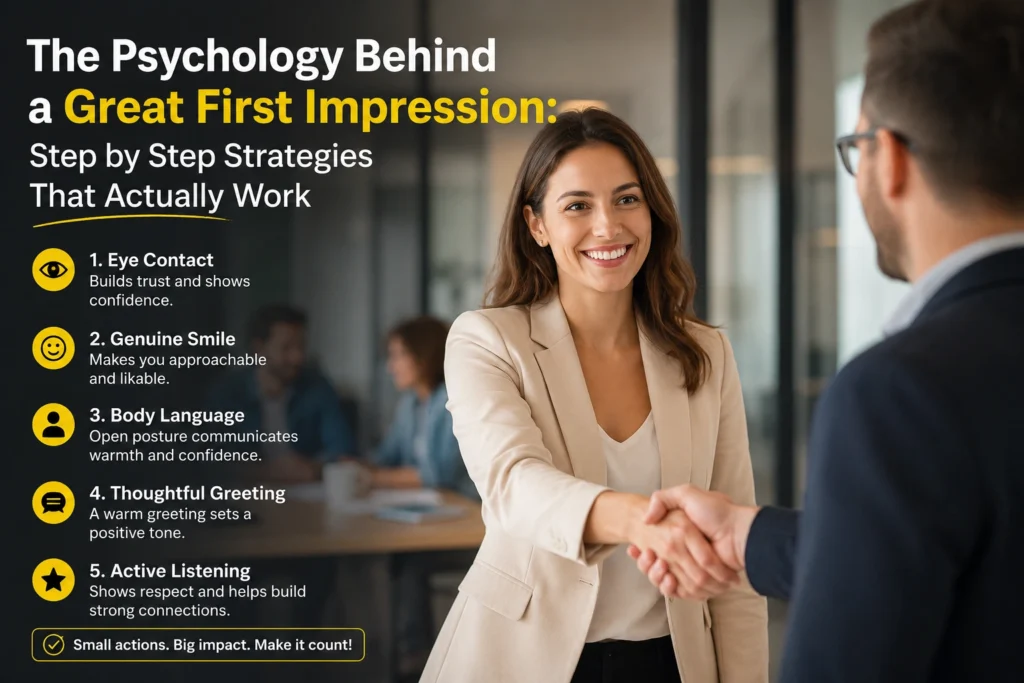
The Psychology Behind a Great First Impression: Step-by-Step Strategies
1. Prepare Your Mindset Before the Interaction
Many people focus on external presentation while ignoring internal preparation.
Your thoughts influence:
- Facial expressions
- Energy levels
- Voice tone
- Body language
Instead of worrying about being judged, focus on curiosity and connection.
Ask yourself:
- What can I learn from this person?
- How can I contribute value?
- How can I make this interaction enjoyable?
This mindset naturally reduces anxiety and increases authenticity.
2. Use Open and Confident Body Language
Body language often speaks louder than words.
Positive signals include:
- Standing upright
- Relaxed shoulders
- Facing people directly
- Keeping arms uncrossed
- Using natural hand gestures
Confident posture communicates self-assurance without appearing arrogant.
People tend to associate open body language with trustworthiness and competence.
3. Make Strong Eye Contact
Eye contact is one of the most powerful elements of first impressions.
Appropriate eye contact signals:
- Attention
- Confidence
- Respect
- Sincerity
Avoid staring continuously, which can feel uncomfortable.
Instead, maintain natural eye contact while speaking and listening.
Balanced eye contact helps establish trust quickly.
4. Smile Genuinely
A genuine smile remains one of the simplest and most effective ways to create a positive first impression.
Smiling can:
- Increase approachability
- Reduce tension
- Encourage positive emotions
- Build rapport
People naturally respond more positively to warmth and friendliness.
Authenticity matters far more than forced enthusiasm.
5. Pay Attention to Your Voice
Many people underestimate vocal communication.
Your voice communicates:
- Confidence
- Enthusiasm
- Authority
- Emotional state
Try to:
- Speak clearly
- Avoid rushing
- Use varied tone
- Maintain a comfortable volume
A calm and confident voice often leaves a stronger impression than perfectly chosen words.
6. Listen More Than You Talk
One of the most overlooked secrets of making a great first impression is active listening.
People enjoy conversations where they feel heard and understood.
Demonstrate engagement by:
- Asking thoughtful questions
- Nodding appropriately
- Avoiding interruptions
- Reflecting on what the other person says
Strong listeners are often perceived as intelligent, empathetic, and trustworthy.
7. Find Common Ground
Humans naturally connect with people who seem familiar.
Look for shared interests, experiences, or goals.
Examples include:
- Professional interests
- Hobbies
- Educational background
- Industry challenges
- Mutual connections
Common ground helps conversations feel natural and memorable.
8. Dress Appropriately for the Situation
Appearance influences perception because it provides immediate information about professionalism and attention to detail.
You don’t need expensive clothing.
Instead, focus on:
- Cleanliness
- Neat grooming
- Appropriate attire
- Good fit
- Context awareness
The goal is to support your message, not distract from it.
9. Show Authentic Confidence
Confidence is attractive because it signals competence and emotional stability.
However, confidence differs from arrogance.
Authentic confidence involves:
- Speaking clearly
- Acknowledging strengths honestly
- Being comfortable with imperfections
- Respecting others
People respond positively to individuals who appear secure without needing constant validation.
10. End the Interaction Positively
Many people focus entirely on introductions while neglecting conclusions.
Strong endings improve memorability.
Consider:
- Expressing appreciation
- Summarizing shared interests
- Offering a future connection
- Ending with positive energy
People often remember how interactions conclude.
ALSO READ ABOUT: Understanding Employment Contracts Before You Sign
Best Practices Experts Recommend
Professionals in psychology, communication, and leadership frequently recommend the following practices:
Be Present
Avoid checking your phone or appearing distracted.
Full attention demonstrates respect and interest.
Focus on Others
People who focus exclusively on impressing others often create unnecessary anxiety.
Instead, concentrate on understanding the other person.
Practice Self-Awareness
Pay attention to habits that may undermine your communication, such as:
- Fidgeting
- Speaking too quickly
- Avoiding eye contact
- Interrupting
Awareness allows improvement.
Maintain Consistency
Authenticity matters.
A polished introduction followed by inconsistent behavior can damage trust.
Ensure your actions match the impression you wish to create.
Build Emotional Intelligence
Recognizing emotions in yourself and others helps you adapt your communication effectively.
Emotionally intelligent individuals often leave stronger first impressions because they respond appropriately to social cues.
Mistakes People Often Make
Even well-intentioned individuals sometimes undermine their first impressions.
Trying Too Hard
Excessive self-promotion can appear insecure.
Confidence is most effective when it feels natural.
Talking Too Much
Dominating conversations prevents relationship-building.
Balanced dialogue creates stronger connections.
Ignoring Nonverbal Signals
People often focus entirely on words while overlooking posture, facial expressions, and tone.
Nonverbal communication strongly influences perception.
Appearing Distracted
Looking at your phone, scanning the room, or interrupting eye contact frequently may suggest disinterest.
Being Inauthentic
People are surprisingly good at detecting insincerity.
Authenticity creates stronger and more lasting impressions than rehearsed perfection.
Neglecting Follow-Up
A great first impression can fade if there is no meaningful follow-up.
Maintaining connections strengthens relationships beyond the initial meeting.
How to Improve First Impressions in Different Situations
Job Interviews
Focus on:
- Professional appearance
- Confident posture
- Clear communication
- Thoughtful questions
- Genuine enthusiasm
Networking Events
Focus on:
- Introductions
- Active listening
- Curiosity
- Exchanging contact information
- Following up afterward
Virtual Meetings
Pay attention to:
- Camera positioning
- Lighting
- Eye contact with the camera
- Audio quality
- Professional background
Social Gatherings
Prioritize:
- Warm greetings
- Positive energy
- Inclusiveness
- Genuine interest in others
The principles of The Psychology Behind a Great First Impression remain consistent across environments.
Frequently Asked Questions
How long does it take to form a first impression?
Research suggests people can begin forming impressions within seconds. These initial judgments may continue evolving during the first few minutes of interaction.
Can a bad first impression be changed?
Yes. While first impressions are powerful, consistent positive behavior can reshape perceptions over time. It often requires patience and repeated interactions.
Is appearance the most important factor?
No. Appearance influences initial perceptions, but communication skills, confidence, authenticity, and emotional intelligence often have a greater long-term impact.
Do first impressions matter in online meetings?
Absolutely. Factors such as eye contact, facial expressions, professionalism, audio quality, and communication style influence virtual first impressions just as strongly as in-person interactions.
Final Thoughts
Understanding The Psychology Behind a Great First Impression can significantly improve your personal and professional relationships. While first impressions form quickly, they are not based solely on appearance. People evaluate a combination of verbal communication, body language, emotional signals, confidence, and authenticity.
The most effective strategy is not to create a perfect image but to communicate genuine warmth, competence, and interest in others. Small actions—such as maintaining eye contact, listening attentively, smiling naturally, and speaking confidently—can dramatically influence how people perceive you.
The next time you meet someone new, focus less on impressing them and more on building a real connection. In many cases, that simple shift is what creates the strongest and most memorable first impression.
ALSO APPLY FOR: Alfa Laval Internship 2026
ALSO APPLY FOR: DHL Inhouse Graduate Internships 2026
ALSO READ ABOUT: Understanding Employment Contracts Before You Sign