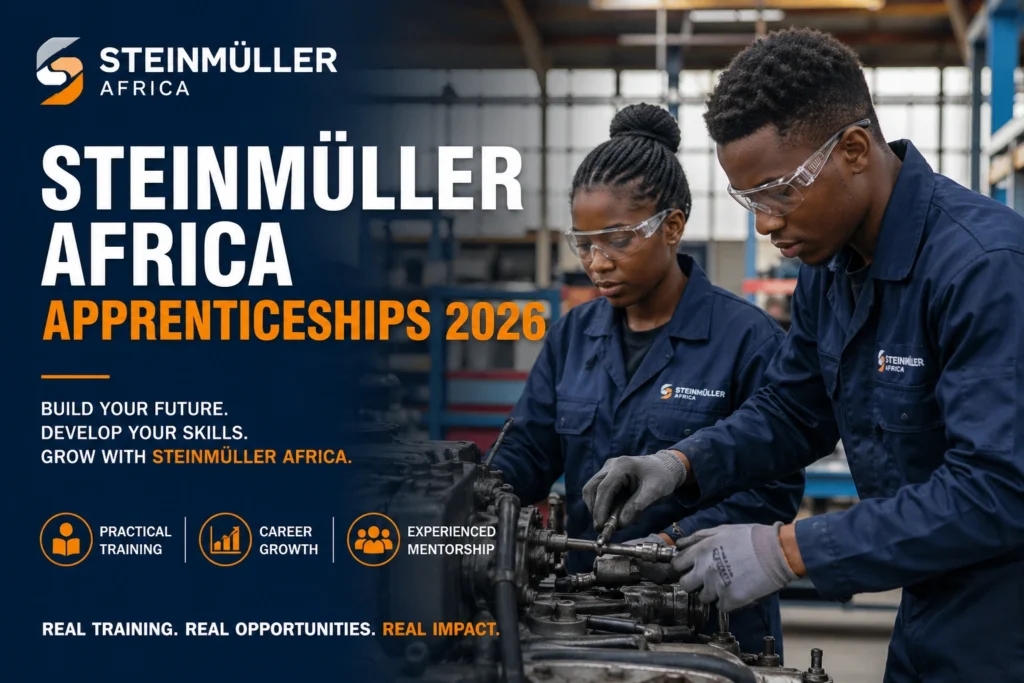

At a time when youth unemployment in South Africa continues to dominate headlines, the Steinmüller Africa Apprenticeships 2026 programme is quietly becoming one of the most talked-about opportunities in skills development circles.
It’s not just another apprenticeship listing. It’s the timing, the structure, and the location that are sparking interest—especially among young people in Mpumalanga and beyond.
With the application deadline set for 22 May 2026, the window is tight. And in a landscape where many opportunities feel either inaccessible or oversaturated, this programme stands out for a different reason: it offers a direct pathway into scarce, technical skills that the country urgently needs.
But why is this specific apprenticeship trending now—and what does it say about the broader state of employment and training in South Africa?
A Programme Rooted in Industry Demand
The Steinmüller Africa Apprenticeships 2026 initiative is not emerging in a vacuum. It sits at the intersection of two pressing realities: a shortage of skilled artisans and a growing pool of unemployed youth.
Steinmüller Africa, working alongside Bilfinger Intervalve Africa, has positioned this programme to address both.
Located in Bethal, near Kriel Power Station in Mpumalanga, the apprenticeship focuses on Boilermaking and Welding—two trades that remain essential to South Africa’s energy, infrastructure, and manufacturing sectors.
Unlike short-term training initiatives, this is a 36-month structured apprenticeship. That matters. It signals depth, not just exposure.
Participants won’t only sit in classrooms. They will:
- Complete merSETA-accredited modules
- Gain hands-on workplace experience
- Prepare for a formal trade test
- Graduate as certified artisans at NQF Level 4
In a job market often criticized for producing graduates without practical skills, this hybrid approach is precisely what many policymakers have been calling for.
APPLY HERE: Steinmüller Africa Apprenticeships 2026
How We Got Here: The Bigger Picture
To understand why the Steinmüller Africa Apprenticeships 2026 programme is resonating, it helps to look at the broader backdrop.
South Africa’s youth unemployment rate has hovered at crisis levels for years. While universities continue to produce graduates, industries frequently report a mismatch between qualifications and practical capability.
At the same time, the country faces a shortage of qualified artisans—especially in sectors tied to energy and heavy industry.
Government initiatives and Sector Education and Training Authorities (SETAs) have long promoted apprenticeships as a solution. But implementation has been uneven, and many programmes have struggled with scale, funding, or industry alignment.
This is where Steinmüller Africa’s approach feels different.
By anchoring the programme near an operational power station and tying it directly to industry needs, the apprenticeship bypasses some of the common pitfalls of purely academic training.
It’s not just about learning a trade—it’s about learning it in context.
The Fine Print: Who Gets In?
Of course, opportunities like this come with strict requirements—and that’s part of what’s driving conversation online.
To qualify, applicants must:
- Be 35 years or younger
- Have Grade 12 with Mathematics (not Mathematical Literacy) and Physical Science, or an N2 qualification
- Be physically and medically fit
- Have a clear criminal record
- Live within a 50 km radius of Kriel Power Station—or be willing to relocate to Bethal
There’s also a strong emphasis on Employment Equity (EE) candidates, reflecting broader transformation goals in the sector.
For many young people, these requirements are both a gateway and a barrier.
On one hand, the criteria ensure that candidates are prepared for the technical demands of the programme. On the other, they exclude a significant portion of youth who may lack access to quality schooling or who studied Mathematical Literacy instead of pure Mathematics.
This tension—between maintaining standards and expanding access—is a recurring theme in South Africa’s skills development debate.
Public Reaction: Hope, Skepticism, and Urgency
Online platforms and career forums have seen a noticeable uptick in discussions around the Steinmüller Africa Apprenticeships 2026.
The reactions are mixed—but telling.
Optimism is the dominant tone. Many see this as a rare chance to enter a stable, well-paying trade without needing a university degree.
There’s also a sense of urgency. With limited spots and a firm closing date, applicants are scrambling to gather documents and meet requirements.
But skepticism hasn’t disappeared.
Some users question the lack of accommodation and transport support, noting that relocation costs could be prohibitive for unemployed applicants. Others raise concerns about the Employment Equity restriction, debating its fairness and impact.
Still, even critics acknowledge one thing: opportunities like this are scarce.
And scarcity tends to amplify both excitement and scrutiny.

APPLY HERE: Steinmüller Africa Apprenticeships 2026
Why This Matters Right Now
The timing of the Steinmüller Africa Apprenticeships 2026 programme couldn’t be more relevant.
South Africa is in the midst of an ongoing energy transition, with aging infrastructure, power station maintenance, and new energy projects all requiring skilled technical labor.
At the same time, the conversation around “jobs vs skills” is intensifying.
For years, the focus has been on job creation. But increasingly, experts argue that the real issue is skills alignment—ensuring that people are trained for roles that actually exist.
This apprenticeship sits squarely in that space.
It doesn’t promise instant employment. Instead, it offers something arguably more valuable: a recognized trade qualification with real-world experience.
For young people navigating a difficult job market, that distinction matters.
It shifts the narrative from short-term fixes to long-term capability.
The Hidden Challenges
Despite its promise, the programme is not without challenges—and these are worth examining closely.
First, the geographic limitation. Requiring applicants to live within a 50 km radius of Kriel Power Station narrows the pool significantly. While relocation is an option, the absence of accommodation support makes this difficult for many.
Second, the academic requirements. The insistence on Mathematics rather than Mathematical Literacy reflects the technical nature of the trades—but also highlights inequalities in the education system.
Third, the three-year commitment. While beneficial in the long run, it may deter applicants who need immediate income or who cannot commit to extended training without financial support.
These factors don’t diminish the value of the programme—but they do shape who can realistically access it.
What Could Happen Next
Looking ahead, several scenarios could unfold as the Steinmüller Africa Apprenticeships 2026 programme progresses.
1. Increased Competition for Apprenticeships
If interest continues to grow, similar programmes may see a surge in applications. This could push companies to expand intake—or tighten selection criteria even further.
2. Greater Industry Involvement
Success stories from this initiative could encourage other industrial players to invest in apprenticeship models, particularly in energy and infrastructure sectors.
3. Policy Attention
Government and SETAs may use programmes like this as case studies for scaling work-integrated learning. The balance between accessibility and quality could become a central policy focus.
4. Rising Demand for Technical Education
As awareness grows, more students may opt for Mathematics and science pathways in school, recognizing their importance for technical careers.
But there’s also a less optimistic possibility:
If programmes remain limited in scale, they risk becoming highly competitive lifelines rather than broad solutions to unemployment.
APPLY HERE: Steinmüller Africa Apprenticeships 2026
ALSO APPLY FOR: Thos Begbie’s 2026 Engineering Apprentice
A Shift in Career Thinking?
One of the more subtle impacts of the Steinmüller Africa Apprenticeships 2026 conversation is cultural.
For years, university education has been positioned as the primary path to success. But that narrative is slowly shifting.
Apprenticeships in trades like welding and boilermaking are gaining recognition—not just as alternatives, but as strategic career choices.
They offer:
- Practical, in-demand skills
- Clear qualification pathways
- Opportunities for entrepreneurship
In some cases, experienced artisans can earn salaries comparable to—or exceeding—those of degree holders.
This shift doesn’t diminish the value of higher education. Instead, it broadens the definition of success.
And programmes like this play a crucial role in that redefinition.
Final Thoughts
The Steinmüller Africa Apprenticeships 2026 programme is more than just a training opportunity—it’s a snapshot of where South Africa’s workforce development efforts are heading.
It reflects a growing emphasis on skills, practicality, and industry alignment.
It also highlights ongoing challenges around access, equity, and scale.
For those who meet the requirements and can navigate the logistical hurdles, it represents a meaningful step toward a stable, skilled career.
For everyone else, it raises an important question:
What would it take to make opportunities like this the norm, rather than the exception?
As the application deadline approaches, that question feels more urgent than ever.