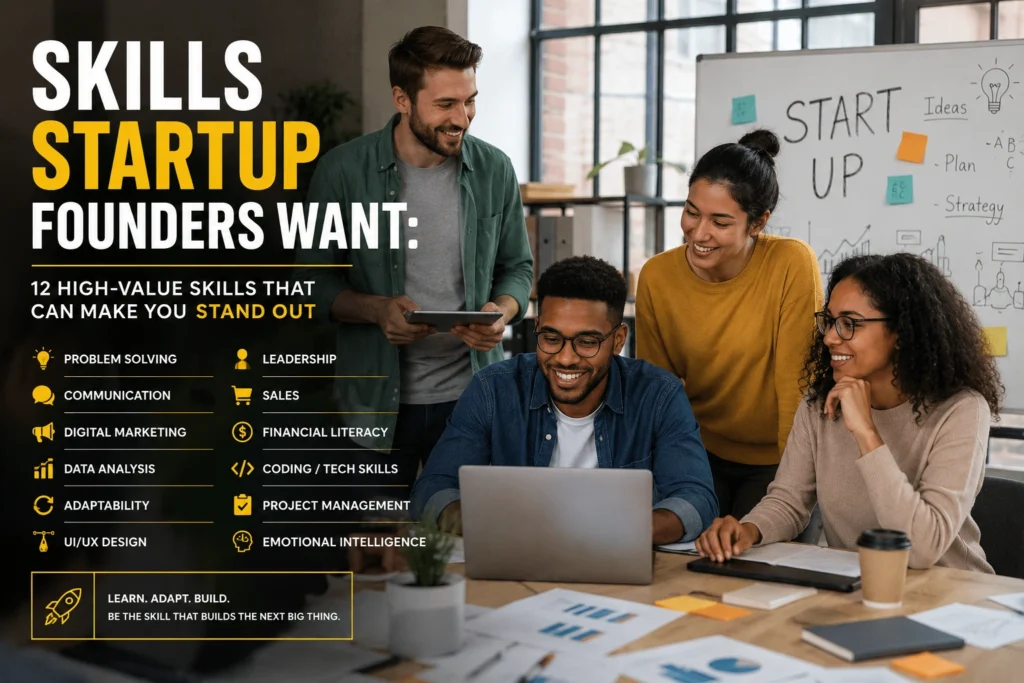

Finding a job at a startup can be exciting, but getting noticed is not always easy. Many applicants have similar qualifications, similar CVs and the same basic computer skills. If you are applying for an entry-level position, internship, graduate role or junior opportunity, you may be asking yourself: What can I offer a startup if I do not have years of experience?
The answer is not simply a degree.
Startups operate differently from large, established organisations. Teams are often smaller, budgets are tighter and priorities can change quickly. A founder may need an employee who can communicate with customers in the morning, analyse information in the afternoon and help solve an unexpected problem before the end of the day.
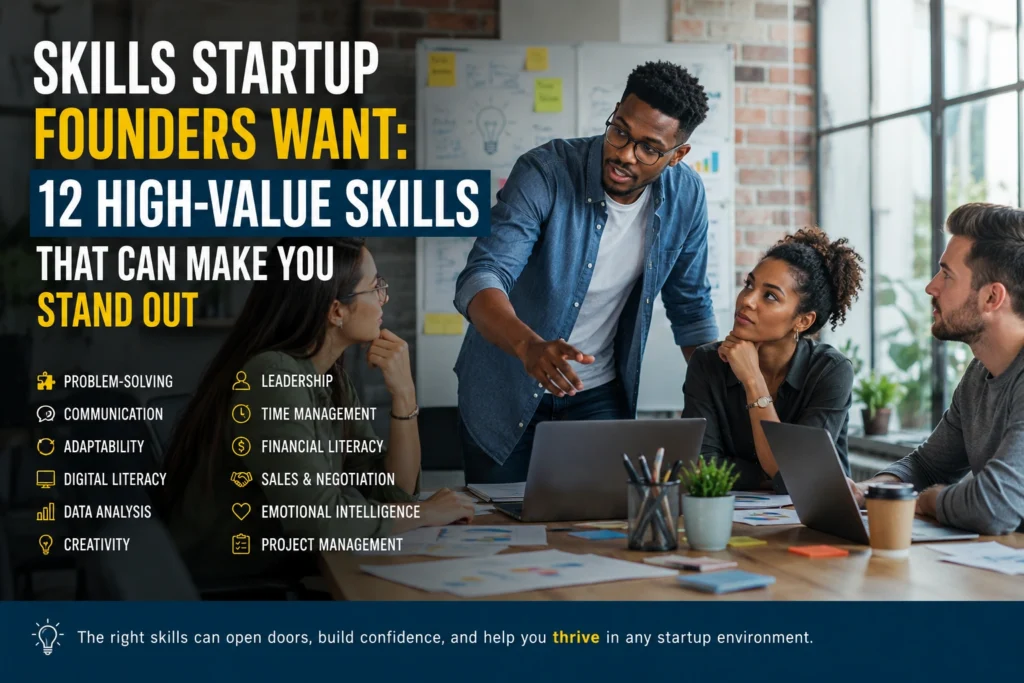
That is why understanding the Skills Startup Founders Want can give you a significant advantage.
The good news is that many of these skills can be developed without expensive courses or years of formal employment. You can build them through personal projects, volunteering, freelancing, university assignments, community activities and even small businesses.
This guide breaks down the most valuable startup skills, explains why founders care about them and shows you how to develop and demonstrate them.
What Are Startup Employers Really Looking For?
Before focusing on individual skills, it helps to understand the environment in which startups operate.
A large company might have separate departments for finance, marketing, IT, human resources, sales and customer service.
A startup may have only a handful of employees covering all these functions.
This means startup employees are frequently expected to be flexible, practical and proactive.
A founder may value someone who says:
“I have not done this before, but I can learn it and come back with a solution.”
That attitude can be more useful than someone who knows one technical skill but refuses to work outside a narrow job description.
The most valuable startup skills often fall into four categories:
- Thinking skills: problem-solving, critical thinking and decision-making.
- People skills: communication, teamwork, customer service and emotional intelligence.
- Business skills: sales, commercial awareness and financial understanding.
- Execution skills: organisation, digital literacy, project management and adaptability.
The strongest candidates usually develop a combination of all four.
ALSO APPLY FOR: Aramex Learnership 2026
ALSO APPLY FOR: Gold Fields Learnerships 2026
Skills Startup Founders Want Most
1. Problem-Solving: Turn Problems Into Solutions
Every business has problems.
A customer might complain. A product might fail. A supplier might deliver late. A marketing campaign might produce disappointing results.
Founders do not necessarily expect junior employees to solve every problem independently. However, they value employees who can think through a problem before immediately asking someone else to fix it.
A strong problem-solving process looks like this:
- Identify the problem.
- Gather the relevant information.
- Find the likely cause.
- Consider several solutions.
- Choose the most practical option.
- Test the solution.
- Review the result.
How to develop this skill
You do not need a corporate job.
Try:
- Analysing a real business problem.
- Improving a process at a community organisation.
- Creating a solution for a university project.
- Running a small online project.
- Studying why a business succeeds or fails.
- Participating in competitions or entrepreneurship programmes.
Keep evidence of what you did.
That evidence can become powerful material during an interview.
2. Communication: Explain Ideas Clearly
Communication is one of the most underestimated workplace skills.
A startup can move quickly, meaning poor communication can create expensive mistakes.
Imagine a developer misunderstands a customer’s requirements because nobody explained the problem clearly. Or a sales employee gives a customer incorrect information because internal communication was poor.
Good communication reduces these risks.
A strong communicator can:
- Write professional emails.
- Explain technical information simply.
- Listen carefully.
- Ask relevant questions.
- Give concise progress updates.
- Present ideas.
- Handle difficult conversations professionally.
- Accept constructive criticism.
A useful test
Take something complicated that you understand and explain it to someone unfamiliar with the subject.
If you can make the explanation simple without making it inaccurate, your communication skills are developing.
3. Adaptability: Become Comfortable With Change
Startups rarely operate exactly according to the original plan.
A company may change its product, target customers, pricing strategy or marketing approach.
Employees therefore need to remain productive when circumstances change.
Adaptability does not mean agreeing with everything.
It means being capable of adjusting your approach while remaining focused on the objective.
Show adaptability by explaining situations where you:
- Learned new software quickly.
- Took on an unfamiliar responsibility.
- Worked with changing deadlines.
- Changed a project after receiving feedback.
- Learned independently.
- Worked with people from different backgrounds or disciplines.
A CV that says “adaptable” is weak.
A CV that demonstrates how you adapted is much stronger.
4. Digital Literacy: Work Smarter With Technology
You do not have to be a programmer to need digital skills.
Almost every startup depends on technology in some form.
Useful skills can include:
- Microsoft Excel.
- Google Sheets.
- Data visualisation.
- Social media platforms.
- Content management systems.
- Customer relationship management software.
- Project management tools.
- Basic cybersecurity awareness.
- Artificial intelligence tools.
- Online research.
- Presentation software.
The important question is not:
“How many software programmes do I know?”
Instead ask:
“Can I use technology to save time, improve accuracy or solve a business problem?”
For example, an employee who can create an automated spreadsheet to reduce repetitive administrative work can immediately create value.
ALSO READ ABOUT: Startup Jobs vs Corporate Jobs
5. Customer Understanding
A startup without customers does not have a sustainable business.
That makes customer understanding incredibly important.
You should learn to think about:
- What problem is the customer experiencing?
- What does the customer actually need?
- Why would they pay for a solution?
- What frustrates them?
- Why might they choose a competitor?
- What feedback appears repeatedly?
This is useful whether you work in marketing, finance, IT, administration or operations.
Practical exercise
Choose a business you use regularly.
Write down:
- Its target customer.
- The problem it solves.
- Its main competitors.
- Why customers might choose it.
- One thing the company could improve.
This simple exercise develops commercial thinking.
6. Sales Skills: Learn How Businesses Generate Revenue
Sales can feel intimidating, particularly to people who do not consider themselves persuasive.
But modern sales is not simply about convincing someone to buy something.
Good sales involves understanding needs and matching those needs to an appropriate solution.
Basic sales knowledge helps employees understand how revenue is generated.
Learn about:
- Lead generation.
- Customer needs.
- Value propositions.
- Objections.
- Negotiation.
- Customer retention.
- Pricing.
- Customer relationships.
Even if you never work in sales, this knowledge can improve your business judgement.
ALSO READ ABOUT: Most Searched Careers This Year
7. Initiative: Do Not Wait for Every Instruction
One of the strongest differences between an average employee and a high-potential employee is often initiative.
Consider two situations.
Employee A: Notices a recurring problem and waits for the manager to notice it.
Employee B: Notices the same problem, investigates it and proposes a possible solution.
Employee B is demonstrating ownership.
Initiative does not mean making unauthorised decisions. It means taking responsible action within your role.
Build initiative by:
- Volunteering for projects.
- Suggesting process improvements.
- Taking ownership of deadlines.
- Researching solutions before asking for help.
- Identifying opportunities.
- Following through on commitments.
8. Analytical Thinking and Data Skills
Modern startups generate data constantly.
Website visitors, customer purchases, social media engagement, expenses and sales figures can all provide useful information.
You do not need to become a data scientist.
Start with basic analytical abilities:
- Reading tables.
- Understanding percentages.
- Comparing results.
- Identifying trends.
- Creating spreadsheets.
- Building simple charts.
- Asking why a number changed.
- Turning data into recommendations.
Example
Instead of saying:
“Our website traffic increased.”
An analytical employee might say:
“Traffic increased by 20% after the campaign, but enquiries did not increase at the same rate, suggesting that the business should examine conversion quality.”
That is the difference between reporting information and interpreting it.
9. Time Management and Prioritisation
Startup employees can quickly become overwhelmed because there is always another task to complete.
The solution is not simply working longer hours.
It is learning to prioritise.
| Priority | Question to Ask | Typical Action |
|---|---|---|
| Critical | What could seriously damage the business if ignored? | Do immediately |
| High | What directly affects important goals? | Schedule first |
| Medium | Is this valuable but not urgent? | Plan it |
| Low | Does this need to happen now? | Complete later or delegate |
| Unnecessary | Does this actually create value? | Remove it |
A useful habit is to identify your three most important outcomes at the beginning of each working day.
This prevents a long to-do list from becoming a substitute for actual productivity.
10. Financial Awareness
You do not need to be an accountant to understand business finances.
However, every startup employee should understand the basics.
Learn the difference between:
- Revenue.
- Expenses.
- Profit.
- Cash flow.
- Fixed costs.
- Variable costs.
- Pricing.
- Budgeting.
Why does this matter?
Because an employee’s decisions can affect the company’s finances.
For example, choosing a cheaper supplier may reduce expenses, but if quality declines and customers leave, the decision could ultimately cost the business more.
Financial awareness helps you consider the wider consequences of your actions.
11. Creativity and Resourcefulness
Startups often have limited resources.
That means employees may need to accomplish more with less.
Resourcefulness could mean:
- Finding a low-cost software alternative.
- Creating a simple marketing experiment.
- Repurposing existing content.
- Improving an inefficient process.
- Finding a new customer segment.
- Testing an idea before spending heavily.
Creativity is not only about designing logos or making videos.
It is about finding better possibilities when the obvious solution is unavailable.
12. Emotional Intelligence and Teamwork
Startup pressure can be intense.
People work closely together, deadlines can change and disagreements are inevitable.
Emotional intelligence helps employees understand their own reactions and work effectively with others.
Useful behaviours include:
- Listening before responding.
- Accepting feedback.
- Staying professional during disagreements.
- Recognising when colleagues need support.
- Communicating concerns early.
- Giving credit to others.
- Taking responsibility for mistakes.
A technically brilliant employee who creates constant conflict can become a liability.
A capable employee who is dependable, respectful and collaborative can become extremely valuable.
A Practical Skills Matrix for Startup Job Seekers
Use this table to identify where you are strong and where you need development.
| Skill | Why Founders Value It | How to Practise It | Evidence You Can Show |
| Problem-solving | Helps overcome unexpected challenges | Solve practical problems | Case study/project |
| Communication | Reduces misunderstandings | Present and write regularly | Presentation/sample |
| Adaptability | Startups change quickly | Learn unfamiliar tools | Learning example |
| Digital literacy | Improves productivity | Master workplace software | Portfolio/project |
| Sales | Supports revenue growth | Practise customer research | Sales exercise |
| Data analysis | Improves decisions | Work with spreadsheets | Data project |
| Initiative | Reduces need for supervision | Lead small projects | Project outcome |
| Time management | Improves execution | Prioritise daily tasks | Project completion |
| Financial awareness | Supports better decisions | Learn business basics | Business analysis |
| Teamwork | Builds effective teams | Collaborate on projects | Team example |
How to Build These Skills Without a Job
One of the biggest challenges facing young job seekers is the classic problem:
“I need experience to get a job, but I need a job to get experience.”
You can break that cycle.
Create your own experience.
Try these practical projects:
Start a small online business
Even if it does not make significant money, you can learn about marketing, customers, pricing and operations.
Analyse a public dataset
Use spreadsheet software to identify trends and create a simple report.
Build a portfolio
Create examples of writing, design, research, coding, marketing or analysis.
Volunteer
Small organisations often need assistance with administration, social media, events or digital tools.
Improve an existing process
Find something inefficient in a club, society or community organisation and propose a better system.
The objective is not to pretend these activities are equivalent to years of employment.
The objective is to demonstrate that you can take action, learn and produce results.
Best Practices Experts Recommend
Focus on proof, not claims
Instead of saying:
“I am a great problem-solver.”
Explain:
“I identified a recurring problem, tested two possible solutions and implemented the option that reduced the amount of manual work.”
Evidence is more convincing.
Build a T-shaped skill profile
A useful career strategy is to develop:
- One area of deep expertise, such as accounting, coding, marketing or design.
- Several complementary skills, such as communication, data analysis, project management and customer understanding.
This gives you a specialisation without becoming too narrowly focused.
Learn continuously
Technology and business practices change quickly.
Set aside regular time to learn.
You could:
- Complete free online lessons.
- Read business case studies.
- Follow industry developments.
- Analyse successful startups.
- Watch practical tutorials.
- Build projects.
- Ask experienced professionals for feedback.
Measure your progress
Do not simply say you are improving.
Create measurable targets.
For example:
- Complete two portfolio projects.
- Learn Excel formulas.
- Deliver three presentations.
- Analyse one business each month.
- Complete a digital marketing project.
- Read one business case study weekly.
Small targets become meaningful when maintained consistently.
Mistakes People Often Make
1. Trying to look perfect
Founders know nobody knows everything.
Honesty about what you do not know, combined with evidence that you can learn, can be more convincing.
2. Listing too many skills
A CV with 30 skills but no evidence can look generic.
Prioritise skills relevant to the position.
3. Ignoring soft skills
Technical abilities may get you noticed, but communication and teamwork can determine whether you succeed.
4. Chasing certificates without practice
A certificate is useful, but practical application is stronger.
5. Failing to research the startup
Before an interview, understand:
- What the company sells.
- Who its customers are.
- What problem it solves.
- Who its competitors are.
- How it appears to make money.
- What challenges it may face.
This allows you to have a much more meaningful conversation with the founder or hiring manager.
6. Saying “I am willing to learn” without demonstrating it
Show evidence.
Explain what you taught yourself, why you learned it and how you used it.
How to Prepare for a Startup Interview
Startup interviews can be less predictable than traditional interviews.
Prepare examples for questions such as:
- “Tell me about a problem you solved.”
- “Describe a time you made a mistake.”
- “How do you handle changing priorities?”
- “Tell me about something you taught yourself.”
- “How would you deal with an unhappy customer?”
- “What would you do if you were given a task you had never performed before?”
- “Why do you want to work for a small company?”
- “What do you know about our business?”
Do not memorise robotic answers.
Instead, prepare real experiences that demonstrate your abilities.
A 30-Day Plan to Become More Startup-Ready
If you want a practical starting point, try this four-week challenge.
Week 1: Understand yourself
- Identify your strongest five skills.
- Identify three weaknesses.
- Review five startup job advertisements.
- Write down the skills they repeatedly request.
Week 2: Develop one technical skill
Choose one useful ability such as:
- Excel.
- Data analysis.
- Digital marketing.
- Coding.
- Graphic design.
- AI-assisted productivity.
- Project management.
Practise every day.
Week 3: Build something
Create a small project using the skill.
Do not worry about making it perfect.
Focus on producing something you can show.
Week 4: Package your evidence
Update your:
- CV.
- LinkedIn profile.
- Portfolio.
- Interview examples.
Then begin applying.
Frequently Asked Questions
1. What is the most important skill for working at a startup?
There is no single skill that guarantees success. However, problem-solving, adaptability, communication, initiative and customer awareness are highly valuable because startup employees often operate across multiple responsibilities.
2. Can I work at a startup without previous work experience?
Yes. Depending on the role, you can demonstrate your ability through personal projects, volunteering, freelance work, university projects, entrepreneurship activities and a strong portfolio.
3. Should I focus on technical or soft skills?
Develop both. Technical skills can help you perform specific tasks, while communication, teamwork, adaptability and problem-solving help you apply those technical abilities effectively.
4. How can I make my CV attractive to startup founders?
Focus on evidence and outcomes. Instead of simply listing skills, explain projects you completed, problems you solved, tools you used and measurable results where available.
Final Takeaway: Become Someone Who Can Create Value
The Skills Startup Founders Want go far beyond having an impressive qualification.
Startups need people who can think, learn, communicate and execute.
If you want to become more competitive, do not wait until you have a job before developing these abilities. Start now.
Choose two skills that you currently lack. Learn them. Build something with them. Document the result. Then use that evidence in your CV and interviews.
The most powerful career advantage is not being able to claim that you have many skills.
It is being able to prove that you can use your skills to solve real problems.
Whether you are a graduate, student, career changer or first-time job seeker, that mindset can make your profile much more attractive to a startup looking for someone who can grow with the business.