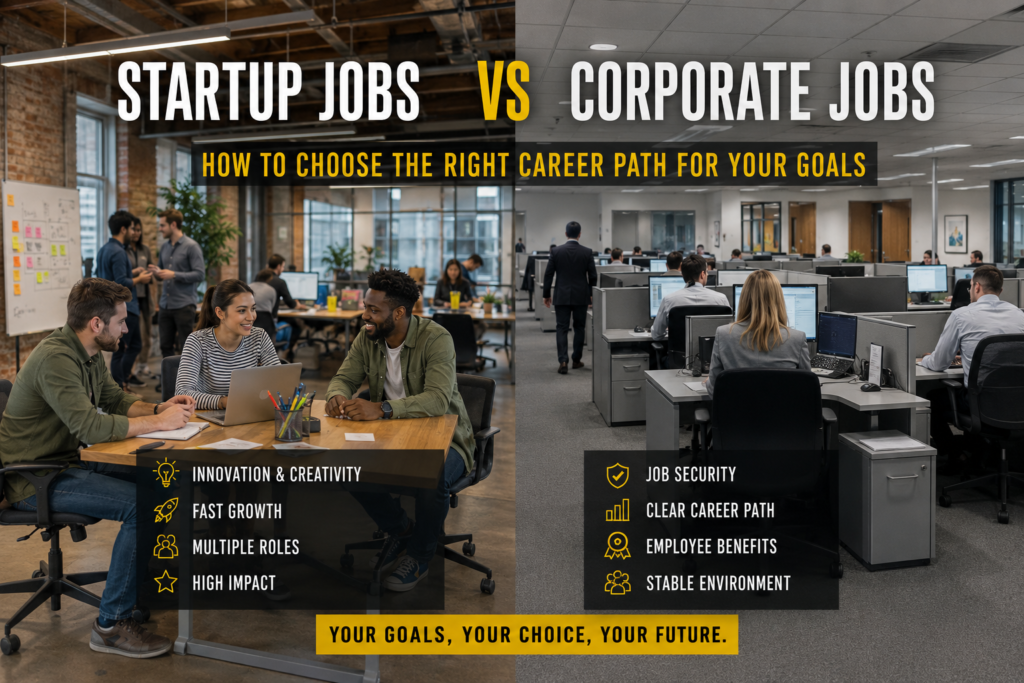

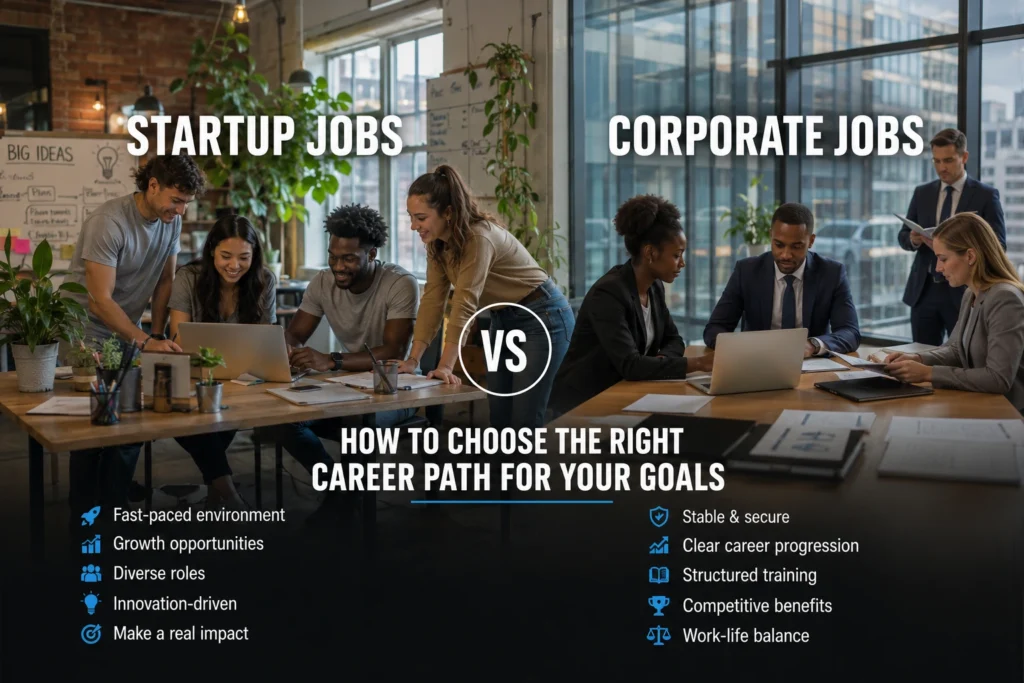
Choosing between a startup and a large company has become one of the biggest career decisions professionals face today. A startup may promise rapid learning, exciting projects, and the chance to make a visible impact. A corporate employer may offer stability, structured career development, and stronger employee benefits. The difficulty is knowing which environment will actually help you achieve your long-term goals.
Many job seekers make this decision based on salary alone or by following popular opinions online. Unfortunately, that often leads to disappointment. Someone who thrives in a fast-moving startup may feel restricted in a corporate environment, while another person who values stability may struggle with the uncertainty that startups naturally bring.
Understanding Startup Jobs vs Corporate Jobs is about much more than comparing company size. It is about matching your personality, career ambitions, financial needs, and preferred working style with the right type of employer.
This guide explains the key differences, advantages, challenges, and practical strategies to help you make a confident career decision.
What Does Startup Jobs vs Corporate Jobs Mean?
The discussion around Startup Jobs vs Corporate Jobs focuses on two very different workplace environments.
A startup is typically a young business that is still growing its products, services, customer base, and market position. Teams are usually smaller, roles are flexible, and employees often perform multiple responsibilities.
A corporate company is generally an established business with structured departments, formal policies, defined career paths, and larger workforces. Examples include multinational companies, banks, telecommunications firms, government-owned enterprises, and large retailers.
Neither option is automatically better.
The right choice depends on what stage of your career you are in and what kind of work environment motivates you.
ALSO APPLY FOR: (WRC) Internship 2026
ALSO APPLY FOR: Eduvos Internships 2026
Why This Issue Matters
Choosing the wrong workplace can affect far more than your monthly salary.
Your first few years in employment often shape your professional habits, confidence, technical skills, and future opportunities. Working in an environment that matches your strengths increases job satisfaction, productivity, and career growth.
The wrong fit can lead to:
- Frequent job changes
- Burnout
- Slow professional development
- Limited learning opportunities
- Poor work-life balance
- Lower long-term earning potential
As industries continue to evolve through technology, artificial intelligence, and remote work, understanding where you can develop the right skills has become increasingly important.
Instead of asking, “Which pays more?” a better question is:
“Which environment will help me become the professional I want to be?”
Startup Jobs vs Corporate Jobs: Understanding the Main Differences
Work Environment
Startups are usually informal.
Employees communicate directly with founders, decisions happen quickly, and processes change frequently. You might help with marketing in the morning, customer support after lunch, and product testing before going home.
Corporate companies operate differently.
Responsibilities are clearly defined. Departments have specialized functions, approvals follow established procedures, and employees normally focus on their designated roles.
If you enjoy variety, startups may feel exciting.
If you prefer structure and predictability, corporate environments may suit you better.
Learning Opportunities
One of the biggest advantages of startups is accelerated learning.
Because teams are smaller, employees gain exposure to many areas of the business.
For example, a marketing graduate might also learn:
- Sales
- Customer success
- Product management
- Data analysis
- Business strategy
Corporate organizations usually provide deeper expertise.
Instead of learning many different skills, employees often become specialists within a specific department.
Neither approach is wrong.
Generalists often thrive in startups.
Specialists often build successful long-term corporate careers.
Career Growth
Career progression looks different in each environment.
At a startup, promotions can happen quickly if the company grows rapidly.
Employees who demonstrate leadership may receive management responsibilities much earlier than they would at larger organizations.
Corporate companies generally have structured promotion systems.
Advancement may take longer but usually follows clear performance standards, training programmes, and leadership development pathways.
Salary and Benefits
Corporate employers often provide:
- Medical aid
- Retirement contributions
- Paid training
- Annual bonuses
- Wellness programmes
- Study assistance
- Larger leave benefits
Startups may offer:
- Competitive salaries
- Performance bonuses
- Share options or equity
- Flexible working arrangements
- Faster salary growth if the business succeeds
However, startups sometimes have tighter budgets, meaning benefits may be more limited during early growth stages.
Job Security
This is one of the biggest differences.
Established corporations generally have stronger financial reserves and diversified revenue streams.
Startups may face:
- Funding challenges
- Cash-flow pressures
- Market competition
- Business closures
That does not mean every startup is risky, but job security is often less predictable.
Innovation
Innovation is often where startups stand out.
Employees frequently contribute ideas that directly influence products, services, and company strategy.
Corporate businesses also innovate but usually through structured planning, larger budgets, and multiple approval processes.
Who Should Consider Startup Jobs?
Startup careers often suit people who enjoy:
- Solving new problems
- Working independently
- Learning quickly
- Wearing multiple hats
- Taking calculated risks
- Building products from scratch
- Fast decision-making
Graduates looking to gain broad business experience sometimes find startups valuable because they are exposed to many aspects of running a company.
Who May Prefer Corporate Jobs?
Corporate careers may be ideal for professionals who value:
- Stable income
- Formal training
- Clear career progression
- Large-scale projects
- Defined responsibilities
- Professional mentorship
- International opportunities
Many industries—including finance, engineering, consulting, healthcare, and telecommunications—offer excellent long-term corporate careers.
ALSO READ ABOUT: Drone Careers
How to Decide Between Startup Jobs vs Corporate Jobs
Instead of relying on assumptions, evaluate your priorities systematically.
Step 1: Define Your Career Goals
Ask yourself:
- Do I want rapid learning?
- Do I want leadership opportunities?
- Do I prefer becoming a specialist?
- Do I want predictable career progression?
Knowing your destination makes choosing an employer much easier.
Step 2: Assess Your Risk Tolerance
Can you comfortably handle uncertainty?
If job security is your highest priority, a corporate role may reduce stress.
If you enjoy building something new despite occasional uncertainty, startups can be rewarding.
Step 3: Consider Your Financial Situation
Someone supporting a family may prioritize predictable income and comprehensive benefits.
A recent graduate with fewer financial obligations may feel comfortable exploring startup opportunities.
Your personal circumstances matter.
Step 4: Think About Your Preferred Management Style
Do you enjoy:
- Close collaboration?
- Informal communication?
- Flexible responsibilities?
Or do you prefer:
- Clear reporting lines?
- Structured performance reviews?
- Formal career development?
Your answer often points toward the right environment.
Step 5: Research Individual Companies
Not every startup operates the same way.
Not every corporate employer offers the same culture.
Research:
- Employee reviews
- Leadership team
- Financial stability
- Company mission
- Staff turnover
- Growth plans
Focus on the specific employer rather than relying on stereotypes.
Best Practices Experts Recommend
Career advisers consistently suggest focusing on long-term skill development rather than chasing impressive company names.
Some practical recommendations include:
- Build transferable skills regardless of employer.
- Keep learning through online courses and certifications.
- Network both inside and outside your workplace.
- Ask questions during interviews about culture, expectations, and growth opportunities.
- Evaluate managers as carefully as they evaluate you.
- Think beyond your first salary when comparing offers.
- Review employee benefits alongside base pay.
- Keep your CV updated with measurable achievements.
Experts also recommend choosing roles where you can regularly solve meaningful problems instead of simply completing repetitive tasks.
Mistakes People Often Make
Many career decisions become disappointing because people overlook important factors.
Common mistakes include:
Choosing Only Based on Salary
A higher salary may not compensate for poor work-life balance, limited growth, or an unhealthy culture.
Assuming Every Startup Is Exciting
Some startups have excellent leadership and strong funding.
Others struggle with planning, communication, or financial stability.
Research carefully.
Assuming Every Corporate Job Is Boring
Large organizations often manage billion-rand projects involving advanced technology, international collaboration, and complex innovation.
Corporate work can be highly engaging.
Ignoring Company Culture
Culture affects daily happiness more than company size.
Supportive leadership often matters more than whether a business has 20 employees or 20,000.
Thinking the Decision Is Permanent
Many professionals successfully move between startups and corporate organizations throughout their careers.
Your first choice does not lock you into one path forever.
Skills That Help in Both Environments
Regardless of where you work, employers increasingly value:
- Communication
- Problem-solving
- Adaptability
- Digital literacy
- Data analysis
- Time management
- Collaboration
- Emotional intelligence
- Critical thinking
- Customer focus
Developing these transferable skills improves employability across every industry.
Questions to Ask During Interviews
Whether interviewing at a startup or a corporation, consider asking:
- How is success measured in this role?
- What training opportunities are available?
- How does the company support career growth?
- What challenges is the team currently facing?
- How often are performance reviews conducted?
- What does a typical working week look like?
- Why is this position available?
The answers often reveal far more than the job advertisement.
Is It Possible to Switch Later?
Absolutely.
Many professionals begin in startups before moving into larger corporations.
Others spend years in corporate roles before joining startups to gain broader responsibilities.
Each experience builds valuable skills.
Employers increasingly appreciate candidates who have worked across different business environments because they bring diverse perspectives and problem-solving approaches.
Frequently Asked Questions
Is a startup job better for graduates?
It depends on your goals. Startups often provide broad experience and faster learning, while corporate graduate programmes usually offer structured training, mentoring, and clearer career progression.
Do startup jobs pay less than corporate jobs?
Not always. Some startups offer competitive salaries, bonuses, or equity. However, corporate employers generally provide more comprehensive benefits and greater long-term financial stability.
Which option offers faster career growth?
Startups can provide quicker promotions if the company expands rapidly. Corporate organizations usually have structured promotion processes that may take longer but often come with formal leadership development.
Can working at a startup help me get a corporate job later?
Yes. Experience in a startup often demonstrates adaptability, initiative, and problem-solving skills, which many corporate employers value when hiring experienced candidates.
Final Thoughts
The debate around Startup Jobs vs Corporate Jobs has no universal winner because careers are deeply personal.
If you enjoy fast learning, flexibility, and building something from the ground up, a startup could be an excellent place to grow. If you value stability, structured development, comprehensive benefits, and established career pathways, a corporate employer may be the better choice.
Rather than chasing trends, evaluate your own goals, personality, financial situation, and preferred working style. Research employers carefully, ask thoughtful questions during interviews, and focus on developing skills that remain valuable regardless of where you work.
The best career decision is not the one that looks most impressive on paper—it is the one that helps you learn, grow, and build a sustainable future.
ALSO READ ABOUT: Drone Careers
ALSO APPLY FOR: (WRC) Internship 2026
ALSO APPLY FOR: Eduvos Internships 2026