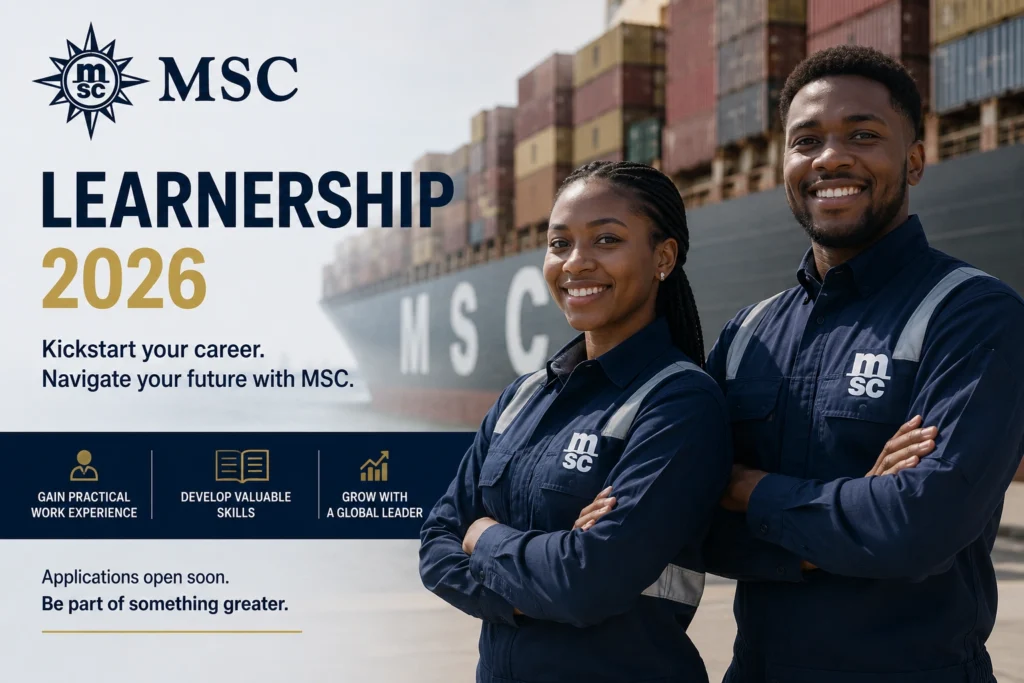

South Africa’s high youth unemployment rate has made it increasingly difficult for young people to gain meaningful work experience after completing Matric. Many entry-level positions require practical skills that first-time job seekers simply do not have, creating a frustrating cycle where experience is needed to get a job, but a job is needed to gain experience.
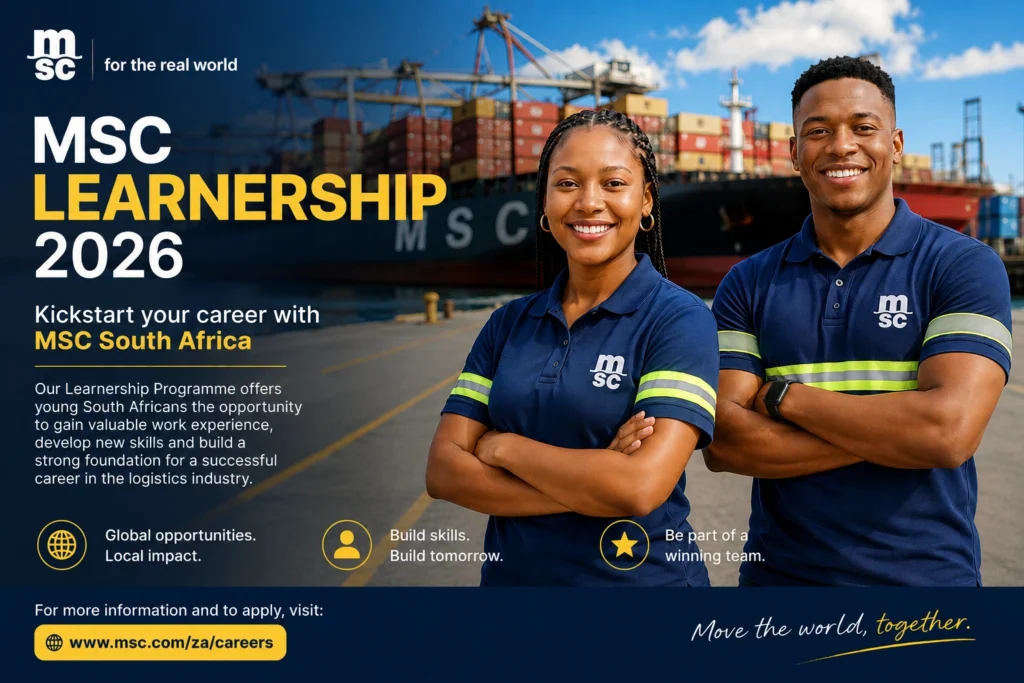
The MSC Learnership 2026 provides a practical solution to this challenge. Designed for unemployed South African youth, this programme combines classroom learning with real workplace experience in the maritime and logistics industry. Participants receive fully subsidised training, a monthly stipend, and the opportunity to earn nationally recognised qualifications while building valuable industry skills.
If you have an interest in shipping, international trade, customs compliance, or logistics, this learnership could be an excellent first step toward a long-term career. This guide explains everything you need to know, including eligibility requirements, qualifications offered, application tips, and ways to improve your chances of being selected.
What Is the MSC Learnership 2026?
The MSC Learnership 2026 is a structured skills development programme created to prepare young South Africans for careers in the maritime, shipping, and logistics sectors.
Rather than focusing only on classroom education, the programme combines theoretical studies with practical workplace exposure. This allows learners to understand how the shipping industry operates while developing skills employers value.
Successful learners gain experience in areas such as:
- International trade
- Freight forwarding
- Customs compliance
- Shipping administration
- Logistics operations
- Import and export documentation
- Customer service
- Business communication
The programme is available in:
- Durban
- Johannesburg
- Pretoria
- Port Elizabeth
Applicants must choose one region during the application process because transfers are generally not permitted after acceptance.
Why This Issue Matters
South Africa depends heavily on international trade, with thousands of imported and exported goods moving through ports every day. Behind every shipment is a team of logistics professionals responsible for documentation, customs procedures, freight coordination, customer communication, and supply chain management.
Unfortunately, many young people never receive the opportunity to enter this growing industry because they lack relevant qualifications or workplace experience.
The MSC Learnership 2026 helps bridge this gap by:
- Providing recognised qualifications
- Offering practical workplace training
- Helping unemployed youth gain industry experience
- Improving long-term employability
- Developing skills that are transferable across logistics and supply chain careers
For many participants, a learnership becomes the first professional experience listed on their CV, making future job applications much stronger.
Qualifications Offered Through the Programme
MSC has developed a three-stage learning pathway that gradually builds learners’ knowledge and practical abilities.
The qualifications include:
Phase 1
National Certificate in International Trade
This introduces learners to:
- Global commerce
- Import and export processes
- Trade documentation
- International business fundamentals
Phase 2
National Certificate in Freight Forwarding and Customs Compliance
Learners develop knowledge of:
- Freight forwarding
- Customs regulations
- Shipping documentation
- Cargo movement
- Compliance procedures
Phase 3
Further Education and Training Certificate in Shipping
The final phase focuses on:
- Maritime operations
- Shipping procedures
- Logistics administration
- Industry practices
- Operational efficiency
Each phase lasts approximately 12 months, allowing learners to steadily develop their knowledge and workplace competence.
What Support Do Learners Receive?
One of the biggest advantages of the MSC Learnership 2026 is that learners are supported financially while completing their studies.
Benefits include:
- Fully subsidised training
- Monthly stipend
- Practical workplace exposure
- Nationally recognised qualifications
- Potential annual performance bonus for eligible learners
The annual bonus may depend on factors such as attendance, assessment results, discipline, and overall conduct throughout the programme.
Receiving a stipend helps reduce some of the financial barriers that often prevent young people from participating in long-term training opportunities.
Who Can Apply?
Applicants must meet the programme’s minimum requirements before submitting an application.
Typical requirements include:
- South African Matric certificate
- Minimum C aggregate
- Mathematics as a subject
- Computer literacy
- Good communication skills
- Strong work ethic
- Reliability
- Attention to detail
- Methodical approach to work
Previous work experience may be considered an advantage but is generally not compulsory.
The programme primarily considers unemployed youth under the age of 25 from designated groups.
Meeting the minimum requirements does not guarantee selection, so applicants should focus on submitting the strongest application possible.
MSC Learnership 2026: Choosing the Right Region
One of the most important decisions during the application process is selecting your preferred training location.
Available regions include:
- Durban
- Johannesburg
- Pretoria
- Port Elizabeth
Applicants should think carefully before choosing because changing regions later may not be possible.
Before selecting a location, consider:
- Daily transport costs
- Accommodation arrangements
- Family responsibilities
- Ability to attend regularly
- Travel time
Choosing a region you can realistically commit to increases your chances of completing the programme successfully.
Step-by-Step Guide to Applying
Applying correctly can significantly improve your chances of being shortlisted.
Step 1: Confirm You Meet the Requirements
Read the eligibility criteria carefully before starting your application.
Ensure you have:
- Matric
- Mathematics
- Computer literacy
- Required age qualification
- Reliable internet access
Step 2: Prepare Your Documents
Although the advert does not provide a full checklist, applicants should prepare:
- Updated CV
- Certified South African ID copy
- Matric certificate
- Mathematics results
- Additional certificates
- Proof of computer literacy (if available)
- Professional email address
- Active cellphone number
Ensure scanned documents are clear and readable.
Step 3: Update Your CV
Your CV should highlight:
- Mathematics achievement
- Computer skills
- Administrative experience
- Customer service experience
- Communication skills
- Teamwork
- Leadership roles
- Volunteer work
Keep your CV neat and limited to relevant information.
Step 4: Complete the Online Application
Applications must be submitted through the official MSC careers portal.
APPLY HERE: MSC Learnership 2026
Complete every section carefully and avoid leaving information blank.
Double-check:
- Contact details
- Email address
- Region selection
- Uploaded documents
Step 5: Submit Early
The advert does not specify a closing date.
Because learnership opportunities often close once sufficient applications have been received, submitting early is strongly recommended.
ALSO APPLY FOR: African Resonance Learnership 2026
Skills That Can Help You Stand Out
Competition for learnerships is often high.
Strong applicants usually demonstrate:
- Computer literacy
- Excellent communication
- Organisation
- Professional behaviour
- Reliability
- Time management
- Attention to detail
- Ability to follow procedures
- Positive attitude
- Genuine interest in logistics
Shipping companies value employees who can accurately handle documentation, meet deadlines, and communicate professionally with clients and colleagues.
Best Practices Experts Recommend
Career advisers frequently recommend taking the following steps before applying for competitive learnerships.
Research the Company
Learn about MSC’s operations and understand its role in shipping and logistics.
Tailor Your CV
Don’t use the same CV for every opportunity.
Adjust your CV to highlight skills relevant to shipping, logistics, administration, and customer service.
Use a Professional Email Address
Avoid informal email addresses.
Create one using your first and last name whenever possible.
Check Every Document
Ensure scans are:
- Clear
- Complete
- Correctly labelled
- Easy to read
Apply Before the Deadline
Waiting until the final day increases the risk of technical issues or missed opportunities.
Mistakes People Often Make
Many otherwise qualified applicants miss opportunities because of avoidable errors.
Common mistakes include:
Applying Without Reading the Requirements
Some applicants submit applications despite lacking Mathematics or other required qualifications.
Choosing the Wrong Region
Selecting a location that is too far away often leads to attendance problems later.
Poor CV Presentation
Spelling mistakes, inconsistent formatting, and outdated information create a poor first impression.
Missing Documents
Incomplete applications may not be considered.
Always verify that every required document has been uploaded.
Using Incorrect Contact Details
If recruiters cannot contact you, you may lose your opportunity even after being shortlisted.
Career Opportunities After Completing the Learnership
The maritime and logistics industry offers numerous entry-level opportunities.
Graduates may pursue careers such as:
- Shipping Assistant
- Freight Forwarding Assistant
- Customs Support Clerk
- Logistics Administrator
- Documentation Clerk
- Import and Export Clerk
- Operations Assistant
- Customer Service Consultant
- International Trade Assistant
With additional experience and further qualifications, professionals can advance into supervisory and management positions within shipping, logistics, and supply chain operations.
Frequently Asked Questions
1. Is the MSC Learnership 2026 paid?
Yes. Successful learners receive a monthly stipend while participating in the programme. Eligible learners may also qualify for an annual performance bonus based on programme requirements.
2. Can I apply if I have no work experience?
Yes. Previous work experience may be beneficial but is generally not a compulsory requirement. The programme is designed to provide practical workplace experience.
3. Is there an application closing date?
The current advertisement does not specify an official closing date. Applicants should apply as soon as possible while the opportunity remains available.
4. Can I change my training region after being accepted?
Generally, no. Applicants are expected to complete the programme in the region selected during the application process, so choose carefully.
Final Thoughts
The MSC Learnership 2026 offers far more than a monthly stipend. It provides structured learning, recognised qualifications, and practical workplace experience in one of South Africa’s most important economic sectors.
For young people interested in shipping, freight forwarding, customs compliance, logistics, or international trade, this programme can serve as a valuable stepping stone into long-term employment. Because the training is fully subsidised and combines classroom education with practical exposure, participants gain both theoretical knowledge and real-world skills that employers actively seek.
Before submitting your application, review the eligibility requirements carefully, prepare a professional CV, organise all supporting documents, and choose the region where you can realistically complete the programme. Since no official closing date has been announced, applying early is the safest strategy.
With careful preparation, attention to detail, and a well-presented application, you can significantly improve your chances of securing a place in the MSC Learnership 2026 and beginning a rewarding career in South Africa’s growing maritime and logistics industry.