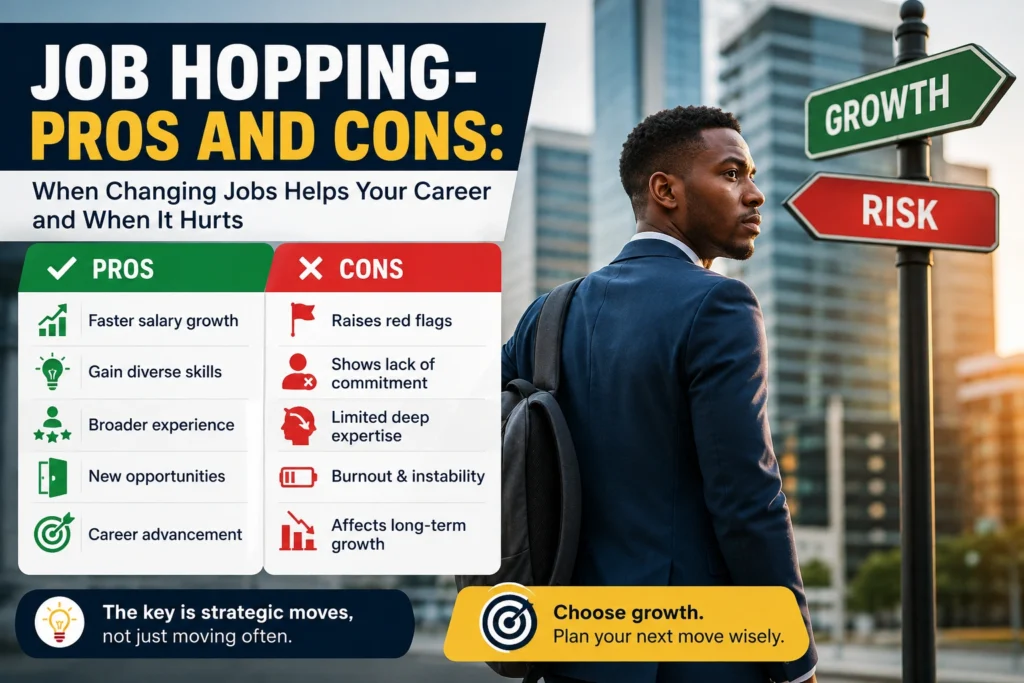

Changing jobs every few years has become increasingly common. For some professionals, moving from one employer to another is a smart way to increase their salary, gain new skills and find better opportunities. For others, frequent job changes can create questions about reliability, commitment and long-term career direction.
This is why understanding the Job Hopping-Pros and Cons is important before deciding whether to accept another offer.
The challenge is that there is no universal rule saying how long someone should stay in a job. A person who changes employers after one year may be making a sensible career decision, while someone who stays in the same position for ten years may be limiting their professional growth.
The real question is not simply, “Am I changing jobs too often?” It is, “Does this move make sense for my career?”
Job hopping can be beneficial when each move provides meaningful progress. It can become a problem when someone changes jobs repeatedly without gaining skills, responsibility, stability or a clearer career direction.
What Is Job Hopping?
Job hopping generally refers to changing employers relatively frequently, particularly when someone spends a short period in each position.
There is no fixed definition. One employer may view three jobs in five years as normal career development, while another may regard several six-month positions as excessive movement.
The interpretation also depends on the industry, profession, seniority and reason for leaving.
For example, moving between companies in technology, consulting, sales or project-based industries may be more common than frequent moves in professions where long-term experience with one organisation is highly valued.
The difference between strategic career movement and job hopping is important.
Strategic movement means changing jobs because the new opportunity offers something meaningful, such as:
- Better career progression
- Increased responsibility
- Improved compensation
- New technical skills
- Leadership experience
- A stronger professional environment
- Relocation
- A change in career direction
- Better work-life balance
Job hopping becomes more concerning when a person repeatedly leaves positions without being able to explain what they accomplished or why the next move represents progress.
ALSO APPLY FOR: SAS Marketing Intern 2026
ALSO APPLY FOR: GE Vernova Internships 2026
Job Hopping-Pros and Cons: The Advantages and Disadvantages
There are legitimate benefits to changing employers, but there are also risks. Understanding both sides can help you make a decision based on your circumstances rather than following career trends.
The Pros of Job Hopping
1. You may increase your earning potential
One of the biggest reasons professionals change employers is compensation.
An external job offer can sometimes provide a larger salary increase than an employee would receive through normal annual increments.
Changing companies may therefore help professionals close a compensation gap, particularly if their responsibilities have increased significantly without a corresponding salary adjustment.
However, salary should not be the only factor.
A higher-paying position that provides no development, has poor management or offers little future progression may not be a good career move.
2. You can build a broader skill set
Every workplace operates differently.
Changing organisations can expose you to different systems, technologies, customers, management approaches and business processes.
For example, a marketing professional might gain experience in:
- Digital marketing
- Content strategy
- Paid advertising
- Analytics
- Brand management
That broader experience can make the professional more versatile.
The same principle applies to engineering, finance, human resources, information technology, administration and other fields.
3. You can discover what type of workplace suits you
Early-career professionals often do not know what kind of working environment they prefer.
One company may have a highly structured corporate culture, while another may operate with a smaller, more flexible team.
Changing jobs can teach you valuable lessons about:
- Management styles
- Team culture
- Communication
- Workload
- Career progression
- Organisational structure
That self-knowledge can help you make better career decisions later.
4. You may find better career opportunities
Sometimes the easiest way to move into a more senior role is to change organisations.
An employee who has reached the highest realistic level in a department may find limited opportunities internally.
Another company may offer a position with greater responsibility.
For example, someone working as a junior analyst could move into an analyst or specialist role elsewhere rather than waiting indefinitely for an internal vacancy.
5. You can expand your professional network
Every workplace introduces you to new colleagues, managers, clients, suppliers and industry professionals.
Over time, these relationships can become valuable sources of:
- Career advice
- Referrals
- Industry information
- Mentorship
- Job opportunities
- Professional partnerships
The key is to maintain relationships even after leaving an organisation.
The Cons of Job Hopping
The benefits can be attractive, but frequent job changes also carry risks.
1. Employers may question your commitment
Recruiters often examine employment history when assessing candidates.
Several short stays can raise questions, particularly if there is no obvious progression.
An employer may wonder whether you will leave after receiving training or accepting a more attractive offer.
This does not automatically mean you will be rejected, but it can create an additional concern that you need to address.
2. You may miss opportunities to develop deep expertise
Starting a new job requires a learning period.
You need to understand the organisation, systems, processes, customers and expectations.
If you leave too quickly, you may repeatedly experience the beginner stage without reaching the point where you become highly skilled.
Deep expertise often develops through sustained exposure to challenging work.
3. Frequent moves can make your CV look unstable
A CV containing many short-term positions may be difficult to interpret.
For example:
- Company A — 7 months
- Company B — 9 months
- Company C — 8 months
- Company D — 11 months
This pattern may concern employers unless there are clear explanations.
By comparison, a candidate who has spent several years developing progressively greater responsibilities may appear more stable.
4. You may underestimate the value of internal progression
Changing companies is not the only way to advance.
Sometimes an employee can secure a promotion, salary adjustment, leadership opportunity or transfer by having a career conversation with their current employer.
Leaving immediately can mean abandoning opportunities that might have become available with better communication.
5. Job hopping can become a cycle
A new job can initially feel exciting because everything is unfamiliar.
But if the underlying problem is poor career planning, changing companies may not solve it.
Someone who repeatedly leaves because of difficult managers, demanding workloads or normal workplace challenges may eventually discover the same problems at another employer.
The goal should be to identify whether the problem is genuinely the organisation or whether it is something that requires a different solution.
Why This Issue Matters
Job mobility affects more than your CV.
Your employment history can influence how recruiters assess your reliability, how quickly you build expertise and whether you develop meaningful professional relationships.
For younger workers, changing jobs can sometimes accelerate learning. But excessive movement can also prevent them from building a strong track record.
For experienced professionals, a job change can represent an important promotion or strategic career shift. At the same time, employers recruiting for senior positions may expect evidence of sustained performance and leadership.
The South African employment market also makes career decisions particularly important. Competition for desirable positions can be high, and applicants often need to demonstrate not only qualifications but practical experience, achievements and adaptability.
This means every career move should ideally strengthen your professional story.

ALSO READ ABOUT: What Recruiters Check Online Before Hiring You
How to Decide Whether You Should Change Jobs
Before resigning, work through these steps.
Step 1: Identify the actual reason you want to leave
Write down the main reason.
Is it:
- Salary?
- Poor management?
- Lack of growth?
- Burnout?
- Relocation?
- Better career alignment?
- A toxic workplace?
- Lack of learning?
Be honest.
If you cannot identify the problem, it becomes difficult to determine whether another employer will actually solve it.
Step 2: Compare your current job with the new opportunity
Do not compare salaries alone.
Create a simple comparison covering:
| Factor | Current Job | New Job | What to Consider |
|---|---|---|---|
| Salary | What you earn now | Proposed salary | Is the increase large enough to justify moving? |
| Benefits | Medical aid, retirement, bonuses and allowances | New benefits package | Are you gaining or losing important benefits? |
| Career growth | Current promotion opportunities | Expected progression | Which employer offers a clearer path to advancement? |
| Skills development | Skills you are currently gaining | New skills you could develop | Will the new role make you more employable in future? |
| Management | Current manager and leadership style | New manager/team | Have you researched what it is like to work with the new team? |
| Work-life balance | Current working hours | hours Expected working hours | Will the move improve or worsen your personal time? |
| Job security | Stability of current employer | Stability of new employer | Is the new organisation financially and operationally stable? |
| Location/commute | Travel time and transport costs | New travel requirements | Could additional commuting costs reduce your effective salary increase? |
| Responsibilities | Your current duties | New responsibilities | Does the new position give you more responsibility or valuable experience? |
The result may reveal that a seemingly attractive offer has significant disadvantages.
Step 3: Look for measurable career progression
Ask yourself whether the new position gives you something you can explain on your CV.
For example:
“I moved to a position with responsibility for a larger team.”
is a stronger career narrative than:
“I wanted a change.”
Step 4: Check the employer carefully
Research the organisation before accepting.
Look at its reputation, leadership, financial stability, employee reviews and opportunities for development.
A job offer is not automatically a good opportunity simply because it comes with a higher salary.
Step 5: Calculate the financial impact
Consider the complete package.
Include:
- Basic salary
- Bonuses
- Retirement contributions
- Medical benefits
- Transport costs
- Remote-work arrangements
- Leave benefits
- Relocation costs
- Other allowances
A small salary increase may disappear once additional commuting or living costs are considered.
Step 6: Consider your employment history
If you have already changed jobs several times recently, ask whether another move will strengthen or weaken your CV.
You do not necessarily need to stay somewhere simply to create an impressive timeline. But you should have a clear reason for another move.
Step 7: Prepare your explanation
Recruiters may ask why you left previous employers.
Prepare an honest, professional explanation that focuses on career development rather than criticism.
Instead of complaining about a former manager, explain what you were seeking in your next professional opportunity.
Best Practices Experts Recommend
A sensible approach to job mobility is to focus on progress rather than movement.
Before accepting another position, ask whether it provides at least one substantial improvement.
That improvement could be:
- More responsibility
- Better compensation
- New technical expertise
- Management experience
- A stronger career path
- Better alignment with your qualifications
- Improved working conditions
Keep records of your achievements at every employer. Quantifiable results make job changes easier to explain.
For example, “managed social media” is relatively vague.
“Managed social media campaigns that increased monthly engagement by 35%” provides evidence of contribution.
Also, avoid burning bridges.
Your former colleagues and managers can become future references, clients or professional contacts.
Finally, do not resign based solely on frustration. Secure the new opportunity, understand the terms and make a financially responsible transition where possible.
Mistakes People Often Make
Changing jobs only for a small salary increase
Money matters, but a slightly higher salary may not justify losing strong development opportunities.
Leaving without another plan
Unemployment can place financial pressure on you and reduce your negotiating power.
Where possible, understand your next step before resigning.
Assuming every new company will be better
Every workplace has challenges. Research the new employer rather than assuming the grass is greener.
Staying too long out of fear
The opposite extreme is also problematic.
Remaining in a role indefinitely despite having no development, poor conditions or no realistic progression can also damage your career growth.
Failing to document achievements
If you change jobs frequently, your achievements become especially important.
Keep evidence of projects, responsibilities, improvements, certifications and measurable results.
Treating LinkedIn and your CV as an afterthought
Your professional profiles should clearly explain your career progression.
Focus on achievements rather than simply listing responsibilities.
FAQs About Job Hopping
Is job hopping bad for your career?
Not necessarily. Changing jobs can be positive when each move provides meaningful career development. It becomes more concerning when a candidate repeatedly leaves positions after short periods without demonstrating progression or a clear reason
How long should you stay at a job?
There is no universal number. The appropriate length depends on the role, industry, career stage and opportunities available. Instead of focusing only on months or years, consider whether you have gained meaningful experience and delivered measurable results.
Can job hopping increase your salary?
It can. Moving to a new employer may provide access to a higher salary or better overall package. However, compensation should be evaluated alongside career development, benefits, stability and working conditions.
How should I explain frequent job changes during an interview?
Be honest and focus on the professional reason behind each move. Explain what you learned, what responsibilities you gained and why the new position represents a logical next step. Avoid attacking previous employers.
Final Summary: Make Career Moves With a Purpose
The debate around Job Hopping-Pros and Cons is often presented as if changing jobs is automatically good or bad. The reality is much more nuanced.
A carefully planned job move can increase your income, expand your skills, introduce you to new industries and accelerate career progression. On the other hand, repeated short-term moves can make your CV harder to explain, prevent you from developing deep expertise and raise concerns among potential employers.
The most useful question is therefore not how many times you have changed jobs.
Ask whether your career is moving forward.
Before accepting another offer, examine the salary, responsibilities, learning opportunities, workplace culture, stability and long-term prospects. Consider how the move fits into the story you want your CV to tell.
If the new position represents genuine progress, changing jobs may be a sensible career decision. If you are simply escaping temporary frustration or chasing a small increase in pay, taking time to reassess may be wiser.
Practical advice: treat every job change as an investment in your professional future. Do not move simply because another job is available. Move when the opportunity gives you a clear reason to become more skilled, more experienced, better compensated or better positioned for the career you want.
ALSO APPLY FOR: SAS Marketing Intern 2026
ALSO APPLY FOR: GE Vernova Internships 2026
ALSO READ ABOUT: What Recruiters Check Online Before Hiring You