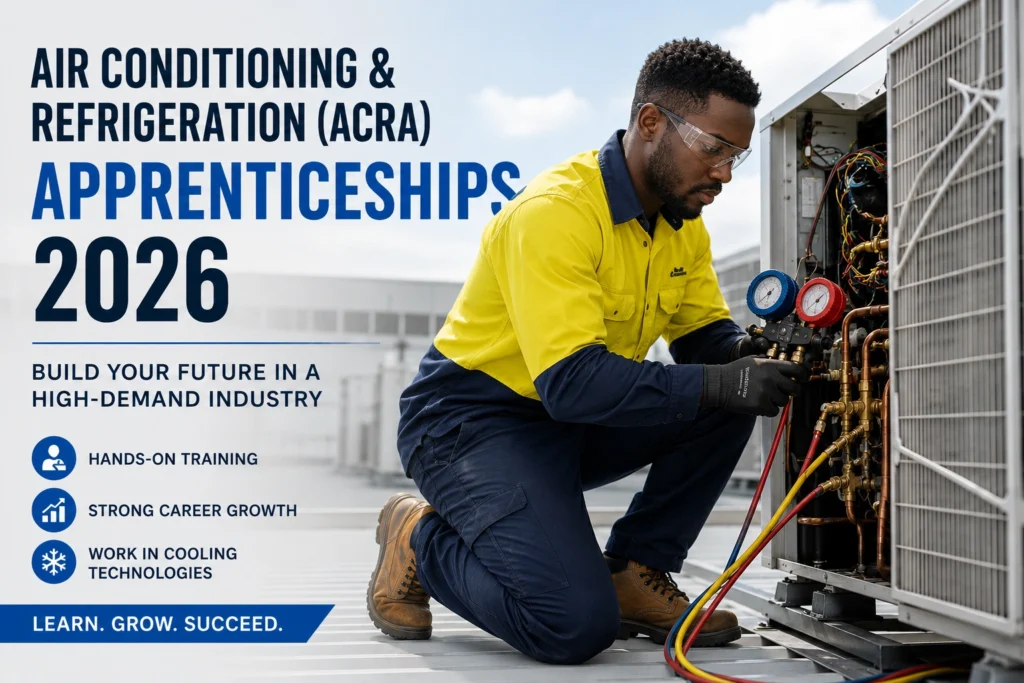

For years, university degrees dominated conversations about career success in South Africa. But a noticeable shift is taking place. As youth unemployment remains a major challenge and industries increasingly search for qualified technical workers, more young people are exploring artisan careers that offer practical skills, steady income, and long-term employment prospects.
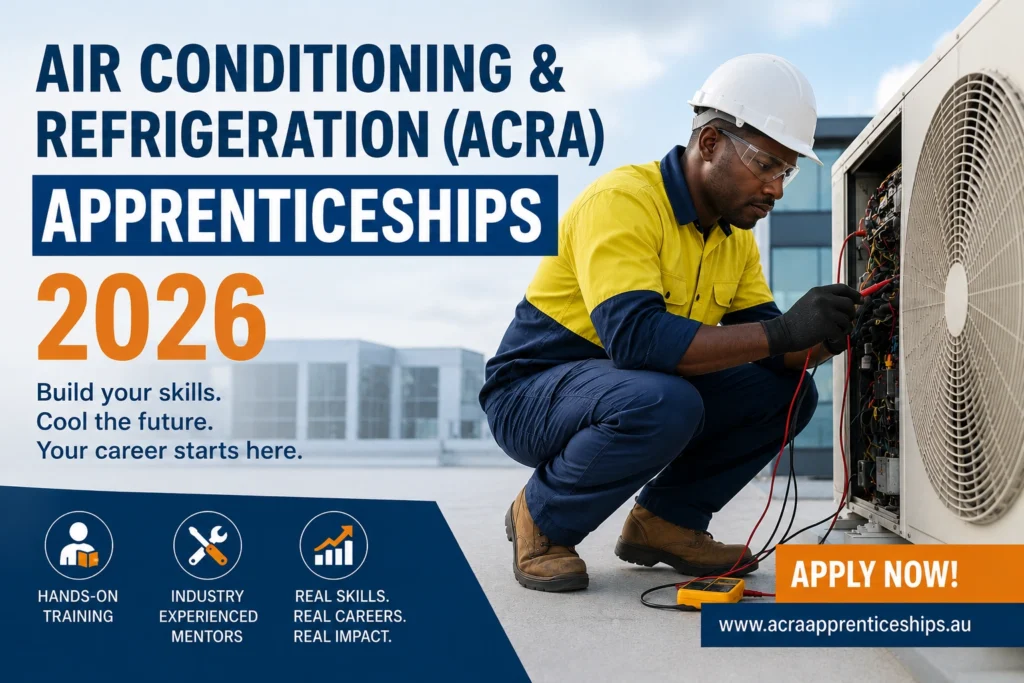
That growing interest is one reason Air Conditioning & Refrigeration (ACRA) Apprenticeships are attracting attention ahead of the 2026 intake period. The programme offers a structured route into one of South Africa’s most in-demand technical trades, combining classroom learning with real-world workplace experience.
At a time when businesses, hospitals, supermarkets, data centres, manufacturing facilities, and residential developments all rely heavily on cooling and refrigeration systems, the demand for trained technicians continues to rise. For school leavers and young job seekers looking for a career path with tangible opportunities, ACRA apprenticeships are increasingly being viewed as a practical alternative to traditional academic routes.
The Growing Importance of Technical Skills in South Africa
The conversation around artisan development has changed dramatically over the past decade.
Government departments, industry associations, and training authorities have repeatedly highlighted shortages in critical technical occupations. Refrigeration mechanics, electricians, plumbers, and other skilled artisans have consistently appeared on scarce skills lists because employers struggle to find qualified professionals.
The refrigeration and air conditioning sector sits at the centre of several growing industries.
Modern supermarkets depend on refrigeration systems to preserve food. Hospitals require temperature-controlled environments and specialised cooling equipment. Commercial buildings rely on sophisticated HVAC systems to maintain comfortable working conditions. Even the rapid expansion of data centres has increased demand for cooling specialists.
As these sectors grow, so does the need for technicians capable of installing, maintaining, and repairing complex systems.
That reality has placed programmes like the Air Conditioning & Refrigeration (ACRA) Apprenticeships firmly on the radar of career seekers across South Africa.
Understanding What the ACRA Apprenticeship Programme Offers
The Air Conditioning and Refrigeration Academy (ACRA) has been training students since 1998 and has established itself as a recognised provider of technical training within the HVAC and refrigeration industry.
The apprenticeship programme is designed to develop fully qualified Refrigeration and Air Conditioning Technicians through a combination of practical and theoretical learning.
Unlike short courses that focus on limited skills, the apprenticeship follows a structured artisan development model over approximately three years.
Participants typically receive:
- Workplace-based practical training
- Industry mentorship from qualified artisans
- Classroom-based theoretical instruction
- Exposure to commercial and industrial systems
- Preparation for trade testing
- Opportunities to gain nationally recognised qualifications
This combination reflects the traditional apprenticeship model that has successfully produced skilled tradespeople around the world for generations.
Why This Trade Is Suddenly Receiving More Attention
One of the most interesting developments in South Africa’s employment landscape is the renewed respect for artisan careers.
For many years, technical trades were sometimes viewed as secondary options compared to university education. However, labour market realities have challenged that perception.
Graduates in some academic fields often face lengthy job searches after completing their studies. Meanwhile, many qualified artisans find employment relatively quickly because their skills directly address industry needs.
The refrigeration and air conditioning sector offers an especially attractive proposition because it intersects with multiple industries.
Technicians may work in:
- Commercial refrigeration
- Residential air conditioning
- Industrial cooling systems
- Food production facilities
- Mining operations
- Healthcare institutions
- Hospitality establishments
- Data centres
This diversity reduces dependence on a single industry and creates multiple pathways for career growth.
What Apprentices Actually Learn
A key strength of the ACRA programme is its broad technical curriculum.
The training extends far beyond simply repairing air conditioners.
Students develop a deep understanding of refrigeration science, electrical systems, installation procedures, diagnostics, and maintenance techniques.
Key learning areas include:
Refrigeration Principles and Thermodynamics
Every cooling system operates according to scientific principles. Apprentices learn how refrigeration cycles function, how heat transfer occurs, and how different cooling technologies achieve temperature control.
Understanding these fundamentals allows technicians to diagnose problems effectively rather than relying on trial-and-error repairs.
Electrical Systems and Controls
Modern HVAC equipment depends heavily on electrical and electronic components.
Apprentices gain knowledge of:
- Electrical wiring
- Control circuits
- Sensors
- Safety systems
- Fault diagnosis
- System testing
These skills are highly transferable and valuable across many technical industries.
Installation and Maintenance
Practical workplace experience forms a major component of the apprenticeship.
Students learn how to install equipment correctly, perform routine maintenance, and ensure systems operate efficiently.
This hands-on training often becomes one of the most valuable aspects of the programme.
Refrigerant Handling and Environmental Compliance
As environmental regulations evolve globally, refrigeration technicians must understand the safe handling of various refrigerants.
Training includes exposure to:
- Traditional refrigerants
- Hydrocarbon systems
- Carbon dioxide systems
- Ammonia-based refrigeration
- Safety procedures
- Environmental regulations
These competencies are becoming increasingly important as industries adopt greener technologies.
ALSO VISIT: https://www.acra.co.za
Eligibility Requirements: Who Can Apply?
One reason the programme generates significant interest is its relatively accessible entry requirements.
Applicants generally need:
- South African citizenship
- Minimum age of 16 years
- Grade 9 or higher qualification
- Mathematics or Science background
- Ability to participate in practical workplace training
Funded apprenticeship projects often target applicants between 18 and 35 years old, although requirements may vary depending on funding arrangements.
Candidates with a National Senior Certificate, NC(V), or N2 qualification may enjoy a competitive advantage during selection.
Those who studied Mathematics and Physical Science at school may also find the technical content easier to navigate
APPLY HERE: (ACRA) Apprenticeships 2026
ALSO APPLY FOR: BASF Apprenticeship Programme 2026
Public Reaction: Why Young People Are Taking Notice
Online discussions around apprenticeships have increasingly highlighted concerns about graduate unemployment and the rising cost of higher education.
Many young South Africans are looking for alternatives that offer both training and income.
The “earn while you learn” model remains one of the strongest attractions of apprenticeship programmes.
Instead of accumulating significant educational debt, apprentices gain practical experience while receiving financial support through stipends or salaries.
Parents are also becoming more receptive to artisan careers as success stories emerge across multiple sectors.
Qualified artisans frequently secure stable employment and may eventually earn incomes comparable to or exceeding those of some degree holders.
This changing perception is contributing to renewed enthusiasm for programmes such as the Air Conditioning & Refrigeration (ACRA) Apprenticeships.
Why This Matters Right Now
South Africa faces a complex employment challenge.
While many people are searching for work, employers in technical sectors often struggle to find candidates with the right practical skills.
This mismatch creates opportunities for apprenticeship programmes to bridge the gap.
Several factors make ACRA apprenticeships particularly relevant in 2026:
The Demand for Cooling Technology Is Growing
Climate change, urbanisation, and infrastructure development continue to increase demand for cooling solutions.
Air conditioning systems are becoming standard features in commercial and residential developments.
At the same time, refrigeration remains essential to food security and healthcare systems.
Skilled Artisans Remain Scarce
The shortage of qualified technical workers continues to affect many industries.
Employers frequently report difficulties filling artisan positions, creating favourable employment conditions for qualified technicians.
Practical Training Is Increasingly Valued
Many employers prioritise hands-on competence alongside academic qualifications.
Apprenticeships provide direct exposure to workplace environments, helping graduates transition into employment more smoothly.
Entrepreneurship Opportunities Are Expanding
Many experienced refrigeration technicians eventually establish independent businesses.
As demand grows for installation, maintenance, and repair services, entrepreneurship becomes a realistic long-term option.
The Trade Test: A Critical Milestone
The apprenticeship ultimately leads to the trade test, one of the most important stages of artisan development.
Passing the trade test demonstrates that a candidate has achieved the required level of competence and can perform industry-standard work independently.
Successful candidates become qualified artisans and may obtain an NQF Level 4 qualification associated with the trade.
This qualification often serves as the foundation for further career progression.
Career Paths Beyond Qualification
One of the strongest arguments in favour of refrigeration and air conditioning training is the range of career opportunities available after qualification.
Qualified technicians can pursue roles such as:
- Refrigeration Mechanic
- HVAC Technician
- Maintenance Technician
- Service Technician
- Installation Specialist
- Workshop Supervisor
- Technical Trainer
- Project Coordinator
With sufficient experience, many professionals move into management positions or launch their own service companies.
The trade therefore offers both employment and entrepreneurial pathways.
Global Mobility and International Demand
Another factor driving interest is the international relevance of refrigeration and air conditioning skills.
Countries around the world continue to invest heavily in infrastructure, commercial construction, healthcare facilities, and energy-efficient cooling systems.
As a result, experienced HVAC and refrigeration technicians are often in demand internationally.
While immigration requirements vary between countries, the technical competencies developed through structured apprenticeship programmes can enhance global career opportunities.
For ambitious young artisans, this adds another layer of appeal.
What Could Happen Next?
Looking ahead, several trends could influence the future of refrigeration and air conditioning apprenticeships in South Africa.
Increased Industry Investment
As cooling technology becomes more advanced, employers may invest more heavily in apprenticeship pipelines to secure future talent.
Expansion of Green Technologies
The industry is rapidly moving toward environmentally friendly refrigerants and energy-efficient systems.
Future apprentices may receive even greater exposure to sustainable technologies and smart building systems.
Greater Recognition of Artisan Careers
Public attitudes toward vocational education appear to be evolving.
If current trends continue, artisan careers may receive broader recognition as respected and financially rewarding professions.
More Competition for Training Opportunities
As awareness grows, funded apprenticeship opportunities may become increasingly competitive.
Applicants who demonstrate strong academic performance, technical aptitude, and genuine interest in the trade could enjoy an advantage.
Application Preparation Tips
For prospective applicants, preparation can make a significant difference.
Consider the following steps:
- Ensure academic records are complete and certified.
- Prepare a professional CV.
- Obtain certified copies of identification documents.
- Write a clear motivation letter explaining your interest in the trade.
- Highlight any technical subjects studied at school.
- Include relevant practical experience, even if informal.
- Monitor official apprenticeship announcements regularly.
Demonstrating enthusiasm, reliability, and willingness to learn can strengthen an application significantly.
Final Thoughts
The renewed interest in artisan development is not simply a passing trend. It reflects deeper changes in the labour market and growing recognition that practical technical skills remain essential to economic growth.
The Air Conditioning & Refrigeration (ACRA) Apprenticeships offer more than vocational training. They provide a structured pathway into a scarce-skill profession with strong employment prospects, opportunities for entrepreneurship, and potential access to international markets.
For young South Africans who enjoy problem-solving, working with technology, and building practical expertise, refrigeration and air conditioning may represent one of the most overlooked career opportunities available today.
As industries continue to rely on sophisticated cooling systems and qualified technicians remain in short supply, the value of these skills is unlikely to diminish anytime soon.