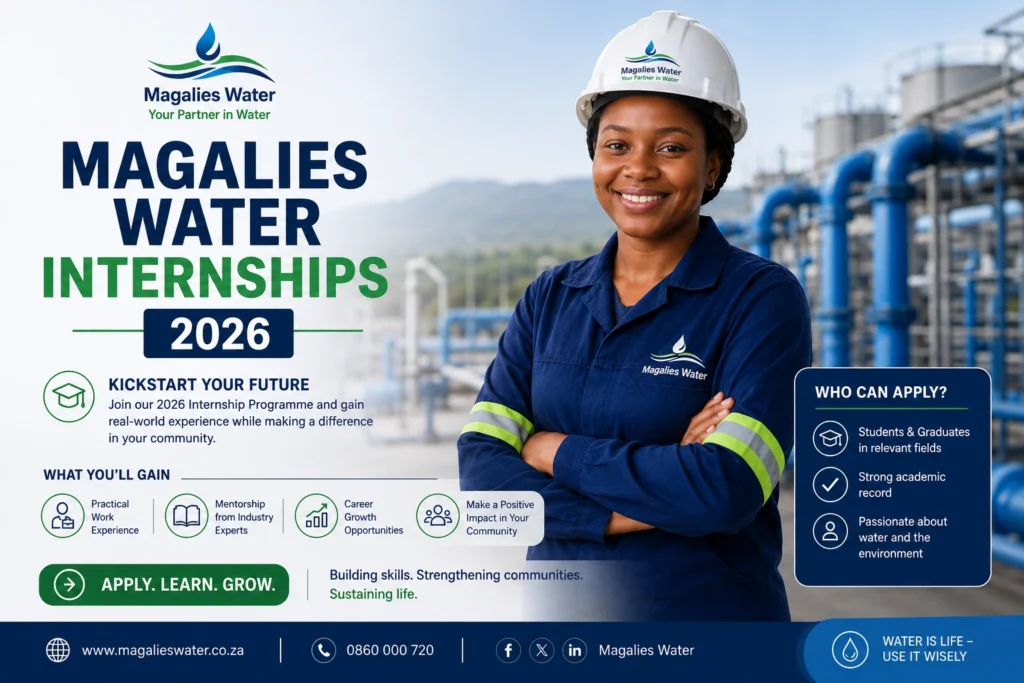

On a chilly winter morning in Mafikeng, a recent engineering graduate refreshes their email inbox for what feels like the hundredth time. Months have passed since graduation. The qualification is complete, the certificates are framed, and the ambition remains strong. Yet like thousands of young South Africans, they face a familiar challenge: finding that first opportunity to gain meaningful workplace experience.
This reality has become increasingly common across South Africa’s graduate landscape. Employers frequently seek candidates with practical experience, while graduates often struggle to obtain that experience without first securing a position. It is a cycle that has left many talented young people searching for pathways into the workforce.
The Magalies Water Internships 2026 programme arrives at a time when such pathways are needed more than ever. Offering a 24-month internship period and a monthly stipend of R7,500, the programme provides unemployed graduates and students with an opportunity to bridge the gap between academic learning and professional employment.
More importantly, it places participants within one of South Africa’s essential public entities responsible for water services and infrastructure, giving them exposure to work that directly affects communities, industries, and economic development.
Why water-sector internships matter more than ever
Water infrastructure rarely dominates public conversation until something goes wrong.
When treatment plants experience operational challenges, when drought pressures increase, or when communities face supply interruptions, the importance of skilled professionals suddenly becomes clear. Behind every functioning water system are engineers, technicians, GIS specialists, laboratory personnel, ICT professionals, and operational teams working to keep critical infrastructure running.
South Africa’s water sector faces significant long-term challenges. Population growth, aging infrastructure, climate variability, and increasing service demands require a steady pipeline of qualified professionals.
That makes programmes like the Magalies Water internship initiative particularly relevant. They are not simply employment opportunities. They are part of a broader effort to develop technical skills that support national infrastructure and service delivery.
For young graduates, this creates a unique advantage. Instead of gaining experience in a purely commercial environment, interns have the opportunity to contribute to projects with visible public impact.
Inside the Magalies Water Internships 2026 programme
The internship programme will run for a period of 24 months, providing participants with extended exposure to workplace operations rather than the shorter placements commonly offered elsewhere.
Successful applicants will receive a monthly stipend of R7,500, helping to reduce some of the financial pressure often associated with internship participation.
The programme is open to South African citizens between the ages of 18 and 35 who are unemployed and possess the relevant qualifications for their chosen field.
Internship opportunities are available across multiple operational locations, including:
- Mafikeng
- Brits Water Treatment Works (WTW)
- Vaalkop Water Treatment Works (WTW)
- Padda Junction Projects
- Brits Laboratory
- Head Office
These locations expose interns to different operational environments, from engineering project sites to laboratory and information technology functions.
Rather than concentrating opportunities in a single department, Magalies Water has structured the programme across several technical disciplines, reflecting the diverse skills required to operate modern water infrastructure systems.
Where the opportunities are available
One of the strengths of the programme is the variety of disciplines included.
Projects and Engineering
Five internship positions are available within the Projects and Engineering division across Mafikeng, Brits WTW, Vaalkop WTW, and Padda Junction Projects.
Applicants require a minimum NQF Level 6 qualification in:
- Civil Engineering
- Mechanical Engineering
For graduates hoping to build careers in infrastructure development, water treatment systems, or project management, these placements offer practical exposure to real engineering environments.
GIS Internship
Geographic Information Systems (GIS) continue to play a growing role in infrastructure planning and management.
One internship position is available within the GIS section at Brits Laboratory.
Applicants must possess a BSc in Geomatics or an equivalent qualification.
GIS professionals increasingly support decision-making through mapping, spatial analysis, and infrastructure monitoring, making this a highly specialized opportunity.
Mechanical Engineering Internship
Located at Vaalkop WTW, this internship focuses on water services mechanical operations.
Accepted qualifications include:
- S4 Mechanical Engineering
- National Diploma in Mechanical Engineering
- Bachelor of Engineering Technology in Mechanical Engineering
- Equivalent qualifications
This role is particularly suited to graduates interested in equipment maintenance, plant operations, and mechanical systems.
Water Services Production Internship
Also based at Vaalkop WTW, this opportunity supports operational water production activities.
Relevant qualifications include:
- National Diploma in Water Care
- Chemical Engineering
- Equivalent qualifications
As water treatment technology evolves, practical production experience becomes increasingly valuable within both public and private sector environments.
ICT Internships
Three ICT internship positions are available across Brits Laboratory, Head Office, and Mafikeng/Far West operations.
Applicants should possess qualifications in:
- Information Technology
- Information Systems
- Equivalent ICT-related fields
As utilities become more digitally integrated, technology professionals are playing a larger role in infrastructure management, cybersecurity, systems administration, and operational efficiency.
Beyond the stipend: the real value of workplace exposure
Many graduates understandably focus on stipend amounts when evaluating opportunities.
While the R7,500 monthly stipend provides important financial support, the longer-term value often lies elsewhere.
A two-year internship allows participants to build something many employers prioritize: demonstrated workplace experience.
Over 24 months, interns can:
- Develop professional networks
- Build practical technical skills
- Gain references from supervisors
- Understand workplace expectations
- Strengthen CVs with measurable achievements
- Improve future employability
This matters because employers increasingly look beyond qualifications alone. They want evidence that candidates can operate effectively within professional environments, collaborate with teams, and apply technical knowledge to real-world challenges.
For many participants, the internship experience itself may ultimately prove more valuable than the stipend attached to it.
Expert insight: Why infrastructure internships often create stronger career foundations
Career development specialists frequently note that infrastructure-related internships provide unique advantages compared with some entry-level programmes.
The reason is simple: infrastructure organisations tend to operate complex systems that require multidisciplinary collaboration.
An engineering intern may interact with GIS specialists, ICT professionals, project managers, procurement teams, environmental experts, and operational staff.
This cross-functional exposure helps graduates understand how large organisations function as integrated systems rather than isolated departments.
Such experience often produces more adaptable professionals who can transition into a wider range of career opportunities later.
In sectors facing long-term skills shortages, practical infrastructure experience can also become a significant competitive advantage during future recruitment processes.
ALSO VISIT: https://magalieswater.co.za
Application requirements and important considerations
Applicants interested in the Magalies Water Internships 2026 programme should ensure they meet all eligibility requirements before submitting an application.
The minimum requirements include:
- South African citizenship
- Age between 18 and 35 years
- Relevant qualification for the internship field
- Unemployed graduate or student status requiring workplace experience
Required supporting documents include:
- Detailed CV
- Certified copies of qualifications
- Certified copy of South African identity document
Applications must be submitted via email to:
internship@magalieswater.co.za
Applicants should pay particular attention to the email subject line requirements. Magalies Water requires candidates to clearly indicate both the department and preferred location when submitting their application.
This may seem like a small detail, but recruitment teams often use subject-line information to sort applications efficiently. Failure to follow instructions can sometimes affect application processing.
ALSO APPLY FOR: ( PMI ) Internships 2026
Timing could be critical for applicants
The application closing date is 08 June 2026.
Given the relatively short application window, prospective candidates should avoid waiting until the final days before submission.
Public-sector internship programmes often attract significant interest, particularly when they offer multi-year placements and structured workplace experience.
Applicants should ensure all documentation is complete, properly certified, and attached before sending their applications.
It is also worth remembering that Magalies Water reserves the right not to make appointments, reduce the number of appointments, or withdraw the advertisement if operational requirements change.
The organisation may also place successful candidates at operational locations according to organisational needs.
Frequently Asked Questions
1. How much is the stipend for the Magalies Water Internships 2026 programme?
Successful interns will receive a monthly stipend of R7,500 throughout the internship period.
2. How long does the internship programme run?
The programme runs for 24 months, providing extensive workplace exposure and practical experience.
3. Can students apply if they still need practical experience to complete their studies?
Yes. The programme is aimed at unemployed graduates and students who require workplace exposure and practical experience relevant to their qualifications
Looking at the bigger picture
The story behind the Magalies Water Internships 2026 programme is larger than a single recruitment opportunity.
It reflects a broader challenge facing South Africa’s labour market: helping young people convert qualifications into sustainable careers. While universities, colleges, and training institutions continue producing graduates, workplace exposure remains one of the most important missing links for many job seekers.
By offering two years of structured experience across engineering, ICT, GIS, and water services functions, Magalies Water is creating opportunities that can influence careers long after the internship ends.
For applicants who meet the requirements, this programme represents more than a monthly stipend. It offers a chance to gain practical skills, contribute to critical infrastructure, and build the professional foundation needed to navigate an increasingly competitive employment market.
In a country where experience often opens doors that qualifications alone cannot, opportunities like these may become some of the most valuable first steps a young professional can take.