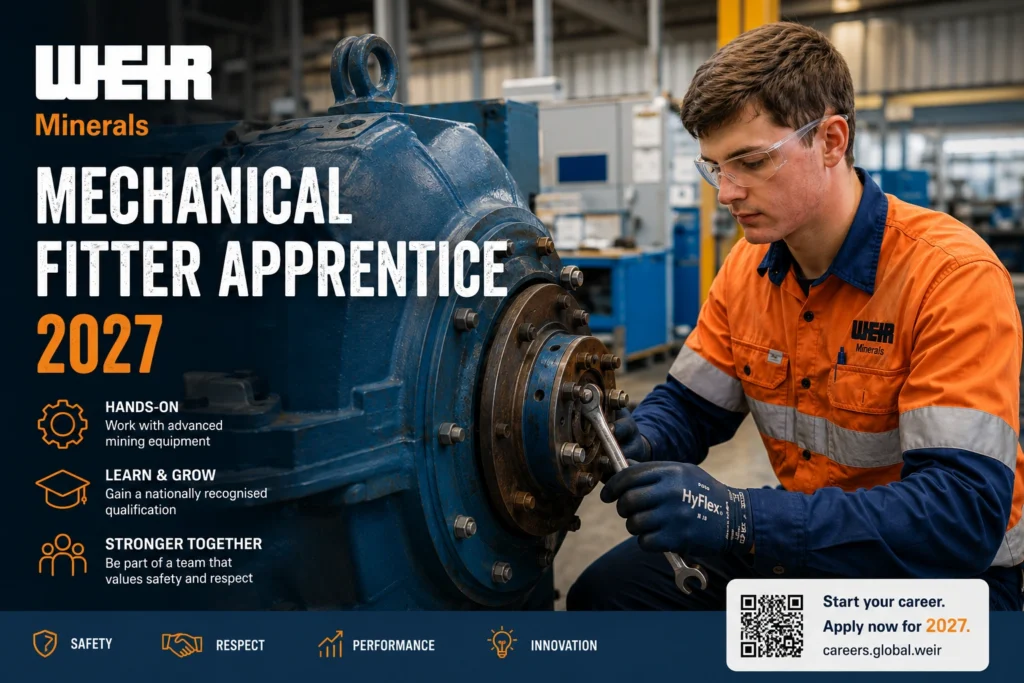

The new Weir Minerals Mechanical Fitter Apprentice 2027 opportunity arrives at a moment when South Africa’s mining and engineering sectors are under pressure to solve a growing skills shortage. While many graduates continue struggling to enter the workforce, artisan trades are quietly becoming some of the most stable and future-focused career paths in the country.
That shift is one reason the latest apprenticeship announcement from Weir Group is drawing attention beyond Rustenburg’s mining circles.
The company’s newly posted Mechanical Fitter apprenticeship is not just another entry-level vacancy. It reflects a broader industry trend: employers are increasingly prioritising practical technical training over purely academic qualifications. For many young South Africans, especially those interested in engineering, mining, maintenance, and industrial systems, apprenticeship programmes like this are becoming one of the few direct bridges into long-term employment.
And because the role is tied to mining technology and sustainable resource extraction, it also connects to a larger conversation happening globally about the future of energy, automation, and industrial infrastructure.
A New Generation of Mining Apprenticeships
For years, apprenticeships were often viewed as secondary to university degrees. That perception has changed dramatically.
Mining companies, engineering firms, and manufacturing businesses are now competing for technically skilled workers who can maintain increasingly advanced machinery and automated systems. Mechanical fitters remain essential because no mine, processing plant, or industrial facility can operate efficiently without equipment maintenance and repair.
The Weir Minerals Mechanical Fitter Apprentice 2027 programme is structured around this reality.
The apprenticeship, based in Rustenburg, combines practical workshop exposure with supervised learning. Apprentices will assist service technicians with maintenance, installations, inspections, dismantling, lubrication, and mechanical repairs while building the competencies required for qualification.
Unlike many entry-level roles that focus mainly on observation, this programme appears heavily hands-on. That matters because employers across South Africa frequently complain that graduates leave training institutions without enough real-world technical exposure.
Weir’s model suggests companies are trying to close that gap internally.
Why Rustenburg Still Matters in South Africa’s Industrial Economy
The location is significant too.
Rustenburg remains one of the country’s most important mining and industrial centres. Although the sector has faced years of uncertainty linked to electricity instability, labour disputes, and fluctuating commodity prices, mining activity around platinum group metals continues to support thousands of technical jobs.
Global demand for minerals linked to renewable energy technologies has also changed the conversation around mining careers.
Companies supplying mining operations increasingly present themselves not only as industrial employers but as contributors to the global energy transition. Weir’s messaging reflects this clearly. The company positions its engineering solutions around sustainability, water efficiency, energy reduction, and smarter mineral extraction.
That framing is becoming common across the mining technology sector.
Young job seekers who once avoided mining because they associated it only with traditional extraction work are now seeing new pathways involving automation, engineering systems, digital maintenance, and sustainability-focused technologies.
The Bigger Story Behind the Recruitment Push
The timing of this apprenticeship is not accidental.
Across South Africa, several major employers have expanded artisan training initiatives over the past year. Apprenticeships in fitting, electrical work, boilermaking, diesel mechanics, and instrumentation have become increasingly visible online.
Part of the reason is demographic pressure.
A large portion of experienced artisans in mining and manufacturing are approaching retirement age. Companies know they need replacement talent urgently. At the same time, many younger South Africans remain unemployed despite holding matric certificates or post-school qualifications.
This mismatch has created renewed interest in apprenticeships because they offer something many graduates still struggle to find: structured workplace experience.
The Weir programme specifically targets applicants with:
- Grade 12 with Mathematics and Physical Science, or
- N3 in Mechanical Engineering
That requirement reflects a growing employer preference for foundational technical literacy rather than advanced degrees alone.
The ability to read technical drawings is also highlighted, showing how modern fitting work increasingly combines mechanical skill with precision interpretation and problem-solving.
Safety Culture Is Becoming a Hiring Priority
One detail that stands out in the apprenticeship listing is the strong emphasis on safety.
Mining and heavy industry employers are under enormous pressure to improve workplace safety records. Fatal incidents and operational shutdowns can have major financial and reputational consequences.
Weir’s reference to “zero harm behaviours” is more than corporate wording. It signals how safety compliance is now deeply integrated into technical training itself.
Today’s apprentices are expected to understand:
- Equipment risk procedures
- Reporting systems
- Preventative maintenance
- Hazard identification
- Compliance protocols
In other words, technical competence alone is no longer enough.
Employers increasingly want apprentices who can operate inside strict operational systems while maintaining productivity and reliability.
That shift could ultimately make artisan training more demanding — but also more valuable.
Public Reaction Shows Growing Interest in Skilled Trades
Online reaction to apprenticeship announcements in South Africa has changed noticeably over the last two years.
A decade ago, many young people focused almost entirely on university pathways. Now, discussions around apprenticeships often attract strong engagement on career pages, community forums, and social media platforms.
Part of this is economic realism.
People have watched graduates struggle to secure work despite expensive qualifications. At the same time, artisans with specialised technical skills often move more quickly into stable employment.
The Weir Minerals apprenticeship taps directly into that growing awareness.
There is also increasing recognition that technical trades can eventually lead to:
- Supervisory roles
- Engineering support positions
- Entrepreneurship opportunities
- International mining contracts
- Specialist maintenance careers
For many families, apprenticeships are no longer viewed as fallback options. They are increasingly seen as strategic career choices.
Why Mining Technology Companies Are Expanding Their Influence
Another interesting aspect of this opportunity is how companies like Weir are redefining their role within mining.
Traditional mining recruitment focused heavily on extraction operations themselves. Today, engineering technology providers are becoming major employers and training contributors.
That matters because mining is evolving into a far more technology-driven environment.
Modern mines rely on:
- Smart monitoring systems
- Predictive maintenance
- Automated processing equipment
- Water efficiency systems
- Digital diagnostics
Mechanical fitters entering the sector today may work alongside technologies that barely existed in older apprenticeship models.
This evolution changes the nature of technical careers themselves.
Artisans are increasingly expected to understand integrated systems rather than isolated mechanical tasks alone.
APPLY HERE: Weir Minerals Mechanical Fitter Apprentice 2027
ALSO APPLY FOR: New Age Engineering Solutions Apprentice 2026
Why This Matters Right Now
South Africa’s youth unemployment crisis continues to shape almost every conversation about education and career planning.
Against that backdrop, the Weir Minerals Mechanical Fitter Apprentice 2027 programme represents more than a single apprenticeship intake. It reflects a wider shift toward skills-based employment models that connect training directly to operational industries.
There are several reasons this matters now:
Technical Skills Are Becoming More Valuable
Many sectors are struggling to recruit qualified artisans. Mechanical fitting remains one of the core industrial skills required across mining, manufacturing, logistics, and energy infrastructure.
Apprenticeships Offer Workplace Experience
One of the biggest barriers facing young job seekers is lack of practical exposure. Apprenticeships solve that problem by combining learning with daily operational work.
Mining Is Reinventing Its Image
The industry increasingly markets itself around sustainability, technology, and future-focused engineering solutions. That changes how younger generations view mining-related careers.
Employers Want Trainable Candidates
Companies are placing greater emphasis on attitude, adaptability, and willingness to learn — especially for technical development roles.
Rustenburg Remains Economically Important
Despite industry challenges, the North West mining belt continues generating opportunities linked to maintenance, engineering, and industrial support services.
The Human Side of Apprenticeship Life
Behind the corporate descriptions lies a demanding reality many applicants underestimate.
Mechanical fitting apprenticeships are physically intensive and mentally demanding. Apprentices often balance workshop tasks, technical assessments, training modules, logbooks, and workplace discipline simultaneously.
The learning curve can be steep.
New apprentices must adjust to:
- Early work schedules
- Industrial environments
- Safety procedures
- Technical terminology
- Performance evaluations
- Team-based operations
But that pressure is also what makes apprenticeship graduates attractive to future employers.
By the end of structured training, many apprentices already understand operational discipline in ways classroom-only graduates may not.
Competition Is Likely to Be High
Given current unemployment levels and the popularity of artisan opportunities, competition for programmes like this will likely be intense.
Applicants with stronger Mathematics and Physical Science performance may hold an advantage. Exposure to technical workshops, engineering studies, or practical mechanical tasks could also strengthen applications.
The inclusion of a Code 10/C1 driver’s licence as a “nice-to-have” requirement is notable too. Employers increasingly value mobility and operational flexibility in technical environments.
Even reporting skills are mentioned — another sign that modern apprentices are expected to communicate effectively, not just perform manual tasks.
What Could Happen Next
The broader implications of programmes like the Weir Minerals Mechanical Fitter Apprentice 2027 opportunity could extend beyond a single recruitment cycle.
Several trends may follow.
More Mining Companies Could Expand Artisan Training
As skills shortages deepen, additional firms may increase apprenticeship intakes rather than relying only on external recruitment.
Technical Careers May Gain More Public Attention
Growing frustration with graduate unemployment may continue shifting interest toward vocational and artisan pathways.
Apprenticeships Could Become More Competitive
As awareness increases, companies may raise entry standards or prioritise candidates with stronger technical foundations.
Industry Training May Become More Technology-Focused
Future apprenticeships are likely to integrate digital systems, automation exposure, and predictive maintenance technologies more heavily.
Employers Could Prioritise Retention
Companies investing heavily in apprenticeship training may increasingly focus on long-term employee development to prevent skilled workers from leaving for competitors.
A Quiet Shift in South Africa’s Career Landscape
One of the most interesting developments happening in South Africa right now is that the country’s labour market is slowly redefining what “good careers” look like.
For years, success was framed narrowly around traditional university degrees.
Now, the economy is forcing a more complicated conversation.
Industries facing operational pressure need technicians, artisans, and maintenance specialists just as urgently as they need office-based professionals. Apprenticeships are becoming central to that recalibration.
The Weir Minerals Mechanical Fitter opportunity sits directly inside that changing landscape.
It reflects an industrial economy still hungry for practical capability — and a generation of young people increasingly searching for realistic entry points into stable careers.
Whether programmes like this can scale enough to meaningfully impact unemployment is another question entirely.
But for applicants with technical interest, discipline, and willingness to work in demanding environments, opportunities like this may represent one of the clearest career pathways still available in South Africa’s evolving economy.