

The conversation around jobs in South Africa has shifted dramatically over the past few years. While university degrees still matter, a growing number of young people are turning their attention toward technical trades, apprenticeships, and artisan careers that offer practical experience and clearer employment pathways.
That is part of the reason the Wilmar SA-Electrician Apprenticeship 2027 is attracting attention right now.
At a time when electricity infrastructure, industrial maintenance, manufacturing efficiency, and technical skills shortages remain major national issues, opportunities linked to artisan development are becoming increasingly important. For many school leavers and N3 graduates, apprenticeship programmes are no longer seen as “second-choice” careers. They are now viewed as realistic routes into stable, respected, and potentially high-paying professions.
Wilmar SA’s newly announced 4-year apprentice electrician training programme arrives in the middle of that shift.
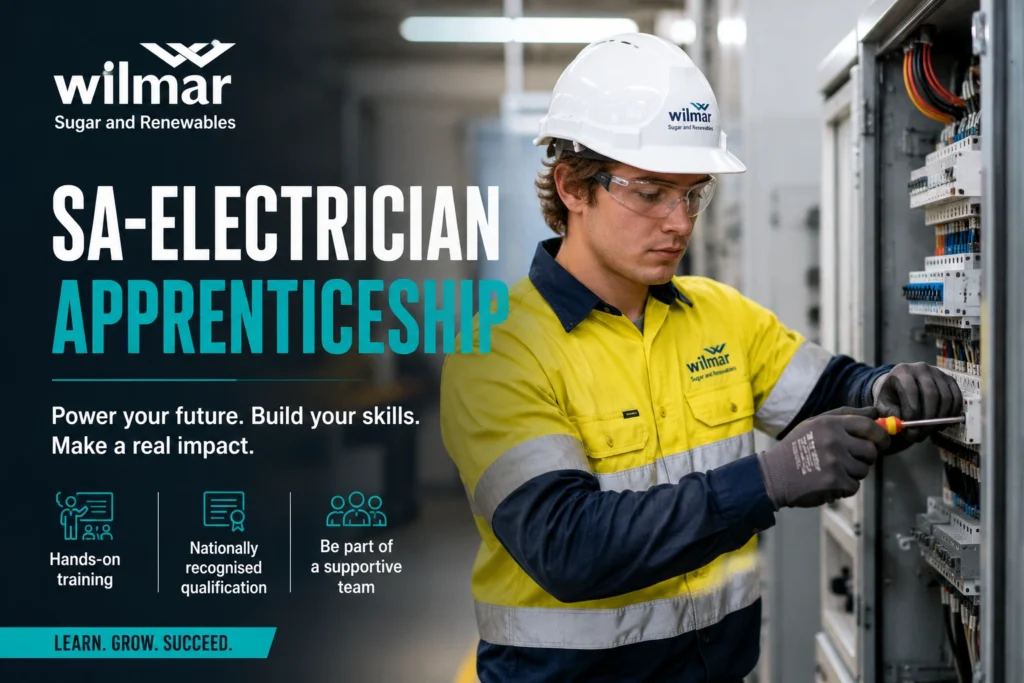
The programme offers qualifying candidates structured training toward a recognised trade qualification as an electrician, while also covering critical support costs such as institutional training, toolkits, protective clothing, and a monthly stipend.
In today’s economy, that combination matters more than ever.
Why the Wilmar SA-Electrician Apprenticeship 2027 Is Getting Attention
South Africa continues to face two connected challenges at the same time: high youth unemployment and a shortage of qualified technical artisans.
For years, industry leaders have warned that the country needs more electricians, millwrights, fitters, welders, and engineering technicians to sustain industrial growth and maintain essential infrastructure. At the same time, thousands of young people struggle to enter the labour market because they lack workplace exposure or specialised skills.
That gap has pushed apprenticeship programmes back into the spotlight.
The Wilmar SA-Electrician Apprenticeship 2027 stands out because it combines formal training with real workplace experience over an extended period. Instead of short-term internships that sometimes leave graduates uncertain about their next move, this programme is designed around a long-term artisan development model.
For many applicants, that structure could be the most attractive feature.
The programme runs over four years and is aimed at helping candidates work toward a formal electrician trade qualification. In a country where certified artisans remain in demand across mining, manufacturing, energy, agriculture, logistics, and infrastructure sectors, a recognised trade qualification can significantly improve employability.
The Bigger Story Behind the Growing Interest in Apprenticeships
A decade ago, many young South Africans felt pressure to pursue university degrees regardless of industry demand. But economic realities have changed public attitudes.
Technical careers are increasingly being viewed as future-focused rather than outdated.
Electricians in particular remain essential across multiple industries. South Africa’s ongoing energy challenges, industrial expansion projects, renewable energy growth, and maintenance backlogs all require skilled electrical professionals.
This has created renewed respect for artisan training pipelines.
Companies are also under pressure to invest in skills development and transformation initiatives. Programmes like this one align with broader national goals linked to employment equity, technical development, and workforce sustainability.
Wilmar SA specifically notes that applicants must be South African citizens from previously disadvantaged groups, in line with the Employment Equity Act 55 of 1998.
That focus reflects broader trends across many corporate apprenticeship and learnership programmes in South Africa today.
Who Qualifies for the Programme?
The entry requirements show that the programme is designed for candidates who already have a technical academic foundation.
Applicants must have:
- A Senior Certificate or Matric
- English passed with at least 50%
- Mathematics (not Mathematical Literacy) passed with at least 40%
- A National N3 Certificate in Engineering Studies
The N3 qualification must include technical subjects such as:
- Engineering Science
- Mathematics
- Electro Techniques
- Electricians Work
- Electrical Technology
- Technical Electrical
- Technical Drawings
- Industrial Electronics
- Another relevant trade-related subject
Most of these subjects must be passed with a minimum of 50%.
These requirements suggest that Wilmar SA is looking for candidates who are already serious about technical careers and who can handle the academic demands of electrical training.
That could make the competition fairly strong.
What the Apprenticeship Covers
One reason apprenticeship programmes often fail to attract enough applicants is the financial pressure attached to training. Many students struggle to afford transport, tools, meals, or additional coursework.
Wilmar SA appears to be addressing several of those barriers directly.
The programme includes:
- A monthly stipend of R4 434
- Three future competency-based stipend increases
- Payment for institutional training
- A toolkit
- Personal Protective Equipment (PPE)
- Meals while training or working
While the starting stipend is not equivalent to a full salary, many aspiring artisans view this kind of support as essential because it allows them to gain experience without carrying the entire financial burden themselves.
In South Africa’s current economy, even structured workplace exposure with training support can become highly competitive.
The Application Process Reflects Broader Industry Standards
Applicants are required to submit:
- A CV
- Certified ID copy
- Certified Matric certificate
- Certified academic results
The programme also includes several pre-employment screening steps:
- Safety medical assessments
- Criminal checks
- Qualification verification
- Reference checks
APPLY HERE: Wilmar SA-Electrician Apprenticeship 2027
ALSO APPLY FOR: ArcelorMittal SA Engineering Apprentice 2026
These requirements are standard across many industrial and engineering environments where workplace safety and technical reliability are critical.
Electrical work carries significant responsibility. Employers need confidence that trainees can meet both technical and safety expectations.
Public Reaction: Why Many Young People Are Paying Attention
Online reactions to artisan programmes have changed noticeably in recent years.
Previously, apprenticeships sometimes received less attention than graduate internships or university bursaries. Now, many young people actively search for technical training opportunities because they see stronger long-term employment potential.
Social media discussions around apprenticeships increasingly focus on practical concerns:
- Which industries still hire artisans?
- Which trades offer stable demand?
- Which programmes provide recognised qualifications?
- Which opportunities lead to permanent employment?
Electrician training often ranks highly in those conversations because electrical skills remain transferable across industries.
Even beyond large corporations, qualified electricians can eventually work in:
- Industrial plants
- Construction
- Renewable energy
- Municipal infrastructure
- Maintenance operations
- Private contracting
- Self-employment
That flexibility makes electrician qualifications especially attractive in uncertain economic conditions.
Why This Matters Right Now
South Africa’s labour market is evolving quickly.
Many industries are reducing reliance on purely entry-level labour while increasing demand for specialised technical capability. At the same time, infrastructure maintenance and energy-related challenges continue to create pressure for more qualified artisans.
That makes programmes like the Wilmar SA-Electrician Apprenticeship 2027 more significant than they may initially appear.
This is not just another recruitment advert.
It reflects a wider shift toward rebuilding technical skills pipelines in sectors that remain critical to the economy.
There is also a broader social dimension.
Youth unemployment continues to affect millions of South Africans, especially young people trying to enter the workforce without professional networks or expensive qualifications. Apprenticeships offer one of the few structured routes that combine:
- Training
- Workplace exposure
- Industry certification
- Financial support
That combination is becoming increasingly valuable.
At the same time, the country’s energy and infrastructure pressures have reminded both government and industry that skilled electrical workers are essential for long-term economic stability.
The importance of electricians is no longer theoretical. It is visible in everyday life.
The POPIA Section Signals Changing Recruitment Practices
One detail in the advert that reflects modern recruitment trends is the explicit reference to the Protection of Personal Information Act (POPIA).
Wilmar SA explains that personal information submitted during applications will remain confidential and used only for recruitment purposes.
This may seem like a routine legal statement, but it highlights how recruitment processes are changing across South Africa.
Applicants today are increasingly aware of concerns around:
- Data privacy
- Fraudulent job adverts
- Unauthorised sharing of documents
- Identity theft risks
Including a POPIA notice helps reassure candidates that their documents and personal details will be managed responsibly.
In an era where online scams targeting job seekers continue to rise, transparency around data handling has become more important.
The Hidden Challenge: Competition Could Be Intense
Although opportunities like this generate excitement, they also attract high application volumes.
Several factors could make this programme particularly competitive:
- The recognised trade qualification pathway
- Long-term structured training
- Financial support during training
- Growing demand for electrician skills
- Limited apprenticeship opportunities nationally
Many technically qualified N3 candidates are actively searching for opportunities exactly like this.
That means applicants will likely need well-prepared documentation, accurate certified copies, and strong academic results to stand out.
Even small mistakes in applications can affect outcomes when competition is high.
What Could Happen Next
The growing visibility of artisan opportunities may continue reshaping how young South Africans think about careers.
If more companies expand apprenticeship programmes, South Africa could gradually rebuild technical skills capacity in sectors struggling with shortages.
Several developments are worth watching over the next few years:
Increased Corporate Investment in Artisan Training
More employers may begin prioritising apprenticeships as part of long-term workforce planning, especially in engineering and manufacturing industries.
Stronger Interest in Technical Education
TVET colleges and engineering studies programmes could see rising demand as students recognise the value of trade qualifications.
Greater Focus on Energy and Infrastructure Skills
Electricians, renewable energy technicians, and industrial maintenance specialists may become even more important as infrastructure upgrades continue.
More Competition for Structured Apprenticeships
As awareness grows, high-quality programmes like this one could become significantly harder to secure.
That may push applicants to improve academic performance earlier and gain technical exposure before applying.
The Emotional Reality Behind Opportunities Like This
For many applicants, apprenticeship opportunities represent more than training.
They represent possibility.
In a difficult labour market, structured technical development programmes can offer something many young people are searching for: a realistic pathway forward.
Not every candidate who applies will be selected. The advert itself notes that applicants who do not hear back within two weeks after the closing date should consider their applications unsuccessful.
But the increasing attention around programmes like the Wilmar SA-Electrician Apprenticeship 2027 reveals something important about the current moment in South Africa.
Technical skills are regaining value.
Practical careers are gaining renewed respect.
And for a growing number of young people, artisan pathways are no longer viewed as alternatives to success — they are becoming the plan itself.