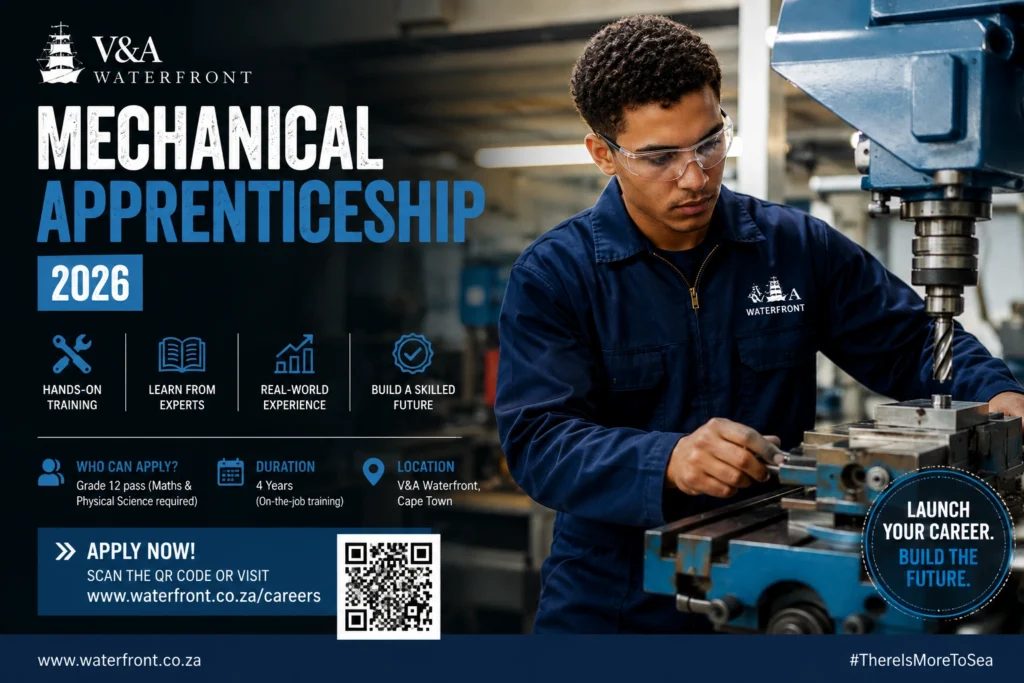

The V&A waterfront mechanical apprenticeship 2026 is quickly becoming one of the more talked-about technical training opportunities among unemployed youth in South Africa. At a time when thousands of graduates and school leavers are struggling to gain practical workplace experience, even short-term apprenticeships are attracting enormous attention online.
What makes this opportunity stand out is not only the location — the globally recognised V&A Waterfront — but the kind of exposure candidates could receive inside a high-pressure commercial environment where infrastructure, tourism, retail, hospitality and engineering all intersect.
For many young applicants, this is more than another contract position. It represents access to real-world mechanical systems, facilities management operations and maintenance experience that could eventually open doors into larger engineering and technical careers.
And in 2026, that kind of opportunity matters more than ever.
A Technical Apprenticeship at One of South Africa’s Most Recognisable Destinations
The apprenticeship programme, listed under reference number VAW004, invites unemployed youth to apply for mechanical and electrical apprenticeship opportunities linked to maintenance operations at the waterfront precinct in Cape Town CBD.
The role reports directly to the Mechanical Supervisor and focuses heavily on planned maintenance, reactive repairs and operational support across a wide range of infrastructure systems.
This is not the kind of apprenticeship where candidates spend months making coffee or observing from the sidelines.
According to the role description, apprentices may work with:
- HVAC systems
- Pump stations
- District cooling systems
- Bridges
- Lifts and escalators
- Building Management Systems (BMS)
- Mechanical plant rooms
- Control panels
- Seawater systems
That level of exposure explains why the vacancy is receiving strong interest among candidates looking for practical engineering-related experience rather than purely administrative internships.
The position is listed as a contract role lasting between six and nine months, with market-related remuneration and an employment equity focus.
Why Technical Apprenticeships Are Suddenly Trending Again
Over the past few years, South Africa’s youth employment conversation has shifted dramatically.
University degrees alone are no longer viewed as guaranteed pathways into stable careers. Increasingly, employers are prioritising candidates who can demonstrate hands-on technical experience, workplace discipline and operational understanding.
That has placed apprenticeships, learnerships and workplace training programmes back into the spotlight.
Mechanical maintenance, electrical systems and facilities management are also becoming more important as commercial infrastructure ages and businesses invest in operational reliability instead of expansion alone.
The V&A Waterfront environment amplifies that importance.
Unlike isolated industrial plants, the precinct combines tourism, hospitality, retail and public infrastructure into one ecosystem. A single breakdown involving escalators, cooling systems or mechanical equipment can directly affect visitors, tenants and commercial operations.
That means apprentices are likely to experience fast-paced operational realities rather than purely classroom-style technical exposure.
For many applicants, that practical intensity is exactly the appeal.
The Hidden Value Behind the Role Description
At first glance, some readers may see the listing as a standard maintenance apprenticeship.
But several details reveal something more significant.
The programme places strong emphasis on:
- Fault finding
- Preventative maintenance
- Quality control inspections
- Stakeholder communication
- Safety compliance
- Service provider coordination
- Building management monitoring
Those are the kinds of operational competencies that employers increasingly value across multiple sectors.
In modern infrastructure environments, technicians are expected to do far more than repairs.
They must understand systems integration, customer impact, safety regulations and contractor coordination. Candidates exposed to these environments early often become more adaptable in future engineering or facilities-management careers.
The apprenticeship also requires communication with tenants and service providers — something often overlooked in technical training discussions.
That signals a growing industry reality: technical professionals are now expected to combine engineering awareness with customer-service capability.
Cape Town’s Infrastructure Economy Is Creating New Interest
Another reason the V&A waterfront mechanical apprenticeship 2026 is attracting attention is the broader economic positioning of Cape Town itself.
The city continues to invest heavily in tourism infrastructure, mixed-use developments and commercial property management. As these spaces become more technologically complex, demand for maintenance and engineering support grows alongside them.
Modern commercial precincts rely on interconnected systems operating continuously behind the scenes:
- Cooling systems
- Smart monitoring technology
- Escalators and lifts
- Energy systems
- Mechanical ventilation
- Water systems
- Security-linked infrastructure
When those systems fail, operational disruptions become expensive very quickly.
As a result, practical technical roles are becoming more strategically important than many people realise.
Young people entering apprenticeships today are stepping into industries that are quietly evolving toward smarter infrastructure management.
Public Reaction: Why Applicants Are Sharing the Opportunity Widely
Across job-seeking communities and social media platforms, apprenticeship opportunities linked to major brands or high-profile locations tend to spread rapidly.
The V&A Waterfront name carries strong recognition nationally, which naturally increases interest.
But public reaction also reflects something deeper: frustration around the shortage of meaningful entry-level technical opportunities.
Many graduates and matriculants repeatedly encounter the same barrier:
“No experience required” often still translates into needing previous workplace exposure.
That contradiction leaves many young people trapped between qualifications and employability.
So when a programme appears to offer real operational experience inside a respected environment, online engagement increases immediately.
Applicants are also paying attention to the broader scope of the role.
This is not positioned as narrow factory-floor work. The maintenance responsibilities stretch across public-facing commercial infrastructure, which many candidates view as more versatile experience for future job applications.
The Physical Demands Are Not Being Hidden
One notable aspect of the listing is its honesty about the realities of the job.
The apprenticeship explicitly mentions:
- Weekend work
- Public holiday shifts
- Overtime requirements
- Physical fitness expectations
- Work inside sewer pump stations
That level of transparency matters.
Too many entry-level opportunities market technical careers romantically without preparing applicants for the demanding environments involved.
Mechanical maintenance work often requires uncomfortable conditions, emergency responses and physically intensive tasks.
By stating these realities upfront, the programme appears to be filtering for candidates genuinely interested in operational engineering environments rather than purely office-based careers.
For serious applicants, that honesty may actually strengthen the programme’s credibility.
Why This Matters Right Now
South Africa’s youth unemployment crisis continues to shape nearly every discussion around education and work opportunities.
But another issue is quietly emerging beneath the surface:
the growing gap between academic qualifications and technical employability.
Many sectors urgently need skilled technicians, maintenance specialists and operational support staff. Yet young people often lack pathways into those industries because practical exposure remains limited.
That is why apprenticeship programmes matter beyond the individual applicants selected.
They help bridge the transition between theory and real-world work.
The timing is especially relevant because infrastructure maintenance is becoming more critical across South Africa’s commercial economy. Businesses are increasingly focused on operational resilience, energy efficiency and preventative maintenance rather than reactive repairs alone.
Apprenticeships connected to live commercial environments therefore become more valuable than traditional simulated training.
The V&A Waterfront opportunity reflects that broader shift.
It shows how facilities management, mechanical systems and infrastructure maintenance are becoming central to the future of urban commercial operations.
APPLY HERE: V&A Waterfront Mechanical Apprenticeship 2026
ALSO APPLY FOR: ( TARDI ) Diesel Apprenticeship
A Broader Shift Toward Multi-Skilled Technical Workers
Another interesting trend visible in this apprenticeship is the move toward multi-skilled operational workers.
The job description references:
- Mechanical systems
- Monitoring technology
- Building Management Systems
- Service-provider coordination
- Health and safety compliance
- Customer communication
That combination reflects where many technical industries are heading.
The modern technician is no longer expected to operate in isolation.
Instead, employers increasingly want adaptable workers who can navigate:
- Technical troubleshooting
- Digital monitoring systems
- Regulatory compliance
- Operational reporting
- Tenant or customer engagement
For young South Africans considering career paths, this shift could become extremely important over the next decade.
Purely theoretical knowledge may carry less value than practical versatility.
The Tourism Connection Adds Another Layer
The V&A Waterfront is not simply a shopping centre or office precinct.
It is one of Africa’s best-known tourism and commercial destinations, attracting both local and international visitors.
That creates operational pressure very different from quieter industrial environments.
Mechanical downtime in highly visible public spaces can affect:
- Visitor experience
- Retail operations
- Tenant relationships
- Public safety
- Revenue flow
As a result, apprentices entering this environment may gain exposure to fast-response maintenance cultures where reliability and communication matter as much as technical skill.
That experience could become valuable later when applying for roles in:
- Property management
- Facilities operations
- Hospitality infrastructure
- Commercial engineering
- Municipal systems
- Industrial maintenance
What Could Happen Next
The growing interest around opportunities like the V&A waterfront mechanical apprenticeship 2026 may signal a larger trend in South Africa’s employment market.
Several possible developments could follow.
Increased Competition for Technical Apprenticeships
As traditional graduate pathways become more saturated, technical apprenticeships may become significantly more competitive.
Candidates are increasingly recognising that hands-on workplace exposure often improves employability faster than additional theoretical qualifications alone.
More Commercial Property Groups Could Launch Similar Programmes
If infrastructure-focused apprenticeship models prove successful, other commercial precincts and property groups may expand similar initiatives.
Large mixed-use developments require constant maintenance support, and apprenticeship pipelines can help organisations develop future technical talent internally.
Facilities Management Could Become a Bigger Career Conversation
Facilities management has historically received less attention than fields like software development or finance.
But modern infrastructure systems are becoming more sophisticated and technology-driven.
That could increase long-term demand for technically skilled maintenance professionals who understand both systems management and operational coordination.
Greater Focus on Practical Skills in Youth Employment Policy
Government and private-sector discussions around youth unemployment may increasingly prioritise practical workplace integration instead of qualification numbers alone.
Apprenticeships connected to operational infrastructure may therefore receive stronger institutional support in coming years.
The Bigger Conversation Behind the Opportunity
Ultimately, the excitement around this apprenticeship is not only about one contract position in Cape Town.
It reflects a broader national conversation about work, opportunity and employability.
Young South Africans are searching for realistic pathways into industries where practical experience still matters.
They are looking for opportunities that provide exposure rather than promises.
And employers are slowly recognising that sustainable talent development requires investment in workplace learning environments — not just recruitment advertisements demanding experience from first-time applicants.
The V&A Waterfront apprenticeship sits directly inside that intersection.
It represents both a short-term opportunity and a symbol of a changing labour market where technical adaptability, operational understanding and practical exposure are becoming increasingly valuable.
For applicants interested in engineering support, infrastructure systems and maintenance operations, programmes like this may become some of the most important entry points available in 2026.