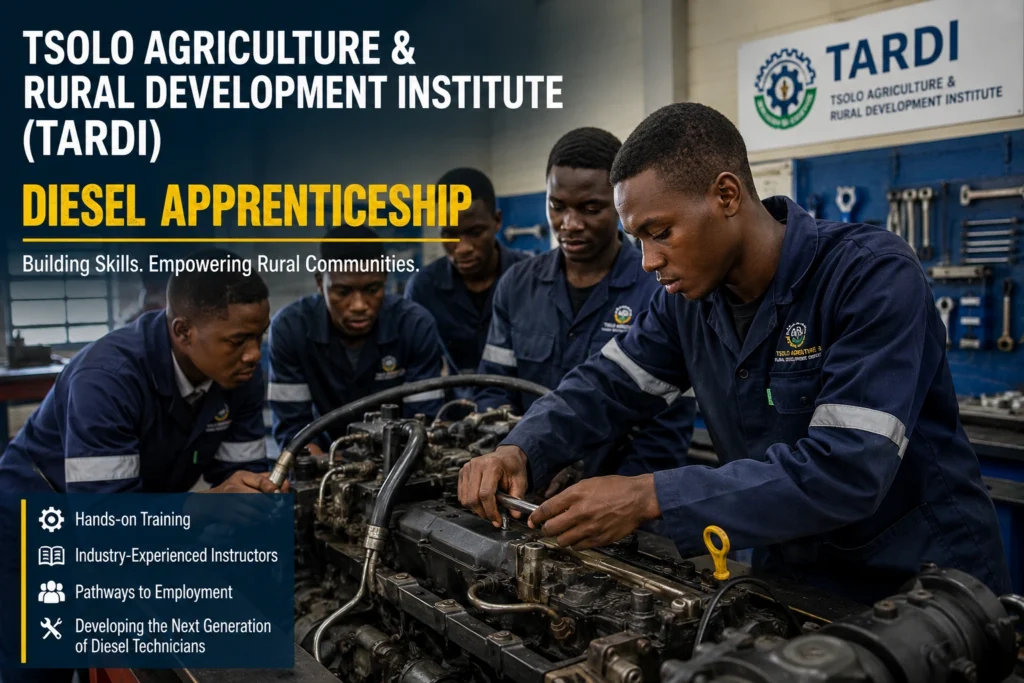

South Africa’s youth unemployment crisis has pushed technical training opportunities into the spotlight again, and the Tsolo Agriculture & Rural Development Institute9 ( TARDI ) Diesel Apprenticeship is emerging as one of the programmes attracting growing interest in 2026.
At first glance, it looks like another artisan training opportunity for young people with engineering qualifications. But the timing of this apprenticeship matters more than many people realize. Across South Africa, industries tied to transport, agriculture, logistics, mining, and infrastructure are struggling with a shortage of qualified diesel mechanics and artisans. At the same time, thousands of technically trained young people remain unemployed despite holding N2 or related qualifications.
That gap between education and employability is exactly why the TARDI diesel apprenticeship is generating conversation online and among job seekers.
The programme combines technical learning, workshop exposure, and long-term workplace training over a structured three-year pathway. In an economy where many entry-level opportunities offer only short contracts or unpaid internships, a structured artisan pipeline stands out.
For many applicants, this is not simply another apprenticeship advertisement. It represents access to a scarce category of opportunity: practical training linked to a recognized trade pathway.
Understanding the TARDI Diesel Apprenticeship Opportunity
The Tsolo Agriculture & Rural Development Institute9 ( TARDI ) Diesel Apprenticeship is aimed at young South Africans between the ages of 18 and 35 who already possess an N2 qualification or higher in diesel mechanics, mechanical engineering, motor mechanics, or related engineering studies.
The structure follows a traditional artisan development model:
- Six months of theoretical and practical training
- Twenty-four months of workplace exposure
- Six months focused on trade test preparation and assessment
That structure is important because many aspiring artisans struggle to secure the workplace component needed to complete their qualifications. Technical colleges often produce graduates who understand classroom concepts but lack sufficient workshop exposure.
This apprenticeship attempts to bridge that problem directly.
The agricultural connection also makes the programme notable. Diesel mechanics remain essential in farming environments where tractors, harvesters, irrigation systems, generators, and heavy transport vehicles require constant maintenance. Rural economic development increasingly depends on technical maintenance capacity, especially as farming operations become more mechanized.
For TARDI, the programme appears aligned with broader efforts to strengthen agricultural infrastructure and technical skills development in rural areas.
Why Diesel Mechanics Are Suddenly in Demand Again
One reason this apprenticeship is gaining traction is because diesel mechanic careers are quietly becoming more valuable.
While much public conversation focuses on digital careers, coding, and artificial intelligence, South Africa’s industrial economy still depends heavily on mechanical trades. Logistics fleets, construction equipment, agricultural machinery, buses, and mining vehicles all rely on diesel systems.
Even as electric vehicle discussions grow globally, Africa’s industrial and commercial sectors are expected to remain diesel-dependent for years.
This creates an interesting contradiction in the labor market.
Some university graduates struggle to enter oversaturated professional sectors, while skilled artisans in specialized trades often secure stable employment faster once qualified.
Industry analysts have repeatedly pointed to artisan shortages as a structural problem affecting economic growth. Diesel mechanics, welders, fitters, electricians, and millwrights continue to appear on scarce skills discussions because practical technical expertise cannot easily be automated or outsourced.
That reality is reshaping how young people view apprenticeships.
A decade ago, many students saw artisan training as a secondary option. Today, the perception is changing. Technical trades are increasingly viewed as practical pathways toward employability, entrepreneurship, and long-term income stability.
The Rural Development Angle Matters More Than Expected
Another reason the programme stands out is its rural development positioning.
Urban job opportunities often dominate national attention, but rural technical skills shortages remain severe. Agricultural institutions and rural municipalities frequently struggle to recruit qualified artisans willing to work outside major cities.
By linking diesel mechanic training to agricultural environments, the TARDI apprenticeship reflects a broader shift toward localized skills development.
This matters because rural economies face unique infrastructure pressures:
- Farming machinery requires regular maintenance
- Transport systems support food supply chains
- Equipment downtime can directly affect productivity
- Skilled technical workers are harder to retain in remote regions
Programmes like this are increasingly viewed not only as youth employment interventions but also as economic sustainability tools for rural communities.
That broader impact helps explain why artisan development programmes are receiving renewed policy attention.
The Competition for Opportunities Is Likely to Be Intense
Despite the positive reaction, competition for placements will likely be extremely high.
South Africa’s apprenticeship landscape remains highly competitive because structured artisan pathways are limited relative to demand. Thousands of technically qualified youth apply for each major apprenticeship intake across sectors like energy, transport, automotive, and manufacturing.
The TARDI programme’s appeal comes from several factors:
- Recognized technical exposure
- Long-duration workplace training
- Potential trade test qualification
- Agricultural industry experience
- Structured artisan development
For unemployed youth holding N2 qualifications, these opportunities are often viewed as critical career turning points.
The required documentation list also signals that the programme is designed to identify serious candidates prepared for long-term commitment. Applicants are expected to submit academic records, proof of unemployment, motivational letters, and supporting certificates.
The emphasis on professionalism and discipline reflects the demanding nature of artisan training itself.
Public Reaction Reflects Growing Frustration — and Hope
Online reactions to apprenticeship programmes in 2026 reveal a mixture of optimism and frustration.
Many young South Africans express excitement whenever artisan opportunities appear because technical training programmes are seen as more realistic employment pathways than generic entry-level jobs.
At the same time, frustration remains widespread over how difficult it can be to secure workplace exposure after completing college studies.
A recurring concern among graduates is that qualifications alone are no longer enough. Employers increasingly prioritize hands-on experience, creating a cycle where inexperienced candidates struggle to enter the workforce.
That is why structured apprenticeships attract so much attention online.
For many applicants, the real value lies not only in training but in access to actual industrial environments where practical competence can be developed.
There is also growing recognition that artisan careers can lead to entrepreneurship. Qualified diesel mechanics often move into independent repair services, fleet maintenance businesses, agricultural equipment servicing, or transport-sector contracting.
This entrepreneurial angle is changing perceptions around technical trades.
Why This Matters Right Now
South Africa is entering a period where technical skills development may become even more economically important.
Several forces are converging at once:
- Aging artisan workforces in key sectors
- Expanding logistics and infrastructure needs
- Agricultural modernization
- Persistent youth unemployment
- Increased pressure on vocational education systems
At the same time, employers across multiple industries continue reporting difficulties finding experienced technical workers.
The Tsolo Agriculture & Rural Development Institute9 ( TARDI ) Diesel Apprenticeship arrives during this broader national conversation about employability and skills alignment.
There is also a deeper social relevance.
For years, public discourse often emphasized university education as the primary route to career success. But rising graduate unemployment has complicated that narrative. Technical and vocational pathways are now receiving renewed respect because they often connect more directly to labor market needs.
Apprenticeships are increasingly viewed as bridges between education and economic participation.
For rural youth especially, access to structured artisan development can significantly affect long-term career mobility.
The Agricultural Sector Could Benefit Significantly
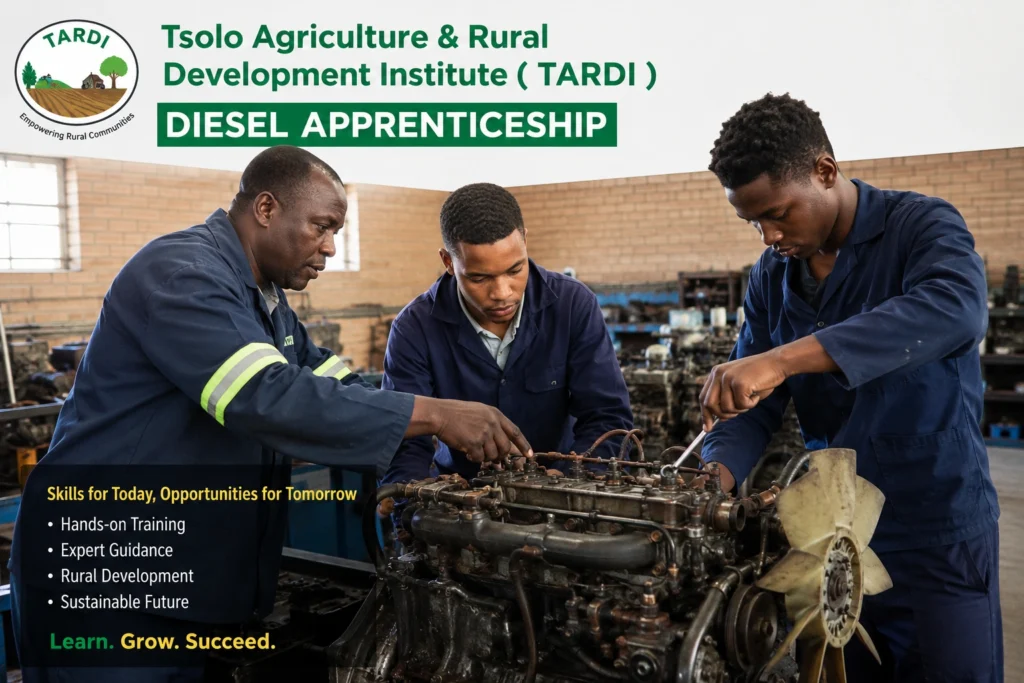
Agriculture is becoming more mechanized, data-driven, and equipment-intensive.
Modern farms rely heavily on diesel-powered machinery, transport systems, and industrial equipment. When machinery breaks down during planting or harvesting periods, financial losses can escalate quickly.
That operational pressure increases demand for reliable technical maintenance expertise.
By training diesel mechanics within agricultural contexts, programmes like this could help strengthen local maintenance ecosystems that reduce equipment downtime and improve operational efficiency.
There may also be broader food security implications over time.
Reliable agricultural infrastructure depends partly on access to skilled technicians capable of maintaining machinery in working condition. Rural artisan development therefore intersects with larger economic and developmental priorities.
APPLY HERE: ( TARDI ) Diesel Apprenticeship
ALSO APPLY FOR: Volvo Apprenticeship Program 2026
The Structure of the Programme May Be Its Biggest Strength
One overlooked aspect of the apprenticeship is its phased structure.
Many training initiatives fail because they focus too heavily on theory without sustained workplace integration. TARDI’s model combines classroom instruction with extended workplace exposure before trade test preparation.
That sequence mirrors how artisan competence is actually built.
Technical confidence develops gradually through repeated practical application, troubleshooting, and exposure to real workshop environments.
The inclusion of trade test preparation is particularly significant because passing a trade test remains one of the key milestones for formal artisan recognition in South Africa.
Without structured preparation, many trainees struggle at this final stage.
The programme’s design therefore suggests a more comprehensive approach to artisan development than short-term skills initiatives that offer only limited exposure.
Could More Institutions Follow This Model?
One possible outcome is that more rural institutions begin adopting similar apprenticeship frameworks.
As pressure grows to address unemployment while supporting local economic development, integrated technical training models may become more attractive to both public and private stakeholders.
There is increasing recognition that vocational training works best when tied closely to real operational environments.
Agriculture, renewable energy, transport logistics, and infrastructure maintenance all require technical talent pipelines that combine theory with applied learning.
If programmes like this produce successful artisan outcomes, they could influence how future training initiatives are structured nationally.
What Could Happen Next
Several possible developments could follow from the growing attention around programmes like the Tsolo Agriculture & Rural Development Institute9 ( TARDI ) Diesel Apprenticeship.
First, demand for artisan training may continue rising as more young people reconsider traditional career pathways. Technical trades could increasingly be viewed as stable, skills-based professions with entrepreneurial potential.
Second, agricultural institutions may expand partnerships with technical colleges and industry stakeholders to strengthen workforce pipelines in rural regions.
Third, government and industry bodies could place greater emphasis on apprenticeship funding as economic pressures intensify around youth unemployment.
There is also the possibility that artisan development becomes more closely linked to industrial policy and infrastructure planning. South Africa’s long-term economic growth depends partly on maintaining technical maintenance capacity across transport, agriculture, mining, and manufacturing sectors.
If skilled artisan shortages worsen, investment projects and operational systems may face increasing pressure.
On the individual level, successful apprentices from programmes like this could eventually become workshop supervisors, independent contractors, fleet specialists, or business owners.
That long-term mobility is part of what makes structured apprenticeships valuable.
The Bigger Conversation Behind the Opportunity
Ultimately, the TARDI apprenticeship reflects a larger national conversation about the future of work in South Africa.
Young people are increasingly searching for career paths that offer practical experience, recognized qualifications, and realistic employment prospects. Employers, meanwhile, continue emphasizing workplace readiness and technical competence.
This tension between education and employability is shaping how apprenticeships are perceived.
The renewed attention around artisan training suggests a cultural shift may already be underway. Technical careers are no longer seen only as alternatives to academic pathways. In many cases, they are becoming strategic career choices in their own right.
That does not mean apprenticeships guarantee employment. Economic conditions remain difficult, and competition for opportunities remains intense.
But programmes that combine accredited learning with real workplace exposure continue to stand out in a crowded and uncertain labor market.
For many applicants, the Tsolo Agriculture & Rural Development Institute9 ( TARDI ) Diesel Apprenticeship represents more than technical training.
It represents access to momentum, experience, and the possibility of entering industries where practical skills still matter deeply.