
For a young person in Johannesburg, getting a first opportunity in the electrical trade can feel like a difficult circle to break. Employers want people with experience, but gaining that experience is difficult when you have just left school.
That is why apprenticeships remain important.
Instead of asking a beginner to arrive already knowing how to work as an electrician, an apprenticeship is designed to provide a structured environment where theoretical learning and practical workplace exposure can develop together.
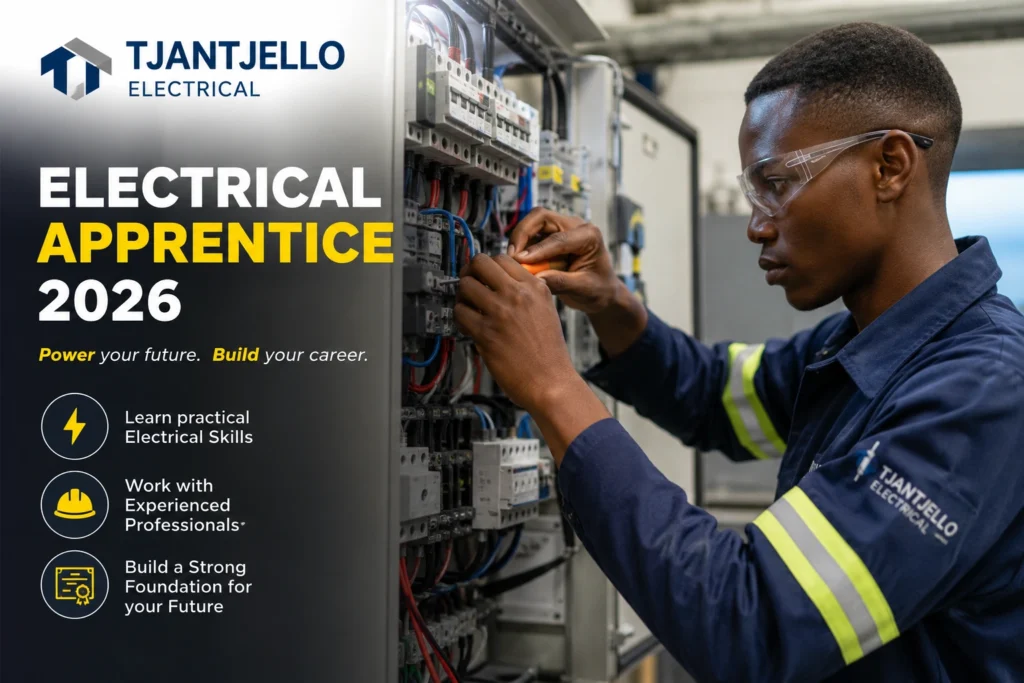
The Tjantjello Electrical Apprentice 2026 opportunity is aimed at people interested in developing a career in the electrical trade. Tjantjello Training Solutions (TTS) is advertising a SETA-funded Electrician Apprenticeship Programme lasting three years, with TTS based in Mondeor, Johannesburg, Gauteng.
For a prospective applicant, however, the most important question is not simply, “Is this apprenticeship available?”
It is: “What will I need to prepare, how do I apply correctly, and what should I know before committing to three years of technical training?”
Those questions deserve careful attention.
What makes the Tjantjello electrical apprenticeship different from a short course?
A short training course can introduce someone to an electrical subject in a relatively limited period. An apprenticeship is intended to go much further by developing practical occupational competence over an extended period.
The TTS programme is advertised as a three-year electrician apprenticeship, meaning applicants should be prepared for a serious long-term commitment.
Training can involve areas such as:
- Electrical installations and wiring
- Electrical maintenance
- Fault finding and troubleshooting
- Electrical safety
- Reading electrical drawings
- Using electrical tools and testing equipment
- Practical workplace experience
- Trade-related theoretical learning
Think of the difference this way: reading about fault finding is one thing; standing beside an experienced worker and learning how a fault is investigated methodically is another.
That practical component is one of the reasons apprenticeships can be valuable to young people trying to enter technical occupations.
However, applicants should not interpret “SETA-funded” as meaning that every cost associated with their personal circumstances is automatically covered. Transport, meals, accommodation and other personal expenses may still be the learner’s responsibility unless the official programme documentation says otherwise.
That is something worth confirming before accepting a place.
Tjantjello Electrical Apprentice 2026: who should seriously consider applying?
The strongest candidate is not necessarily the person who simply wants “any job.”
Electrical work suits people who enjoy understanding how things work and are comfortable learning through both theory and practical activity.
An applicant should think carefully about whether they are prepared to:
- Follow safety instructions consistently
- Work carefully rather than rushing
- Learn from experienced artisans and supervisors
- Use tools responsibly
- Study technical concepts
- Solve problems logically
- Accept correction and improve
- Commit to a multi-year training programme
Electrical work also comes with real responsibility. Incorrect procedures can damage equipment or create dangerous situations. Consequently, safety, concentration and attention to detail are not optional qualities.
A candidate who is genuinely interested in becoming an electrician should therefore see the apprenticeship as career development rather than simply another temporary opportunity.
The documents you should prepare before applying
The available information for the TTS apprenticeship identifies three important documents:
- Certified South African ID copy
- Certified Matric certificate
- Latest academic results
Do not leave this preparation until the final day.
Check that your copies are readable, complete and properly certified where certification is requested. If you are applying electronically, scan the documents clearly and keep backup copies on your phone, computer or secure cloud storage.
It is also worth preparing a simple CV even if the advert focuses mainly on supporting documents. A concise CV can make it easier to present your education, technical interests, school subjects, practical exposure and contact details professionally if requested during the selection process.
Do not add qualifications you do not have.
For an entry-level apprenticeship, honesty is much more useful than trying to make your CV look like that of an experienced electrician.
ALSO VISIT: https://tjantjello.co.za
How to apply for the Tjantjello Electrical Apprentice 2026 programme
The application process should always follow the latest official TTS recruitment instructions. Because application channels and deadlines can change, applicants should verify the current advert before sending personal documents.
Here is a practical step-by-step approach.
Step 1: Confirm that the opportunity is still open
Start by checking the most recent Tjantjello Training Solutions apprenticeship announcement.
Step 2: Check your eligibility carefully
Read every requirement rather than assuming that having Matric is enough.
Pay attention to requirements relating to citizenship, qualifications, subjects, academic results, location, age or other conditions if they appear in the current advert.
If you do not meet a mandatory requirement, sending multiple applications will not solve the problem.
Step 3: Get your documents certified
Prepare your certified ID and certified Matric certificate before submitting.
Also have your latest academic results available.
Make sure your name and personal details are consistent across the documents. If there is a legitimate discrepancy—for example, a spelling difference between documents—deal with it properly rather than submitting unexplained information.
Step 4: Prepare a professional CV
Where a CV is requested or accepted, keep it short and relevant.
A useful apprentice CV can include:
- Full name and contact details
- Education and Matric information
- Relevant subjects
- Technical or practical experience
- Computer or technical skills
- Short description of your career interest
- References, where appropriate
You do not need a five-page CV for an entry-level apprenticeship.
The goal is to make it easy for the recruiter to understand who you are and why electrical training interests you.
Step 5: Submit using the specified application channel
Follow the application instructions exactly.
If the official advertisement provides an email address, online application form or another submission method, use that channel.
EMAIL APPLICATION
Email: admin@tjantjello.co.za
Step 6: Keep evidence of your application
Save the submitted email, confirmation message, application reference or screenshot.
If you are contacted later, you will have a record of what you submitted.
Also monitor your email inbox, SMS messages and missed calls. An applicant can be shortlisted and still lose the opportunity by failing to respond in time.
ALSO APPLY FOR: UCL Engineering Apprentice 2026
What happens after you apply?
Applicants should understand that submitting an application is only the beginning.
Depending on the recruitment process, shortlisted candidates may be asked to participate in screening, interviews, assessments or other selection activities.
This is where genuine preparation matters.
You should be able to explain why you want to become an electrician without giving a rehearsed answer that sounds copied from the internet.
For example, think about your own experience.
Did you enjoy physical science or technical subjects at school? Have you repaired household equipment under supervision? Do you enjoy understanding electrical systems? Have you worked with tools before?
These experiences can help you explain your interest naturally.
You should also be ready to discuss safety.
A good apprentice should understand that electrical work is not an area where shortcuts are acceptable.
Expert insight: choose the training opportunity, not just the funding label
The most valuable part of an apprenticeship is the competence you build, not simply the fact that it is funded.
SETA funding can make structured training more accessible, but applicants should still investigate what the programme actually involves.
Before accepting an opportunity, try to understand how theoretical training, practical workplace exposure, supervision and trade development fit together.
For an aspiring electrician, meaningful exposure to real equipment, safe working procedures, testing methods, maintenance and fault diagnosis can make a major difference to future employability.
The three-year duration should therefore not automatically be viewed as a disadvantage.
Learning a skilled trade takes time.
Important mistakes to avoid
Some mistakes are surprisingly easy to prevent.
Do not pay for a job. A person claiming that payment will guarantee an apprenticeship place should immediately raise concerns.
Do not submit false documents. Fake certificates or altered results can have serious consequences.
Do not use unofficial application links without checking them. Scammers sometimes copy genuine advertisements and replace the application details.
Do not ignore location. TTS is based in Mondeor, Johannesburg, so applicants should consider whether they can realistically attend the required training and workplace activities.
Do not assume funding covers everything. Confirm what the programme covers before making financial commitments.
Do not stop looking after applying. Until you have received formal confirmation of selection, continue exploring legitimate training and career opportunities.
Frequently asked questions
1. How long is the Tjantjello electrician apprenticeship?
The advertised programme has a three-year duration.
2. Is the Tjantjello apprenticeship SETA-funded?
Yes. The programme is advertised as a SETA-funded Electrician Apprenticeship Programme. Applicants should confirm the specific funding and learner-support arrangements in the latest official advert.
3. Which documents are required?
The available information lists a certified South African ID copy, certified Matric certificate and latest academic results. Check the latest recruitment instructions for any additional documents.
Why this opportunity matters
For South Africa’s young job seekers, the biggest challenge is often the transition between education and employment.
A Matric certificate can open a door, but technical careers require more than a certificate. They require competence.
That is where a structured apprenticeship can become valuable.
The Tjantjello Electrical Apprentice 2026 programme offers prospective electricians the chance to spend several years developing trade-related knowledge and practical experience. It should not be viewed as an easy shortcut into employment. Instead, it is better understood as a demanding training pathway that requires patience, discipline and genuine interest in the electrical field.
For applicants, the smartest approach is to prepare properly: verify the latest requirements, organise certified documents, apply through the correct channel and understand what a three-year commitment involves.
If the goal is to build a sustainable career as an artisan, the real prize is not simply getting accepted into an apprenticeship.
It is leaving the programme with practical knowledge, stronger technical ability and the foundation needed to continue developing as a qualified electrical professional.
That is the opportunity worth pursuing.