

Finding a first opportunity in South Africa’s financial services sector can be difficult, particularly for young people who have matric but little or no workplace experience. Many entry-level vacancies ask for previous experience, while university qualifications can take several years to complete and may not be financially accessible to everyone.
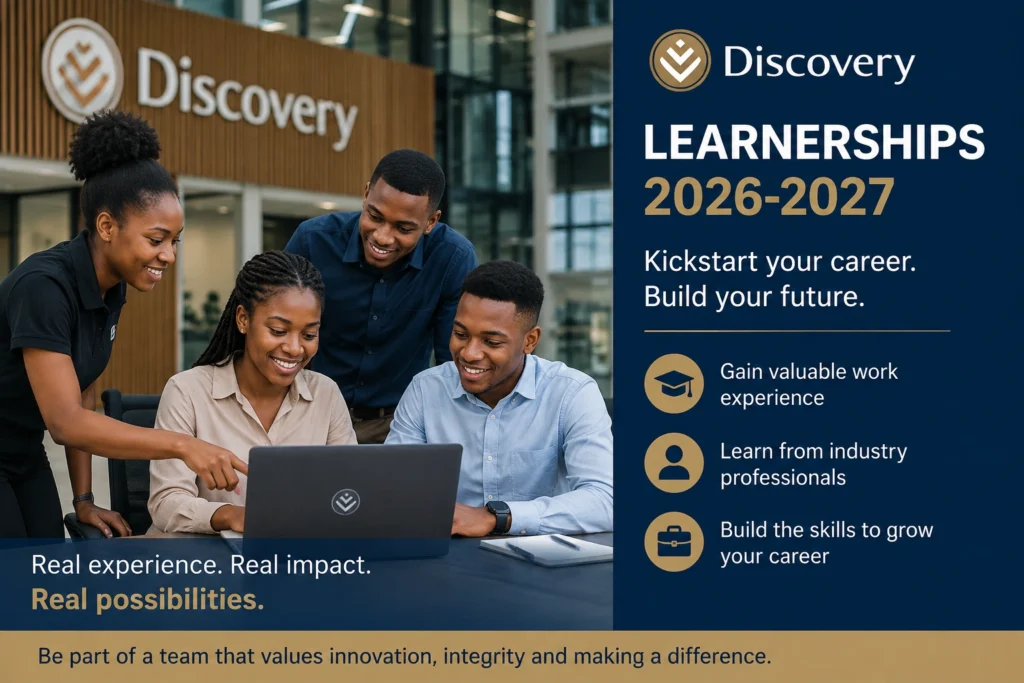
The Discovery Learnerships 2026-2027 opportunity offers a different route. Discovery is inviting suitably qualified young South Africans to apply for its Wealth Management Learnership Programme, based in Sandton, Gauteng. The programme combines structured learning with practical workplace exposure and works towards a National Certificate: Wealth Management at NQF Level 5.
However, meeting the basic requirements does not automatically mean you will be selected. Applicants need to understand what the programme involves, whether they genuinely qualify, what documents they may need and how to submit a strong application.
This guide explains the opportunity in practical terms and highlights what applicants should consider before applying.
Discovery Learnerships 2026-2027: What Is the Programme?
The Discovery Wealth Management Learnership is designed to introduce young people to the financial services environment while they work towards a recognised qualification.
Rather than simply attending classes, learners can expect a combination of learning and workplace exposure. This is important because financial services employers value both theoretical knowledge and the ability to operate professionally in a real business environment.
The advertised qualification is:
National Certificate: Wealth Management – NQF Level 5
The programme is located in Sandton, Gauteng, an important financial and business hub.
Based on the supplied opportunity information, the key details are:
| Programme detail | Information |
|---|---|
| Organisation | Discovery |
| Programme | Wealth Management Learnership 2026/2027 |
| Qualification | National Certificate: Wealth Management NQF Level 5 |
| Location | Sandton, Gauteng |
| Age | 18–30 years |
| Citizenship | South African candidates by birth |
| Employment status | Must not be formally employed |
| Study status | Must not be engaged in post-Matric studies |
| Application | Online |
| Closing date | Not specified in the supplied information |
Important: Because no closing date is specified in the supplied advert, applicants should not assume that applications will remain open indefinitely. Check the official application page before submitting your application.
Why This Issue Matters
For many young South Africans, the biggest barrier to entering financial services is not necessarily a lack of ambition. It is the combination of limited work experience, limited professional networks and high competition for entry-level jobs.
A learnership can help address some of these barriers because it combines a formal qualification with exposure to the workplace.
For someone interested in wealth management, financial planning or broader financial services, the experience could help answer practical questions such as:
- How does a professional financial-services workplace operate?
- How should client information be handled?
- What does professional communication look like?
- How are financial products and services discussed with clients?
- What workplace standards are expected from employees?
- How does theoretical financial knowledge translate into everyday work?
The NQF Level 5 qualification can also provide a more structured starting point for someone who wants to develop a longer-term career in financial services.
But applicants should keep their expectations realistic. A learnership is not a guaranteed permanent job. Its value lies in the qualification, workplace exposure and skills gained during the programme.
Who Can Apply?
According to the supplied requirements, applicants should satisfy several conditions before applying.
You should carefully check that you:
- Are between 18 and 30 years old.
- Are a South African citizen by birth.
- Are currently not in formal employment.
- Are not studying towards a post-Matric qualification.
- Meet any additional requirements stated on the official application platform.
- Can participate in the programme in Sandton, Gauteng, where required.
The distinction between employment and study status is particularly important.
For example, someone who already has a full-time job may not qualify even if they meet the age and citizenship requirements. Similarly, someone currently enrolled in a university or other post-Matric qualification should not assume that they can apply simply because they are looking for additional experience.
A simple eligibility check
Before completing the application, ask yourself:
Age: Am I 18–30?
Citizenship: Am I a South African citizen by birth?
Employment: Am I currently unemployed and not formally employed?
Studies: Am I not currently enrolled in post-Matric studies?
Location: Can I realistically participate in an opportunity based in Sandton?
If the answer to any of these questions is “no”, carefully review the official requirements before proceeding.
What Will You Actually Learn?
The phrase “wealth management” can sound complicated, especially to someone who has never worked in financial services.
At a basic level, wealth management involves helping individuals understand and manage financial matters such as saving, investing, planning and protecting their financial position.
A learner may therefore develop exposure to areas such as:
- Financial services concepts
- Client service
- Professional communication
- Financial planning concepts
- Wealth management processes
- Administrative procedures
- Compliance and responsible handling of information
- Workplace professionalism
- Business and financial terminology
The exact duties assigned to learners can vary, so applicants should rely on the official programme information rather than assuming they will perform the same tasks as a qualified financial adviser.
How to Apply for the Discovery Wealth Management Learnership
One of the most important parts of applying is getting the basics right. A good application does not need to be complicated, but it does need to be accurate.
Step 1: Confirm the opportunity
Use the official application channel whenever possible.
APPLY HERE: Discovery Learnerships 2026-2027
Step 2: Check your eligibility
Review the age, citizenship, employment and study requirements before spending time preparing your application.
This prevents applicants from submitting applications for programmes for which they are clearly ineligible.
Step 3: Prepare your information
Have your personal and educational information available before starting the online application.
This may include:
- Full name and surname
- Contact details
- Identification information
- Residential information
- Matric details
- Educational background
- Employment status
- Other information requested by the application form
Only provide information requested through the legitimate application process.
Step 4: Prepare supporting documents
If the application platform requests documents, make sure your copies are clear and readable.
Depending on the instructions, applicants may need documents such as:
- South African ID
- Matric certificate or statement of results
- Updated CV
- Other certificates requested by the employer
Do not upload documents simply because another website says they are required. Follow the actual application instructions.
Step 5: Complete the online application carefully
Take your time with every field.
Check spelling, contact numbers, email addresses and educational information before submitting.
A simple typing error in an email address or telephone number could make it difficult for recruiters to contact you.
Step 6: Save proof of application
After submitting, save any confirmation email, application reference number or screenshot that the platform provides.
This can be useful if you later need to verify that your application was successfully submitted.
ALSO APPLY FOR: Momentum YES Learnership 2026
Best Practices Experts Recommend
A common mistake among applicants is believing that eligibility alone makes an application competitive. It does not.
When applying for a competitive financial-services opportunity, focus on presenting yourself as someone who is reliable, willing to learn and genuinely interested in the industry.
1. Make your CV easy to understand
If you have limited work experience, do not leave your CV almost empty.
Include relevant information such as:
- Matric subjects and results where appropriate
- Computer skills
- Volunteer experience
- School leadership
- Community activities
- Short courses
- Relevant projects
- Customer-service experience
- Administrative experience
Keep the document professional and easy to read.
2. Show genuine interest in financial services
You do not need to pretend to be a financial expert.
Instead, demonstrate that you understand the basic purpose of wealth management and are interested in learning.
For example, researching basic concepts such as budgeting, investing, financial planning and client service before an interview can help you speak more confidently.
3. Take communication seriously
Financial services involves dealing with people and sensitive information. Professional communication matters.
Use a professional email address and check your inbox regularly after applying.
4. Prepare for possible assessments or interviews
If shortlisted, you could potentially be assessed on more than academic performance.
Prepare to discuss:
- Why you are interested in wealth management
- Why you want to join Discovery
- What you hope to learn
- Your strengths
- How you handle challenges
- Examples of teamwork
- Examples of taking responsibility
Use real examples rather than memorised answers.
5. Be honest
Never exaggerate qualifications, employment history or experience.
Recruitment information can be verified, and false information can damage an otherwise promising application.
Mistakes People Often Make
Several mistakes can reduce an applicant’s chances unnecessarily.
Applying without checking eligibility
Some applicants submit applications to every opportunity they see. This wastes time and can lead to frustration.
Check the requirements first.
Assuming a learnership is simply a job
A learnership has an educational component. You are expected to learn, participate and meet programme requirements.
Treat it as both a workplace opportunity and a learning programme.
Ignoring the location
Sandton is not simply a name on the advert. Applicants need to consider transport, travel time and the practical cost of attending a programme in the area.
Do this calculation before accepting an offer.
Using an outdated CV
A CV containing an old telephone number, incorrect email address or outdated education information creates an avoidable problem.
Paying someone to apply
Legitimate recruitment processes should not require applicants to pay an individual to “secure” a position.
Be especially cautious of anyone promising guaranteed selection in exchange for money.
How Competitive Is This Opportunity?
Competition level: High
A Discovery learnership is likely to attract considerable interest because it combines a recognised qualification with exposure to a major financial-services environment.
Competition can be particularly strong among young people who have matric but have not yet entered formal employment.
This means applicants should avoid a “submit and forget” approach.
Your best strategy is to:
- Confirm eligibility.
- Submit through the correct channel.
- Provide accurate information.
- Present a clean CV.
- Prepare for possible screening or interviews.
- Continue applying for other suitable opportunities while waiting.
Do not put your entire career plan on one application.
Documents Checklist
Before starting, create a small application folder on your phone or computer.
Consider keeping:
- South African ID copy
- Matric certificate or statement of results
- Updated CV
- Relevant certificates
- Contact details
- Academic information
- Application confirmation
Keep digital documents clearly named so that you can find them quickly.
Safety and Scam Check
Learnership seekers are frequently targeted by fake recruitment advertisements.
Be cautious if someone:
- Requests an upfront application fee.
- Promises guaranteed employment.
- Requests your banking PIN or password.
- Claims they can secure selection for payment.
- Sends suspicious shortened links.
- Uses pressure tactics such as “pay today or lose your place.”
- Asks you to send sensitive information to an unknown personal account.
A legitimate opportunity should be independently verifiable.
Also remember that a social-media post discussing a Discovery opportunity is not automatically an official Discovery recruitment notice. Verify the application route before submitting personal documents.
Frequently Asked Questions
What qualification does the programme offer?
The supplied information states that successful learners will work towards a National Certificate: Wealth Management at NQF Level 5.
Can I apply if I am currently studying after matric?
The supplied requirements state that applicants must not be engaged in post-Matric studies. If you are currently studying, carefully check the official requirements before applying.
Is the closing date confirmed?
The supplied information does not specify a closing date. Applicants should check the official application platform for the current status rather than assuming that applications are open for a particular period.
Final Assessment
The Discovery Learnerships 2026-2027 opportunity could be a valuable entry point for an eligible young South African who wants to explore wealth management and financial services without beginning with a conventional graduate position.
Its strongest features are the combination of workplace exposure and an NQF Level 5 qualification. For someone at the beginning of their career, gaining experience in a professional financial-services environment can be more useful than simply collecting certificates without practical exposure.
However, applicants should approach the opportunity realistically. Competition is likely to be strong, the location is in Sandton, and eligibility conditions matter. There is also no guarantee of permanent employment after completing a learnership.
The smartest approach is therefore simple: check the requirements, verify the application channel, prepare your documents, submit an accurate application and continue pursuing other opportunities at the same time.
If wealth management genuinely interests you, use the application process as the beginning of your preparation—not the end. Learn basic financial concepts, improve your communication skills, keep your CV updated and be ready to explain why you want to build a career in financial services.