
On a cold Monday morning, thousands of South African graduates will once again refresh their inboxes, polish their CVs and hope that months of job searching finally lead to an opportunity. For many, the biggest challenge is no longer earning a qualification—it’s gaining the practical workplace experience employers expect.
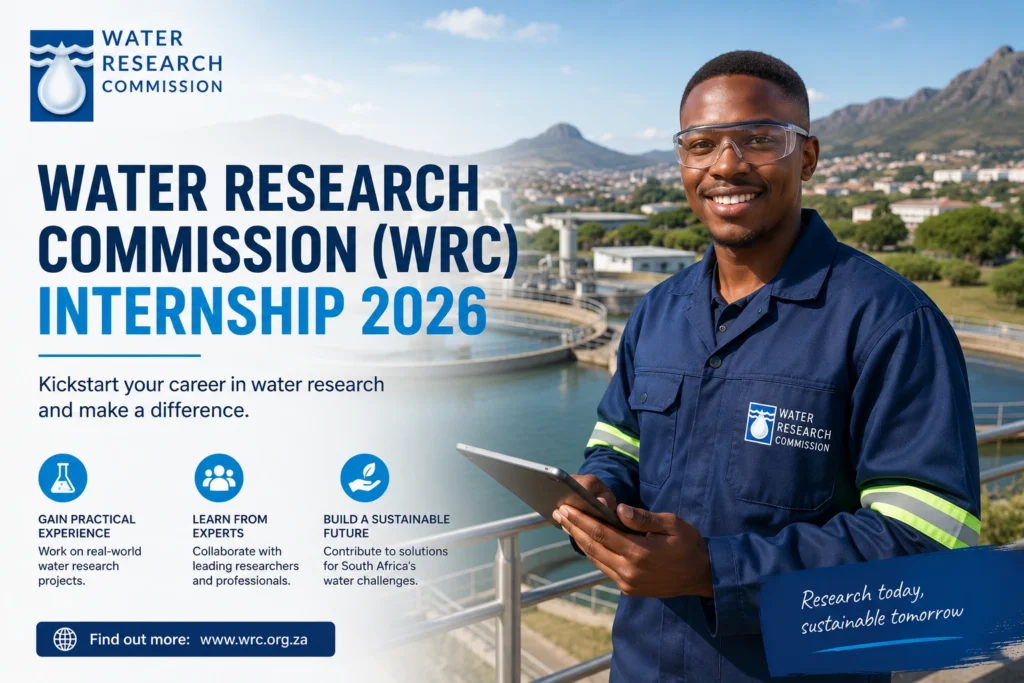
That is why the Water Research Commission (WRC) Internship 2026 stands out. Rather than offering a few weeks of shadowing or a short contract, the programme provides 24 months of structured workplace exposure for unemployed graduates and Technical and Vocational Education and Training (TVET) learners who need Work Integrated Learning (WIL).
In today’s labour market, practical experience has become almost as valuable as academic qualifications. Employers increasingly look for candidates who understand workplace systems, communication, project management and professional responsibility. The WRC programme is designed to bridge that gap while contributing to an organisation that plays an important role in South Africa’s water research and development landscape.
Applications close on 13 July 2026, making this one of the more immediate opportunities available to graduates and TVET learners seeking meaningful workplace experience.
Why the Water Research Commission (WRC) Internship 2026 deserves attention
South Africa continues to face a difficult youth employment environment. Every year universities and TVET colleges produce thousands of capable graduates, yet many struggle to secure their first professional role because employers expect previous experience.
Programmes like this recognise that challenge.
Instead of simply advertising entry-level jobs, the Water Research Commission is investing in workplace learning that allows participants to develop technical abilities alongside professional skills. Over a full two years, interns and WIL learners can become familiar with organisational processes, policy implementation, stakeholder engagement, administration and digital workplace systems.
The WRC itself occupies a unique position within South Africa. While many people associate it only with scientific research, its work depends on professionals across numerous disciplines, from finance and information technology to communications, procurement and human resources.
That broad organisational structure explains why this intake includes opportunities far beyond engineering or environmental science.
For graduates whose qualifications fall outside traditional science fields, this programme opens doors that many may not have realised existed.
More than research: opportunities across multiple career fields
One of the strongest aspects of this recruitment drive is its diversity.
Rather than focusing on a single department, the internship and WIL programme includes placements across several professional functions.
Graduate opportunities include:
- Human Resource Management
- Legal and Auxiliary Services
- Information Technology
- Risk Management
- Finance
- Supply Chain Management
- Stakeholder Relations and Communications
TVET Work Integrated Learning placements are available in:
- Legal and Auxiliary Services
- Office Administration and Executive Support
- Monitoring and Evaluation
- Stakeholder Relations and Communications
This variety means applicants are not competing for one generic internship but can target positions that closely match their studies.
For example, an Information Technology graduate can apply under Reference WRC/26-05, while someone who completed Finance can submit under Reference WRC/26-07.
Matching qualifications correctly to the advertised reference number is one of the simplest ways applicants can strengthen their submission.
Who qualifies for the programme?
The programme is aimed at unemployed South Africans who are ready to transition from education into the workplace.
Applicants must generally:
- Be South African citizens
- Preferably be between 18 and 35 years old
- Be unemployed
- Not have previously participated in an internship programme
- Submit every required supporting document
- Clearly indicate the correct reference number
The Commission has also encouraged applications from persons living with disabilities, reflecting ongoing efforts to improve workplace inclusion.
Graduate applicants need a qualification at NQF Level 6 or above, including National Diplomas, Bachelor’s Degrees or higher qualifications relevant to the advertised field.
TVET applicants follow a slightly different route.
They must have completed an N6 National Certificate (or equivalent) and provide an official letter from their TVET college confirming that Work Integrated Learning is required before they can obtain their National Diploma.
This distinction matters because WIL placements are specifically designed to complete academic requirements rather than serve as general internships.
The value of spending two years in one organisation
Many internship programmes last six or twelve months.
Twenty-four months creates a very different learning experience.
During the first few months, most interns are still adjusting to workplace expectations. By the second year, many begin taking greater responsibility, participating in projects, supporting teams independently and building confidence.
That longer timeframe often produces stronger references, better professional networks and a deeper understanding of organisational operations.
For graduates entering competitive industries, those advantages can make a meaningful difference when applying for permanent positions later.
Longer placements also allow supervisors enough time to mentor participants instead of treating internships as temporary administrative support.
Looking beyond the job title
It is easy to focus only on the department names listed in the advertisement, but each field develops transferable skills that employers value across industries.
Human Resources interns gain exposure to recruitment processes, employee relations and organisational development.
Finance interns strengthen budgeting, reporting and compliance skills.
Supply Chain Management participants learn procurement procedures and contract administration.
Communications interns improve stakeholder engagement, public communication and organisational branding.
Risk Management placements develop analytical thinking, governance awareness and compliance knowledge.
Even Office Administration roles build professional capabilities in scheduling, documentation, communication and office systems that remain valuable throughout a career.
This means participants are not preparing for one employer alone—they are developing skills recognised across South Africa’s public and private sectors.
Expert insight: Why workplace exposure is becoming more valuable than another certificate
A common mistake among unemployed graduates is assuming another short course will automatically improve their employability.
While additional qualifications certainly have value, employers increasingly prioritise candidates who can demonstrate practical application of their knowledge.
Two years inside a professional environment allows interns to develop qualities that are difficult to teach in a classroom:
- Professional communication
- Time management
- Project coordination
- Team collaboration
- Problem-solving under real workplace conditions
- Understanding organisational culture
These competencies often become the deciding factor between candidates with similar academic achievements.
For many young professionals, practical exposure is the missing bridge between education and long-term employment.
ALSO VISIT: https://www.heitha.co.za
Preparing an application that reflects attention to detail
The application requirements are straightforward, but they leave little room for carelessness.
Applicants need to submit:
- A comprehensive CV
- Certified South African ID copy (not older than six months)
- Certified qualifications
- Academic transcripts
- Proof of residential address
- Sworn affidavit confirming they have not previously participated in an internship
TVET applicants must additionally include:
- Certified N6 certificate
- Official WIL confirmation letter from their college
One detail deserves particular attention.
Every application must clearly display the correct reference number.
Large recruitment campaigns often receive hundreds or even thousands of applications. Recruiters rely on reference numbers to sort candidates efficiently. Missing or incorrect references can delay processing or result in applications being placed in the wrong category.
Applicants should also tailor their CV to the specific department instead of sending the same generic document for every position.
A Finance application should emphasise financial software, budgeting modules and accounting projects.
An IT application should highlight technical skills, programming languages or networking experience.
Small adjustments like these demonstrate genuine interest and improve readability for recruiters.
How To Apply
Submitting applications early also allows time to correct missing attachments if email issues occur.
Applications should be emailed to:
Detailed role descriptions are available through the recruitment platform managed by Heitha.
No hand-delivered applications will be accepted
ALSO APPLY FOR: (ECIC) ICT Internships 2026
Why this programme matters beyond individual careers
The Water Research Commission’s internship programme reflects a broader challenge facing South Africa.
The country needs experienced professionals in public institutions, research organisations and technical sectors.
Building that workforce starts by giving graduates an opportunity to gain experience.
Internships are therefore more than employment programmes—they are investments in institutional capacity.
As experienced professionals eventually retire, organisations require younger employees who already understand governance, compliance, administration and operational systems.
Structured internships help create that pipeline.
Participants benefit individually, but organisations and the wider economy also benefit from developing skilled professionals who can contribute confidently in future roles.
Common mistakes applicants should avoid
Many otherwise strong candidates lose opportunities because of avoidable administrative errors.
Some of the most common include:
- Applying for the wrong reference number.
- Sending incomplete supporting documents.
- Using an outdated or poorly organised CV.
- Forgetting certified copies where required.
- Waiting until the final day to email applications.
- Ignoring qualification requirements.
Submitting applications early also allows time to correct missing attachments if email issues occur.
Applications should be emailed to:
Detailed role descriptions are available through the recruitment platform managed by Heitha.
No hand-delivered applications will be accepted.
Frequently Asked Questions
Is the programme only for science graduates?
No. Although the Water Research Commission is a research organisation, this intake includes Human Resources, Finance, IT, Legal Services, Communications, Supply Chain Management and several administrative fields.
Can TVET learners apply?
Yes. TVET applicants with an N6 qualification who require Work Integrated Learning to complete their National Diploma are eligible for designated WIL positions, provided they submit confirmation from their college.
What happens after submitting an application?
Applications close on 13 July 2026. Candidates who have not received communication by 30 September 2026 should regard their application as unsuccessful.
Final thoughts
The Water Research Commission (WRC) Internship 2026 arrives at an important moment for many young South Africans who possess qualifications but still need practical workplace experience to begin their careers.
Its greatest strength lies not simply in the number of available disciplines, but in the programme’s structure. A two-year placement offers enough time for graduates and TVET learners to move beyond observation and become productive contributors within a professional organisation.
In a labour market where experience often determines who receives the next interview, programmes like this provide something increasingly valuable: the opportunity to build confidence, develop practical skills and establish a stronger foundation for long-term employment.
Applicants who meet the requirements should prepare their documents carefully, select the correct reference number and submit well before the 13 July 2026 closing date.